Chile Data Protection Market Size & Growth Rate (2026-2032)
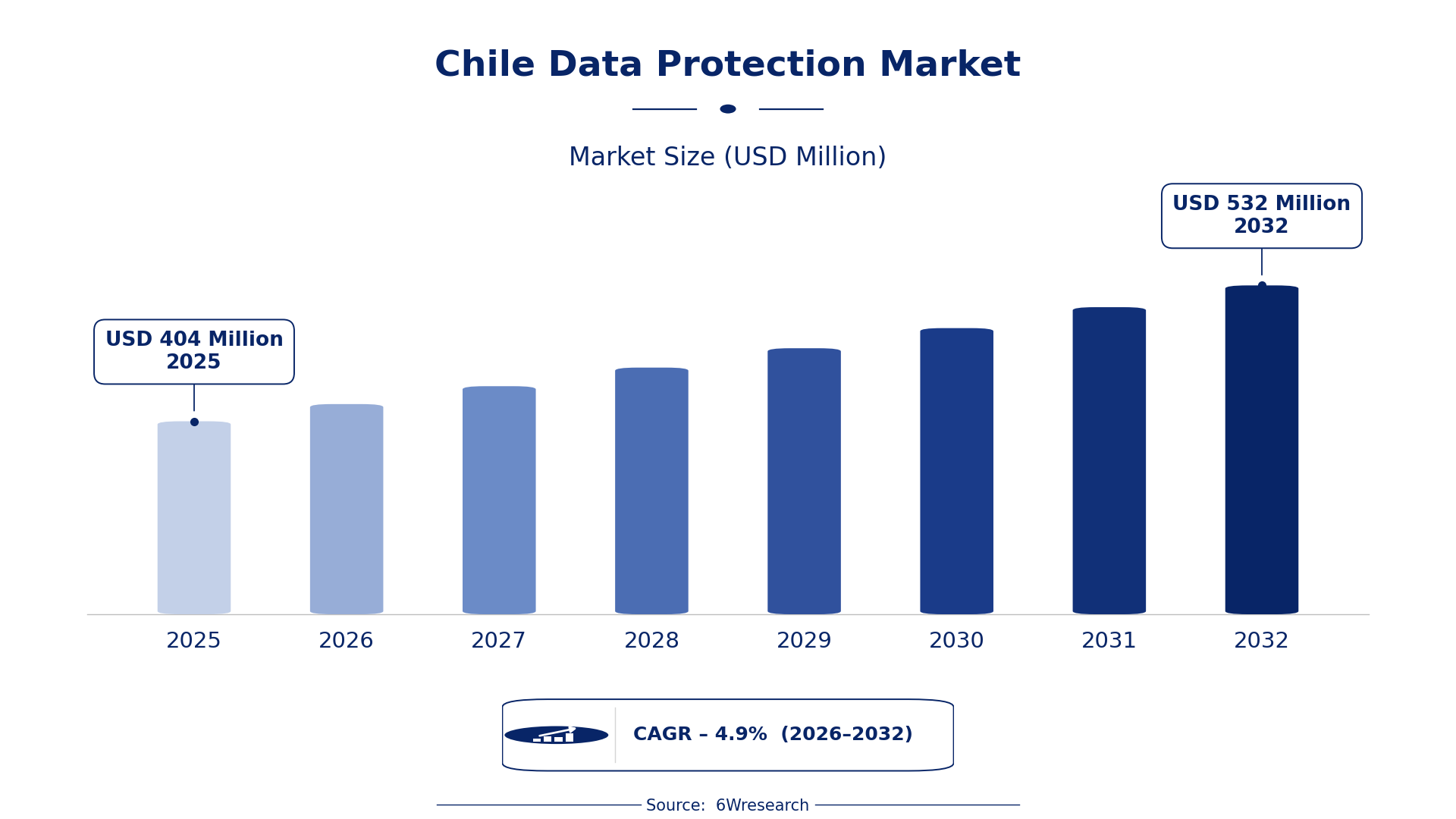
The Chile Data Protection Market was estimated at USD 404 Million in 2025 and is projected to reach USD 532 Million by 2032, growing at a CAGR of 4.9% from 2026 to 2032.
Chile Data Protection Market Synopsis
The Chile Data Protection Market is currently witnessing a surge in demand driven by the increasing need to secure sensitive information against cyber threats. Organizations across various sectors are ramping up investments to enhance their data protection frameworks, reflecting a proactive approach to cybersecurity.
Looking ahead, the momentum suggests that as regulatory pressures intensify and data breaches become more prevalent, companies will likely invest in advanced technologies. The market is set for steady growth, particularly as Chile adapts to evolving standards in data protection.
Chile Data Protection Market Year-wise Growth Rate and Key Drivers
This graph illustrates the annual growth rates of the Chile Data Protection Market from 2021 to 2032, highlighting a steady upward trajectory and projected expansion over the forecast period.
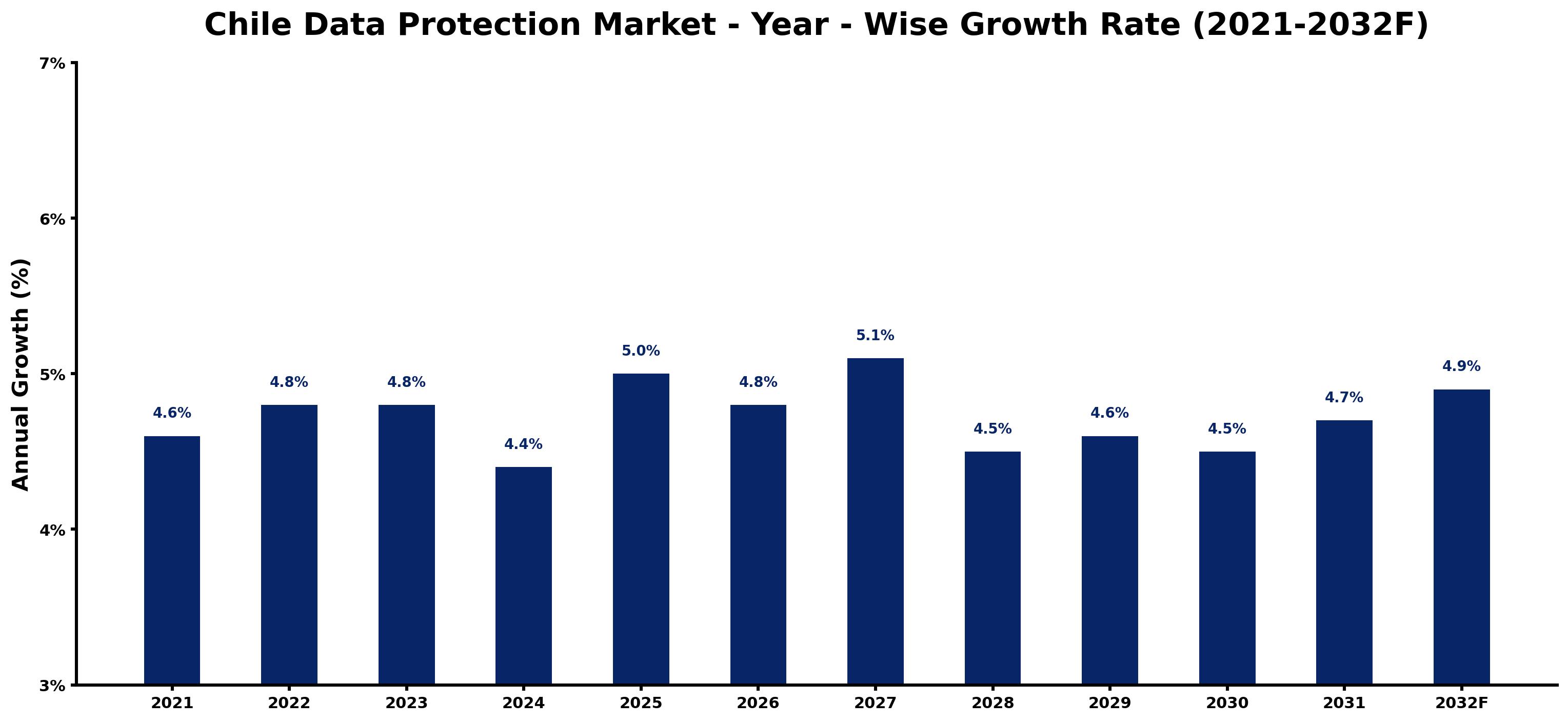
The table below presents the year‑wise growth rates along with the key drivers influencing the market
| Year | Growth Rate | Major Drivers |
| 2021 | 4.6% | Implementation of Chile's personal data protection law. |
| 2022 | 4.8% | Increased demand for compliance drives data protection services. |
| 2023 | 4.8% | Rise in cybersecurity threats fuels market growth. |
| 2024 | 4.4% | Growing privacy concerns among consumers accelerate data policies. |
| 2025 | 5.0% | Adoption of cloud services necessitates robust data protection. |
| 2026 | 4.8% | Regulatory pressures on data handling boost service providers. |
| 2027 | 5.1% | Emergence of local data protection consulting firms enhances market. |
| 2028 | 4.5% | Investment in digital identity solutions strengthens data security. |
| 2029 | 4.6% | Corporate data breach incidents increase demand for protections. |
| 2030 | 4.5% | Collaboration with international bodies enhances regulatory compliance. |
| 2031 | 4.7% | Government incentives promote regional data protection initiatives. |
| 2032 | 4.9% | Technological advancements in encryption drive investment in security. |
Note: Market size estimations and growth projections presented in this report are based on 6Wresearch's proprietary forecasting methodology, utilizing the latest available industry data, government publications, and primary research inputs.
Chile Data Protection Market Key Takeaways
Below are some of the specific key takeaways from the market, including:
- Growing awareness among organizations regarding cybersecurity threats is driving increased investment in data protection solutions.
- The need for compliance with both local and international data protection regulations is becoming a critical priority for businesses.
- Technological advancements are fostering the development of more effective data encryption and access control measures.
- Emerging threats, particularly from insider attacks, highlight the necessity for organizations to enhance their data security protocols.
Evaluation of Restraints in Chile Data Protection Market
The Chile Data Protection Market faces several constraints that could impede its growth trajectory. One major issue is the increasing complexity of data environments, making it challenging for organizations to implement comprehensive security measures. Fragmented data storage solutions create vulnerabilities that can be exploited by cybercriminals. Additionally, keeping pace with evolving regulatory frameworks demands continuous monitoring and adaptation, straining resources. These factors combine to create a landscape where effective data protection strategies must constantly evolve to meet emerging threats.
Chile Data Protection Market Trends
Several trends are currently shaping the Chile Data Protection Market. Firstly, there is a clear shift towards integrating AI and machine learning technologies in data protection strategies. These technologies enhance threat detection and response capabilities significantly. Secondly, the move toward cloud-based data solutions continues to gain traction, leading organizations to adopt more sophisticated cloud security measures. Finally, a growing focus on privacy by design principles is encouraging companies to embed data protection protocols into their core processes from the outset.
Chile Data Protection Market Opportunities
The Chile Data Protection Market presents numerous opportunities for growth and investment. One notable area is the demand for specialized consulting services that help organizations navigate complex regulatory requirements. Additionally, the rise of remote work has created a need for enhanced endpoint security solutions. Companies that innovate in developing secure collaboration tools for distributed teams stand to benefit significantly. Finally, the ongoing evolution of data privacy laws opens the door for new compliance technologies that can streamline organizations’ efforts to adhere to regulations.
Government Initiatives in the Chile Data Protection Market
The Chilean government is taking decisive steps to bolster data protection efforts through comprehensive regulatory frameworks. These initiatives are designed to enhance public trust in how data is handled and processed. By establishing clear guidelines and enforcement mechanisms, the government is working to create a secure environment for personal and sensitive information.
- A recently completed initiative saw the introduction of updated privacy regulations, emphasizing penalties for non-compliance to strengthen data handling standards.
- Ongoing efforts include the rollout of a national awareness campaign targeting businesses, focusing on the importance of data security and compliance with local laws.
- A planned regulatory overhaul is expected to further align Chilean data protection laws with international standards like GDPR by 2026.
Future Insights of the Chile Data Protection Market
As we look towards 2026 and beyond, the Chile Data Protection Market is expected to continue its upward trajectory, fueled by technological innovation and regulatory enhancements. Organizations will increasingly prioritize data protection as a core aspect of their business strategies. Companies that effectively adapt to emerging threats and invest in cutting-edge data protection solutions will likely gain a competitive edge. The landscape will be characterized by enhanced collaboration between the public and private sectors, as both work towards a common goal of safeguarding sensitive information.
Chile Data Protection Market Latest Developments
Recent activity in the Chile Data Protection Market reflects a strong commitment to addressing the growing cybersecurity challenges faced by organizations. In the past year, several significant developments have highlighted this focus.
- In early 2025, a major technology vendor launched a new suite of data protection tools designed specifically for compliance with Chilean regulations, enhancing security for local businesses.
- An initiative that began in Q3 2025 to establish a public-private partnership aimed at developing national data protection standards is currently underway.
- A rollout expected to begin in early 2026 will introduce a comprehensive training program for IT professionals focused on the latest data protection technologies and practices.
- By mid-2026, a planned assessment of the effectiveness of current data protection laws will be conducted to ensure alignment with global best practices.
Chile Data Protection Market - Key Attractiveness of the Report
- 10 Years of Market Numbers
- Historical Data Starting from 2022 to 2025
- Base Year: 2025
- Forecast Data until 2032
- Key Performance Indicators Impacting the Market
- Major Upcoming Developments and Projects
Key Highlights of the Report:
- Chile Data Protection Market Outlook
- Market Size of Chile Data Protection Market, 2025
- Forecast of Chile Data Protection Market, 2032
- Historical Data and Forecast of Chile Data Protection Revenues & Volume for the Period 2022-2032F
- Chile Data Protection Market Trend Evolution
- Chile Data Protection Market Drivers and Challenges
- Chile Data Protection Price Trends
- Chile Data Protection Porter's Five Forces
- Chile Data Protection Industry Life Cycle
- Historical Data and Forecast of Chile Data Protection Market Revenues & Volume By Component for the Period 2022-2032F
- Historical Data and Forecast of Chile Data Protection Market Revenues & Volume By Solutions for the Period 2022-2032F
- Historical Data and Forecast of Chile Data Protection Market Revenues & Volume By Services (Professional Services and Managed Services) for the Period 2022-2032F
- Historical Data and Forecast of Chile Data Protection Market Revenues & Volume By Deployment Mode for the Period 2022-2032F
- Historical Data and Forecast of Chile Data Protection Market Revenues & Volume By On-premises for the Period 2022-2032F
- Historical Data and Forecast of Chile Data Protection Market Revenues & Volume By Cloud for the Period 2022-2032F
- Historical Data and Forecast of Chile Data Protection Market Revenues & Volume By Industry Vertical for the Period 2022-2032F
- Historical Data and Forecast of Chile Data Protection Market Revenues & Volume By Government and defense for the Period 2022-2032F
- Historical Data and Forecast of Chile Data Protection Market Revenues & Volume By Banking, Financial Services, and Insurance (BFSI) for the Period 2022-2032F
- Historical Data and Forecast of Chile Data Protection Market Revenues & Volume By Healthcare for the Period 2022-2032F
- Historical Data and Forecast of Chile Data Protection Market Revenues & Volume By IT and telecom for the Period 2022-2032F
- Historical Data and Forecast of Chile Data Protection Market Revenues & Volume By Consumer goods and retail for the Period 2022-2032F
- Historical Data and Forecast of Chile Data Protection Market Revenues & Volume By Education for the Period 2022-2032F
- Historical Data and Forecast of Chile Data Protection Market Revenues & Volume By Media and entertainment for the Period 2022-2032F
- Historical Data and Forecast of Chile Data Protection Market Revenues & Volume By Organization Size Large Enterprises for the Period 2022-2032F
- Historical Data and Forecast of Chile Data Protection Market Revenues & Volume By SMEs for the Period 2022-2032F
- Historical Data and Forecast of Chile Data Protection Market Revenues & Volume By Large Enterprises for the Period 2022-2032F
- Chile Data Protection Import Export Trade Statistics
- Market Opportunity Assessment By Component
- Market Opportunity Assessment By Deployment Mode
- Market Opportunity Assessment By Industry Vertical
- Market Opportunity Assessment By Organization Size Large Enterprises
- Chile Data Protection Top Companies Market Share
- Chile Data Protection Competitive Benchmarking By Technical and Operational Parameters
- Chile Data Protection Company Profiles
- Chile Data Protection Key Strategic Recommendations






































