Chile Fish Farming Market Size, Share & Growth Rate
The Chile Fish Farming Market was estimated at USD 426 Million in 2025 and is projected to reach USD 604 Million by 2032, growing at a CAGR of 5.1% from 2026 to 2032. This growth trajectory is driven by the increasing global demand for high-quality seafood, particularly farmed salmon, which constitutes a significant portion of Chile's aquaculture output. Additionally, ongoing investments in sustainable practices and innovative aquaculture technologies are enhancing operational efficiency and product quality, further contributing to market expansion.
Chile Fish Farming Market Year-wise Growth Rate and Key Drivers
This graph highlights how the Chile Fish Farming Market has steadily grown over the years, supported by major growth factors.
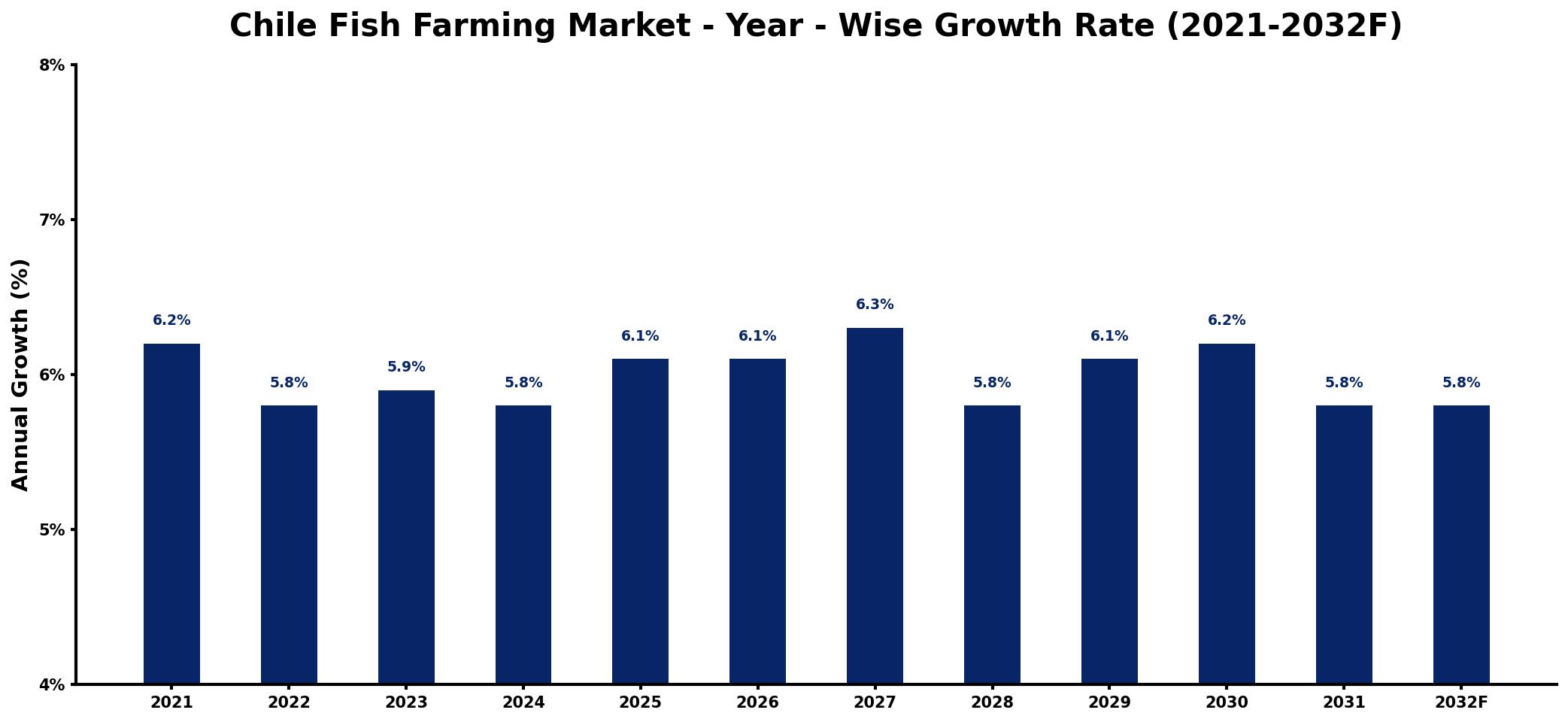
The table below presents the year‑wise growth rates along with the key drivers influencing the market
| Year | Growth Rate | Major Drivers |
| 2021 | 6.2% | Rising global seafood demand |
| 2022 | 5.8% | Increased investment in aquaculture |
| 2023 | 5.9% | Growing health consciousness among consumers |
| 2024 | 5.8% | Expansion of export markets |
| 2025 | 6.1% | Technological advancements in production |
| 2026 | 6.1% | Sustainable practices gaining traction |
| 2027 | 6.3% | Increasing popularity of seafood diets |
| 2028 | 5.8% | Enhanced supply chain efficiencies |
| 2029 | 6.1% | Rising consumer disposable income |
| 2030 | 6.2% | Growing awareness of nutrition benefits |
| 2031 | 5.8% | Emerging markets increasing consumption |
| 2032 | 5.8% | Strengthened partnerships in distribution |
Note: Market size estimations and growth projections presented in this report are based on 6Wresearch's proprietary forecasting methodology, utilizing the latest available industry data, government publications, and primary research inputs.
Chile Fish Farming Market Synopsis
Sustainability is the strongest force shaping the Chile Fish Farming Market today. As consumers become more environmentally conscious, there is a growing demand for responsibly sourced seafood. This shift is prompting local producers to adopt sustainable practices that not only address environmental concerns but also enhance product appeal in the global marketplace.
Chile has established itself as a pivotal player in the global aquaculture industry, particularly in the production of farmed salmon. With its extensive coastline and optimal marine conditions, the nation is strategically positioned to capitalize on the increasing seafood consumption trends. However, the industry must navigate challenges such as disease management and regulatory compliance to maintain its competitive edge.
Chile Fish Farming Market Key Takeaways
- The market is primarily driven by the global demand for farmed salmon, with sustainability as a critical focus.
- Technological advancements are being integrated to improve operational efficiency and minimize environmental impacts.
- Diversification into high-value fish species is gaining traction among producers.
- The Chilean government supports the industry through policies promoting responsible aquaculture practices.
- Investment opportunities in sustainable practices and value-added seafood products remain abundant.
Evaluation of Restraints in Chile Fish Farming Market
Despite its strengths, the Chile Fish Farming Market faces several significant restraints. Environmental issues, particularly water pollution and the risk of disease outbreaks, pose ongoing challenges to fish health and production stability. Regulatory demands also create complexities for operators, leading to increased costs and operational hurdles. Furthermore, competition from established aquaculture regions such as Norway and China intensifies pressure on Chilean producers to maintain competitive pricing and high-quality standards, which can be challenging amidst fluctuating global market demands.
Chile Fish Farming Market Trends
The Chile fish farming market is currently witnessing several notable trends. A prominent shift towards sustainable aquaculture practices is being observed, spurred by consumer preferences for eco-friendly and ethically sourced seafood. Additionally, there is a growing interest in diversifying fish species cultivated, with particular emphasis on high-value options like trout and sea bass. The rise of organic and premium fish products is also a response to evolving consumer demands for healthier and superior quality seafood, driving producers to adapt accordingly.
Chile Fish Farming Market Opportunities
The Chile Fish Farming Market presents numerous investment opportunities, particularly in sustainable practices and innovative technologies that enhance productivity while minimizing environmental impact. As global seafood demand continues to rise, there is ample room for growth in the aquaculture sector. Collaborating with local producers and leveraging Chile's favorable aquaculture conditions can create compelling investment avenues, especially when focusing on high-quality and sustainable seafood products.
Government Initiatives in the Chile Fish Farming Market
The Chilean government has actively implemented policies to regulate and support the fish farming sector. These include stringent environmental regulations designed to foster sustainable aquaculture practices, such as monitoring water quality and limiting production in ecologically sensitive areas. Furthermore, the government offers financial incentives and technical assistance to encourage innovation and competitiveness within the industry. Efforts to ensure traceability and quality assurance for seafood products are also a priority, reflecting the government's commitment to balancing economic growth with environmental stewardship.
Future Insights of the Chile Fish Farming Market
Looking ahead to 2026-2032, the Chile Fish Farming Market is poised for significant growth, driven by persistent global demand for seafood and the country's advantageous aquaculture conditions. The focus on sustainability and innovation will likely become even more pronounced, as industry players strive to overcome existing challenges related to environmental and regulatory pressures. Collaborations with research institutions and continued governmental support for responsible farming practices will propel the market forward, ensuring its relevance and resilience in an evolving industry landscape.
Chile Fish Farming Market Latest Developments (2025 - 2026)
Recent developments within the Chile Fish Farming Market have been characterized by an increased emphasis on technological innovations aimed at enhancing production efficiency and sustainability. New initiatives focused on disease management and biosecurity measures are being implemented to mitigate risks associated with fish health. Additionally, market players are actively pursuing partnerships to further develop value-added products, responding to changing consumer preferences for higher-quality seafood offerings.
Chile Fish Farming Market - Key Attractiveness of the Report
- 10 Years of Market Numbers
- Historical Data Starting from 2022 to 2025
- Base Year: 2025
- Forecast Data until 2032
- Key Performance Indicators Impacting the Market
- Major Upcoming Developments and Projects
Key Highlights of the Report:
- Chile Fish Farming Market Outlook
- Market Size of Chile Fish Farming Market, 2025
- Forecast of Chile Fish Farming Market, 2032
- Historical Data and Forecast of Chile Fish Farming Revenues & Volume for the Period 2022-2032F
- Chile Fish Farming Market Trend Evolution
- Chile Fish Farming Market Drivers and Challenges
- Chile Fish Farming Price Trends
- Chile Fish Farming Porter's Five Forces
- Chile Fish Farming Industry Life Cycle
- Historical Data and Forecast of Chile Fish Farming Market Revenues & Volume By Environment for the Period 2022-2032F
- Historical Data and Forecast of Chile Fish Farming Market Revenues & Volume By Marine Water for the Period 2022-2032F
- Historical Data and Forecast of Chile Fish Farming Market Revenues & Volume By Fresh Water for the Period 2022-2032F
- Historical Data and Forecast of Chile Fish Farming Market Revenues & Volume By Brackish Water for the Period 2022-2032F
- Historical Data and Forecast of Chile Fish Farming Market Revenues & Volume By Fish Type for the Period 2022-2032F
- Historical Data and Forecast of Chile Fish Farming Market Revenues & Volume By Pompano for the Period 2022-2032F
- Historical Data and Forecast of Chile Fish Farming Market Revenues & Volume By Snappers for the Period 2022-2032F
- Historical Data and Forecast of Chile Fish Farming Market Revenues & Volume By Groupers for the Period 2022-2032F
- Historical Data and Forecast of Chile Fish Farming Market Revenues & Volume By Salmon for the Period 2022-2032F
- Historical Data and Forecast of Chile Fish Farming Market Revenues & Volume By Milkfish for the Period 2022-2032F
- Historical Data and Forecast of Chile Fish Farming Market Revenues & Volume By Tuna for the Period 2022-2032F
- Historical Data and Forecast of Chile Fish Farming Market Revenues & Volume By Tilapia for the Period 2022-2032F
- Historical Data and Forecast of Chile Fish Farming Market Revenues & Volume By Others for the Period 2022-2032F
- Chile Fish Farming Import Export Trade Statistics
- Market Opportunity Assessment By Environment
- Market Opportunity Assessment By Fish Type
- Chile Fish Farming Top Companies Market Share
- Chile Fish Farming Competitive Benchmarking By Technical and Operational Parameters
- Chile Fish Farming Company Profiles
- Chile Fish Farming Key Strategic Recommendations






































