Chile Herbal Cosmetics Market Size, Share & Growth Rate
The Chile Herbal Cosmetics Market was estimated at USD 260 Million in 2025 and is projected to reach USD 359 Million by 2032, growing at a CAGR of 4.7% from 2026 to 2032. This upward trajectory is primarily driven by an increasing consumer inclination towards natural and eco-friendly beauty products. As awareness of the harmful effects of synthetic ingredients grows, more consumers in Chile are seeking herbal alternatives that promise both effectiveness and safety.
Chile Herbal Cosmetics Market Year-wise Growth Rate and Key Drivers
This graph highlights how the Chile Herbal Cosmetics Market has steadily grown over the years, supported by major growth factors.
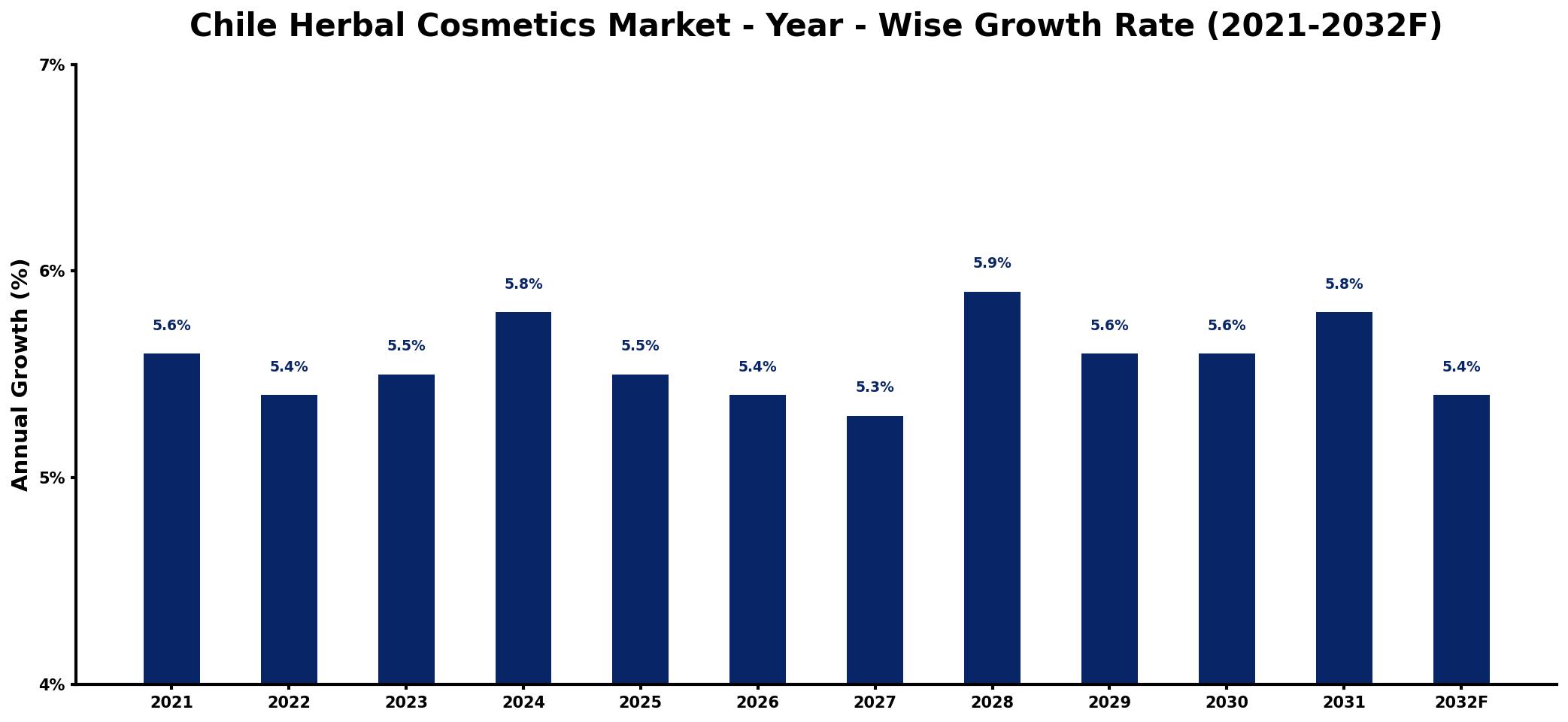
The table below presents the year‑wise growth rates along with the key drivers influencing the market
| Year | Growth Rate | Major Drivers |
| 2021 | 5.6% | Rising consumer interest in wellness |
| 2022 | 5.4% | Increased investment in natural ingredients |
| 2023 | 5.5% | Expansion of e-commerce platforms |
| 2024 | 5.8% | Growing awareness of sustainability practices |
| 2025 | 5.5% | Higher demand for organic alternatives |
| 2026 | 5.4% | Emergence of new distribution channels |
| 2027 | 5.3% | increased overall sector activity |
| 2028 | 5.9% | Surge in influencer marketing strategies |
| 2029 | 5.6% | Enhanced product innovation and variety |
| 2030 | 5.6% | Development of eco-friendly packaging solutions |
| 2031 | 5.8% | rising export shipment volumes |
| 2032 | 5.4% | Focus on holistic health benefits |
Note: Market size estimations and growth projections presented in this report are based on 6Wresearch's proprietary forecasting methodology, utilizing the latest available industry data, government publications, and primary research inputs.
Chile Herbal Cosmetics Market Synopsis
In recent years, the Chile Herbal Cosmetics Market has gained significant momentum as consumers embrace the idea of clean beauty. However, as the market evolves, it is poised to embark on an even more substantial growth trajectory. This shift is largely fueled by an increasingly health-conscious consumer base that prioritizes ingredients derived from nature.
Local and international brands are rapidly expanding their product portfolios to include herbal ingredients like aloe vera, chamomile, and indigenous herbs. The focus on sustainability is transforming the market landscape, paving the way for innovative products that align with consumer values around wellness and environmental stewardship.
Chile Herbal Cosmetics Market Key Takeaways
- The market is projected to grow at a CAGR of 4.7% from 2026 to 2032.
- Increasing consumer preference for natural and eco-friendly products is shaping demand.
- Key herbal ingredients include aloe vera, chamomile, rosemary, and various natural oils.
- Regulatory frameworks are evolving to support the growth of herbal cosmetics while ensuring consumer safety.
- Sustainable packaging and practices are becoming essential for brand differentiation.
Evaluation of Restraints in Chile Herbal Cosmetics Market
Despite the promising growth, several factors inhibit the Chile Herbal Cosmetics Market. Regulatory complexities surrounding the formulation and labeling of herbal products create challenges for local manufacturers. Additionally, competition from well-established international brands adds pressure on domestic players, complicating market penetration. The need for consumer education on the benefits of herbal cosmetics further poses a challenge, especially in reaching diverse demographics across urban and rural regions.
Chile Herbal Cosmetics Market Trends
The Chile Herbal Cosmetics Market is witnessing a shift towards indigenous ingredients that resonate with local cultural practices. These products not only offer efficacy but also appeal to consumers' desire for authenticity. Another noteworthy trend is the rise of clean beauty, which emphasizes the absence of harmful chemicals and artificial additives. Brands are also innovating with eco-friendly packaging solutions, aligning with the values of environmentally aware consumers.
Chile Herbal Cosmetics Market Opportunities
Investment opportunities in this market are robust, particularly for businesses focused on natural product development. As consumer awareness about herbal benefits continues to grow, there is potential in expanding product lines that focus on herbal skincare, hair care, and body care. Collaborating with local suppliers can yield unique formulations, and investing in marketing strategies aimed at educating consumers can enhance brand reputation and market reach.
Government Initiatives in the Chile Herbal Cosmetics Market
The Chilean government has enacted several supportive policies aimed at boosting the herbal cosmetics industry. Regulatory bodies like the Instituto de Salud Pública (ISP) oversee product approvals to ensure safety and quality. Additionally, the Ministry of Economy, Development, and Tourism promotes local production through incentives for innovation. These initiatives foster a conducive environment for the growth of sustainable practices in the herbal cosmetics sector.
Future Insights of the Chile Herbal Cosmetics Market
Looking ahead to 2026-2032, the Chile Herbal Cosmetics Market is expected to experience sustained growth. The increasing focus on health and wellness will continue to drive consumer interest in herbal products. As disposable incomes rise and lifestyle preferences shift, more consumers will likely seek out natural alternatives. Brands that prioritize innovative formulations and sustainability will be well-positioned to capture the growing market segment.
Chile Herbal Cosmetics Market Latest Developments (2025 - 2026)
Recent developments within the Chile Herbal Cosmetics Market indicate a growing trend towards the incorporation of traditional herbal remedies into contemporary products. Additionally, brands are increasingly adopting sustainability practices in their supply chains. Notable industry dialogues around regulatory compliance are helping to clarify the path for new entrants, as consumer demand for herbal cosmetics continues to rise.
Chile Herbal Cosmetics Market - Key Attractiveness of the Report
- 10 Years of Market Numbers
- Historical Data Starting from 2022 to 2025
- Base Year: 2025
- Forecast Data until 2032
- Key Performance Indicators Impacting the Market
- Major Upcoming Developments and Projects
Key Highlights of the Report:
- Chile Herbal Cosmetics Market Outlook
- Market Size of Chile Herbal Cosmetics Market, 2025
- Forecast of Chile Herbal Cosmetics Market, 2032
- Historical Data and Forecast of Chile Herbal Cosmetics Revenues & Volume for the Period 2022-2032F
- Chile Herbal Cosmetics Market Trend Evolution
- Chile Herbal Cosmetics Market Drivers and Challenges
- Chile Herbal Cosmetics Price Trends
- Chile Herbal Cosmetics Porter's Five Forces
- Chile Herbal Cosmetics Industry Life Cycle
- Historical Data and Forecast of Chile Herbal Cosmetics Market Revenues & Volume By Physical State for the Period 2022-2032F
- Historical Data and Forecast of Chile Herbal Cosmetics Market Revenues & Volume By Solid for the Period 2022-2032F
- Historical Data and Forecast of Chile Herbal Cosmetics Market Revenues & Volume By Semi-solid for the Period 2022-2032F
- Historical Data and Forecast of Chile Herbal Cosmetics Market Revenues & Volume By Liquid for the Period 2022-2032F
- Historical Data and Forecast of Chile Herbal Cosmetics Market Revenues & Volume By Product for the Period 2022-2032F
- Historical Data and Forecast of Chile Herbal Cosmetics Market Revenues & Volume By Skin Care Product for the Period 2022-2032F
- Historical Data and Forecast of Chile Herbal Cosmetics Market Revenues & Volume By Hair Care Product for the Period 2022-2032F
- Historical Data and Forecast of Chile Herbal Cosmetics Market Revenues & Volume By Baby Care Product for the Period 2022-2032F
- Historical Data and Forecast of Chile Herbal Cosmetics Market Revenues & Volume By Oral Care Product for the Period 2022-2032F
- Historical Data and Forecast of Chile Herbal Cosmetics Market Revenues & Volume By Make-up Product for the Period 2022-2032F
- Historical Data and Forecast of Chile Herbal Cosmetics Market Revenues & Volume By Distribution Channel for the Period 2022-2032F
- Historical Data and Forecast of Chile Herbal Cosmetics Market Revenues & Volume By Supermarket for the Period 2022-2032F
- Historical Data and Forecast of Chile Herbal Cosmetics Market Revenues & Volume By Pharmacy for the Period 2022-2032F
- Historical Data and Forecast of Chile Herbal Cosmetics Market Revenues & Volume By Departmental Store for the Period 2022-2032F
- Historical Data and Forecast of Chile Herbal Cosmetics Market Revenues & Volume By Beauty Spa/Salon for the Period 2022-2032F
- Historical Data and Forecast of Chile Herbal Cosmetics Market Revenues & Volume By Internet Retailing for the Period 2022-2032F
- Historical Data and Forecast of Chile Herbal Cosmetics Market Revenues & Volume By Specialty Store for the Period 2022-2032F
- Chile Herbal Cosmetics Import Export Trade Statistics
- Market Opportunity Assessment By Physical State
- Market Opportunity Assessment By Product
- Market Opportunity Assessment By Distribution Channel
- Chile Herbal Cosmetics Top Companies Market Share
- Chile Herbal Cosmetics Competitive Benchmarking By Technical and Operational Parameters
- Chile Herbal Cosmetics Company Profiles
- Chile Herbal Cosmetics Key Strategic Recommendations






































