Chile Mineral Oil Market Size, Share & Growth Rate
The Chile Mineral Oil Market was estimated at USD 448 Million in 2025 and is projected to reach USD 628 Million by 2032, growing at a CAGR of 4.9% from 2026 to 2032. This upward trajectory is primarily driven by the robust growth of Chile's industrial sectors, particularly in automotive and manufacturing. As these industries continue to expand, the demand for mineral oils as lubricants and functional fluids is set to increase significantly, ensuring steady market progression.
Chile Mineral Oil Market Growth Rate Analysis (2021-2032)
The Chile mineral oil market is expected to maintain a stable growth pattern, with projections indicating a 5.9% increase in 2023, followed by a slight uptick to 6.0% in 2024. This growth can be attributed to rising consumer demand spurred by an expanding automotive sector and increased investments in renewable energy technologies that utilize mineral oils as transitional fuels. Although growth rates may fluctuate slightly, such as dipping to 5.5% in 2029, the underlying trend remains positive. Infrastructure improvements and supportive government policies further bolster market stability, with 2026 and 2032 expected to see consistent growth at 6.0% and 5.8%, respectively, as overall energy transition efforts continue to evolve in Chile.
Chile Mineral Oil Market Year-wise Growth Rate and Key Drivers
This graph highlights how the Chile Mineral Oil Market has steadily grown over the past five years, supported by major growth factors.
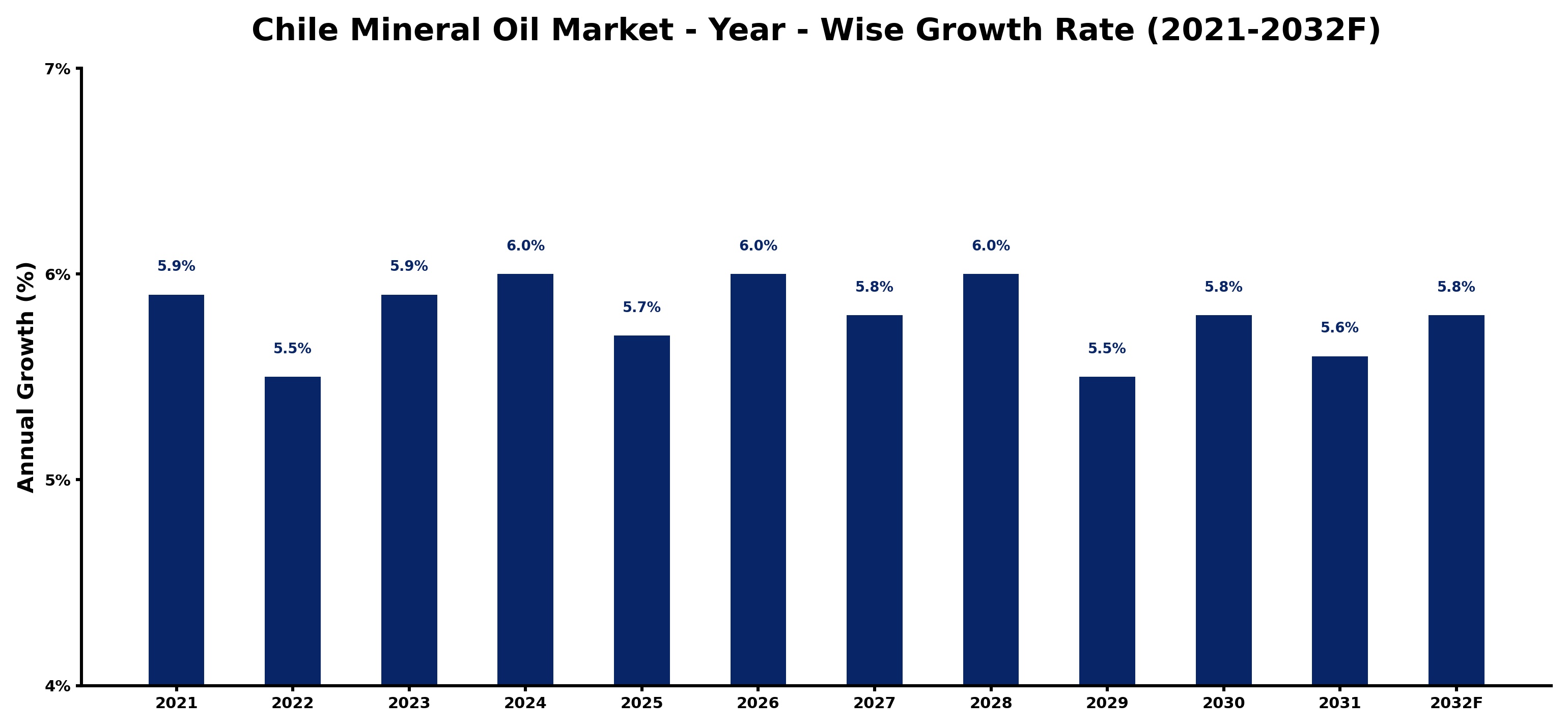
The table below presents the year‑wise growth rates along with the key drivers influencing the market
| Year | Growth Rate | Major Drivers |
| 2021 | 5.9% | Increasing adoption of advanced technologies |
| 2022 | 5.5% | Increasing adoption of advanced technologies |
| 2023 | 5.9% | Increasing adoption of advanced technologies |
| 2024 | 6.0% | Increasing adoption of advanced technologies |
| 2025 | 5.7% | Government infrastructure modernization initiatives |
| 2026 | 6.0% | Increasing industrial infrastructure investments |
| 2027 | 5.8% | Expansion of commercial construction activities |
| 2028 | 6.0% | Government infrastructure modernization initiatives |
| 2029 | 5.5% | Expansion of commercial construction activities |
| 2030 | 5.8% | Expansion of manufacturing activities |
| 2031 | 5.6% | Expansion of transportation and logistics networks |
| 2032 | 5.8% | Increasing adoption of advanced technologies |
Note - Market size estimations and growth projections presented in this report are based on 6Wresearch’s advanced forecasting approach, validated with industry datasets as of June 2026.
Chile Mineral Oil Market Synopsis
In Chile, the mineral oil market is characterized by high consumption levels, particularly within the automotive sector, where mineral oils are crucial for vehicle maintenance. As more consumers invest in vehicles, the corresponding demand for high-quality lubricants and functional fluids continues to rise.
Moreover, industrial machinery applications are on the rise, with businesses increasingly relying on mineral oils for efficient operations. This trend is reinforced by a growing emphasis on energy efficiency and sustainability, which further fuels the demand for mineral oil-based products in various industrial settings.
Chile Mineral Oil Market Key Takeaways
- The market is primarily driven by growth in the automotive and industrial sectors.
- Demand for mineral oils is increasing in automotive lubrication and machinery applications.
- Focus on sustainability is encouraging the use of mineral oil-based products.
- Challenges include fluctuating crude oil prices and environmental regulations.
- Potential exists for innovative product differentiation to enhance competitiveness.
Evaluation of Restraints in Chile Mineral Oil Market
Despite the positive growth outlook, several factors restrain the Chile Mineral Oil Market. The volatility of crude oil prices remains a significant concern, impacting production costs and pricing strategies for manufacturers. Additionally, strict environmental regulations governing the use and disposal of mineral oils pose compliance challenges. The increasing competition from alternative lubricants, including synthetic oils, further complicates the market landscape. To navigate these issues, companies must focus on quality assurance and supply chain optimization to maintain profitability and market relevance.
Chile Mineral Oil Market Trends
Currently, the Chilean mineral oil market is witnessing an uptick in technological advancements, particularly in refining processes that enhance product quality and performance. The integration of sustainable practices in production and distribution is also gaining traction, as consumers and businesses alike become more environmentally conscious. Additionally, a shift towards bio-based lubricants is beginning to make an impact, indicating a trend toward more sustainable alternatives.
Chile Mineral Oil Market Opportunities
Significant growth opportunities lie in expanding the product offerings tailored for niche markets, such as bio-lubricants that align with sustainability goals. Furthermore, investments in enhancing distribution networks and local partnerships could open new avenues for market penetration. The anticipated growth in the automotive and industrial sectors presents an ideal backdrop for businesses to innovate and differentiate their product lines, thereby capturing a larger share of the market.
Government Initiatives in the Chile Mineral Oil Market
The Chilean government has been actively promoting energy efficiency and sustainable practices across various industries. Programs aimed at reducing the environmental impact of mineral oil usage are in place, encouraging businesses to adopt cleaner technologies. Furthermore, public spending initiatives aimed at enhancing infrastructure and supporting industrial growth are expected to bolster demand for mineral oils in the coming years.
Future Insights of the Chile Mineral Oil Market
Looking ahead to the period from 2026 to 2032, the Chile Mineral Oil Market is poised for significant growth, driven by the ongoing expansion of the industrial base and the automotive sector. As manufacturers and consumers increasingly focus on sustainability, the market is likely to witness a gradual shift towards greener alternatives, including bio-lubricants. Nonetheless, navigating challenges such as volatile oil prices and competitive pressures will be critical for companies seeking to capitalize on emerging opportunities.
Chile Mineral Oil Market Latest Developments (May 2025 - June 2026)
Recent trends indicate a strong emphasis on technology adoption within the Chile Mineral Oil Market. Companies are exploring innovative refining techniques to enhance product quality while simultaneously focusing on environmental sustainability. Additionally, industry players are increasingly collaborating with governmental bodies to align with new regulatory frameworks and leverage public initiatives aimed at supporting industrial growth.
Chile Mineral Oil Market - Key Attractiveness of the Report
- 10 Years of Market Numbers
- Historical Data Starting from 2022 to 2025
- Base Year: 2025
- Forecast Data until 2032
- Key Performance Indicators Impacting the Market
- Major Upcoming Developments and Projects
Key Highlights of the Report:
- Chile Mineral Oil Market Outlook
- Market Size of Chile Mineral Oil Market, 2025
- Forecast of Chile Mineral Oil Market, 2032
- Historical Data and Forecast of Chile Mineral Oil Revenues & Volume for the Period 2022-2032F
- Chile Mineral Oil Market Trend Evolution
- Chile Mineral Oil Market Drivers and Challenges
- Chile Mineral Oil Price Trends
- Chile Mineral Oil Porter's Five Forces
- Chile Mineral Oil Industry Life Cycle
- Historical Data and Forecast of Chile Mineral Oil Market Revenues & Volume By Grade for the Period 2022-2032F
- Historical Data and Forecast of Chile Mineral Oil Market Revenues & Volume By Technical Oil for the Period 2022-2032F
- Historical Data and Forecast of Chile Mineral Oil Market Revenues & Volume By White Oil for the Period 2022-2032F
- Historical Data and Forecast of Chile Mineral Oil Market Revenues & Volume By Application for the Period 2022-2032F
- Historical Data and Forecast of Chile Mineral Oil Market Revenues & Volume By Baby Oil for the Period 2022-2032F
- Historical Data and Forecast of Chile Mineral Oil Market Revenues & Volume By Cosmetics for the Period 2022-2032F
- Historical Data and Forecast of Chile Mineral Oil Market Revenues & Volume By Skin Care Products for the Period 2022-2032F
- Historical Data and Forecast of Chile Mineral Oil Market Revenues & Volume By Hair Care Products for the Period 2022-2032F
- Historical Data and Forecast of Chile Mineral Oil Market Revenues & Volume By Consumer Goods for the Period 2022-2032F
- Historical Data and Forecast of Chile Mineral Oil Market Revenues & Volume By Others for the Period 2022-2032F
- Chile Mineral Oil Import Export Trade Statistics
- Market Opportunity Assessment By Grade
- Market Opportunity Assessment By Application
- Chile Mineral Oil Top Companies Market Share
- Chile Mineral Oil Competitive Benchmarking By Technical and Operational Parameters
- Chile Mineral Oil Company Profiles
- Chile Mineral Oil Key Strategic Recommendations






































