Chile Organic Fruits And Vegetables Market Size, Share & Growth Rate
The Chile Organic Fruits And Vegetables Market was estimated at USD 187 Million in 2025 and is projected to reach USD 257 Million by 2032, growing at a CAGR of 4.6% from 2026 to 2032. This upward trajectory is underpinned by rising consumer awareness around health and wellness, coupled with a heightened preference for sustainable food sources. Chiles unique agricultural conditions, including its diverse climate and rich soil, provide the ideal backdrop for cultivating an extensive range of organic produce.
Chile Organic Fruits And Vegetables Market Year-wise Growth Rate and Key Drivers
This graph highlights how the Chile Organic Fruits And Vegetables Market has steadily grown over the years, supported by major growth factors.
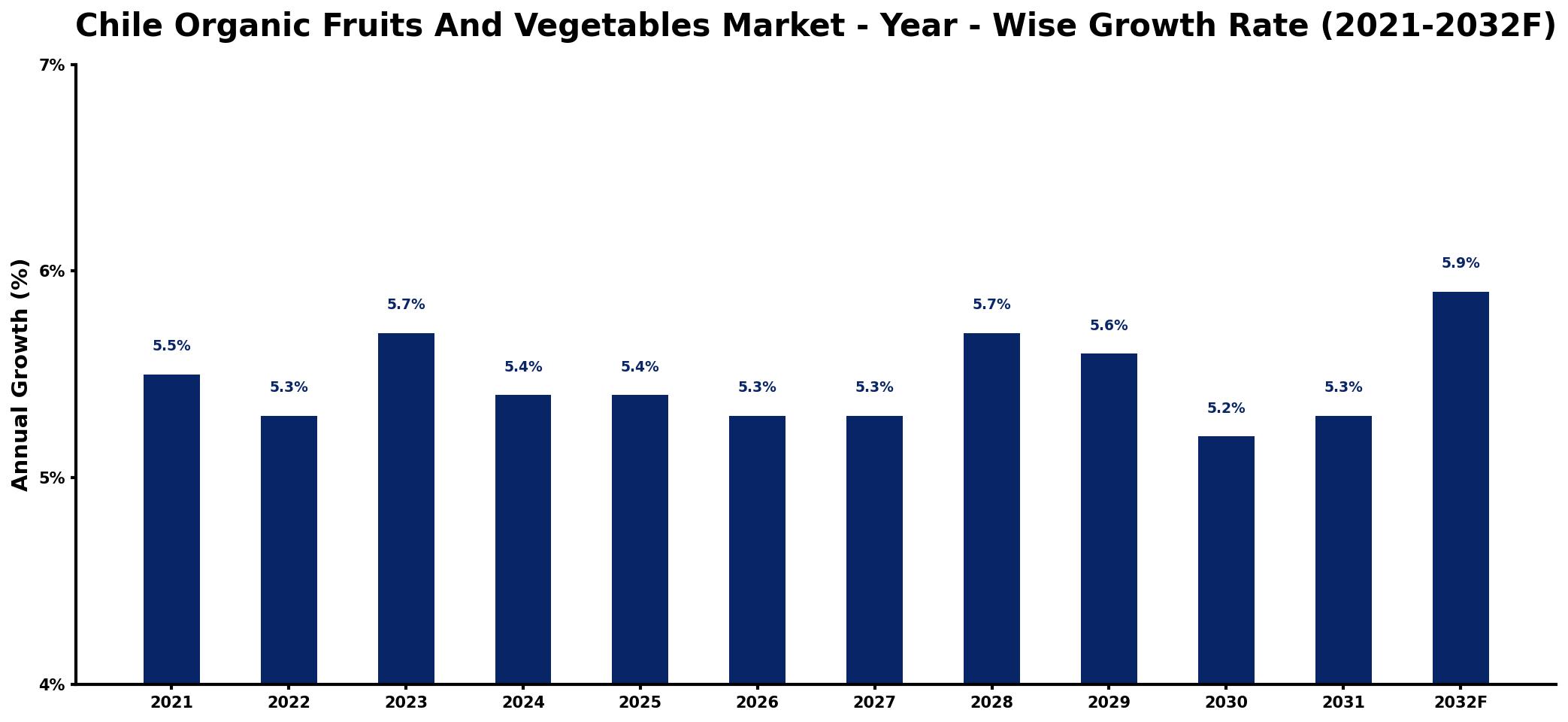
The table below presents the year‑wise growth rates along with the key drivers influencing the market
| Year | Growth Rate | Major Drivers |
| 2021 | 5.5% | Rising consumer health awareness |
| 2022 | 5.3% | Increased sustainability initiatives adopted |
| 2023 | 5.7% | Expansion of local farming programs |
| 2024 | 5.4% | Growing interest in plant-based diets |
| 2025 | 5.4% | Enhanced distribution network efficiency |
| 2026 | 5.3% | Investments in agricultural technology |
| 2027 | 5.3% | Surge in export opportunities globally |
| 2028 | 5.7% | Development of eco-friendly packaging solutions |
| 2029 | 5.6% | Strengthened partnerships with retailers |
| 2030 | 5.2% | Focus on urban agriculture innovations |
| 2031 | 5.3% | Emergence of community-supported agriculture |
| 2032 | 5.9% | Boost in agricultural research funding |
Note: Market size estimations and growth projections presented in this report are based on 6Wresearch's proprietary forecasting methodology, utilizing the latest available industry data, government publications, and primary research inputs.
Chile Organic Fruits And Vegetables Market Synopsis
In recent years, Chile has emerged as a key player in the global organic fruits and vegetables sector, attracting interest from both domestic and international consumers. The nations favorable climatic conditions and commitment to sustainable farming practices have fostered a robust organic agricultural environment, leading to an abundant supply of quality produce.
As the market continues to evolve, key stakeholders are expanding their portfolios to include a broader spectrum of organic offerings, responding to the increasing consumer demand for healthful and eco-friendly products. This growth trend is supported by government initiatives that promote organic farming and facilitate certification processes for producers.
Chile Organic Fruits And Vegetables Market Key Takeaways
- The market exhibits a steady growth trajectory, influenced by rising consumer demand for healthy and sustainable produce.
- Chiles unique agricultural landscape enables a diverse range of high-quality organic fruits and vegetables.
- Government initiatives play a crucial role in promoting organic farming and certification.
- Investment opportunities abound, particularly in expanding distribution networks to international markets.
- Education on the benefits of organic produce is essential for continued market growth.
Evaluation of Restraints in Chile Organic Fruits And Vegetables Market
Despite its promising outlook, the Chile Organic Fruits And Vegetables Market faces several constraints that can hinder its growth. Primarily, competition from conventional agriculture poses a challenge, as conventional produce often has lower prices, making it difficult for organic options to compete. Additionally, many small-scale farmers encounter barriers related to the high costs of organic certification, which can limit their entry into the organic market.
Moreover, inadequate infrastructure and technology for distribution and storage can lead to supply chain disruptions, impacting the availability of high-quality organic produce. Lastly, fluctuations in weather patterns and occasional natural disasters can also pose risks to crop yields, thus challenging market stability.
Chile Organic Fruits And Vegetables Market Trends
Several trends are shaping the Chile Organic Fruits And Vegetables Market. Increasing consumer awareness about health benefits and environmental impact is driving the demand for organic products. Varietals such as blueberries, avocados, and organic tomatoes are experiencing heightened interest, both locally and overseas. Furthermore, producers are embracing innovative farming techniques and technologies, which enhance yield and quality while reducing the environmental footprint of production.
Additionally, an upsurge in e-commerce channels has made organic products more accessible, allowing consumers to conveniently obtain their preferred choices online. Retailers are also responding by expanding their organic product lines, ensuring they meet the diverse needs of health-conscious consumers.
Chile Organic Fruits And Vegetables Market Opportunities
The Chile Organic Fruits And Vegetables Market presents numerous investment opportunities, particularly in the context of escalating global demand for organic produce. The countrys favorable climate conditions and established reputation for quality agriculture position it well for investments in organic farming. Opportunities to partner with existing organic producers are plentiful, and expanding distribution networks to international markets could further enhance profitability.
As consumers increasingly gravitate towards organic food options, there is also potential for introducing innovative organic product lines that cater to evolving taste preferences. This landscape is ripe for stakeholders ready to capitalize on the burgeoning market for healthful and sustainable food.
Government Initiatives in the Chile Organic Fruits And Vegetables Market
The Chilean government is actively fostering the organic fruits and vegetables sector through various supportive policies and initiatives. These efforts include providing financial incentives for organic farmers, promoting sustainable agricultural practices, and enhancing organic certification standards. Collaboration between the Ministry of Agriculture and industry stakeholders aims to create a more competitive and sustainable market, facilitating the growth of organic produce both within Chile and in international arenas.
Future Insights of the Chile Organic Fruits And Vegetables Market
Looking ahead to 2026-2032, the Chile Organic Fruits And Vegetables Market is poised for substantial growth. Increasing consumer consciousness regarding health, sustainability, and the ecological impact of food production is expected to propel market demand. The combination of a robust export strategy, supported by government initiatives and consumer interest, will likely enhance production capacities.
The market will also see innovation in organic farming techniques, ensuring the continued delivery of high-quality produce. As consumer preferences shift further toward organic, the potential for growth appears not only sustainable but also transformative for the industry.
Chile Organic Fruits And Vegetables Market Latest Developments (2025 - 2026)
Recent developments in the Chile Organic Fruits And Vegetables Market reflect a positive trajectory as stakeholders adapt to evolving consumer preferences. Increased collaboration among producers has led to enhanced sharing of best practices in organic farming, which is crucial for improving yield and quality. Additionally, advancements in supply chain logistics have improved the distribution efficiency of organic products, ensuring fresher produce reaches consumers.
Furthermore, various organic certification programs have been streamlined, making it more feasible for small-scale farmers to participate in the organic market. These developments signal an increasingly vibrant market landscape, aimed at meeting the growing demand for organic food.
Chile Organic Fruits And Vegetables Market - Key Attractiveness of the Report
- 10 Years of Market Numbers
- Historical Data Starting from 2022 to 2025
- Base Year: 2025
- Forecast Data until 2032
- Key Performance Indicators Impacting the Market
- Major Upcoming Developments and Projects
Key Highlights of the Report:
- Chile Organic Fruits And Vegetables Market Outlook
- Market Size of Chile Organic Fruits And Vegetables Market, 2025
- Forecast of Chile Organic Fruits And Vegetables Market, 2032
- Historical Data and Forecast of Chile Organic Fruits And Vegetables Revenues & Volume for the Period 2022-2032F
- Chile Organic Fruits And Vegetables Market Trend Evolution
- Chile Organic Fruits And Vegetables Market Drivers and Challenges
- Chile Organic Fruits And Vegetables Price Trends
- Chile Organic Fruits And Vegetables Porter's Five Forces
- Chile Organic Fruits And Vegetables Industry Life Cycle
- Historical Data and Forecast of Chile Organic Fruits And Vegetables Market Revenues & Volume By Product Type for the Period 2022-2032F
- Historical Data and Forecast of Chile Organic Fruits And Vegetables Market Revenues & Volume By Organic Fruits for the Period 2022-2032F
- Historical Data and Forecast of Chile Organic Fruits And Vegetables Market Revenues & Volume By Organic Vegetables for the Period 2022-2032F
- Historical Data and Forecast of Chile Organic Fruits And Vegetables Market Revenues & Volume By Form for the Period 2022-2032F
- Historical Data and Forecast of Chile Organic Fruits And Vegetables Market Revenues & Volume By Fresh for the Period 2022-2032F
- Historical Data and Forecast of Chile Organic Fruits And Vegetables Market Revenues & Volume By Frozen for the Period 2022-2032F
- Historical Data and Forecast of Chile Organic Fruits And Vegetables Market Revenues & Volume By End User for the Period 2022-2032F
- Historical Data and Forecast of Chile Organic Fruits And Vegetables Market Revenues & Volume By Residential for the Period 2022-2032F
- Historical Data and Forecast of Chile Organic Fruits And Vegetables Market Revenues & Volume By Commercial for the Period 2022-2032F
- Historical Data and Forecast of Chile Organic Fruits And Vegetables Market Revenues & Volume By Distribution Channel for the Period 2022-2032F
- Historical Data and Forecast of Chile Organic Fruits And Vegetables Market Revenues & Volume By Supermarket for the Period 2022-2032F
- Historical Data and Forecast of Chile Organic Fruits And Vegetables Market Revenues & Volume By Hypermarket for the Period 2022-2032F
- Historical Data and Forecast of Chile Organic Fruits And Vegetables Market Revenues & Volume By Convenience Store for the Period 2022-2032F
- Historical Data and Forecast of Chile Organic Fruits And Vegetables Market Revenues & Volume By Online Sale Channel for the Period 2022-2032F
- Historical Data and Forecast of Chile Organic Fruits And Vegetables Market Revenues & Volume By Others for the Period 2022-2032F
- Chile Organic Fruits And Vegetables Import Export Trade Statistics
- Market Opportunity Assessment By Product Type
- Market Opportunity Assessment By Form
- Market Opportunity Assessment By End User
- Market Opportunity Assessment By Distribution Channel
- Chile Organic Fruits And Vegetables Top Companies Market Share
- Chile Organic Fruits And Vegetables Competitive Benchmarking By Technical and Operational Parameters
- Chile Organic Fruits And Vegetables Company Profiles
- Chile Organic Fruits And Vegetables Key Strategic Recommendations






































