Chile Packaged Water Market Top 5 Importing Countries and Market Competition (HHI) Analysis
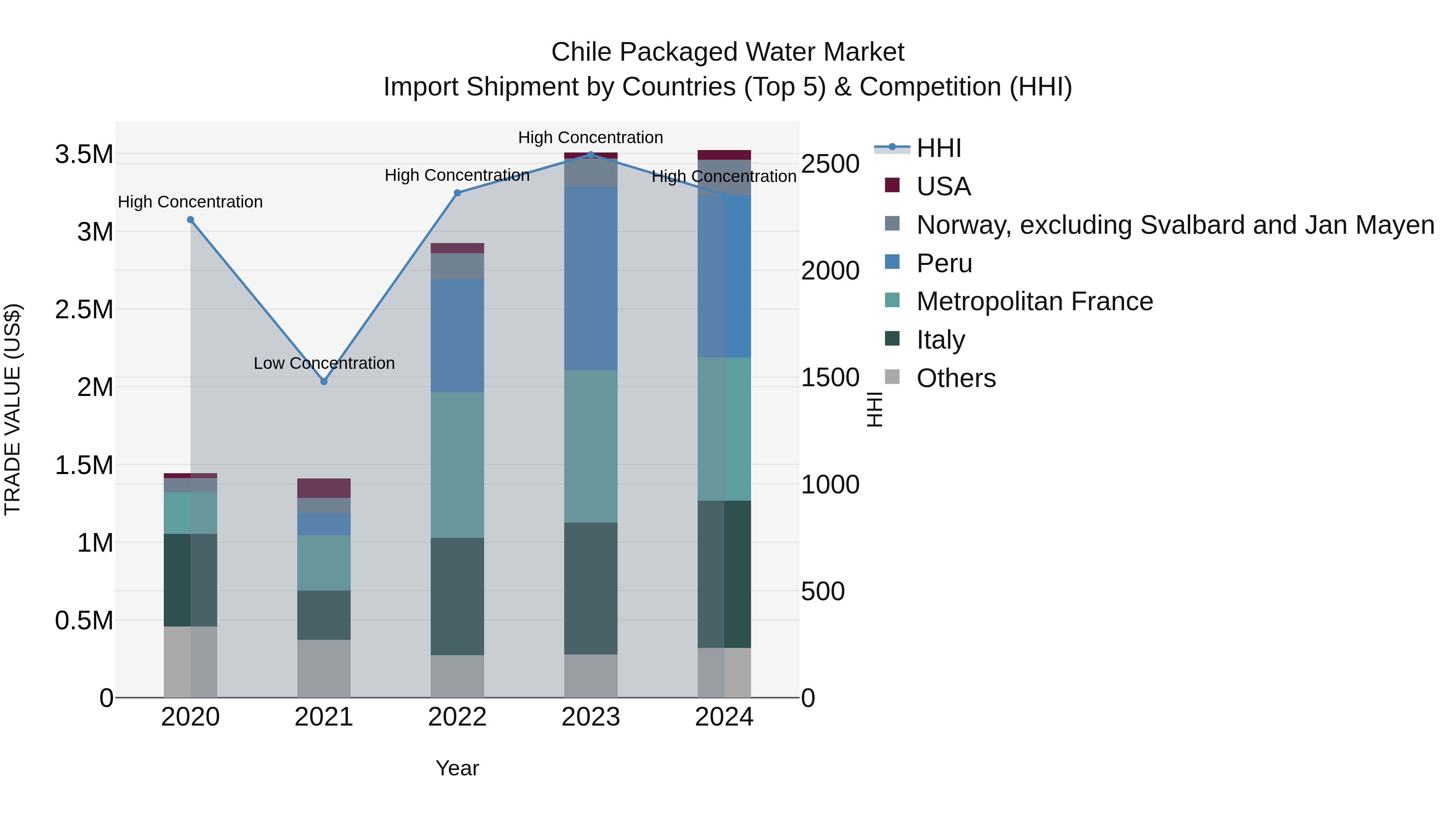
Chile`s packaged water import market saw continued growth in 2024, with top exporting countries including Peru, Italy, Metropolitan France, Norway, and Austria. Despite high concentration with a high Herfindahl-Hirschman Index (HHI), the market experienced a steady CAGR of 24.99% from 2020 to 2024. The growth rate in 2024 remained positive at 0.43%, indicating sustained interest in imported packaged water in Chile. This suggests a strong demand for foreign brands and products in the Chilean market, creating opportunities for both domestic and international suppliers.
Chile Packaged water Market Overview
The packaged water market in Chile has been experiencing steady growth due to increasing health awareness and changing consumer preferences towards healthier beverage options. The market is highly competitive with both domestic and international players offering a wide range of products to cater to different consumer segments. Key drivers of growth in the market include rising disposable incomes, urbanization, and a growing trend towards convenience and on-the-go consumption. Premium and flavored water products are gaining popularity among consumers looking for unique and enhanced hydration options. Sustainability and environmental concerns are also becoming important factors influencing consumer choices, leading to an increased demand for eco-friendly packaging solutions. Overall, the Chile packaged water market is expected to continue its growth trajectory driven by evolving consumer preferences and industry innovations.
Chile Packaged water Market Trends and Opportunities
The Chile packaged water market is experiencing a growth trend driven by increasing health consciousness, urbanization, and convenience. Consumers are seeking out purified and mineral-enriched water options, leading to a rise in demand for premium and functional packaged water products. Opportunities exist for innovative packaging solutions that are sustainable and eco-friendly to appeal to environmentally conscious consumers. Additionally, the e-commerce sector presents a potential avenue for market expansion, as online shopping becomes increasingly popular among Chilean consumers. Collaborations with retailers and strategic marketing efforts focusing on the health benefits and quality of packaged water can help companies capitalize on the growing market demand in Chile.
Chile Packaged water Market Challenges
In the Chile packaged water market, some of the key challenges include increasing competition from both local and international brands, price sensitivity among consumers, concerns about the environmental impact of plastic packaging, and the need for innovative marketing strategies to differentiate products in a saturated market. Additionally, fluctuations in raw material prices, regulatory issues related to water sourcing and bottling practices, and logistical challenges in distribution and storage also present obstacles for companies operating in the packaged water sector in Chile. To succeed in this market, companies need to focus on sustainability efforts, product diversification, and effective branding strategies to meet the evolving consumer demands and stand out in a competitive landscape.
Chile Packaged water Market Drivers
The Chile Packaged water market is mainly driven by increasing health consciousness among consumers, leading to a shift towards healthier beverage choices like bottled water. Growing concerns about water quality and safety, coupled with a rise in disposable income levels, have also fueled the demand for convenient and portable hydration options. Additionally, changing lifestyle patterns, urbanization, and a preference for on-the-go consumption have contributed to the market`s growth. Innovative packaging formats, such as eco-friendly materials and functional packaging designs, are further attracting consumers. The availability of various flavored and fortified bottled water options is also driving market expansion, catering to diverse consumer preferences and contributing to the overall market growth in Chile.
Chile Packaged water Market Government Policy
In Chile, the packaged water market is regulated by various government policies and regulations aimed at ensuring the safety, quality, and labeling of bottled water products. The Ministry of Health oversees the approval and monitoring of bottled water facilities to maintain strict hygiene standards and ensure compliance with safety guidelines. Additionally, the Chilean government has implemented labeling requirements to provide consumers with transparent information about the contents, source, and nutritional value of packaged water. These regulations are designed to protect consumer health, prevent misleading advertising practices, and promote fair competition within the packaged water market. Overall, the government policies in Chile pertaining to the packaged water industry focus on safeguarding public health and promoting accountability among manufacturers and distributors.
Chile Packaged water Market Future Outlook
The future outlook for the Chile packaged water market is positive, with steady growth expected in the coming years. Factors contributing to this growth include increasing health consciousness among consumers, growing concerns about water quality and safety, and the convenience of packaged water for on-the-go consumption. The market is also likely to benefit from the trend towards eco-friendly packaging options and innovative product offerings such as flavored and functional waters. As the economy continues to recover and consumer spending power increases, demand for packaged water is expected to rise. However, the market may face challenges related to sustainability concerns and competition from other beverage categories. Overall, the Chile packaged water market is projected to experience moderate but consistent growth in the foreseeable future.
Key Highlights of the Report:
- Chile Packaged water Market Outlook
- Market Size of Chile Packaged water Market, 2024
- Forecast of Chile Packaged water Market, 2031
- Historical Data and Forecast of Chile Packaged water Revenues & Volume for the Period 2021- 2031
- Chile Packaged water Market Trend Evolution
- Chile Packaged water Market Drivers and Challenges
- Chile Packaged water Price Trends
- Chile Packaged water Porter's Five Forces
- Chile Packaged water Industry Life Cycle
- Historical Data and Forecast of Chile Packaged water Market Revenues & Volume By Product for the Period 2021- 2031
- Historical Data and Forecast of Chile Packaged water Market Revenues & Volume By Still for the Period 2021- 2031
- Historical Data and Forecast of Chile Packaged water Market Revenues & Volume By Carbonated for the Period 2021- 2031
- Historical Data and Forecast of Chile Packaged water Market Revenues & Volume By Flavored for the Period 2021- 2031
- Historical Data and Forecast of Chile Packaged water Market Revenues & Volume By Functional for the Period 2021- 2031
- Chile Packaged water Import Export Trade Statistics
- Market Opportunity Assessment By Product
- Chile Packaged water Top Companies Market Share
- Chile Packaged water Competitive Benchmarking By Technical and Operational Parameters
- Chile Packaged water Company Profiles
- Chile Packaged water Key Strategic Recommendations






































