Philippines Packaged Water Market Top 5 Importing Countries and Market Competition (HHI) Analysis
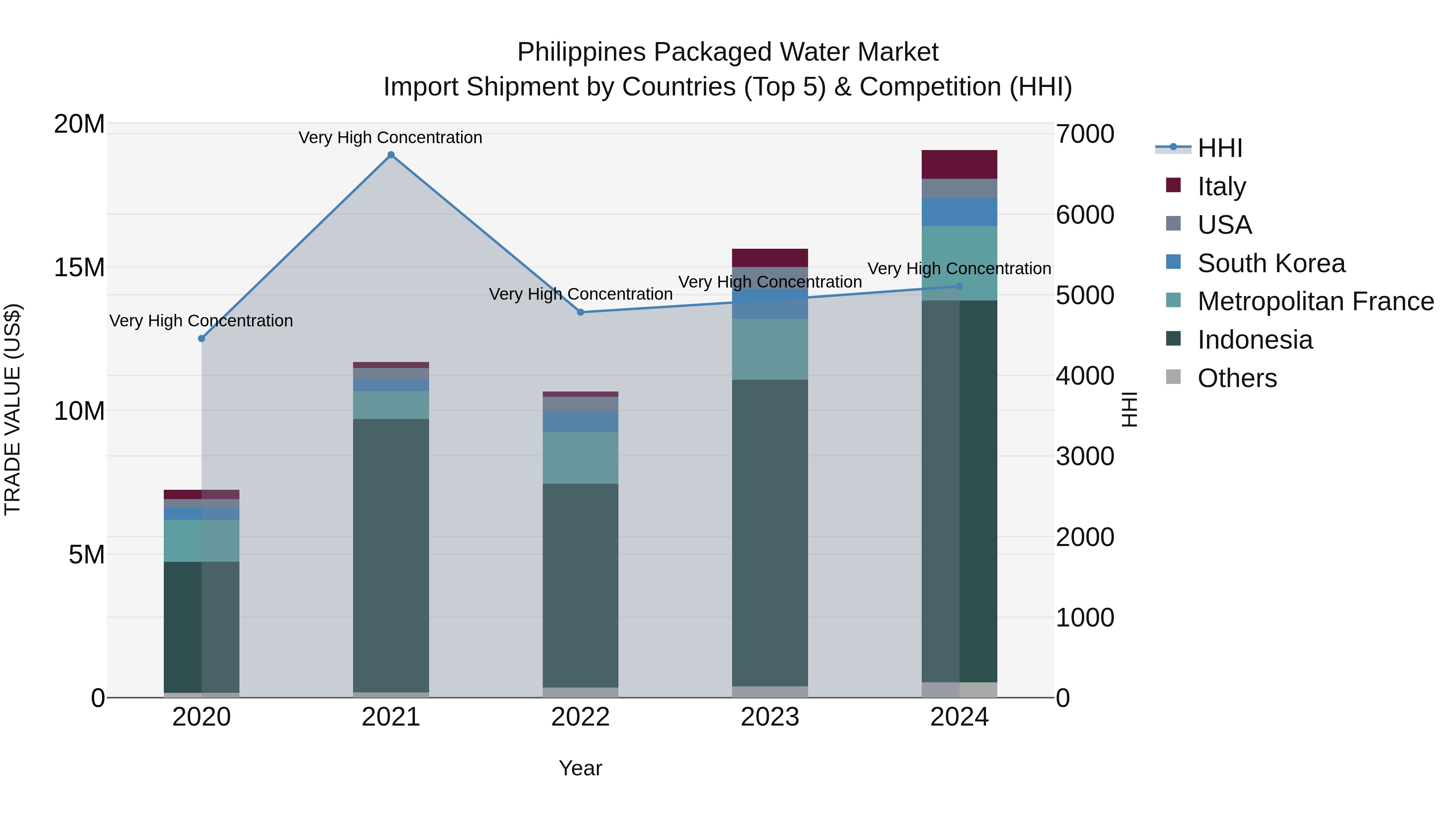
The Philippines continues to be a key market for packaged water imports, with top exporting countries including Indonesia, Metropolitan France, Italy, South Korea, and the USA in 2024. Despite the high Herfindahl-Hirschman Index (HHI) indicating concentration in the market, the industry has shown impressive growth with a CAGR of 27.4% from 2020 to 2024. The growth rate in 2024 alone was 21.94%, highlighting the increasing demand for packaged water in the Philippines. This trend suggests a positive outlook for the industry and opportunities for further expansion in the market.
Philippines Packaged water Market Overview
The packaged water market in the Philippines continues to expand due to increasing health awareness and demand for safe drinking water. Bottled water consumption has surged, driven by concerns over water contamination and the convenience of on-the-go hydration. Premium segments, including mineral and flavored water, are gaining popularity. The market is also witnessing the adoption of sustainable packaging solutions, such as biodegradable bottles and refillable containers.
Drivers of the market
The packaged water market remains strong due to rising health awareness and concerns about water quality. Bottled water is a necessity for many Filipinos, especially in urban areas with unreliable tap water. The demand for premium and alkaline water is growing, along with eco-friendly packaging solutions such as biodegradable and recyclable bottles.
Challenges of the market
The packaged water market faces intense competition from local and international brands, leading to price wars and thin profit margins. Additionally, growing environmental concerns regarding plastic waste from bottled water have led to increased demand for sustainable packaging solutions, adding to production costs. Furthermore, water contamination risks require strict quality control, increasing regulatory pressures on manufacturers.
Investment opportunities in the Market
The demand for packaged drinking water is expanding due to urbanization and health-conscious consumers. Investors can explore premium water brands, eco-friendly packaging solutions such as biodegradable bottles, and strategic retail partnerships to capture market share. Investing in advanced filtration and purification technologies can further enhance product quality.
Government Policy of the market
The FDA and the Department of Health (DOH) enforce strict regulations on packaged water to ensure cleanliness and safety. The government requires bottled water companies to comply with sanitation guidelines. Policies promote the use of biodegradable packaging to minimize plastic waste.
Key Highlights of the Report:
- Philippines Packaged water Market Outlook
- Market Size of Philippines Packaged water Market, 2024
- Forecast of Philippines Packaged water Market, 2031
- Historical Data and Forecast of Philippines Packaged water Revenues & Volume for the Period 2021- 2031
- Philippines Packaged water Market Trend Evolution
- Philippines Packaged water Market Drivers and Challenges
- Philippines Packaged water Price Trends
- Philippines Packaged water Porter's Five Forces
- Philippines Packaged water Industry Life Cycle
- Historical Data and Forecast of Philippines Packaged water Market Revenues & Volume By Product for the Period 2021- 2031
- Historical Data and Forecast of Philippines Packaged water Market Revenues & Volume By Still for the Period 2021- 2031
- Historical Data and Forecast of Philippines Packaged water Market Revenues & Volume By Carbonated for the Period 2021- 2031
- Historical Data and Forecast of Philippines Packaged water Market Revenues & Volume By Flavored for the Period 2021- 2031
- Historical Data and Forecast of Philippines Packaged water Market Revenues & Volume By Functional for the Period 2021- 2031
- Philippines Packaged water Import Export Trade Statistics
- Market Opportunity Assessment By Product
- Philippines Packaged water Top Companies Market Share
- Philippines Packaged water Competitive Benchmarking By Technical and Operational Parameters
- Philippines Packaged water Company Profiles
- Philippines Packaged water Key Strategic Recommendations






































