Zambia Packaged Water Market: Top 5 Importing Countries and Market Competition (HHI) Analysis
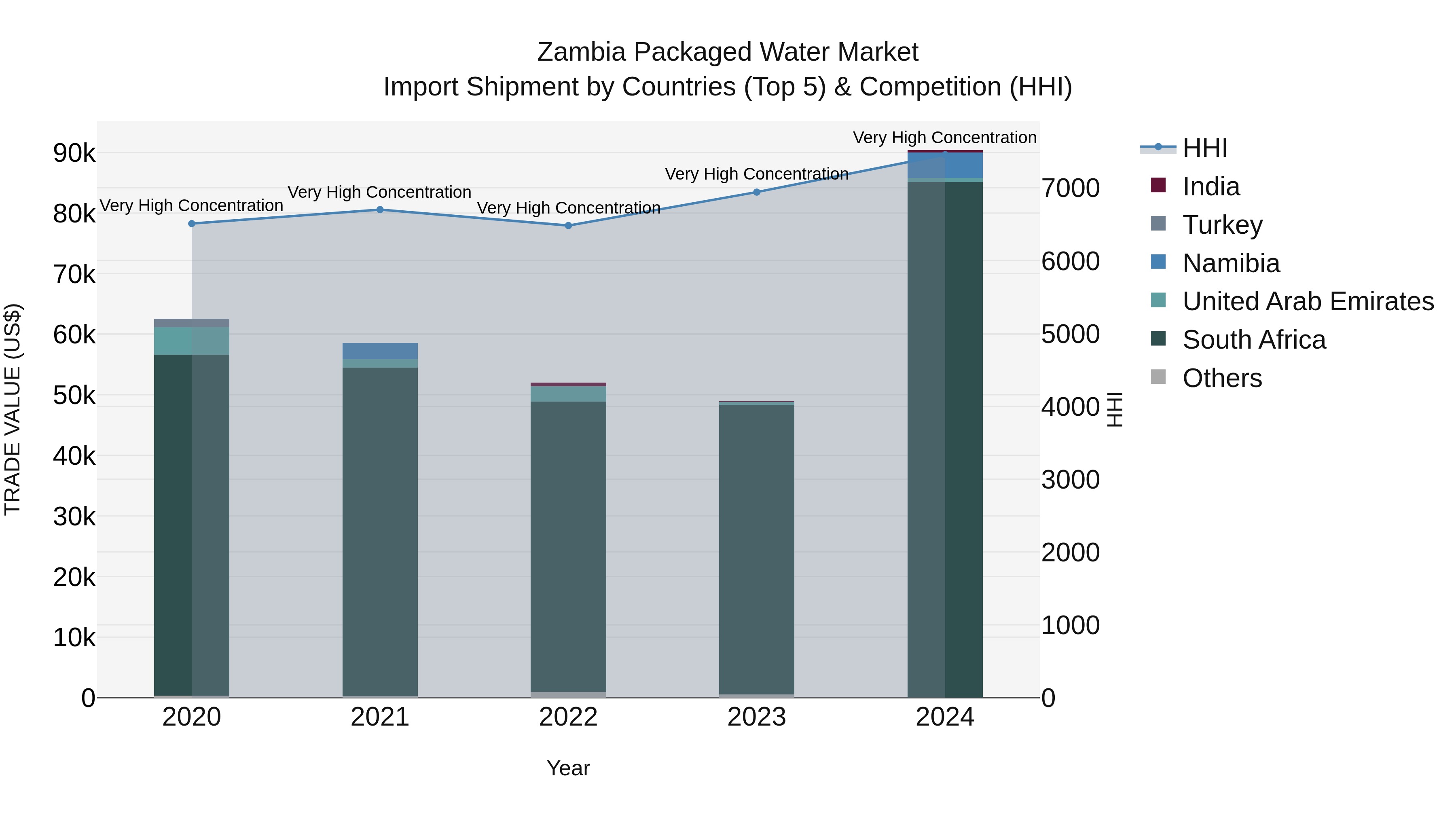
In 2024, Zambia`s packaged water market saw robust import shipments, with key exporting countries being South Africa, Namibia, UAE, India, and Malawi. The high Herfindahl-Hirschman Index (HHI) indicates significant market concentration. The impressive Compound Annual Growth Rate (CAGR) of 9.64% from 2020 to 2024 highlights sustained market expansion. Notably, the exceptional growth rate of 84.7% in 2024 reflects a surge in demand for packaged water in Zambia, presenting lucrative opportunities for stakeholders in the industry.
Zambia Packaged water Market Overview
The Zambia packaged water market is experiencing steady growth driven by factors such as increasing awareness of the importance of clean and safe drinking water, rising urbanization, and a growing population. The market is highly competitive, with key players including both local and international brands offering a variety of packaged water products such as bottled water and sachet water. Consumers in Zambia are increasingly seeking convenient and affordable options for clean drinking water, leading to a surge in demand for packaged water products. The market is also witnessing innovations in packaging, branding, and distribution strategies to cater to different consumer preferences and enhance market penetration. Overall, the Zambia packaged water market presents opportunities for further expansion and product diversification as companies aim to capture a larger share of the growing consumer base.
Zambia Packaged water Market Trends and Opportunities
The Zambia Packaged water market is experiencing significant growth due to increasing awareness about the importance of safe drinking water and the convenience of packaged options. The shift towards healthier lifestyles and the rising demand for on-the-go hydration are driving this trend. Opportunities in the market include the potential for product diversification with flavored or functional water options to cater to evolving consumer preferences. Additionally, the growing focus on sustainability and eco-friendly packaging presents an opportunity for brands to differentiate themselves and appeal to environmentally conscious consumers. Expanding distribution channels, such as online sales and partnerships with retailers, can further enhance market penetration. Overall, the Zambia Packaged water market is poised for continued growth and innovation, offering ample opportunities for companies to capitalize on changing consumer needs and preferences.
Zambia Packaged water Market Challenges
In the Zambia packaged water market, some of the key challenges faced include intense competition among numerous local and international brands, leading to price wars and pressure on profit margins. Additionally, issues related to inconsistent water quality standards and regulatory compliance pose a challenge for companies operating in the market, as maintaining high standards of purity and safety is crucial for consumer trust. Distribution challenges, such as limited access to remote areas and inadequate infrastructure, also impact the market`s growth potential. Furthermore, the prevalence of counterfeit products in the market adds to the complexity of building brand credibility and consumer loyalty. Overall, navigating these challenges requires companies to invest in quality control measures, innovative marketing strategies, and efficient distribution networks to remain competitive in the Zambia packaged water market.
Zambia Packaged water Market Drivers
The Zambia Packaged water market is primarily driven by increasing health consciousness among consumers, leading to a growing preference for safe and clean drinking water. The rising concerns over waterborne diseases and the unreliability of tap water further propel the demand for packaged water. Additionally, the convenience and portability of packaged water make it a popular choice for on-the-go consumers and in settings where access to clean drinking water is limited. Marketing efforts emphasizing the purity, quality, and convenience of packaged water also play a significant role in driving market growth. Furthermore, the expanding urban population and improving economic conditions in Zambia contribute to the increasing consumption of packaged water as consumers seek safer and more reliable hydration options.
Zambia Packaged water Market Government Policy
Government policies related to the Zambia Packaged water Market include the regulation of production and distribution through the Zambia Bureau of Standards (ZABS) to ensure compliance with quality and safety standards. The government also imposes taxes on packaged water products to generate revenue and promote local production. Additionally, there are regulations in place to monitor labeling, advertising, and pricing practices within the industry to protect consumers and promote fair competition. The government encourages investment in the packaged water market to promote economic growth and job creation while also emphasizing the importance of sustainability and environmental protection in production processes. Overall, the government`s policies aim to ensure the availability of safe and high-quality packaged water products for consumers while fostering a competitive market environment.
Zambia Packaged water Market Future Outlook
The future outlook for the Zambia packaged water market appears promising, driven by factors such as increasing urbanization, growing awareness about the importance of clean drinking water, and improving disposable incomes. Consumers are showing a preference for convenient and hygienic drinking water options, which is fueling the demand for packaged water products. Additionally, the expanding retail sector and advancements in distribution channels are making these products more accessible to a wider population. With a focus on health and wellness trends, the market is likely to witness continued growth as more players enter the market with innovative packaging and product offerings to cater to evolving consumer preferences. However, challenges such as regulatory issues and environmental concerns around plastic waste may require industry players to adopt sustainable practices to ensure long-term growth and success.
Key Highlights of the Report:
- Zambia Packaged water Market Outlook
- Market Size of Zambia Packaged water Market, 2024
- Forecast of Zambia Packaged water Market, 2031
- Historical Data and Forecast of Zambia Packaged water Revenues & Volume for the Period 2021- 2031
- Zambia Packaged water Market Trend Evolution
- Zambia Packaged water Market Drivers and Challenges
- Zambia Packaged water Price Trends
- Zambia Packaged water Porter's Five Forces
- Zambia Packaged water Industry Life Cycle
- Historical Data and Forecast of Zambia Packaged water Market Revenues & Volume By Product for the Period 2021- 2031
- Historical Data and Forecast of Zambia Packaged water Market Revenues & Volume By Still for the Period 2021- 2031
- Historical Data and Forecast of Zambia Packaged water Market Revenues & Volume By Carbonated for the Period 2021- 2031
- Historical Data and Forecast of Zambia Packaged water Market Revenues & Volume By Flavored for the Period 2021- 2031
- Historical Data and Forecast of Zambia Packaged water Market Revenues & Volume By Functional for the Period 2021- 2031
- Zambia Packaged water Import Export Trade Statistics
- Market Opportunity Assessment By Product
- Zambia Packaged water Top Companies Market Share
- Zambia Packaged water Competitive Benchmarking By Technical and Operational Parameters
- Zambia Packaged water Company Profiles
- Zambia Packaged water Key Strategic Recommendations






































