Chile Personal Computers Market Size, Share & Growth Rate
The Chile Personal Computers Market was estimated at USD 475 Million in 2025 and is projected to reach USD 652 Million by 2032, growing at a CAGR of 4.6% from 2026 to 2032. This trajectory is primarily fueled by the rising demand for laptops and desktops, driven by an expanding digital landscape in both professional and educational sectors. The increasing focus on remote work, coupled with a tech-savvy population eager for high-performance computing solutions, further supports this positive growth trend.
Chile Personal Computers Market Year-wise Growth Rate and Key Drivers
This graph highlights how the Chile Personal Computers Market has steadily grown over the years, supported by major growth factors.
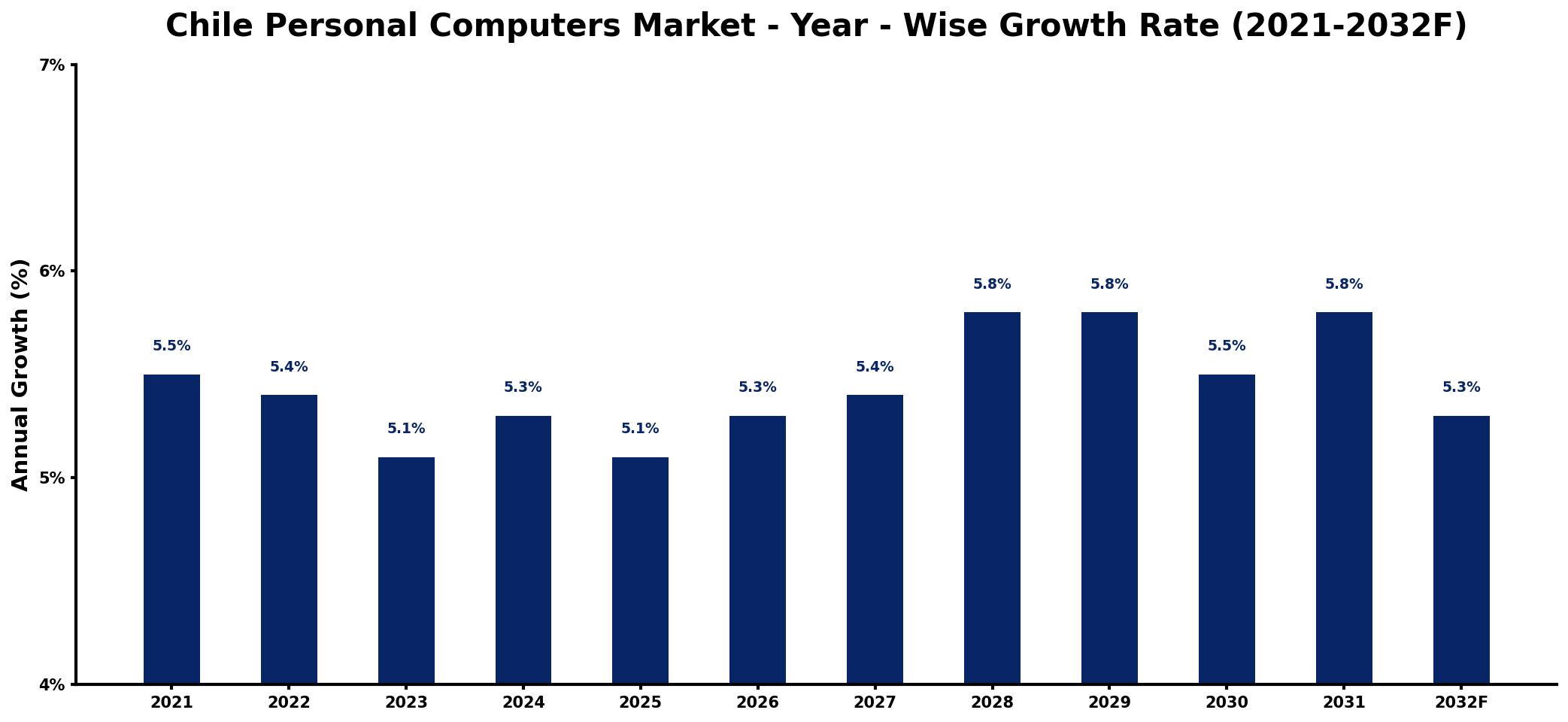
The table below presents the year‑wise growth rates along with the key drivers influencing the market
| Year | Growth Rate | Major Drivers |
| 2021 | 5.5% | Increased remote work adoption |
| 2022 | 5.4% | Growing online education initiatives |
| 2023 | 5.1% | Rising digital content consumption |
| 2024 | 5.3% | Expansion of e-commerce platforms |
| 2025 | 5.1% | Investment in tech infrastructure |
| 2026 | 5.3% | Surge in gaming industry demand |
| 2027 | 5.4% | Development of smart home solutions |
| 2028 | 5.8% | Enhanced cloud computing services |
| 2029 | 5.8% | Growth in cybersecurity investments |
| 2030 | 5.5% | Demand for telehealth services |
| 2031 | 5.8% | Rise in virtual collaboration tools |
| 2032 | 5.3% | Increased demand for streaming services |
Note: Market size estimations and growth projections presented in this report are based on 6Wresearch's proprietary forecasting methodology, utilizing the latest available industry data, government publications, and primary research inputs.
Chile Personal Computers Market Synopsis
The most significant force shaping the Chile Personal Computers Market today is the ongoing digital transformation, accelerated by the pandemic-induced shift to remote work and online learning. With companies and educational institutions increasingly adopting digital solutions, theres a heightened demand for reliable computing devices.
Additionally, the growing interest in personalized and high-performance devices is reshaping consumer preferences. As more users seek tailored computing solutions to meet specific needs—be it for work, gaming, or education—the market is witnessing a surge in customization trends, leading to greater innovation among manufacturers.
Chile Personal Computers Market Key Takeaways
- Significant growth is driven by increasing digitalization, remote work, and online learning.
- The demand for portable and customizable devices is reshaping the market landscape.
- Emerging interests in sustainability are pushing for eco-friendly and energy-efficient solutions.
- Intense competition requires constant innovation and adaptation to market dynamics.
- Government policies are fostering a conducive environment for technological advancement.
Evaluation of Restraints in Chile Personal Computers Market
Despite its growth potential, the Chile Personal Computers Market faces several restraints that can hinder progress. Economic instability affects consumer purchasing power, which can lead to reduced sales in higher-end segments. Additionally, the competitive nature of the market creates pricing pressures, compelling companies to innovate while balancing affordability. High import tariffs on electronic goods also inflate prices, making personal computers less accessible for average consumers. Furthermore, the rapid pace of technological changes mandates constant adaptation from manufacturers to avoid obsolescence.
Chile Personal Computers Market Trends
The market is currently observing a significant shift toward portable computing devices, particularly laptops and 2-in-1 hybrids, which cater to the increasing demand for mobility among professionals and students. Gaming PCs are also gaining traction, fueled by a vibrant gaming community seeking high-performance systems. Moreover, sustainability has become an important consideration, with consumers leaning toward eco-friendly products and manufacturers responding with energy-efficient designs. Customization trends continue to thrive, as users increasingly desire PCs tailored to their individual specifications and preferences.
Chile Personal Computers Market Opportunities
Investment opportunities are abundant in the Chile Personal Computers Market, particularly in addressing the needs of remote workers and students requiring reliable, high-performance devices. Companies that focus on affordability while offering robust features can capture significant market share. Additionally, the rising interest in sustainable technology presents avenues for innovation in eco-friendly computing solutions. Leveraging e-commerce platforms and expanding distribution channels also opens doors to reach a wider customer base and enhance sales.
Government Initiatives in the Chile Personal Computers Market
The Chilean government has been proactive in creating policies that support the personal computers market. Initiatives such as Preferential Trade Agreements aim to reduce tariffs and promote international trade, while tax incentives for R&D investments encourage technological advancements. Programs to expand technology access in schools and rural communities are essential to bridging the digital divide, which further stimulates demand for personal computing solutions across various demographics.
Future Insights of the Chile Personal Computers Market
Looking ahead to 2026-2032, the Chile Personal Computers Market is poised for robust growth. As technological adoption continues to rise, fueled by increasing disposable incomes and a focus on education, demand for personal computers will expand. The market is likely to see advancements in device efficiency, catering to evolving user needs, with a greater inclination towards portable and hybrid options. The focus on sustainability and customization will persist, creating new opportunities for manufacturers to engage with environmentally conscious consumers.
Chile Personal Computers Market Latest Developments (2025 - 2026)
Recently, the Chile Personal Computers Market has seen a notable emphasis on integrating advanced features into devices aimed at enhancing user experience. Manufacturers are increasingly launching laptops with cutting-edge specifications to cater to the growing gaming demographic, while also introducing eco-friendly models to address consumer demands for sustainability. The competitive landscape remains dynamic, with players enhancing their online presence through e-commerce strategies to better connect with tech-savvy consumers.
Chile Personal Computers Market - Key Attractiveness of the Report
- 10 Years of Market Numbers
- Historical Data Starting from 2022 to 2025
- Base Year: 2025
- Forecast Data until 2032
- Key Performance Indicators Impacting the Market
- Major Upcoming Developments and Projects
Key Highlights of the Report:
- Chile Personal Computers Market Outlook
- Market Size of Chile Personal Computers Market, 2025
- Forecast of Chile Personal Computers Market, 2032
- Historical Data and Forecast of Chile Personal Computers Revenues & Volume for the Period 2022-2032F
- Chile Personal Computers Market Trend Evolution
- Chile Personal Computers Market Drivers and Challenges
- Chile Personal Computers Price Trends
- Chile Personal Computers Porter's Five Forces
- Chile Personal Computers Industry Life Cycle
- Historical Data and Forecast of Chile Personal Computers Market Revenues & Volume By Product Type for the Period 2022-2032F
- Historical Data and Forecast of Chile Personal Computers Market Revenues & Volume By Desktop for the Period 2022-2032F
- Historical Data and Forecast of Chile Personal Computers Market Revenues & Volume By Notebook for the Period 2022-2032F
- Historical Data and Forecast of Chile Personal Computers Market Revenues & Volume By Workstation for the Period 2022-2032F
- Historical Data and Forecast of Chile Personal Computers Market Revenues & Volume By Others for the Period 2022-2032F
- Historical Data and Forecast of Chile Personal Computers Market Revenues & Volume By Distribution Channel for the Period 2022-2032F
- Historical Data and Forecast of Chile Personal Computers Market Revenues & Volume By Business-To-Business (B2B) for the Period 2022-2032F
- Historical Data and Forecast of Chile Personal Computers Market Revenues & Volume By Business-To-Consumer (B2C) for the Period 2022-2032F
- Historical Data and Forecast of Chile Personal Computers Market Revenues & Volume By Application for the Period 2022-2032F
- Historical Data and Forecast of Chile Personal Computers Market Revenues & Volume By Consumer for the Period 2022-2032F
- Historical Data and Forecast of Chile Personal Computers Market Revenues & Volume By Commercial for the Period 2022-2032F
- Historical Data and Forecast of Chile Personal Computers Market Revenues & Volume By Industrial for the Period 2022-2032F
- Chile Personal Computers Import Export Trade Statistics
- Market Opportunity Assessment By Product Type
- Market Opportunity Assessment By Distribution Channel
- Market Opportunity Assessment By Application
- Chile Personal Computers Top Companies Market Share
- Chile Personal Computers Competitive Benchmarking By Technical and Operational Parameters
- Chile Personal Computers Company Profiles
- Chile Personal Computers Key Strategic Recommendations






































