Chile Recycled Plastics Market Size, Share & Growth Rate
The Chile Recycled Plastics Market was estimated at USD 435 Million in 2025 and is projected to reach USD 616 Million by 2032, growing at a CAGR of 5.1% from 2026 to 2032. This growth trajectory is primarily driven by heightened environmental consciousness among consumers and businesses, coupled with robust government initiatives aimed at enhancing recycling infrastructure. As industries increasingly pivot towards sustainable practices, the demand for recycled plastics is set to surge.
Chile Recycled Plastics Market Year-wise Growth Rate and Key Drivers
This graph highlights how the Chile Recycled Plastics Market has steadily grown over the years, supported by major growth factors.
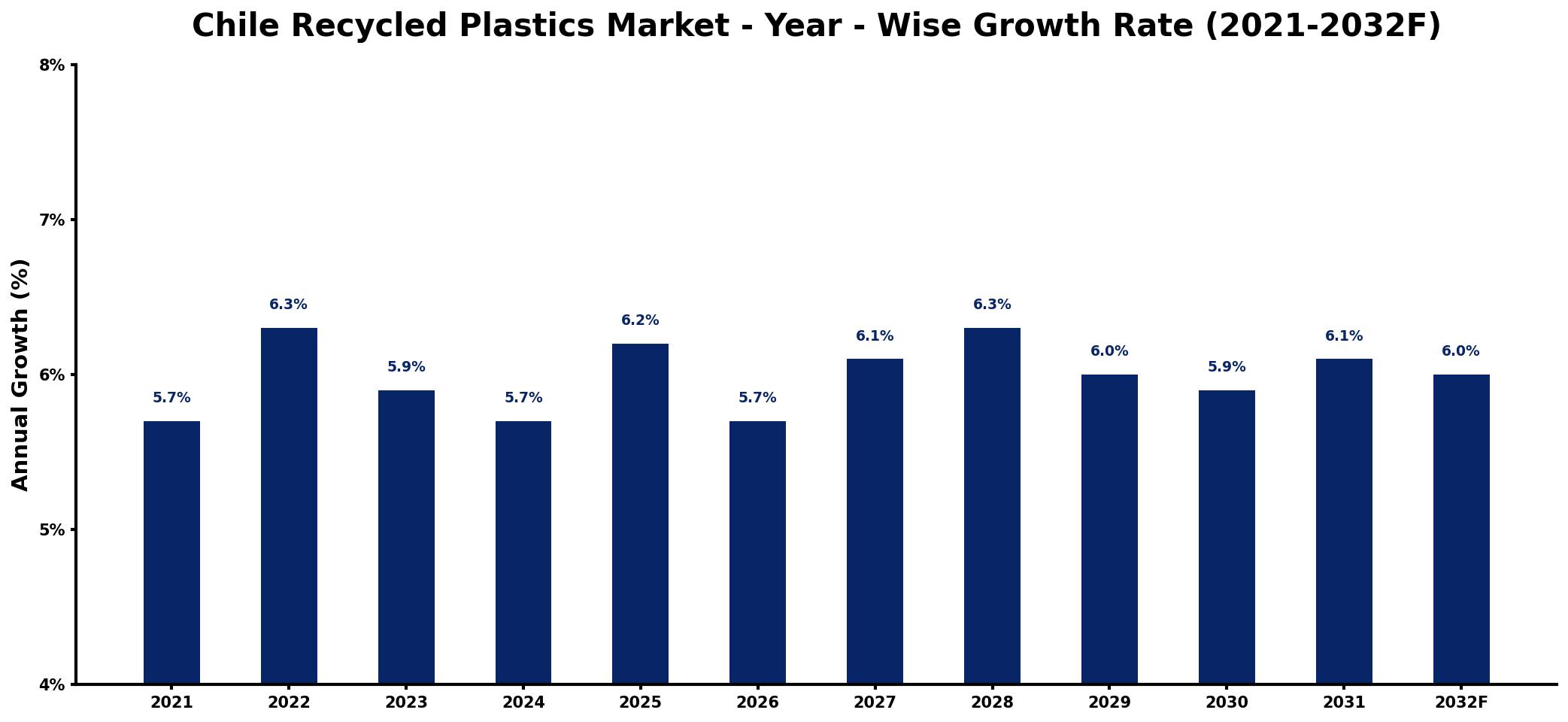
The table below presents the year‑wise growth rates along with the key drivers influencing the market
| Year | Growth Rate | Major Drivers |
| 2021 | 5.7% | Rising environmental awareness initiatives |
| 2022 | 6.3% | Increased government sustainability policies |
| 2023 | 5.9% | Growth in circular economy practices |
| 2024 | 5.7% | Expansion of eco-friendly packaging |
| 2025 | 6.2% | Investment in waste management technology |
| 2026 | 5.7% | Boost in consumer demand sustainability |
| 2027 | 6.1% | Surge in corporate social responsibility |
| 2028 | 6.3% | Development of new recycling infrastructures |
| 2029 | 6.0% | Growing partnerships with manufacturers |
| 2030 | 5.9% | Adoption of sustainable product regulations |
| 2031 | 6.1% | Increase in educational outreach programs |
| 2032 | 6.0% | Strengthening of international trade agreements |
Note: Market size estimations and growth projections presented in this report are based on 6Wresearch's proprietary forecasting methodology, utilizing the latest available industry data, government publications, and primary research inputs.
Chile Recycled Plastics Market Synopsis
The Chile recycled plastics market has gained momentum, propelled by a growing commitment to environmental sustainability. Recent government policies and initiatives have catalyzed the establishment of recycling facilities and the adoption of eco-friendly practices across various sectors. However, to sustain this momentum, the market must address existing gaps in collection infrastructure and public awareness.
Looking forward, the Chile recycled plastics market is poised for substantial growth. With industries such as packaging, automotive, and construction increasingly prioritizing recycled materials, the integration of advanced recycling technologies will be crucial. This evolution reflects a broader trend toward a circular economy, indicating that stakeholders are beginning to embrace innovative solutions to combat plastic waste.
Chile Recycled Plastics Market Key Takeaways
- The market is projected to grow significantly due to rising demand for sustainability in manufacturing.
- Government policies are actively promoting recycling initiatives and infrastructure development.
- Technological advancements in recycling processes are enhancing the quality and availability of recycled plastics.
- Stakeholders are increasingly collaborating to address challenges and maximize recycling efforts.
- Consumer awareness and preferences are shifting towards eco-friendly products, driving market expansion.
Evaluation of Restraints in Chile Recycled Plastics Market
Despite the positive outlook, the Chile recycled plastics market faces notable restraints that could impede its growth. Limited infrastructure for the collection and recycling of plastics continues to be a significant barrier. Furthermore, there is a prevailing lack of public awareness regarding the critical role of recycling, which hampers participation rates. The variability in the quality of recycled plastics also poses challenges, as inconsistent standards can deter industries from fully integrating recycled materials into their production processes. Addressing these issues requires a concerted effort from both public and private sectors to enhance infrastructure and educate consumers about the importance of recycling.
Chile Recycled Plastics Market Trends
The market is currently witnessing transformative trends focused on sustainability and the circular economy. Consumers and businesses alike are prioritizing the integration of recycled plastics in their products and packaging, driven by a greater awareness of environmental impacts. Additionally, government regulations encouraging the use of recycled materials are gaining traction, further intensifying demand. The adoption of innovative recycling technologies is also on the rise, enabling more efficient processing and better-quality recycled plastics. As these trends evolve, they are expected to redefine the landscape of the Chile recycled plastics market.
Chile Recycled Plastics Market Opportunities
Investors looking at the Chile recycled plastics market will find a wealth of opportunities emerging from the nations commitment to sustainability. The establishment or expansion of recycling facilities offers immediate avenues for investment, along with the development of new technologies for more efficient recycling processes. Companies that specialize in producing recycled plastic products are also well-positioned to capitalize on the growing demand. With government backing and a positive regulatory environment, stakeholders can explore these opportunities to drive both economic and environmental benefits in Chile.
Government Initiatives in the Chile Recycled Plastics Market
The Chilean government has been proactive in promoting the recycling of plastics through various initiatives and policies. Notably, the Extended Producer Responsibility (EPR) law places the onus of managing post-consumer plastic waste on manufacturers and importers. This regulation incentivizes companies to enhance their recycling efforts and incorporate recycled materials into their production lines. Additional measures include grants and subsidies aimed at supporting recycling initiatives, thereby promoting a more robust circular economy within the countrys plastics industry.
Future Insights of the Chile Recycled Plastics Market
Looking ahead to 2026-2032, the Chile recycled plastics market is set to expand significantly as awareness of environmental sustainability continues to rise. Industries are likely to increase their consumption of recycled plastics as they strive to meet both regulatory requirements and consumer expectations for eco-friendly products. Investment in recycling technologies and infrastructure will play a critical role in supporting this growth. The markets future is poised for innovation and collaboration, indicating a shift toward a more sustainable approach to plastic waste management.
Chile Recycled Plastics Market Latest Developments (2025 - 2026)
Recent developments in the Chile recycled plastics market reflect a growing commitment to sustainability. There has been a noticeable increase in the establishment of advanced recycling facilities, as well as partnerships between private companies and government agencies to enhance recycling capabilities. Additionally, several industries are exploring innovative uses for recycled plastics, which further demonstrates the market's adaptation to changing consumer demands and regulatory pressures.
Chile Recycled Plastics Market - Key Attractiveness of the Report
- 10 Years of Market Numbers
- Historical Data Starting from 2022 to 2025
- Base Year: 2025
- Forecast Data until 2032
- Key Performance Indicators Impacting the Market
- Major Upcoming Developments and Projects
Key Highlights of the Report:
- Chile Recycled Plastics Market Outlook
- Market Size of Chile Recycled Plastics Market, 2025
- Forecast of Chile Recycled Plastics Market, 2032
- Historical Data and Forecast of Chile Recycled Plastics Revenues & Volume for the Period 2022-2032F
- Chile Recycled Plastics Market Trend Evolution
- Chile Recycled Plastics Market Drivers and Challenges
- Chile Recycled Plastics Price Trends
- Chile Recycled Plastics Porter's Five Forces
- Chile Recycled Plastics Industry Life Cycle
- Historical Data and Forecast of Chile Recycled Plastics Market Revenues & Volume By Plastic Type for the Period 2022-2032F
- Historical Data and Forecast of Chile Recycled Plastics Market Revenues & Volume By Polyethylene Terephthalate (Pet) for the Period 2022-2032F
- Historical Data and Forecast of Chile Recycled Plastics Market Revenues & Volume By High Density Polyethylene (Hdpe) for the Period 2022-2032F
- Historical Data and Forecast of Chile Recycled Plastics Market Revenues & Volume By Polypropylene (Pp) for the Period 2022-2032F
- Historical Data and Forecast of Chile Recycled Plastics Market Revenues & Volume By Low Density Polyethylene (Ldpe) for the Period 2022-2032F
- Historical Data and Forecast of Chile Recycled Plastics Market Revenues & Volume By Others for the Period 2022-2032F
- Historical Data and Forecast of Chile Recycled Plastics Market Revenues & Volume By Application for the Period 2022-2032F
- Historical Data and Forecast of Chile Recycled Plastics Market Revenues & Volume By Non-food Contact Packaging for the Period 2022-2032F
- Historical Data and Forecast of Chile Recycled Plastics Market Revenues & Volume By Food Contact Packaging for the Period 2022-2032F
- Historical Data and Forecast of Chile Recycled Plastics Market Revenues & Volume By Construction for the Period 2022-2032F
- Historical Data and Forecast of Chile Recycled Plastics Market Revenues & Volume By Automotive for the Period 2022-2032F
- Historical Data and Forecast of Chile Recycled Plastics Market Revenues & Volume By Others for the Period 2022-2032F
- Historical Data and Forecast of Chile Recycled Plastics Market Revenues & Volume By Raw Material for the Period 2022-2032F
- Historical Data and Forecast of Chile Recycled Plastics Market Revenues & Volume By Plastic Bottles for the Period 2022-2032F
- Historical Data and Forecast of Chile Recycled Plastics Market Revenues & Volume By Plastic Films for the Period 2022-2032F
- Historical Data and Forecast of Chile Recycled Plastics Market Revenues & Volume By Rigid Plastic And Foam for the Period 2022-2032F
- Historical Data and Forecast of Chile Recycled Plastics Market Revenues & Volume By Fibres for the Period 2022-2032F
- Historical Data and Forecast of Chile Recycled Plastics Market Revenues & Volume By Others for the Period 2022-2032F
- Chile Recycled Plastics Import Export Trade Statistics
- Market Opportunity Assessment By Plastic Type
- Market Opportunity Assessment By Application
- Market Opportunity Assessment By Raw Material
- Chile Recycled Plastics Top Companies Market Share
- Chile Recycled Plastics Competitive Benchmarking By Technical and Operational Parameters
- Chile Recycled Plastics Company Profiles
- Chile Recycled Plastics Key Strategic Recommendations






































