Chile Television Market Summary
The chile television market was estimated at USD 696 Million in 2025 and is projected to reach USD 1253 Million by 2032, growing at a CAGR of 10.1% from 2026 to 2032.
Chile Television Market Year-wise Growth Rate and Key Drivers
This graph highlights how the Chile Television Market has steadily grown over the past five years, supported by major growth factors.
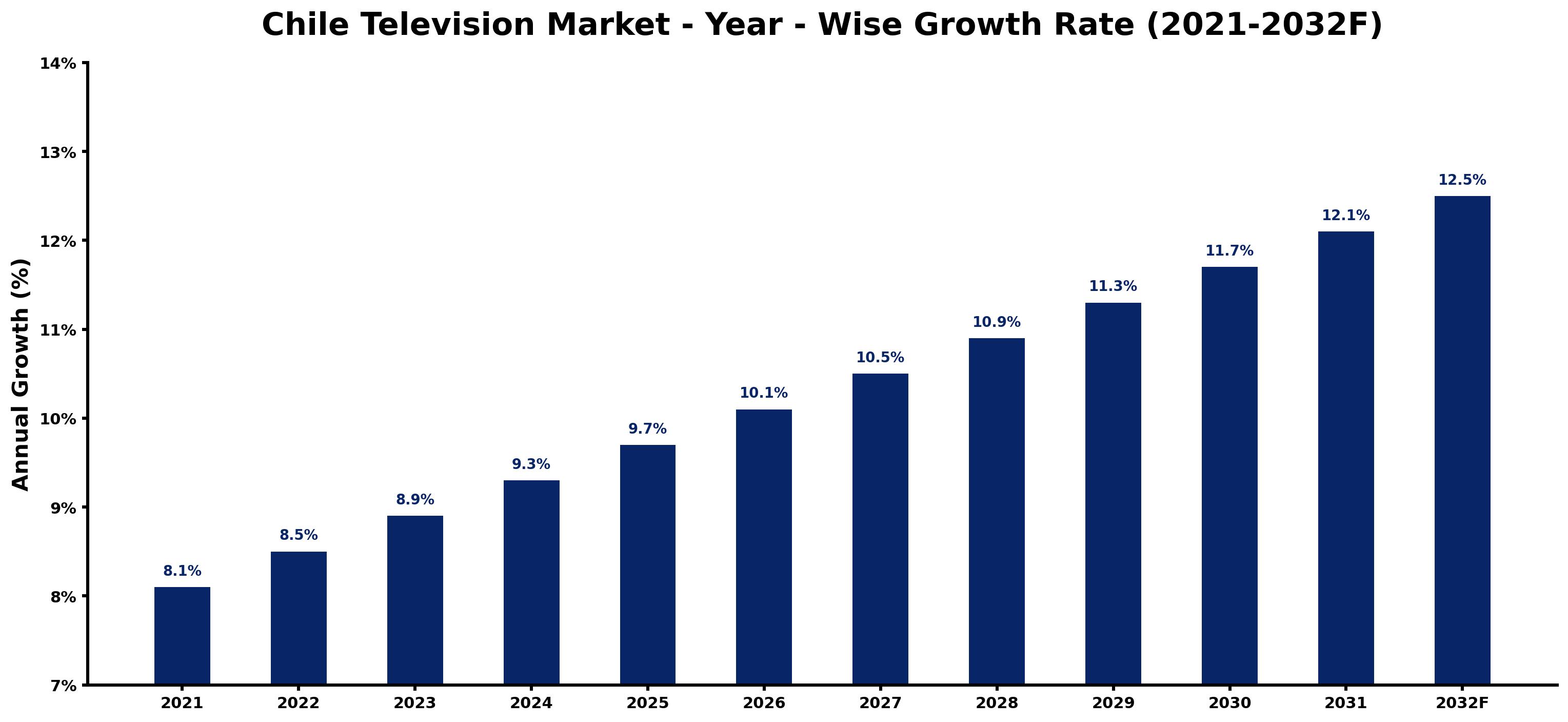
The table below presents the year wise growth rates along with the key drivers influencing the market
| Year | Growth Rate | Major Drivers |
| 2021 | 8.1% | Traditional broadcasting faced fierce competition from online streaming platforms emerging rapidly. |
| 2022 | 8.5% | Consumer preferences shifted towards on-demand content, impacting cable subscriptions significantly. |
| 2023 | 8.9% | Mobile viewing habits surged, with increased access to smartphones and affordable data plans. |
| 2024 | 9.3% | Local content production gained momentum, appealing to cultural tastes and preferences. |
| 2025 | 9.7% | Technological improvements in streaming quality enhanced user experiences across multiple devices. |
| 2026 | 10.1% | Advertising revenues improved as brands targeted audiences through data-driven strategies effectively. |
| 2027 | 10.5% | Partnerships between telecoms and content providers expanded the television service offerings available. |
| 2028 | 10.9% | Investment in original programming increased, enhancing viewer engagement and loyalty over time. |
| 2029 | 11.3% | Competitive pricing models emerged, attracting budget-conscious consumers seeking diverse options. |
| 2030 | 11.7% | Youth demographics increasingly preferred interactive and gamified content formats on platforms. |
| 2031 | 12.1% | Sustainable practices in content production became a focal point for industry stakeholders. |
| 2032 | 12.5% | Global collaborations in media production enriched content diversity available within the market. |
Note - Market size estimations and growth projections presented in this report are based on 6Wresearch's advanced forecasting approach, validated with industry datasets as of June 2026.
Chile Television Market Synopsis
The Chile Television Market is projected to reach 10.1% and witness significant growth during the forecast period (2026-2032). This market is characterized by a notable diversity in content offerings, encompassing both traditional broadcasting services and an expanding array of digital platforms. With leading broadcast networks delivering a range of programming, from news to cultural content, and a vibrant pay-TV segment catering to varied audience preferences, the Chilean television landscape is evolving rapidly.
Chile Television Market Growth Drivers
Several factors are fueling the growth of the Chile television market. Firstly, the increasing penetration of high-speed internet has facilitated the rise of digital streaming services, enabling viewers to access content on their own terms. This technological advancement is complemented by a shift in consumer preferences towards on-demand content, prompting traditional broadcasters to innovate and adapt.
- The rise of smartphones and smart TVs has made streaming services more accessible to a broader demographic, enhancing viewing experiences with larger screens and improved interfaces.
- Consumer demand for original and local content is rising, necessitating investment in homegrown productions that resonate with national audiences and reflect cultural nuances.
- Advertisers are increasingly shifting their focus towards targeted digital advertising, capitalizing on data analytics to reach specific audience segments effectively.
- The competitive nature of the television market compels providers to offer more flexible and affordable subscription packages, which attracts new customers and retains existing ones.
- As disposable incomes continue to rise in Chile, viewers are seeking premium content and entertainment options, further driving market expansion.
Chile Television Market Trends and Opportunities
The Chile television market is experiencing transformative trends that present numerous opportunities for stakeholders. The ascent of streaming services has led to an increased focus on content diversity, with local productions gaining traction both domestically and internationally.
- As digital platforms proliferate, there is a growing demand for high-quality original content, providing an opportunity for content creators and producers to engage viewers with unique offerings.
- Collaborative partnerships between local and international production companies can enhance content quality and broaden market reach.
- Enhanced advertising strategies are focusing on personalized content delivery, allowing brands to connect more effectively with target demographics.
- Local broadcasters are increasingly investing in technology to enhance content distribution, ensuring their services remain competitive against global streaming giants.
- The transition towards a digital-first approach in content consumption is also leading to an increased focus on user engagement and interactive content formats.
Chile Television Market Challenges and Restraints
Despite the promising growth trajectory, the Chile television market faces several challenges that could impede its progress. The increase in competition from digital platforms has compelled traditional broadcasters to reevaluate their strategies, often leading to significant financial pressures.
- Adapting to the dynamic preferences of viewers for on-demand content requires substantial investment in technology and production capabilities, which can strain financial resources.
- Regulatory frameworks surrounding content quotas and foreign ownership may pose additional hurdles for companies looking to expand their operations.
- The rapid pace of technological advancement necessitates constant innovation, as companies risk obsolescence if they fail to keep pace.
- Changing consumer habits can lead to unpredictable fluctuations in viewership and advertising revenues, complicating financial forecasting for television providers.
- Addressing the challenge of retaining talent in a competitive media landscape is crucial, as skilled professionals are essential for producing high-quality content.
Chile Television Market Government Investment and Initiatives
The Chilean government plays an active role in shaping the television landscape through various policies and initiatives aimed at fostering local content production and protecting consumer interests. The National Television Council (CNTV) regulates broadcasting licenses and enforces compliance with national programming quotas.
- Government regulations mandate that a minimum percentage of broadcast content originates from Chile, which stimulates the growth of the domestic audiovisual industry.
- Public funding and incentives are provided for local filmmakers and producers, encouraging the creation of content that reflects Chilean culture and perspectives.
- Advertising regulations exist to safeguard viewers from misleading information, ensuring a fair and transparent media environment.
- The government promotes programs that enhance digital infrastructure, facilitating access to high-speed internet which is critical for content delivery across digital platforms.
- Collaborations between the government and private sector aim to develop innovative media projects that align with technological advancements and evolving consumer preferences.
Chile Television Market Latest Developments (May 2025 - June 2026)
Recent developments in the Chile television market indicate a continued evolution towards digital platforms, reflecting the growing consumer preference for on-demand viewing. Traditional broadcasters have been actively expanding their digital offerings, integrating streaming capabilities into their services to remain competitive.
- There is an observable surge in collaborations aimed at producing co-branded content, enhancing the visibility of local productions both regionally and globally.
- Innovations around interactive content formats are being explored, allowing viewers to engage more dynamically with programming.
- The landscape of advertising is shifting, with a noticeable increase in targeted advertising metrics that leverage big data analytics for improved audience engagement.
- New strategic partnerships are being formed to tackle the increased demand for original content, leading to a diversification of programming that caters to various viewer demographics.
- Investment in technologies that support augmented and virtual reality experiences in content delivery is on the rise, pointing towards a future-focused approach in television offerings.
Chile Television Market - Key Attractiveness of the Report
- 10 Years of Market Numbers
- Historical Data Starting from 2022 to 2025
- Base Year: 2025
- Forecast Data until 2032
- Key Performance Indicators Impacting the Market
- Major Upcoming Developments and Projects
Key Highlights of the Report:
- Chile Television Market Outlook
- Market Size of Chile Television Market, 2025
- Forecast of Chile Television Market, 2032F
- Historical Data and Forecast of Chile Television Revenues & Volume for the Period 2022-2032F
- Chile Television Market Trend Evolution
- Chile Television Market Drivers and Challenges
- Chile Television Price Trends
- Chile Television Porter's Five Forces
- Chile Television Industry Life Cycle
- Historical Data and Forecast of Chile Television Market Revenues & Volume By Resolution for the Period 2022-2032F
- Historical Data and Forecast of Chile Television Market Revenues & Volume By LCD TVs for the Period 2022-2032F
- Historical Data and Forecast of Chile Television Market Revenues & Volume By OLED TVs for the Period 2022-2032F
- Historical Data and Forecast of Chile Television Market Revenues & Volume By Types for the Period 2022-2032F
- Historical Data and Forecast of Chile Television Market Revenues & Volume By 2D TVs for the Period 2022-2032F
- Historical Data and Forecast of Chile Television Market Revenues & Volume By 3D TVs for the Period 2022-2032F
- Chile Television Import Export Trade Statistics
- Market Opportunity Assessment By Resolution
- Market Opportunity Assessment By Types
- Chile Television Top Companies Market Share
- Chile Television Competitive Benchmarking By Technical and Operational Parameters
- Chile Television Company Profiles
- Chile Television Key Strategic Recommendations






































