Chile Trolley Market Size, Share & Growth Rate
The Chile Trolley Market was estimated at USD 874 Million in 2025 and is projected to reach USD 1265 Million by 2032, growing at a CAGR of 5.4% from 2026 to 2032. This growth trajectory is primarily driven by the expansion of the retail and hospitality sectors in Chile, where the demand for efficient transportation solutions is on the rise. Furthermore, the logistics industry is increasingly investing in trolleys to streamline operations, enhancing customer experiences and operational efficiency across various platforms.
Chile Trolley Market Year-wise Growth Rate and Key Drivers
This graph highlights how the Chile Trolley Market has steadily grown over the years, supported by major growth factors.
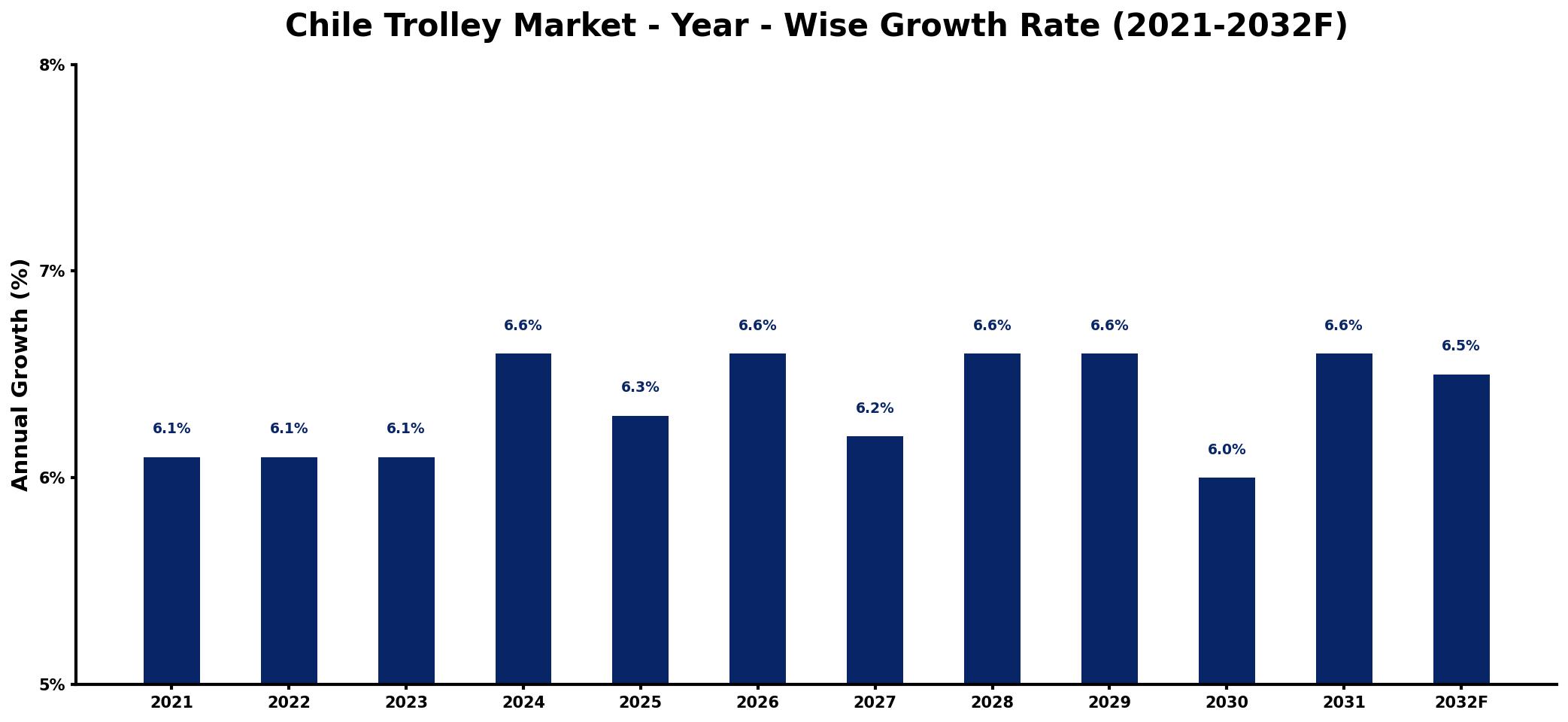
The table below presents the year‑wise growth rates along with the key drivers influencing the market
| Year | Growth Rate | Major Drivers |
| 2021 | 6.1% | Rising consumer demand for mobility |
| 2022 | 6.1% | Increased urban infrastructure investments |
| 2023 | 6.1% | Expansion of e-commerce logistics networks |
| 2024 | 6.6% | Growing focus on sustainability practices |
| 2025 | 6.3% | Technological advancements in transportation |
| 2026 | 6.6% | Emergence of smart city initiatives |
| 2027 | 6.2% | Enhanced public transport integration efforts |
| 2028 | 6.6% | strengthening underlying market demand |
| 2029 | 6.6% | Strengthened supply chain efficiencies |
| 2030 | 6.0% | Growing emphasis on eco-friendly solutions |
| 2031 | 6.6% | Increase in urban population density |
| 2032 | 6.5% | Development of innovative transportation alternatives |
Note: Market size estimations and growth projections presented in this report are based on 6Wresearch's proprietary forecasting methodology, utilizing the latest available industry data, government publications, and primary research inputs.
Chile Trolley Market Synopsis
The demand for trolleys in Chile is notably influenced by urbanization and a growing focus on customer convenience in retail settings. As more consumers opt for online shopping and the omnichannel approach grows in popularity, retailers are investing in advanced trolley solutions to keep pace with evolving shopping habits.
In the hospitality sector, increased tourist arrivals have spurred the need for luggage trolleys in hotels and airports. This demand is complemented by businesses looking for innovative ways to improve service delivery while ensuring a seamless guest experience.
Chile Trolley Market Key Takeaways
- Strong growth driven by the expanding retail, hospitality, and logistics sectors.
- Increasing emphasis on ergonomic and durable trolley designs to enhance user experience.
- Government regulations promoting safety standards and sustainability are shaping market dynamics.
- Opportunities exist in the development of reusable trolleys aligned with eco-friendly practices.
- Space optimization and customization options remain critical for market competitiveness.
Evaluation of Restraints in Chile Trolley Market
Despite the promising growth outlook, the Chile Trolley Market encounters significant restraints that could hinder its potential. One major limitation is market saturation, where numerous products vie for attention, making it challenging for manufacturers to differentiate their offerings. Additionally, the pressure for continuous design innovation means that companies must invest heavily in R&D to keep up with consumer expectations for ergonomic, durable, and user-friendly products. This demand for innovation can strain resources and result in slower product development timelines, creating a competitive disadvantage.
Chile Trolley Market Trends
Several emerging trends are currently shaping the Chile Trolley Market. Notably, the integration of technology into trolley design is gaining traction, with manufacturers exploring features such as smart trolleys equipped with tracking systems and mobile payment options. Additionally, there is a growing trend toward sustainability, as companies are compelled to adopt eco-friendly materials and manufacturing processes. The demand for customization is also on the rise, reflecting the unique needs of different sectors, particularly retail and hospitality.
Chile Trolley Market Opportunities
The Chile Trolley Market presents several compelling opportunities for investment and growth. The push for sustainable shopping practices offers a unique avenue for businesses to innovate eco-friendly trolley solutions, capturing the attention of environmentally conscious consumers. Moreover, as e-commerce continues to expand, there is an increasing need for tailored trolley designs that cater specifically to online retailers. By focusing on customization and incorporating advanced features, companies can differentiate themselves and capture a larger share of this growing market.
Government Initiatives in the Chile Trolley Market
The Chilean government is actively engaged in fostering a conducive environment for the trolley market through various initiatives. Regulations aimed at enhancing product safety and durability standards are in place, ensuring that trolleys meet essential requirements. Additionally, there are incentives for businesses that invest in ergonomic designs, promoting employee welfare and customer satisfaction. The government's focus on sustainable practices, including support for the use of reusable trolleys, reflects a broader commitment to reducing plastic waste and encouraging eco-friendly shopping habits.
Future Insights of the Chile Trolley Market
Looking ahead to the period from 2026 to 2032, the Chile Trolley Market is poised for significant transformation. As the economy continues to recover and grow, we can expect heightened investment in retail and logistics, leading to increased trolley demand. Companies that prioritize innovation and sustainability will likely capture the largest market share. The integration of technology and a focus on user experience will also play pivotal roles in shaping the market's future, paving the way for smarter, more efficient trolley solutions.
Chile Trolley Market Latest Developments (2025 - 2026)
In recent months, the Chile Trolley Market has seen a flurry of activity. Manufacturers are increasingly showcasing trolleys that utilize lightweight materials to improve maneuverability and user comfort. Concurrently, there is a noticeable shift towards designs that cater to urban environments, focusing on compactness without sacrificing functionality. Companies are also exploring partnerships aimed at creating integrated solutions that align with emerging retail technologies, such as mobile apps for trolley management, further enhancing the user experience.
Chile Trolley Market - Key Attractiveness of the Report
- 10 Years of Market Numbers
- Historical Data Starting from 2022 to 2025
- Base Year: 2025
- Forecast Data until 2032
- Key Performance Indicators Impacting the Market
- Major Upcoming Developments and Projects
Key Highlights of the Report:
- Chile Trolley Market Outlook
- Market Size of Chile Trolley Market, 2025
- Forecast of Chile Trolley Market, 2032
- Historical Data and Forecast of Chile Trolley Revenues & Volume for the Period 2022-2032F
- Chile Trolley Market Trend Evolution
- Chile Trolley Market Drivers and Challenges
- Chile Trolley Price Trends
- Chile Trolley Porter's Five Forces
- Chile Trolley Industry Life Cycle
- Historical Data and Forecast of Chile Trolley Market Revenues & Volume By Product for the Period 2022-2032F
- Historical Data and Forecast of Chile Trolley Market Revenues & Volume By Manual for the Period 2022-2032F
- Historical Data and Forecast of Chile Trolley Market Revenues & Volume By Electric for the Period 2022-2032F
- Historical Data and Forecast of Chile Trolley Market Revenues & Volume By Application for the Period 2022-2032F
- Historical Data and Forecast of Chile Trolley Market Revenues & Volume By Commercial for the Period 2022-2032F
- Historical Data and Forecast of Chile Trolley Market Revenues & Volume By Non-commercial for the Period 2022-2032F
- Historical Data and Forecast of Chile Trolley Market Revenues & Volume By Distribution for the Period 2022-2032F
- Historical Data and Forecast of Chile Trolley Market Revenues & Volume By Offline for the Period 2022-2032F
- Historical Data and Forecast of Chile Trolley Market Revenues & Volume By Online for the Period 2022-2032F
- Chile Trolley Import Export Trade Statistics
- Market Opportunity Assessment By Product
- Market Opportunity Assessment By Application
- Market Opportunity Assessment By Distribution
- Chile Trolley Top Companies Market Share
- Chile Trolley Competitive Benchmarking By Technical and Operational Parameters
- Chile Trolley Company Profiles
- Chile Trolley Key Strategic Recommendations






































