China 3D Animation Market Size & Growth Rate (2026-2032)
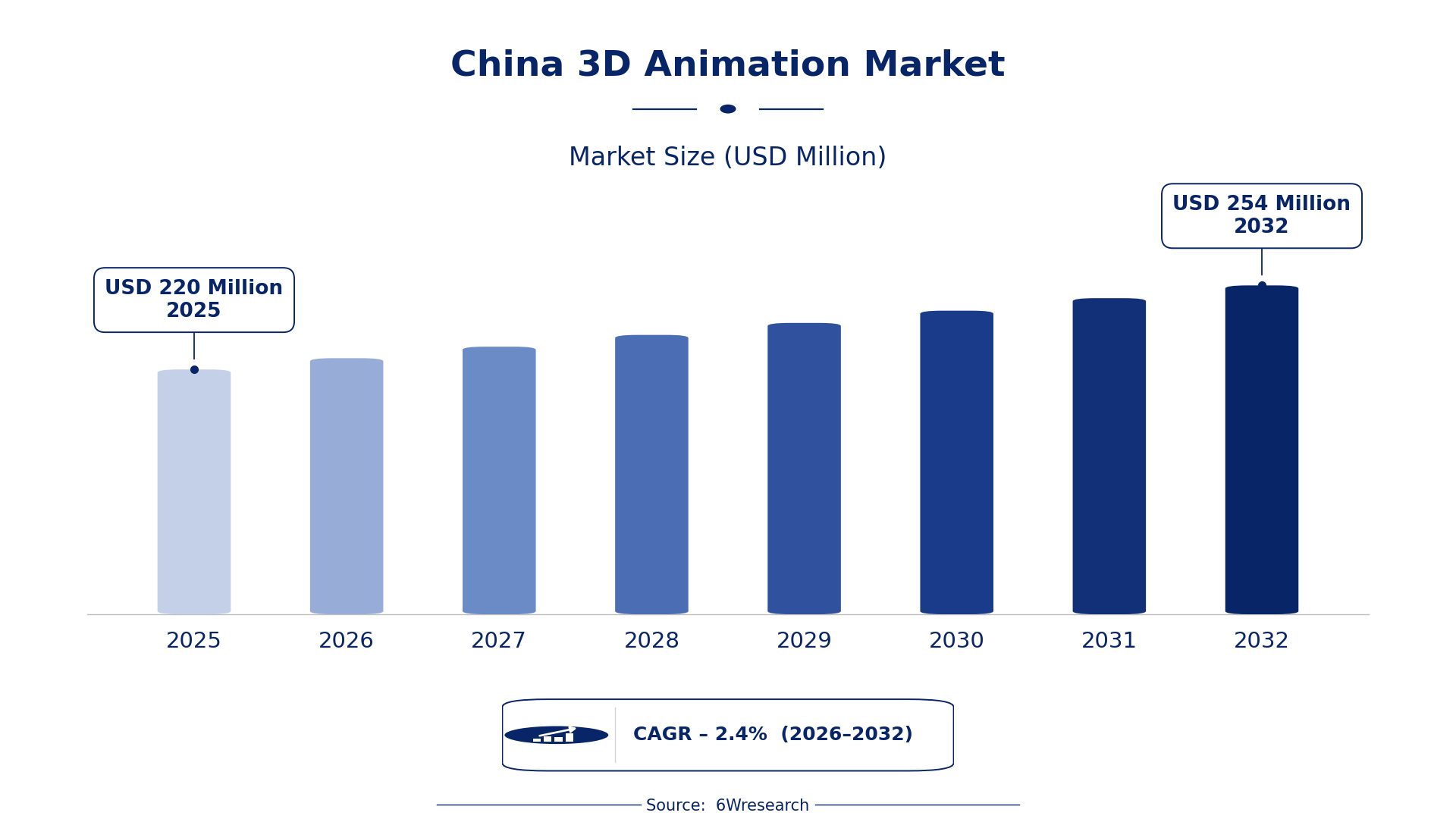
The China 3D Animation Market was estimated at USD 220 Million in 2025 and is projected to reach USD 254 Million by 2032, growing at a CAGR of 2.4% from 2026 to 2032.
China 3D Animation Market Synopsis
In China, the demand for high-quality 3D animated content is surging across various sectors including gaming, education, and advertising. This rapid expansion is largely fueled by the increasing consumption of digital media and the growing sophistication of technology among consumers.
As local studios ramp up production capabilities, foreign collaborations are becoming more commonplace, enriching the creative pool. The rise of streaming platforms has also amplified the appetite for unique animated offerings, creating a vibrant ecosystem for 3D animation.
China 3D Animation Market Year-wise Growth Rate and Key Drivers
This graph illustrates the annual growth rates of the China 3D Animation Market from 2021 to 2032, highlighting a steady upward trajectory and projected expansion over the forecast period.
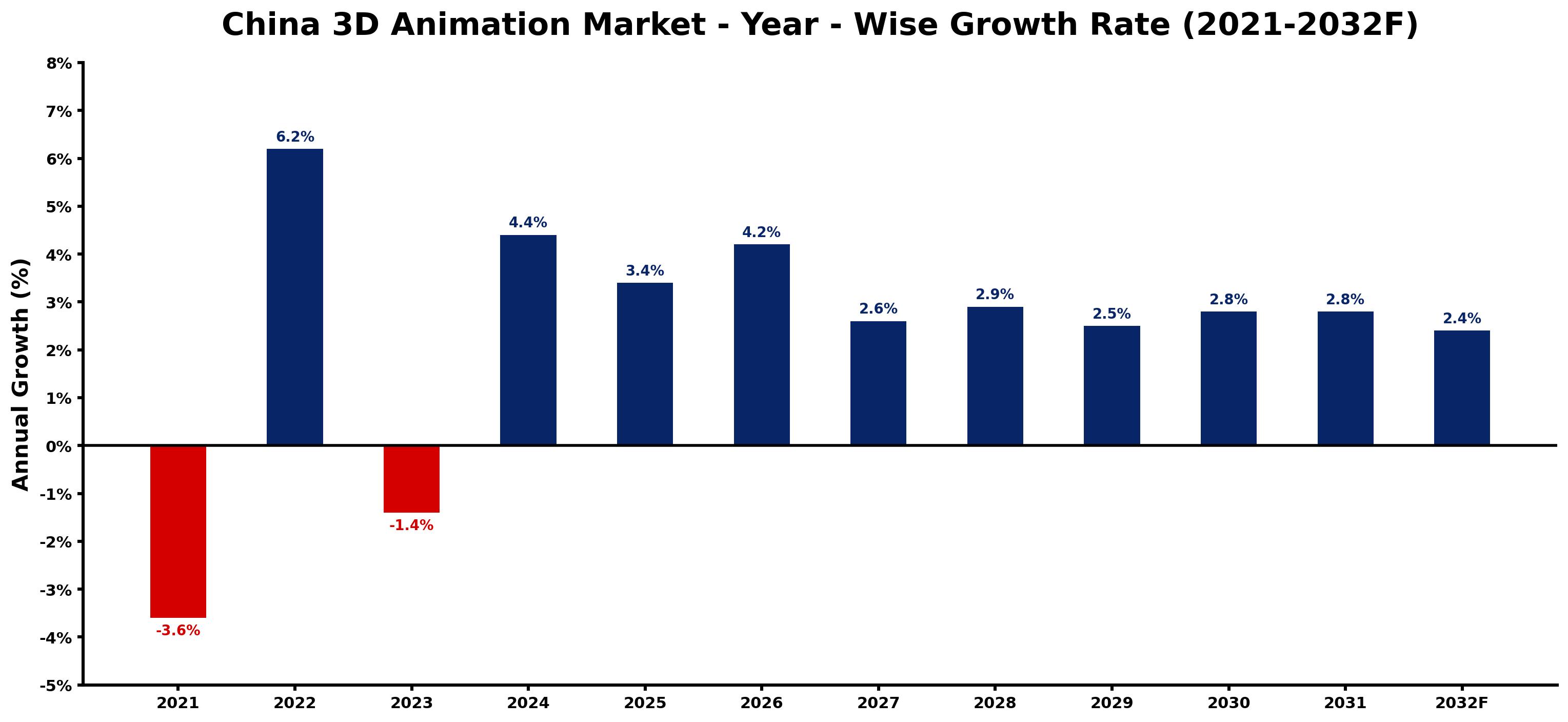
The table below presents the year‑wise growth rates along with the key drivers influencing the market
| Year | Growth Rate | Major Drivers |
| 2021 | -3.6% | New regulations by National Radio and Television Administration |
| 2022 | 6.2% | Investment in national digital creative industry programs |
| 2023 | -1.4% | Increased adoption of mobile gaming over 3D animation |
| 2024 | 4.4% | Youth engagement in online gaming driving 3D content |
| 2025 | 3.4% | Government support for cultural and creative industries |
| 2026 | 4.2% | Rise in local 3D animation education institutions |
| 2027 | 2.6% | Increased demand for animated educational materials |
| 2028 | 2.9% | Growth of virtual reality experiences in entertainment |
| 2029 | 2.5% | Rise in tailor-made 3D content for e-commerce |
| 2030 | 2.8% | Boost in augmented reality applications in tourism |
| 2031 | 2.8% | Cultural heritage projects utilizing 3D modeling technologies |
| 2032 | 2.4% | Surge in animated series production for children |
Note: Market size estimations and growth projections presented in this report are based on 6Wresearch's proprietary forecasting methodology, utilizing the latest available industry data, government publications, and primary research inputs.
China 3D Animation Market Key Takeaways
Below are some of the specific key takeaways from the market, including:
- Growing demand for 3D animated content across entertainment, education, and advertising sectors.
- Increased investments in technology and talent development within the animation industry.
- Emergence of virtual and augmented reality technologies enhancing animation experiences.
- Government support through policies aimed at fostering innovation and protecting intellectual property.
- Competitive challenges from international players and ongoing piracy issues impacting revenue.
Evaluation of Restraints in China 3D Animation Market
The China 3D animation market is not without its hurdles. Intense competition from established international entities presents a formidable challenge for local studios trying to carve out their niche. Additionally, piracy remains a persistent issue, siphoning off potential revenue for creators.
The industry also grapples with a shortage of skilled talent, which restricts the ability of studios to innovate and scale. on top of that, stringent government regulations can stifle creative freedom, making it difficult to navigate content creation and distribution.
China 3D Animation Market Trends
A notable trend in the China 3D animation market is the integration of virtual reality (VR) and augmented reality (AR) technologies into animation projects. These technologies are not just enhancing viewer engagement; they are also creating entirely new genres of interactive content.
The popularity of online streaming platforms continues to rise, leading to an increasing demand for diverse animated series and films. Additionally, animation is finding a foothold in educational settings, where it is used to create engaging learning experiences.
China 3D Animation Market Opportunities
Investment opportunities are abundant in the China 3D animation market, particularly within the realms of content creation and technological development. With local consumers demanding higher quality and more varied animated content, there is a significant need for studios that can deliver on these expectations.
on top of that, partnerships with educational institutions can facilitate talent development, ensuring a steady pipeline of skilled animators. Collaborations with foreign entities can also provide invaluable insight into best practices and emerging trends.
Government Initiatives in the China 3D Animation Market
The Chinese government is actively involved in shaping the 3D animation market through various supportive measures. These include financial incentives and regulatory frameworks aimed at fostering growth and innovation within the industry. As the government prioritizes the animation sector, these policies are critical for attracting investment and enhancing the competitive landscape.
- A recently completed initiative providing tax incentives for new animation projects to stimulate investment in local studios.
- A currently ongoing campaign promoting collaboration between animation companies and educational institutions to enhance workforce skills.
- A planned public-private initiative aimed at establishing a national animation fund to support emerging creators and projects by 2026.
- Regulations introduced in 2025 aimed at strengthening intellectual property protections for local animation studios.
- Ongoing efforts to improve digital infrastructure that supports the animation industry's technical needs.
Future Insights of the China 3D Animation Market
Looking ahead to 2026-2032, the China 3D animation market is set for continued growth. The demand for innovative animated content will likely expand as consumers become more accustomed to high-quality visual experiences. Advances in technology will play a crucial role in this trajectory, enabling more immersive storytelling through VR and AR.
The supportive governmental policies and an increasingly sophisticated consumer base will foster an environment ripe for innovation and investment. As local studios evolve, the market will likely see a diversification in content types, catering to both domestic and international audiences.
China 3D Animation Market Latest Developments
Over the past year, the China 3D animation market has witnessed a flurry of activity, with numerous projects and partnerships emerging. The push for higher quality content has led to significant technological advancements and collaborations aimed at enhancing production capabilities.
- A major technology vendor launched a new animation software suite in early 2025, aimed at streamlining production processes for local studios.
- An ongoing partnership between several regional studios to develop a joint animated series, expected to debut by mid-2026.
- A planned initiative to establish a talent incubator aimed at nurturing young animators, set to kick off in early 2026.
- A recent collaboration between animation studios and streaming platforms to create exclusive animated content, which began in Q3 2025.
- A technology upgrade project enhancing digital infrastructure for animation production is currently underway, expected to conclude by late 2025.
China 3D Animation Market - Key Attractiveness of the Report
- 10 Years of Market Numbers
- Historical Data Starting from 2022 to 2025
- Base Year: 2025
- Forecast Data until 2032
- Key Performance Indicators Impacting the Market
- Major Upcoming Developments and Projects
Key Highlights of the Report:
- China 3D Animation Market Outlook
- Market Size of China 3D Animation Market, 2025
- Forecast of China 3D Animation Market, 2032
- Historical Data and Forecast of China 3D Animation Revenues & Volume for the Period 2022-2032F
- China 3D Animation Market Trend Evolution
- China 3D Animation Market Drivers and Challenges
- China 3D Animation Price Trends
- China 3D Animation Porter's Five Forces
- China 3D Animation Industry Life Cycle
- Historical Data and Forecast of China 3D Animation Market Revenues & Volume By Technology for the Period 2022-2032F
- Historical Data and Forecast of China 3D Animation Market Revenues & Volume By 3D Modeling for the Period 2022-2032F
- Historical Data and Forecast of China 3D Animation Market Revenues & Volume By Motion Graphics for the Period 2022-2032F
- Historical Data and Forecast of China 3D Animation Market Revenues & Volume By 3D Rendering for the Period 2022-2032F
- Historical Data and Forecast of China 3D Animation Market Revenues & Volume By Visual Effects for the Period 2022-2032F
- Historical Data and Forecast of China 3D Animation Market Revenues & Volume By Service for the Period 2022-2032F
- Historical Data and Forecast of China 3D Animation Market Revenues & Volume By Consulting for the Period 2022-2032F
- Historical Data and Forecast of China 3D Animation Market Revenues & Volume By Support and Maintenance for the Period 2022-2032F
- Historical Data and Forecast of China 3D Animation Market Revenues & Volume By Integration and Deployment for the Period 2022-2032F
- Historical Data and Forecast of China 3D Animation Market Revenues & Volume By Education and Training for the Period 2022-2032F
- Historical Data and Forecast of China 3D Animation Market Revenues & Volume By Vertical for the Period 2022-2032F
- Historical Data and Forecast of China 3D Animation Market Revenues & Volume By Media and Entertainment for the Period 2022-2032F
- Historical Data and Forecast of China 3D Animation Market Revenues & Volume By Construction and Architecture for the Period 2022-2032F
- Historical Data and Forecast of China 3D Animation Market Revenues & Volume By Healthcare and Lifesciences for the Period 2022-2032F
- Historical Data and Forecast of China 3D Animation Market Revenues & Volume By Manufacturing for the Period 2022-2032F
- Historical Data and Forecast of China 3D Animation Market Revenues & Volume By Education and Academia for the Period 2022-2032F
- Historical Data and Forecast of China 3D Animation Market Revenues & Volume By Others for the Period 2022-2032F
- Historical Data and Forecast of China 3D Animation Market Revenues & Volume By Deployment for the Period 2022-2032F
- Historical Data and Forecast of China 3D Animation Market Revenues & Volume By On-Premises for the Period 2022-2032F
- Historical Data and Forecast of China 3D Animation Market Revenues & Volume By On-Demand for the Period 2022-2032F
- China 3D Animation Import Export Trade Statistics
- Market Opportunity Assessment By Technology
- Market Opportunity Assessment By Service
- Market Opportunity Assessment By Vertical
- Market Opportunity Assessment By Deployment
- China 3D Animation Top Companies Market Share
- China 3D Animation Competitive Benchmarking By Technical and Operational Parameters
- China 3D Animation Company Profiles
- China 3D Animation Key Strategic Recommendations






































