China 5G Core Market Size, Share & Growth Rate
The China 5G Core Market was estimated at USD 100 Million in 2025 and is projected to reach USD 115 Million by 2032, growing at a CAGR of 2.0% from 2026 to 2032. This growth is largely fueled by the rapid deployment of 5G networks, which are reshaping connectivity across urban centers and industries. The rising demand for high-speed data services and low-latency applications further solidifies this upward trajectory.
China 5G Core Market Year-wise Growth Rate and Key Drivers
This graph highlights how the China 5G Core Market has steadily grown over the years, supported by major growth factors.
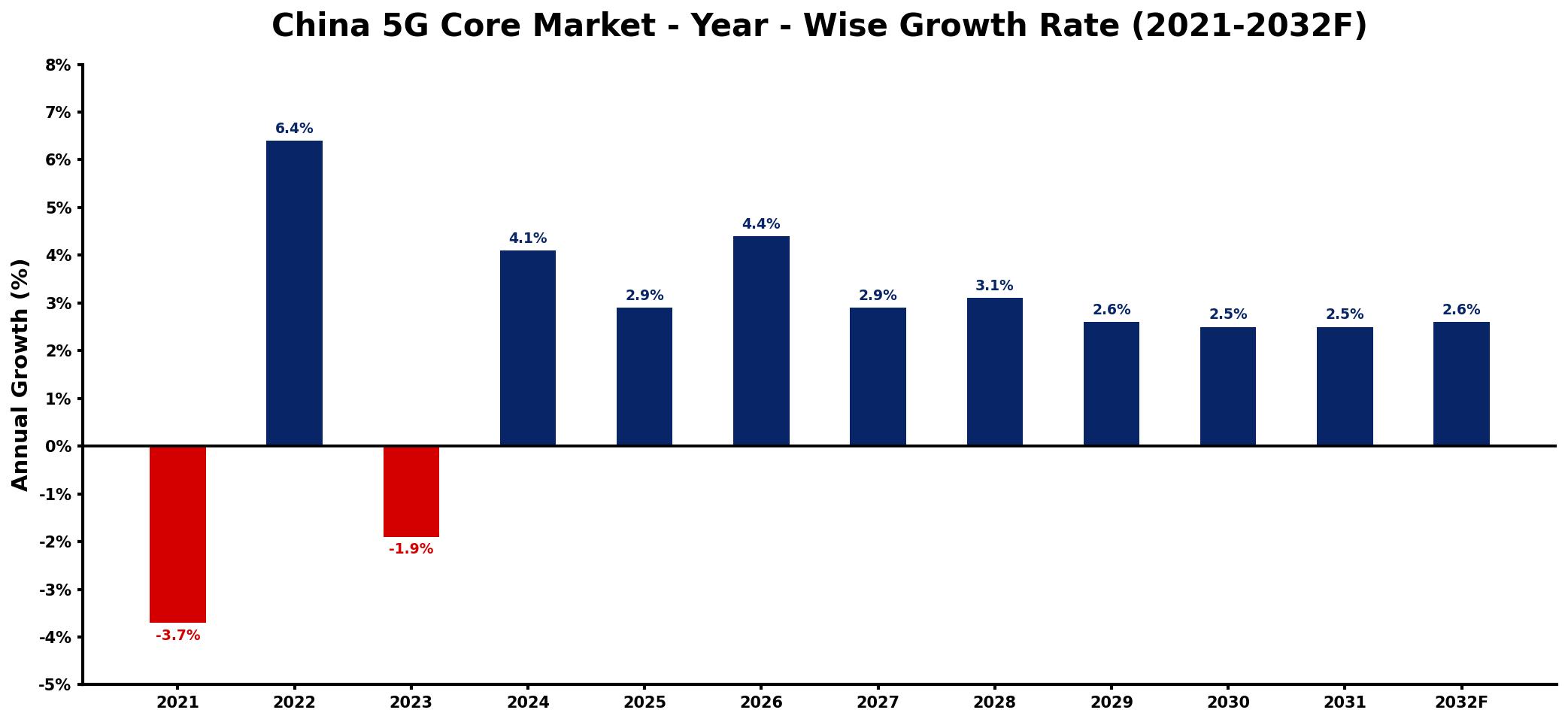
The table below presents the year‑wise growth rates along with the key drivers influencing the market
| Year | Growth Rate | Major Drivers |
| 2021 | -3.7% | Decreased investments in infrastructure |
| 2022 | 6.4% | Rising demand for connectivity solutions |
| 2023 | -1.9% | reduced production output levels |
| 2024 | 4.1% | Expansion of digital services sector |
| 2025 | 2.9% | Growing interest in smart cities |
| 2026 | 4.4% | Increased government technology initiatives |
| 2027 | 2.9% | Rapid growth in IoT applications |
| 2028 | 3.1% | Emerging trends in telecommunication services |
| 2029 | 2.6% | Strengthening demand for automation technologies |
| 2030 | 2.5% | Growing emphasis on network efficiency |
| 2031 | 2.5% | Rising investments in 5G applications |
| 2032 | 2.6% | Expanding ecosystem of digital platforms |
Note: Market size estimations and growth projections presented in this report are based on 6Wresearch's proprietary forecasting methodology, utilizing the latest available industry data, government publications, and primary research inputs.
China 5G Core Market Synopsis
The China 5G Core Market has witnessed a remarkable surge driven by extensive investments in network infrastructure and technological advancements. As the country moves towards a more connected future, demand for robust 5G core solutions is set to intensify, propelling the sector into a new phase of development.
Despite this recent momentum, the market is poised for a transformative evolution as new applications and services emerge, particularly in IoT and artificial intelligence. The concerted efforts of local enterprises to innovate will ensure that the landscape remains competitive and vibrant.
China 5G Core Market Key Takeaways
- Significant growth projected as urban areas expand their 5G infrastructure.
- Emergence of new applications demanding ultra-reliable, high-speed networks.
- Intensifying focus on AI and machine learning integration in network operations.
- Continued government support fostering research and domestic technology advancements.
- Investment opportunities in both hardware infrastructure and software solutions.
Evaluation of Restraints in China 5G Core Market
While the China 5G Core Market shows promise, it faces significant restraints that could hinder its progress. Intense competition among domestic players creates a challenging environment, as companies vie for market share in an evolving landscape. Regulatory hurdles, particularly concerning data localization and content filtering, pose additional complexities for operational strategies. Furthermore, cybersecurity remains a critical concern, with the need for robust measures to protect against potential vulnerabilities inherent in highly interconnected systems.
China 5G Core Market Trends
The China 5G Core Market is currently experiencing several key trends that are shaping its future. The demand for high-speed data services continues to surge, necessitating advancements in network virtualization and cloud-native technologies. Additionally, integrating AI and machine learning within core networks is becoming increasingly vital for enhancing performance and scalability. There is also a marked emphasis on security protocols, ensuring data integrity and addressing privacy concerns as 5G applications proliferate.
China 5G Core Market Opportunities
Opportunities within the China 5G Core Market are expanding across various sectors. Notable growth potential exists in infrastructure development, particularly in data centers and advanced network equipment. Companies involved in producing 5G-compatible devices stand to benefit significantly as the demand for these technologies escalates. Moreover, sectors specializing in cloud services, IoT applications, and cybersecurity are well-positioned for growth, reflecting the ripple effects of 5G deployment across the economy.
Government Initiatives in the China 5G Core Market
The Chinese government has implemented robust initiatives to enhance the 5G Core Market, including granting licenses to major telecom operators to stimulate network rollout. Support for research and development is evident through financial incentives aimed at fostering innovation within domestic technology firms. Additionally, regulatory measures emphasize the use of local suppliers for 5G infrastructure, reducing dependence on foreign technology while enhancing national security. This strategic focus underscores China's ambition to lead in the global 5G landscape.
Future Insights of the China 5G Core Market
Looking ahead to 2026-2032, the China 5G Core Market is set for substantial growth fueled by continued government backing and a robust drive towards digital transformation. The evolution of applications powered by 5G, such as IoT, AI, and autonomous vehicles, will necessitate increasingly sophisticated core network solutions. As telecom operators expand service offerings and network coverage, demand for advanced 5G core technologies will undoubtedly escalate, creating an expansive horizon of opportunities for stakeholders across the sector.
China 5G Core Market Latest Developments (2025 - 2026)
Recent developments in the China 5G Core Market indicate a robust push toward enhancing network infrastructure capabilities. Industry players are innovating rapidly, focusing on deployment strategies that integrate advanced technologies into existing frameworks. Furthermore, collaborative efforts are emerging among tech firms and government bodies to address regulatory challenges and ensure comprehensive cybersecurity measures. Overall, the market's direction is geared toward maximizing efficiency and facilitating the seamless integration of new applications.
China 5G Core Market - Key Attractiveness of the Report
- 10 Years of Market Numbers
- Historical Data Starting from 2022 to 2025
- Base Year: 2025
- Forecast Data until 2032
- Key Performance Indicators Impacting the Market
- Major Upcoming Developments and Projects
Key Highlights of the Report:
- China 5G Core Market Outlook
- Market Size of China 5G Core Market, 2025
- Forecast of China 5G Core Market, 2032
- Historical Data and Forecast of China 5G Core Revenues & Volume for the Period 2022-2032F
- China 5G Core Market Trend Evolution
- China 5G Core Market Drivers and Challenges
- China 5G Core Price Trends
- China 5G Core Porter's Five Forces
- China 5G Core Industry Life Cycle
- Historical Data and Forecast of China 5G Core Market Revenues & Volume By Component for the Period 2022-2032F
- Historical Data and Forecast of China 5G Core Market Revenues & Volume By Solutions for the Period 2022-2032F
- Historical Data and Forecast of China 5G Core Market Revenues & Volume By Services for the Period 2022-2032F
- Historical Data and Forecast of China 5G Core Market Revenues & Volume By Network Function for the Period 2022-2032F
- Historical Data and Forecast of China 5G Core Market Revenues & Volume By Access for the Period 2022-2032F
- Historical Data and Forecast of China 5G Core Market Revenues & Volume By Mobility Management Function for the Period 2022-2032F
- Historical Data and Forecast of China 5G Core Market Revenues & Volume By Policy Control Function for the Period 2022-2032F
- Historical Data and Forecast of China 5G Core Market Revenues & Volume By Unified Data Management for the Period 2022-2032F
- Historical Data and Forecast of China 5G Core Market Revenues & Volume By Deployment Model for the Period 2022-2032F
- Historical Data and Forecast of China 5G Core Market Revenues & Volume By Cloud for the Period 2022-2032F
- Historical Data and Forecast of China 5G Core Market Revenues & Volume By On-premises for the Period 2022-2032F
- Historical Data and Forecast of China 5G Core Market Revenues & Volume By End User for the Period 2022-2032F
- Historical Data and Forecast of China 5G Core Market Revenues & Volume By Telecom Operators for the Period 2022-2032F
- Historical Data and Forecast of China 5G Core Market Revenues & Volume By Enterprises for the Period 2022-2032F
- China 5G Core Import Export Trade Statistics
- Market Opportunity Assessment By Component
- Market Opportunity Assessment By Network Function
- Market Opportunity Assessment By Deployment Model
- Market Opportunity Assessment By End User
- China 5G Core Top Companies Market Share
- China 5G Core Competitive Benchmarking By Technical and Operational Parameters
- China 5G Core Company Profiles
- China 5G Core Key Strategic Recommendations






































