China Aerospace ERP Systems Market Size & Growth Rate
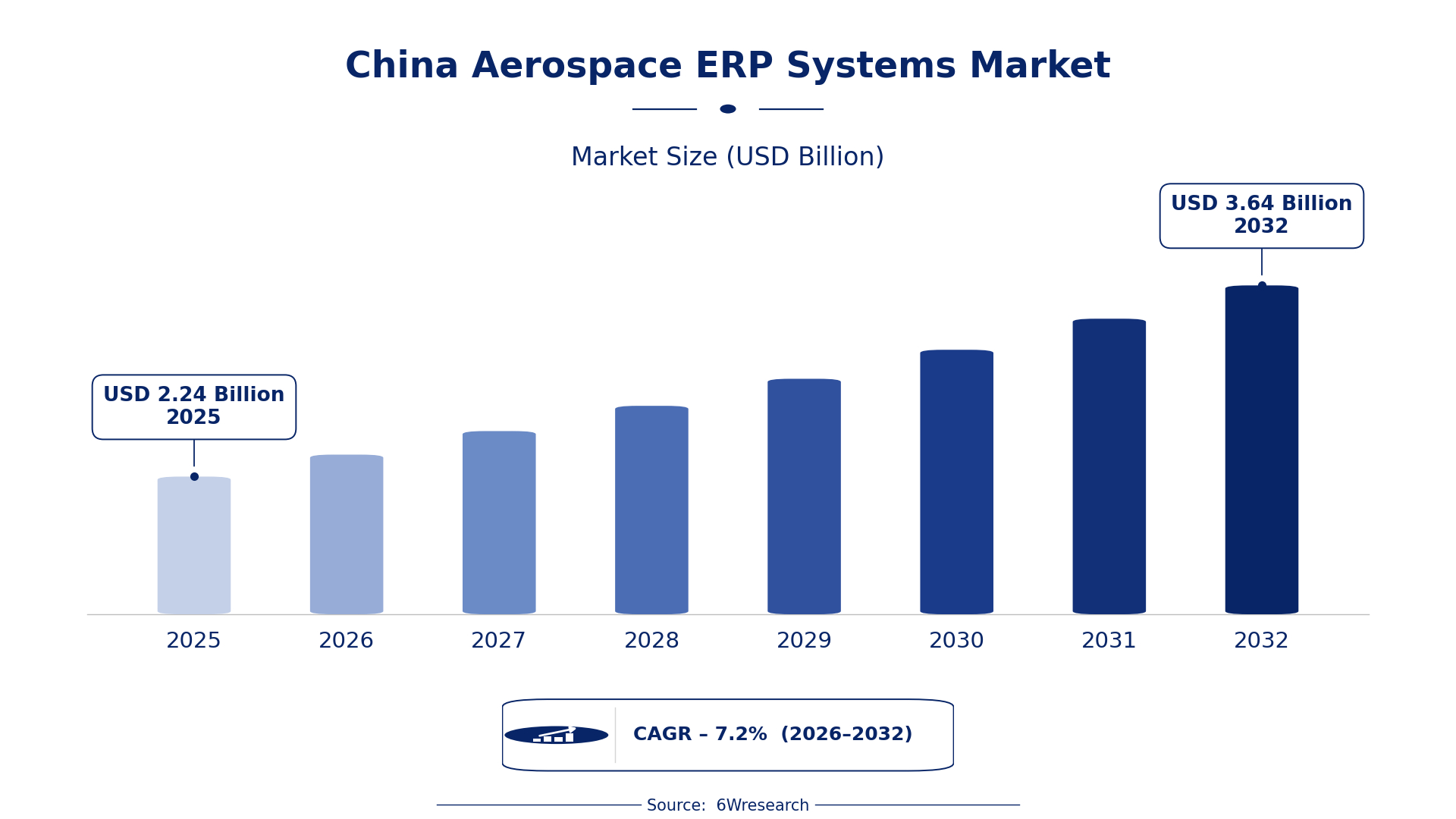
According to 6Wresearch internal database and industry insights, the China Aerospace ERP Systems Market was valued at USD 2.24 billion in 2025 and is projected to reach USD 3.64 billion by 2032, growing at a CAGR of approximately 7.2% during 2026–2032.
China Aerospace ERP Systems Market Highlights
| Report Metric | Details |
| Report Name | China Aerospace ERP Systems Market |
| Market Size 2025 | USD 2.24 billion |
| Market Size 2032 | USD 3.64 billion |
| Absolute Growth 2025–2032 | USD 1.40 billion |
| CAGR 2026–2032 | 7.2% |
| Peak Annual Growth | 9.6% in 2026 |
| Forecast Period | 2026–2032 |
| Historical Data | 2022–2025 |
| Base Year | 2025 |
| Leading ERP Type, 2025 | Manufacturing ERP (37% share) |
| Leading Deployment Type, 2025 | Cloud-Based (41% share) |
| Leading Distribution Channel, 2025 | Direct Sales (36% share) |
| Leading End User, 2025 | Aerospace Suppliers (44% share) |
| Fastest-Growing ERP Type | Supply Chain ERP (9.5% CAGR) |
| Fastest-Growing Distribution Channel | Online Platforms (9.4% CAGR) |
| Fastest-Growing End User | Aerospace Contractors (8.4% CAGR) |
| Growing Sector | Aerospace Manufacturing |
| Key End Users | Aerospace Suppliers, Aircraft Builders, Aerospace Contractors, Defense Aviation Units |
China Aerospace ERP Systems Market Year-wise Growth Rate and Key Drivers (2022–2032)
This graph illustrates the annual growth rates of the market from 2022 to 2032, highlighting a steady upward trajectory and projected market expansion over the forecast period.
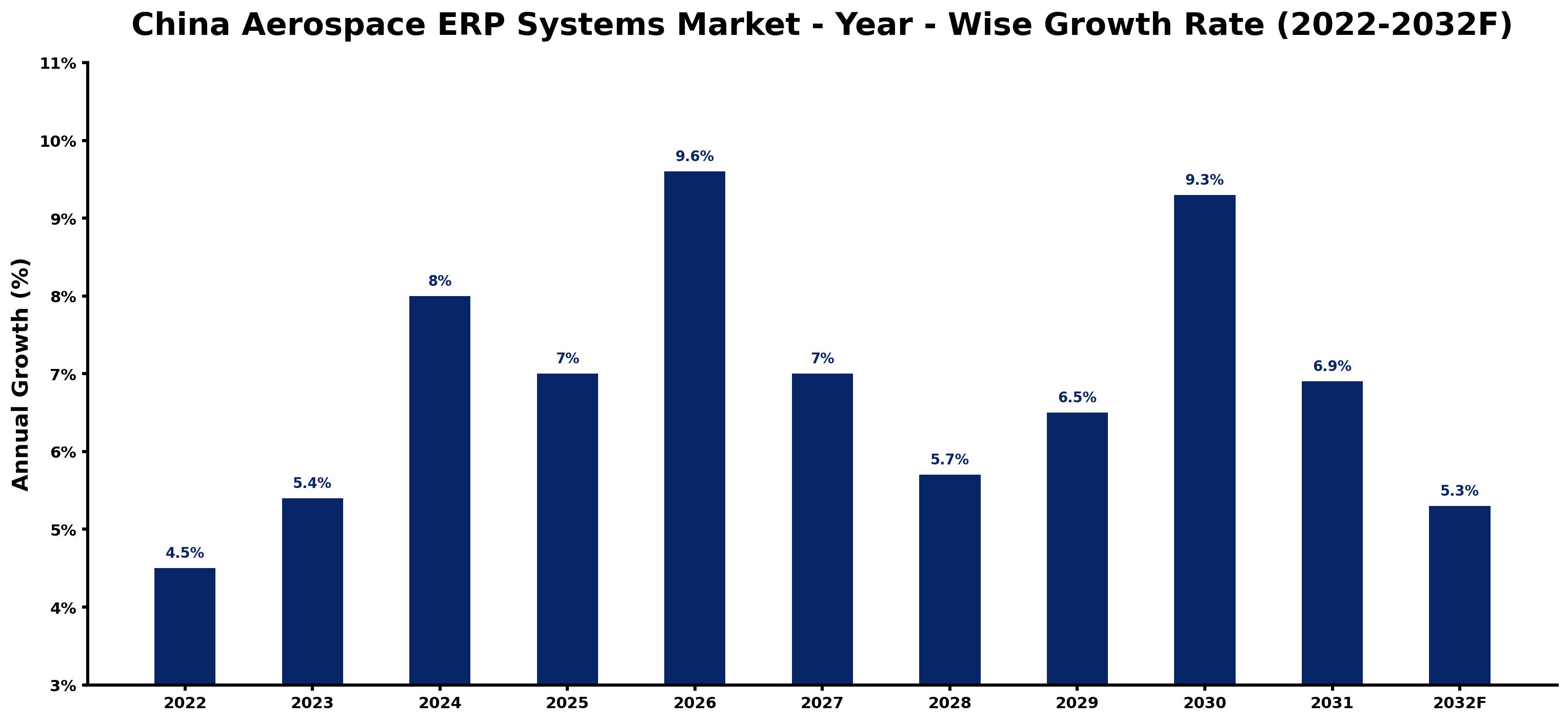
Below, each year's estimated growth is shown next to the factor that most influenced it.
| Year | Estimated Annual Growth (%) | Market Rationale |
| 2022 | 4.5 | The market experienced steady growth driven by demand from aerospace suppliers and aircraft builders. |
| 2023 | 5.4 | Investment in cloud-based solutions increased, leading to faster growth than the previous year. |
| 2024 | 8.0 | The growth rate peaked as more manufacturers adopted ERP systems for operational efficiency. |
| 2025 | 7.0 | A slight slowdown occurred as the market adjusted to previous rapid growth rates. |
| 2026 | 9.6 | The market is expected to rebound with increased investments in ERP systems, marking a new peak. |
| 2027 | 7.0 | Growth will slow as companies focus on optimising existing systems rather than new investments. |
| 2028 | 5.7 | The market is projected to continue growing, albeit at a slower pace, as adoption matures. |
| 2029 | 6.5 | A resurgence in demand is anticipated as new projects initiate across the aerospace sector. |
| 2030 | 9.3 | The market will benefit from the goal of reaching a $1 trillion aerospace industry by 2030, driving ERP adoption. |
| 2031 | 6.9 | Growth is expected to slow again as firms consolidate their ERP systems and focus on integration. |
| 2032 | 5.3 | The market is projected to stabilise as ERP systems become standard across the aerospace industry. |
Note: Market size estimations and growth projections presented in this report are based on 6Wresearch's proprietary forecasting methodology, utilizing the latest available industry data, government publications, and primary research inputs.
China Aerospace ERP Systems Market Synopsis
The China Aerospace ERP Systems Market consists of integrated software solutions that improve operational efficiency within the aerospace sector. These systems oversee finance, manufacturing, and supply chain processes while ensuring adherence to industry standards. The market is expanding due to increasing investments in domestic aerospace suppliers and aircraft manufacturers, along with government initiatives such as the 'Aerospace Industry Development Plan'. By 2030, the aerospace industry is expected to reach a market size of $1 trillion, which will boost demand for ERP solutions.
Market Dynamics Impact Analysis (2026–2032)
| Factor | Type | Impact | Primary Segment Affected |
| Growing investments in cloud-based ERP solutions | Driver | High | Cloud-Based |
| Increased demand from aerospace suppliers for operational efficiency | Driver | High | Aerospace Suppliers |
| Rising need for compliance with ISO 9001 standards | Opportunity | Medium | Manufacturing ERP |
| Expansion of the aerospace industry in Guangdong province | Opportunity | High | Aerospace Contractors |
| High costs associated with ERP system implementation | Restraint | High | On-Premises |
| Limited awareness of ERP benefits among smaller manufacturers | Restraint | Medium | HR ERP |
| Challenges in integrating legacy systems with new ERP solutions | Challenge | High | Supply Chain ERP |
| Regulatory compliance issues affecting ERP adoption | Challenge | Medium | Finance ERP |
Evaluation of Drivers in China Aerospace ERP Systems Market (2026–2032)
The main growth drivers and the segments they affect most are set out below.
| Drivers | Primary Segment Affected | Why It Matters (Evidence) |
| Increased investment in cloud-based solutions | Cloud-Based | This investment is projected to lead to a 60% adoption rate among firms by 2023. |
| Rising demand for operational efficiency | Aerospace Suppliers | Aerospace suppliers are adopting ERP systems to streamline processes and reduce costs, with a 30% increase in efficiency reported. |
| Compliance with ISO 9001 standards | Manufacturing ERP | Manufacturers are implementing ERP systems to meet quality management requirements, boosting demand by 20%. |
| Expansion of the aerospace industry in Guangdong province | Aerospace Contractors | The growth in this region is driving more companies to adopt ERP systems for project management, with a 25% increase in deployments. |
| Government initiatives promoting ERP adoption | Defense Aviation Units | Supportive policies are encouraging defense units to integrate ERP solutions for improved logistics, with funding of $500 million allocated. |
Expansion of the Aerospace ERP Systems market in China is backed by increased investment in cloud-based solutions, which is expected to lead to a 60% adoption rate among firms by 2023. The Guangdong province has seen a 25% increase in ERP system deployments as aerospace contractors seek operational efficiency. Compliance with ISO 9001 standards drives manufacturers to implement these systems, ensuring quality management. As a result, the market is experiencing growth across various segments.
Evaluation of Restraints in China Aerospace ERP Systems Market
The following restraints limit how fast demand can grow.
| Market Restraint | Primary Segment Affected | Why It Matters (Evidence) |
| High implementation costs of ERP systems | On-Premises | Many firms face budget constraints, limiting their ability to adopt costly ERP solutions. |
| Limited awareness of ERP benefits among smaller manufacturers | HR ERP | Small manufacturers often lack knowledge about how ERP can improve their operations. |
| Integration challenges with legacy systems | Supply Chain ERP | Many companies struggle to integrate new ERP solutions with existing systems, delaying adoption. |
| Regulatory compliance issues affecting ERP adoption | Finance ERP | Complex regulations can hinder the swift implementation of ERP systems in finance operations. |
| Dependence on traditional methods | Manufacturing ERP | Some manufacturers are reluctant to shift from established practices to modern ERP systems. |
China Aerospace ERP Systems Market Challenges
The China Aerospace ERP Systems market still has to solve a few problems, starting with a skills shortage. Many aerospace firms find it challenging to recruit qualified personnel for ERP implementation, which can delay projects and inflate operational costs for suppliers. Regulatory complexities also hinder progress; compliance with standards like ISO 9001 is often intricate and time-consuming, risking fines or project delays for buyers. Supply chain disruptions further exacerbate challenges, leading to increased lead times and costs that affect the delivery of ERP solutions. Buyers also face budget constraints, as the high costs of advanced ERP systems limit their ability to invest in upgrades.
Trends in the China Aerospace ERP Systems Market
Several trends are reshaping the China Aerospace ERP Systems Market; the most important are set out below.
- Shift towards Cloud-Based ERP Solutions: By 2023, approximately 60% of aerospace firms in China adopted cloud-based ERP systems, reflecting a shift towards flexibility and scalability in operations.
- Increased Focus on Quality Management Standards: The implementation of ISO 9001 as a key standard for quality management in aerospace ERP systems is driving firms to improve their operational processes and ensure compliance.
- Growing Demand for Integrated Solutions: Aerospace contractors are increasingly seeking integrated ERP solutions to manage complex projects, with a notable rise in adoption rates observed in 2023.
- Expansion in Guangdong Province: Guangdong province is becoming a major hub for aerospace manufacturing, with a 30% increase in ERP system deployments reported in 2023.
Investment Opportunities in the China Aerospace ERP Systems Market
Investors looking at the China Aerospace ERP Systems Market should consider the following areas.
- Aerospace Suppliers Seeking Efficiency: With the aerospace industry projected to reach $1 trillion by 2030, suppliers are keen to invest in ERP systems to boost operational efficiency and compliance, anticipating a 20% increase in adoption.
- Government Support for Small Manufacturers: The recent $100 million subsidy programme for small aerospace manufacturers adopting ERP systems presents a timely investment opportunity in this sector, encouraging growth among smaller firms.
- Growing Aerospace Manufacturing in Guangdong: The expanding aerospace sector in Guangdong province offers ERP providers opportunities to collaborate with local manufacturers and improve system integration, with a 25% increase in demand.
- Increasing Demand for Cloud Solutions: As the Chinese aerospace supply chain embraces cloud-based ERP solutions, a $500 million gap in technology investment presents a prime opportunity for suppliers.
Government Initiatives in the China Aerospace ERP Systems Market
The Ministry of Industry and Information Technology implements various initiatives, including the 'Smart Manufacturing Initiative', which funds ERP adoption in aerospace firms with a budget of $300 million. This initiative aims to improve operational efficiency and competitiveness in the sector. Additionally, the National Development and Reform Commission supports projects that integrate advanced technology in aerospace manufacturing, providing approvals and funding for innovative ERP solutions. By focusing on enhancing collaboration and data accuracy, these agencies promote the adoption of ERP systems across the industry.
The National Aerospace Administration oversees the '2023 ERP Integration Strategy', which aims to improve operational efficiency across defence aviation units, concentrating on cloud-based solutions. This strategy includes funding for ERP implementation and integration, ensuring that defence units can effectively manage logistics and operational processes. The State Administration for Science, Technology and Industry for National Defence also plays a role in approving ERP-related projects, further supporting the industry's growth.
Future Insight of the China Aerospace ERP Systems Market
The China Aerospace ERP Systems market will undergo transformative changes by 2032, primarily driven by advancements in technology and regulatory support. The National Development and Reform Commission's 'Aerospace Industry Development Plan' will facilitate ERP system integration across various sectors. The 2023 Aerospace Technology Innovation Programme aims to improve ERP capabilities, backed by a government allocation of $500 million for technology innovation. The Guangdong province is set to cement its position as a key hub for aerospace manufacturing, encouraging greater collaboration among suppliers and contractors.
Market Segmentation Analysis
The report offers a comprehensive study of the following market segments and their leading categories in the market.
By ERP Type – Manufacturing ERP Dominated, Supply Chain ERP Expected to Grow Fastest
According to Ravi Bhandari, Research Head at 6Wresearch, Manufacturing ERP took a 37% share of erp type in 2025, more than any other category. Manufacturing ERP holds the largest share in China's aerospace ERP systems market because it is essential for production planning and control among over 200 aerospace suppliers. The installed base of approximately 5,000 units underscores its critical role in enhancing operational efficiency within the industry. The quickest growth will come from Supply Chain ERP, forecast to expand at a CAGR of 9.5% between 2026 and 2032. Supply Chain ERP is experiencing rapid growth due to the increasing demand for improved logistics coordination in the aerospace sector. As supply chains become more complex, the adoption of these systems is vital for companies aiming to boost operational efficiency and meet industry standards. Suppliers should focus on Manufacturing ERP solutions while also addressing the growing interest in Supply Chain ERP to capture emerging market opportunities.
By Deployment Type – Cloud-Based Dominated and Is Expected to Record the Fastest Growth
In 2025, Cloud-Based led the deployment type split with a 41% share. Cloud-Based ERP systems dominate the market share as they provide the flexibility and scalability essential for modern aerospace operations. This preference is particularly evident among manufacturers seeking to enhance collaboration and efficiency in their processes. Cloud-Based is also forecast to expand faster than any other category, at a CAGR of 8.8% over 2026–2032. The Cloud-Based segment is also the fastest-growing, driven by its capacity to deliver real-time data access and seamless integration capabilities. As aerospace companies strive to modernise their operations, the demand for cloud solutions will continue to rise, reinforcing its market position. This indicates that suppliers should prioritise the development and marketing of cloud-based ERP solutions to meet the increasing demand in the aerospace sector.
By Distribution Channel – Direct Sales Dominated, Online Platforms Expected to Grow Fastest
With a 36% revenue share in 2025, Direct Sales was the largest distribution channel category. Direct Sales commands the largest share in the distribution of aerospace ERP systems, as it remains the primary method for selling these solutions. This approach facilitates tailored interactions with clients, ensuring their specific needs are effectively addressed. Online Platforms are projected to grow fastest, at a CAGR of 9.4% during 2026–2032. Online Platforms are rapidly growing as a distribution channel, primarily serving as a resource for information gathering rather than direct sales. The shift towards digital engagement is prompting suppliers to enhance their online presence to attract potential buyers effectively. Suppliers should consider strengthening their online platforms to complement direct sales efforts and engage informed buyers more effectively.
By End User – Aerospace Suppliers Dominated, Aerospace Contractors Expected to Grow Fastest
Aerospace Suppliers held a 44% share of the China Aerospace ERP Systems Market by end user in 2025. Aerospace Suppliers represent the largest user group of ERP systems, relying on these solutions to enhance operational efficiency and manage complex production processes. Their significant presence in the market highlights the importance of tailored ERP solutions for their specific operational needs. Over 2026–2032, Aerospace Contractors are expected to post the fastest growth, at a CAGR of 8.4%. Aerospace Contractors are the fastest-growing user segment, utilising ERP systems for effective project management and compliance with industry standards. As demand for aerospace projects increases, contractors are increasingly adopting these systems to streamline their operations. This trend suggests that suppliers should focus on developing ERP solutions that cater specifically to the needs of aerospace contractors.
Key Attractiveness of the Report
- 10 Years of Market Numbers
- Historical Data Starting from 2022 to 2025
- Base Year 2025
- Forecast Data until 2032
- Key Performance Indicators Impacting the Market
- Major Upcoming Developments and Projects
Key Highlights of the Report:
- China Aerospace ERP Systems Market Outlook
- Market Size of China Aerospace ERP Systems Market, 2025
- Forecast of China Aerospace ERP Systems Market, 2032
- Historical Data and Forecast of China Aerospace ERP Systems Revenues & Volume for the Period 2022 - 2032F
- China Aerospace ERP Systems Market Trend Evolution
- China Aerospace ERP Systems Market Drivers and Challenges
- China Aerospace ERP Systems Price Trends
- China Aerospace ERP Systems Porter's Five Forces
- China Aerospace ERP Systems Industry Life Cycle
- Historical Data and Forecast of China Aerospace ERP Systems Market Revenues & Volume By ERP Type for the Period 2022 - 2032F
- Historical Data and Forecast of China Aerospace ERP Systems Market Revenues & Volume By Finance ERP for the Period 2022 - 2032F
- Historical Data and Forecast of China Aerospace ERP Systems Market Revenues & Volume By Manufacturing ERP for the Period 2022 - 2032F
- Historical Data and Forecast of China Aerospace ERP Systems Market Revenues & Volume By Supply Chain ERP for the Period 2022 - 2032F
- Historical Data and Forecast of China Aerospace ERP Systems Market Revenues & Volume By HR ERP for the Period 2022 - 2032F
- Historical Data and Forecast of China Aerospace ERP Systems Market Revenues & Volume By Deployment Type for the Period 2022 - 2032F
- Historical Data and Forecast of China Aerospace ERP Systems Market Revenues & Volume By Cloud-Based for the Period 2022 - 2032F
- Historical Data and Forecast of China Aerospace ERP Systems Market Revenues & Volume By On-Premises for the Period 2022 - 2032F
- Historical Data and Forecast of China Aerospace ERP Systems Market Revenues & Volume By Hybrid for the Period 2022 - 2032F
- Historical Data and Forecast of China Aerospace ERP Systems Market Revenues & Volume By SaaS for the Period 2022 - 2032F
- Historical Data and Forecast of China Aerospace ERP Systems Market Revenues & Volume By Distribution Channel for the Period 2022 - 2032F
- Historical Data and Forecast of China Aerospace ERP Systems Market Revenues & Volume By Direct Sales for the Period 2022 - 2032F
- Historical Data and Forecast of China Aerospace ERP Systems Market Revenues & Volume By Online Platforms for the Period 2022 - 2032F
- Historical Data and Forecast of China Aerospace ERP Systems Market Revenues & Volume By Industrial Suppliers for the Period 2022 - 2032F
- Historical Data and Forecast of China Aerospace ERP Systems Market Revenues & Volume By Specialty Stores for the Period 2022 - 2032F
- Historical Data and Forecast of China Aerospace ERP Systems Market Revenues & Volume By End User for the Period 2022 - 2032F
- Historical Data and Forecast of China Aerospace ERP Systems Market Revenues & Volume By Aerospace Suppliers for the Period 2022 - 2032F
- Historical Data and Forecast of China Aerospace ERP Systems Market Revenues & Volume By Aircraft Builders for the Period 2022 - 2032F
- Historical Data and Forecast of China Aerospace ERP Systems Market Revenues & Volume By Aerospace Contractors for the Period 2022 - 2032F
- Historical Data and Forecast of China Aerospace ERP Systems Market Revenues & Volume By Defense Aviation Units for the Period 2022 - 2032F
- China Aerospace ERP Systems Import Export Trade Statistics
- Market Opportunity Assessment By ERP Type
- Market Opportunity Assessment By Deployment Type
- Market Opportunity Assessment By Distribution Channel
- Market Opportunity Assessment By End User
- China Aerospace ERP Systems Top Companies Market Share
- China Aerospace ERP Systems Competitive Benchmarking By Technical and Operational Parameters
- China Aerospace ERP Systems Company Profiles
- China Aerospace ERP Systems Key Strategic Recommendations
Market Covered
This report examines the market across the segments below.
By ERP Type
- Finance ERP
- Manufacturing ERP
- Supply Chain ERP
- HR ERP
By Deployment Type
- Cloud-Based
- On-Premises
- Hybrid
- SaaS
By Distribution Channel
- Direct Sales
- Online Platforms
- Industrial Suppliers
- Specialty Stores
By End User
- Aerospace Suppliers
- Aircraft Builders
- Aerospace Contractors
- Defense Aviation Units































