China Aerospace Sensors Market Size & Growth Rate
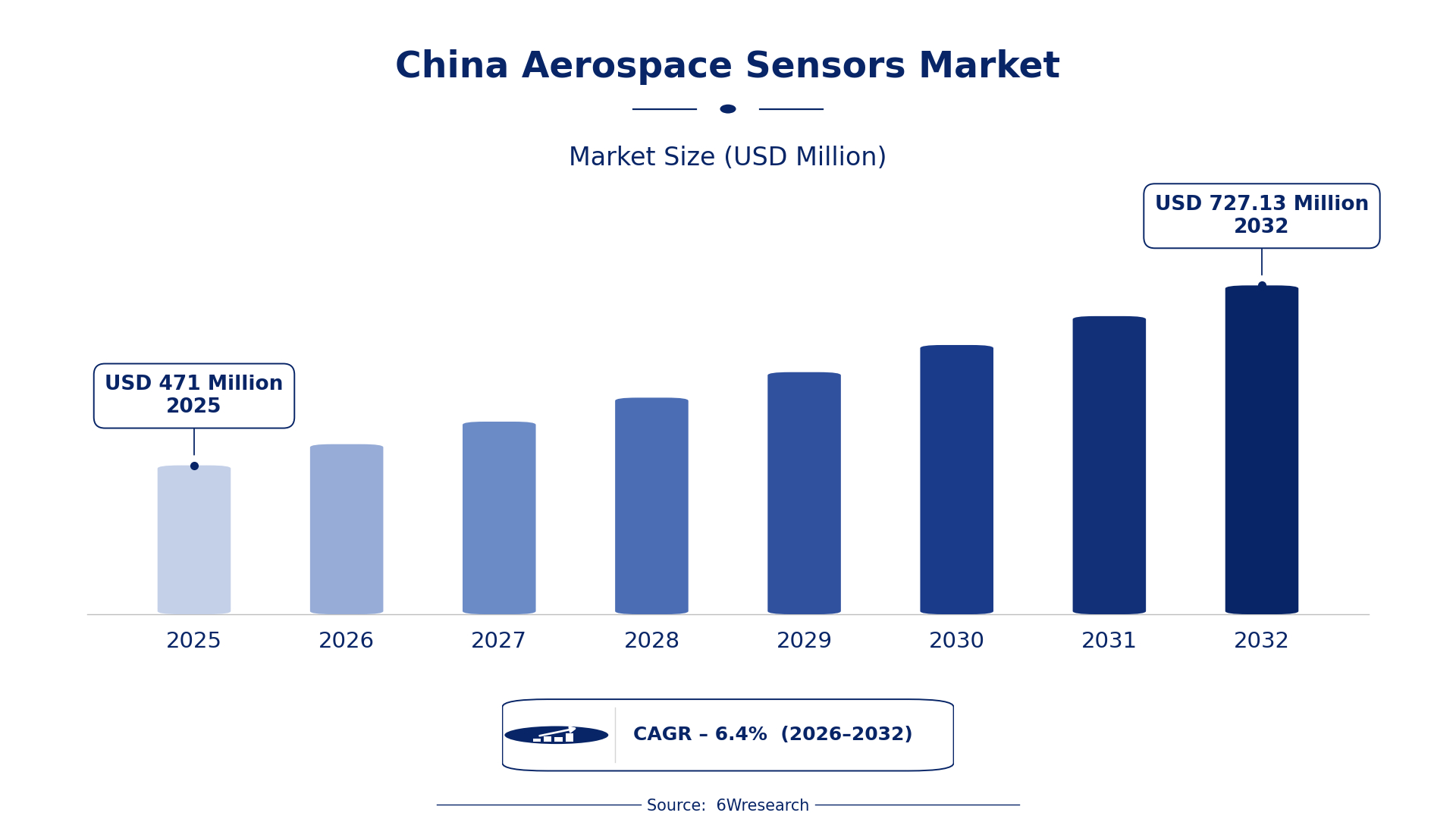
According to 6Wresearch internal database and industry insights, the China Aerospace Sensors Market was valued at USD 471.0 million in 2025 and is projected to reach USD 727.13 million by 2032, growing at a CAGR of approximately 6.4% during 2026–2032.
China Aerospace Sensors Market Highlights
| Report Metric | Details |
| Report Name | China Aerospace Sensors Market |
| Market Size 2025 | USD 471.0 million |
| Market Size 2032 | USD 727.13 million |
| Absolute Growth 2025–2032 | USD 256.13 million |
| CAGR 2026–2032 | 6.4% |
| Peak Annual Growth | 8.1% in 2027 |
| Forecast Period | 2026–2032 |
| Historical Data | 2022–2025 |
| Base Year | 2025 |
| Leading Sensor Type, 2025 | Pressure Sensors (41% share) |
| Leading Application Area, 2025 | Engine Monitoring (50% share) |
| Leading Distribution Channel, 2025 | Direct Sales (53% share) |
| Leading End User, 2025 | Military Jets OEMs (48% share) |
| Fastest-Growing Sensor Type | Temperature Sensors (8.3% CAGR) |
| Fastest-Growing Application Area | Flight Data Logging (7.9% CAGR) |
| Fastest-Growing Distribution Channel | Industrial Suppliers (8.0% CAGR) |
| Fastest-Growing End User | Aerospace Avionics Firms (7.5% CAGR) |
| Growing Sector | Flight Data Logging |
| Key End Users | Engine Monitoring, Hydraulic Systems, Flight Data Logging, Landing Gear |
China Aerospace Sensors Market Year-wise Growth Rate and Key Drivers (2022–2032)
This graph illustrates the annual growth rates of the market from 2022 to 2032, highlighting a steady upward trajectory and projected market expansion over the forecast period.
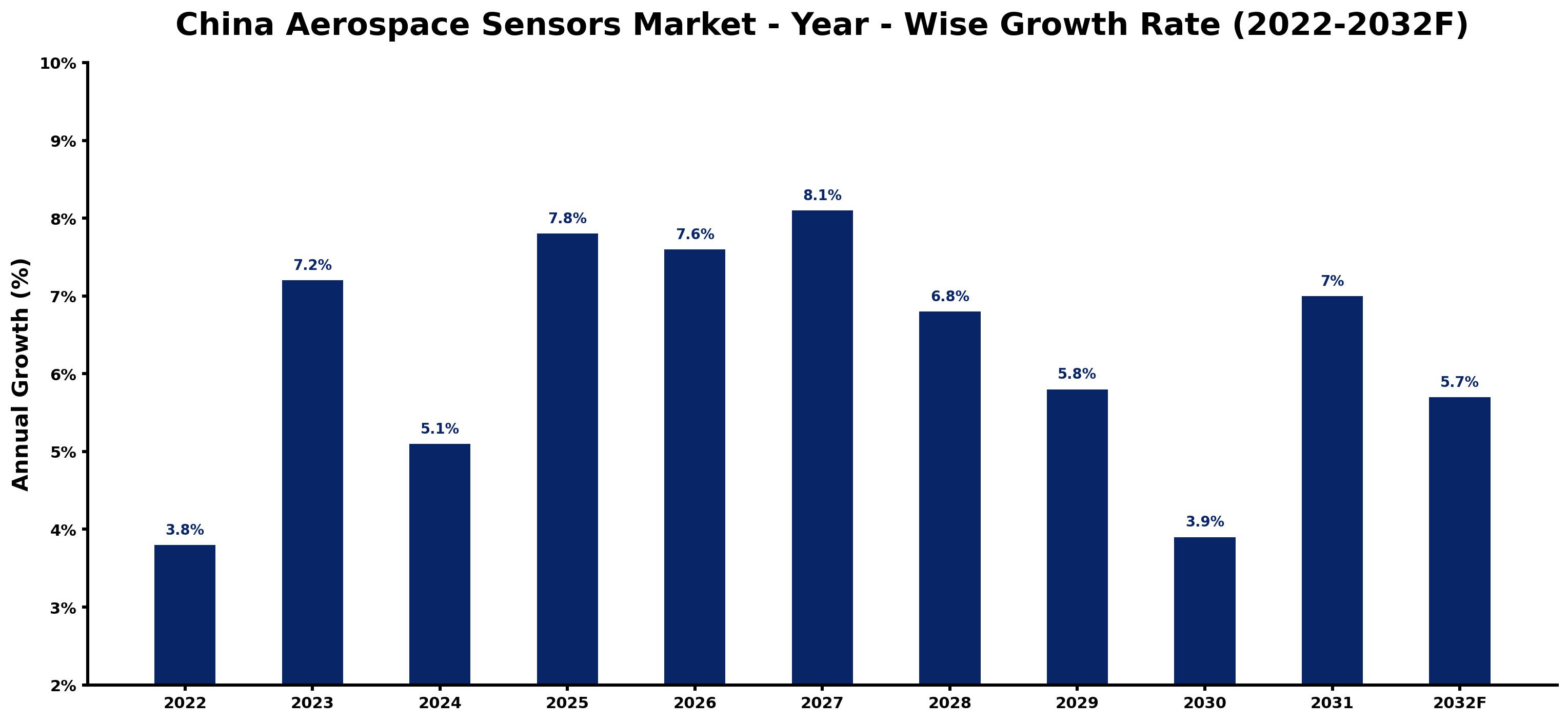
The following table presents the estimated annual growth rate for each year together with the principal factor influencing market performance.
| Year | Estimated Annual Growth (%) | Market Rationale |
| 2022 | 3.8 | The market experienced steady demand from aircraft maintenance firms and military jets OEMs. |
| 2023 | 7.2 | Growth accelerated due to increased production of commercial aircraft and military jets. |
| 2024 | 5.1 | Demand growth slowed as the market adjusted to previous high levels of activity. |
| 2025 | 7.8 | A surge in engine monitoring needs drove higher sensor demand from OEMs. |
| 2026 | 7.6 | The market growth rate decreased slightly as manufacturers faced supply chain challenges. |
| 2027 | 8.1 | A peak in growth occurred with heightened investments in aerospace technology. |
| 2028 | 6.8 | The market continued to grow, but at a slower pace as upgrades became essential. |
| 2029 | 5.8 | Demand moderated as the market adjusted to the previous year's peak growth. |
| 2030 | 3.9 | Growth slowed further as the focus shifted to efficiency and cost management. |
| 2031 | 7.0 | An increase in military spending revitalised demand for aerospace sensors. |
| 2032 | 5.7 | The market is expected to stabilise with consistent demand from aviation sectors. |
Note: Market size estimations and growth projections presented in this report are based on 6Wresearch's proprietary forecasting methodology, utilizing the latest available industry data, government publications, and primary research inputs.
China Aerospace Sensors Market Synopsis
These sensors play a critical role in monitoring aircraft systems, ensuring safety, and improving performance. The market is expanding due to substantial investments in aviation technology and the rising production of both commercial and military aircraft. In 2023, the National Aerospace Technology Innovation Program received a budget of $500 million, further driving demand. With over 200 registered aircraft maintenance firms, the domestic market is growing swiftly.
Market Dynamics Impact Analysis (2026–2032)
| Factor | Type | Impact | Primary Segment Affected |
| Increased production of military jets drives demand for advanced sensors. | Driver | High | Military Jets OEMs |
| Growing focus on engine monitoring enhances demand for temperature sensors. | Driver | High | Engine Monitoring |
| Aerospace avionics firms are seeking advanced sensors for new systems. | Opportunity | Medium | Aerospace Avionics Firms |
| Investment in aerospace technology development creates new market openings. | Opportunity | High | Aircraft Maintenance Firms |
| Supply chain disruptions impact the availability of critical components. | Restraint | High | Pressure Sensors |
| High manufacturing costs hinder the affordability of advanced sensors. | Restraint | Medium | Temperature Sensors |
| The Aerospace Sensors Market in China faces challenges from regulatory compliance. | Challenge | High | Position Sensors |
| Technological advancements require continuous investment from manufacturers. | Challenge | Medium | Accelerometers |
Evaluation of Drivers in China Aerospace Sensors Market (2026–2032)
Key forces behind demand, with the segment each one moves most, are listed below.
| Drivers | Primary Segment Affected | Why It Matters (Evidence) |
| Increased military spending on advanced aircraft. | Military Jets OEMs | This leads to higher purchases of aerospace sensors for improved capabilities. |
| Growing demand for engine monitoring solutions. | Engine Monitoring | This drives the need for temperature sensors to prevent overheating. |
| Expansion of aerospace avionics systems. | Aerospace Avionics Firms | This creates a demand for precise sensors to improve system performance. |
| Investment in aerospace technology development. | Aircraft Maintenance Firms | This encourages the adoption of modern sensors for safety and efficiency. |
| Rising production rates of commercial aircraft. | Pressure Sensors | This increases the need for sensors to monitor hydraulic systems. |
Growth across the Aerospace Sensors market in China is anchored in rising military spending, expanding aerospace avionics systems, and increasing production of commercial aircraft. In 2022, China manufactured approximately 300 commercial aircraft, leading to heightened demand for various sensors. The focus on engine monitoring solutions has intensified, particularly for temperature sensors, which are essential for preventing overheating. Investment in aerospace technology development, supported by a $500 million budget in 2023, has prompted aircraft maintenance firms to adopt advanced sensors. This combination of factors is driving growth in sensor purchases across the sector.
Evaluation of Restraints in China Aerospace Sensors Market
The main factors holding the market back are set out below.
| Market Restraint | Primary Segment Affected | Why It Matters (Evidence) |
| Supply chain disruptions affecting sensor availability. | Pressure Sensors | These disruptions lead to delays in production and increased costs for manufacturers. |
| High manufacturing costs of advanced sensors. | Temperature Sensors | This limits affordability for smaller aerospace firms, impacting their purchasing decisions. |
| Regulatory compliance challenges for sensor manufacturers. | Position Sensors | Strict standards can delay product launches and increase operational costs. |
| Technological advancements requiring continuous investment. | Accelerometers | This creates financial pressure on manufacturers to keep up with innovations. |
| Limited availability of skilled workforce in aerospace technology. | Engine Monitoring | This hampers the ability to implement new sensor technologies efficiently. |
China Aerospace Sensors Market Challenges
In the China Aerospace Sensors Market, outdated technology presents a notable challenge, as many firms depend on legacy systems that limit efficiency. This issue stems from the rapid pace of technological advancements, leading to a 20% performance lag for manufacturers compared to global standards. Skills shortages exacerbate this problem, with over 30% of aerospace firms struggling to find qualified engineers, which delays project timelines and raises training costs for employers. Buyers are also facing increased compliance costs due to stringent regulations from the Civil Aviation Administration of China, resulting in an average 15% rise in procurement expenses for commercial operators.
Trends in the China Aerospace Sensors Market
The trends below show where the China Aerospace Sensors Market is heading.
- Shift from Traditional to Smart Sensors: Since 2021, the aerospace industry has been moving towards smart sensors that provide real-time data analytics. The National Aerospace Technology Innovation Program supports this transition, with a budget of $500 million in 2023, improving operational efficiency.
- Increase in Engine Monitoring Technologies: The demand for advanced engine monitoring technologies has surged, particularly since 2022. This trend is evident in the growing adoption of temperature sensors, which are critical for preventing overheating in aircraft engines.
- Focus on Safety Standards: In 2020, the Civil Aviation Administration of China launched the Aviation Safety Enhancement Program, raising sensor standards. This initiative has led to increased investments in safety compliance technologies within the aerospace sector.
- Emergence of Aerospace Industrial Parks: Since 2021, several aerospace industrial parks have been established in regions like Jiangsu and Guangdong. These parks are expected to enhance local production capabilities, with over 1,000 registered aerospace firms contributing to the market.
Investment Opportunities in the China Aerospace Sensors Market
Below are the investment opportunities with the strongest case in the China Aerospace Sensors Market.
- Military Jets OEMs Seeking Advanced Sensors: With the Chinese military investing heavily in advanced jets, the demand for sophisticated sensors is rising. This presents an opportunity for suppliers to engage with military contractors, particularly in the Beijing-Tianjin-Hebei region.
- Growing Need for Engine Monitoring Solutions: The average age of China's commercial aircraft fleet is around 6 years, indicating a need for sensor upgrades. Suppliers can target aircraft maintenance firms to provide essential monitoring technologies.
- Investment in Aerospace Technology Development: The Ministry of Industry and Information Technology's 2021 program aims to boost aerospace technology. Collaborating with local firms can facilitate entry into this expanding market, particularly in Jiangsu province.
- Expansion of Aerospace Avionics Firms: Aerospace avionics firms are increasingly adopting advanced sensors for new systems. This trend creates opportunities for suppliers to partner with these firms, especially in the growing Guangdong industrial hub.
Government Initiatives in the China Aerospace Sensors Market
The 'Aerospace Industry Development Plan' launched by the Ministry of Industry and Information Technology in 2022 aims to improve technological capabilities in the sector. This plan encourages manufacturers to innovate and comply with updated standards, driving demand for advanced aerospace sensors. Additionally, the program focuses on increasing domestic production rates, targeting a 70% production rate by 2025, which will further stimulate sensor purchases.
The Civil Aviation Administration of China oversees the 'Aviation Safety Enhancement Program', which funds initiatives to improve sensor standards and monitoring. This program supports projects that ensure compliance with safety regulations and facilitates smoother market entry for innovative products. The National Development and Reform Commission also plays a critical role by approving funding for R&D initiatives, enabling advancements in sensor technology.
Future Insight of the China Aerospace Sensors Market
The China Aerospace Sensors Market is set to transform by 2032, driven by a strategic plan aimed at increasing domestic aircraft production rates to 70% by 2025. The National Aerospace Technology Innovation Program, with a budget of $500 million, will propel research and development initiatives, enhancing sensor technology. The establishment of aerospace industrial parks in Jiangsu and Guangdong will facilitate collaboration among firms, fostering innovation. As the average age of China's commercial aircraft fleet approaches 6 years, the demand for sensor upgrades will surge, ensuring improved safety and performance in aviation.
Market Segmentation Analysis
The analysis below covers each segmentation, its leading category in 2025 and its fastest-growing category through 2032.
By Sensor Type – Pressure Sensors Dominated, Temperature Sensors Expected to Grow Fastest
According to Ravi Bhandari, Research Head at 6Wresearch, Pressure Sensors held a 41% share of the China Aerospace Sensors Market by sensor type in 2025. Pressure sensors dominate the market share because they are vital for monitoring hydraulic systems in aircraft. With over 200 registered aircraft maintenance firms in China, the demand for dependable pressure sensors is substantial. The quickest growth will come from Temperature Sensors, forecast to expand at a CAGR of 8.3% between 2026 and 2032. Temperature sensors are growing rapidly due to their critical function in engine monitoring to prevent overheating. The average age of China's commercial aircraft fleet, around 6 years, highlights the urgent need for reliable temperature sensors. Suppliers should prioritise the development of high-quality temperature sensors to address the increasing safety requirements in the aerospace industry.
By Application Area – Engine Monitoring Dominated, Flight Data Logging Expected to Grow Fastest
With a 50% revenue share in 2025, Engine Monitoring was the largest application area category. Engine monitoring commands the largest market share due to its critical role in ensuring aircraft performance and safety. With over 200 registered aircraft maintenance firms, the demand for effective engine monitoring systems is underscored by ongoing investments in aviation technology. Flight Data Logging is set to record the highest CAGR in this split, 7.9% over 2026–2032. Flight data logging is experiencing the fastest growth as it is vital for capturing and analysing flight parameters. The increasing emphasis on aviation safety and regulatory compliance is propelling the demand for advanced flight data logging systems. Suppliers should focus on enhancing flight data logging technologies to meet the growing safety and efficiency demands of buyers.
By Distribution Channel – Direct Sales Dominated, Industrial Suppliers Expected to Grow Fastest
Direct Sales accounted for a 53% market share by distribution channel in 2025. Direct sales dominate the market share as they are the primary method for acquiring aerospace sensors. This channel ensures that manufacturers can provide tailored solutions directly to customers in the aerospace industry. Industrial Suppliers are projected to grow fastest, at a CAGR of 8.0% during 2026–2032. Industrial suppliers are the fastest-growing distribution channel, serving as a major source for aerospace components and sensors. The increasing complexity of aerospace systems is driving demand for reliable industrial suppliers. Suppliers should strengthen relationships with industrial suppliers to ensure wider distribution of their aerospace sensors.
By End User – Military Jets OEMs Dominated, Aerospace Avionics Firms Expected to Grow Fastest
Military Jets OEMs took a 48% share of end user in 2025, more than any other category. Military jets OEMs command the largest market share as they are directly involved in manufacturing and integrating sensors into advanced military aircraft. The heavy investments in military jets by the Chinese government further solidify this segment's dominance. Over 2026–2032, Aerospace Avionics Firms are expected to post the fastest growth, at a CAGR of 7.5%. Aerospace avionics firms are the fastest-growing end users, as they develop systems that rely on accurate sensor data for functionality. The modernization efforts in China's aerospace sector are propelling this growth. Suppliers should target aerospace avionics firms to capitalise on the increasing demand for advanced sensor technologies.
Key Attractiveness of the Report
- 10 Years of Market Numbers
- Historical Data Starting from 2022 to 2025
- Base Year 2025
- Forecast Data until 2032
- Key Performance Indicators Impacting the Market
- Major Upcoming Developments and Projects
Key Highlights of the Report:
- China Aerospace Sensors Market Outlook
- Market Size of China Aerospace Sensors Market, 2025
- Forecast of China Aerospace Sensors Market, 2032
- Historical Data and Forecast of China Aerospace Sensors Revenues & Volume for the Period 2022 - 2032F
- China Aerospace Sensors Market Trend Evolution
- China Aerospace Sensors Market Drivers and Challenges
- China Aerospace Sensors Price Trends
- China Aerospace Sensors Porter's Five Forces
- China Aerospace Sensors Industry Life Cycle
- Historical Data and Forecast of China Aerospace Sensors Market Revenues & Volume By Sensor Type for the Period 2022 - 2032F
- Historical Data and Forecast of China Aerospace Sensors Market Revenues & Volume By Pressure Sensors for the Period 2022 - 2032F
- Historical Data and Forecast of China Aerospace Sensors Market Revenues & Volume By Temperature Sensors for the Period 2022 - 2032F
- Historical Data and Forecast of China Aerospace Sensors Market Revenues & Volume By Position Sensors for the Period 2022 - 2032F
- Historical Data and Forecast of China Aerospace Sensors Market Revenues & Volume By Accelerometers for the Period 2022 - 2032F
- Historical Data and Forecast of China Aerospace Sensors Market Revenues & Volume By Application Area for the Period 2022 - 2032F
- Historical Data and Forecast of China Aerospace Sensors Market Revenues & Volume By Hydraulic Systems for the Period 2022 - 2032F
- Historical Data and Forecast of China Aerospace Sensors Market Revenues & Volume By Engine Monitoring for the Period 2022 - 2032F
- Historical Data and Forecast of China Aerospace Sensors Market Revenues & Volume By Landing Gear for the Period 2022 - 2032F
- Historical Data and Forecast of China Aerospace Sensors Market Revenues & Volume By Flight Data Logging for the Period 2022 - 2032F
- Historical Data and Forecast of China Aerospace Sensors Market Revenues & Volume By Distribution Channel for the Period 2022 - 2032F
- Historical Data and Forecast of China Aerospace Sensors Market Revenues & Volume By Direct Sales for the Period 2022 - 2032F
- Historical Data and Forecast of China Aerospace Sensors Market Revenues & Volume By Online Platforms for the Period 2022 - 2032F
- Historical Data and Forecast of China Aerospace Sensors Market Revenues & Volume By Industrial Suppliers for the Period 2022 - 2032F
- Historical Data and Forecast of China Aerospace Sensors Market Revenues & Volume By Specialty Stores for the Period 2022 - 2032F
- Historical Data and Forecast of China Aerospace Sensors Market Revenues & Volume By End User for the Period 2022 - 2032F
- Historical Data and Forecast of China Aerospace Sensors Market Revenues & Volume By Aircraft Maintenance Firms for the Period 2022 - 2032F
- Historical Data and Forecast of China Aerospace Sensors Market Revenues & Volume By Military Jets OEMs for the Period 2022 - 2032F
- Historical Data and Forecast of China Aerospace Sensors Market Revenues & Volume By Helicopter Builders for the Period 2022 - 2032F
- Historical Data and Forecast of China Aerospace Sensors Market Revenues & Volume By Aerospace Avionics Firms for the Period 2022 - 2032F
- China Aerospace Sensors Import Export Trade Statistics
- Market Opportunity Assessment By Sensor Type
- Market Opportunity Assessment By Application Area
- Market Opportunity Assessment By Distribution Channel
- Market Opportunity Assessment By End User
- China Aerospace Sensors Top Companies Market Share
- China Aerospace Sensors Competitive Benchmarking By Technical and Operational Parameters
- China Aerospace Sensors Company Profiles
- China Aerospace Sensors Key Strategic Recommendations
Market Covered
Segments analysed in this report are listed below.
By Sensor Type
- Pressure Sensors
- Temperature Sensors
- Position Sensors
- Accelerometers
By Application Area
- Hydraulic Systems
- Engine Monitoring
- Landing Gear
- Flight Data Logging
By Distribution Channel
- Direct Sales
- Online Platforms
- Industrial Suppliers
- Specialty Stores
By End User
- Aircraft Maintenance Firms
- Military Jets OEMs
- Helicopter Builders
- Aerospace Avionics Firms































