China Aircraft Missile Market Size & Growth Rate
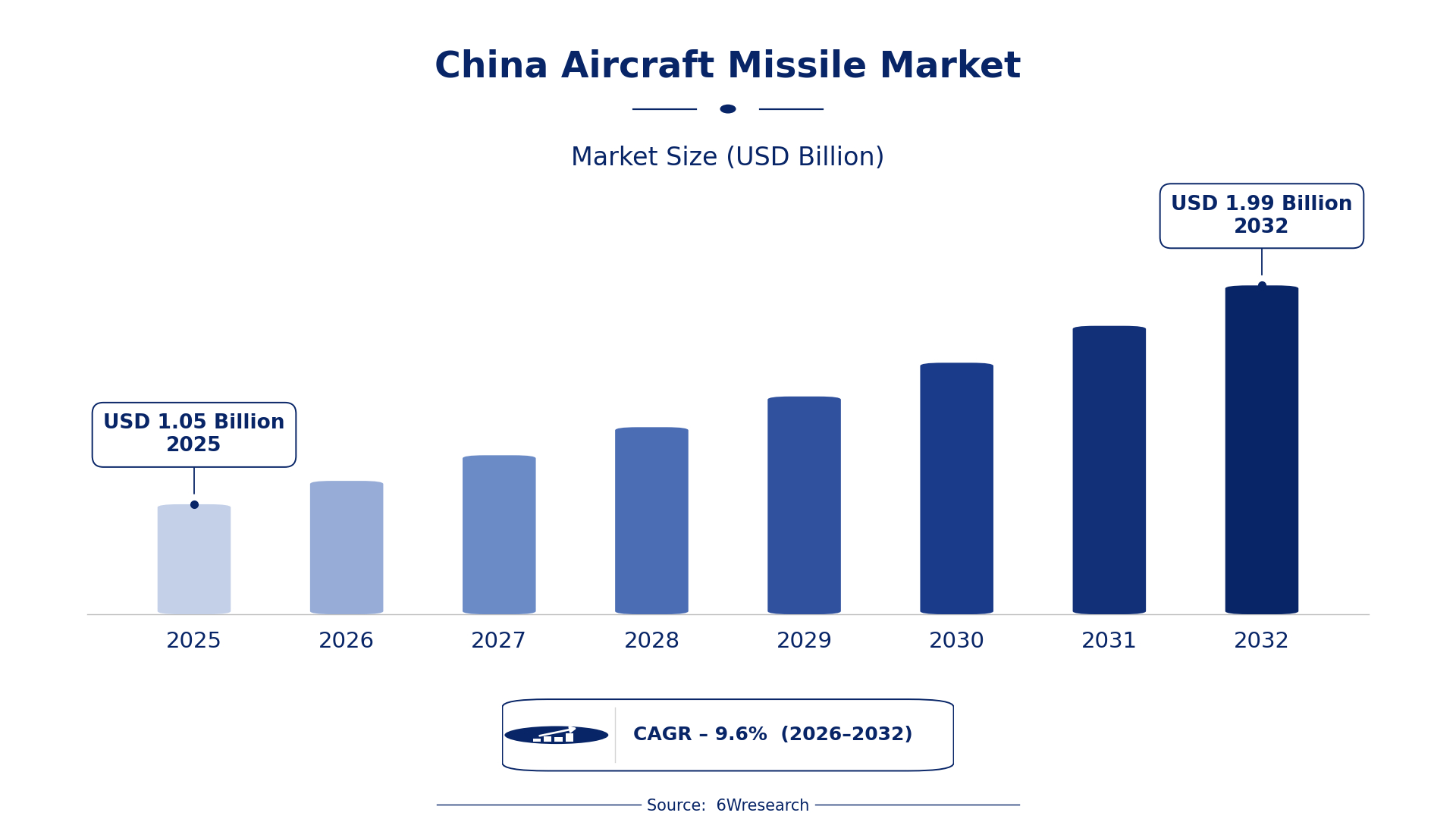
According to 6Wresearch internal database and industry insights, the China Aircraft Missile Market was valued at USD 1.05 billion in 2025 and is projected to reach USD 1.99 billion by 2032, growing at a CAGR of approximately 9.6% during 2026–2032.
China Aircraft Missile Market Highlights
| Report Metric | Details |
| Report Name | China Aircraft Missile Market |
| Market Size 2025 | USD 1.05 billion |
| Market Size 2032 | USD 1.99 billion |
| Absolute Growth 2025–2032 | USD 0.94 billion |
| CAGR 2026–2032 | 9.6% |
| Peak Annual Growth | 11.7% in 2027 |
| Forecast Period | 2026–2032 |
| Historical Data | 2022–2025 |
| Base Year | 2025 |
| Leading Missile Type, 2025 | Air-to-Air Missiles (44% share) |
| Leading Propulsion Type, 2025 | Solid Fuel (36% share) |
| Leading Distribution Channel, 2025 | Government Contracts (38% share) |
| Leading End User, 2025 | Defense Forces (48% share) |
| Fastest-Growing Missile Type | Tactical Missiles (11.6% CAGR) |
| Fastest-Growing Distribution Channel | Direct Sales (10.7% CAGR) |
| Fastest-Growing End User | Fighter Jets (11.8% CAGR) |
| Growing Sector | Defense |
| Key End Users | Defense Forces, Military Vendors, Government Agencies |
China Aircraft Missile Market Year-wise Growth Rate and Key Drivers (2022–2032)
This graph illustrates the annual growth rates of the market from 2022 to 2032, highlighting a steady upward trajectory and projected market expansion over the forecast period.
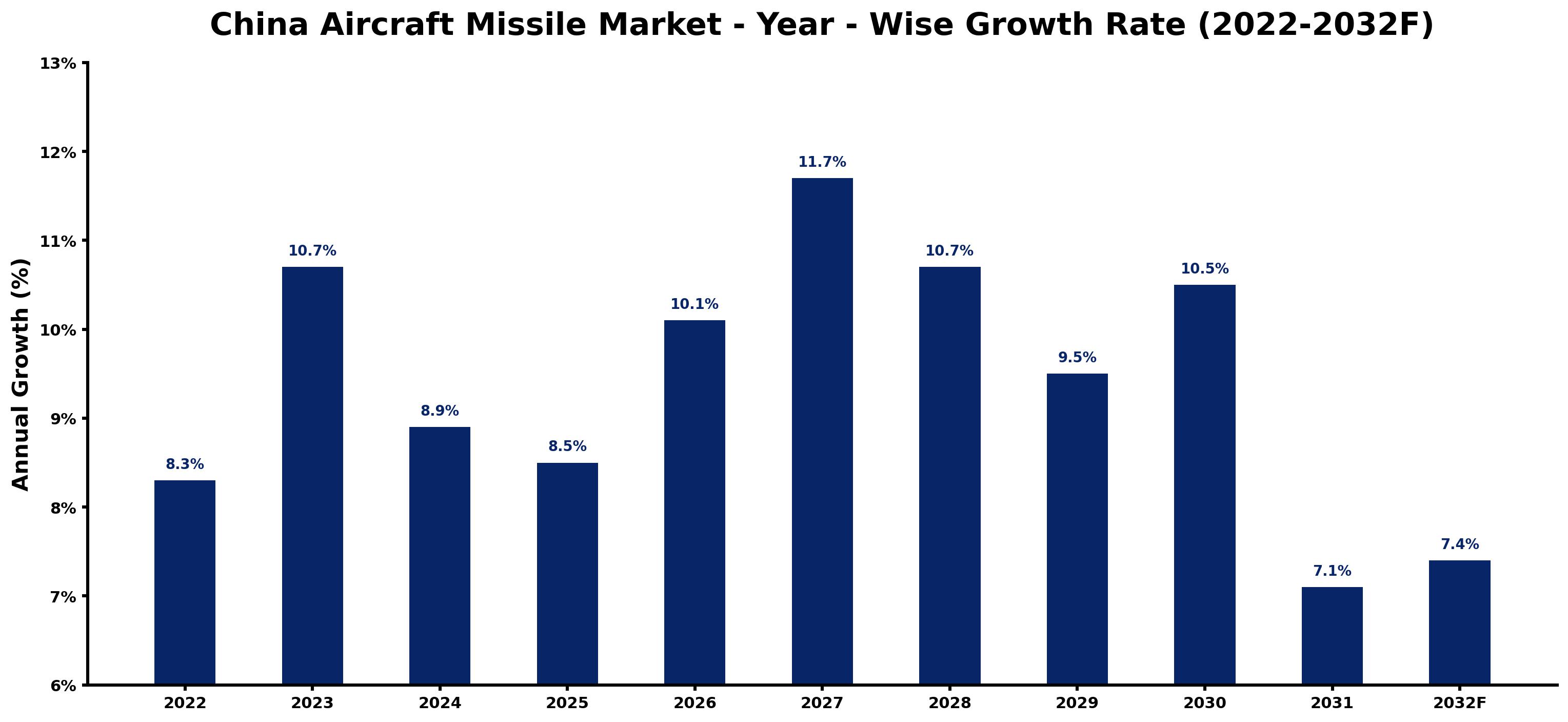
The following table presents the estimated annual growth rate for each year together with the principal factor influencing market performance.
| Year | Estimated Annual Growth (%) | Market Rationale |
| 2022 | 8.3 | The defense budget allocated significant funds for military modernization, boosting missile development. |
| 2023 | 10.7 | Increased focus on advanced missile technology led to higher investments in R&D. |
| 2024 | 8.9 | Regional security concerns prompted a rise in demand for tactical missiles. |
| 2025 | 8.5 | Continued military engagements maintained steady demand for missile systems. |
| 2026 | 10.1 | The launch of new missile programs stimulated growth in the sector. |
| 2027 | 11.7 | Increased funding for missile technology enhanced production capabilities. |
| 2028 | 10.7 | Demand for tactical missiles remained strong due to ongoing military operations. |
| 2029 | 9.5 | Government contracts for missile procurement continued to drive market growth. |
| 2030 | 10.5 | Technological advancements in missile systems further increased demand. |
| 2031 | 7.1 | The focus on modernization slowed growth as the market stabilised. |
| 2032 | 7.4 | Emerging defense strategies are expected to drive renewed interest in missile technology. |
Note: Market size estimations and growth projections presented in this report are based on 6Wresearch's proprietary forecasting methodology, utilizing the latest available industry data, government publications, and primary research inputs.
China Aircraft Missile Market Synopsis
Aircraft Missile Market in China encompasses advanced weaponry designed for aerial combat and ground strikes, developed through sophisticated engineering and military technology. The market includes various missile types, such as air-to-air and tactical missiles, primarily used in defense operations. Growth in this market is driven by substantial domestic demand from the military sector, with a defense budget of approximately 1.5 trillion CNY allocated for modernization. The 'Military-Civilian Integration' initiative launched in 2023 further enhances collaboration in missile technology, leading to increased procurement and investment opportunities.
Market Dynamics Impact Analysis (2026–2032)
| Factor | Type | Impact | Primary Segment Affected |
| Increased military spending and modernization efforts | Driver | High | Tactical Missiles |
| Growing regional security concerns necessitating advanced missile capabilities | Driver | High | Air-to-Air Missiles |
| Expansion of government contracts for missile procurement | Opportunity | High | Government Contracts |
| Rising demand for advanced missile systems from defense forces | Opportunity | High | Defense Forces |
| Complex regulatory environment affecting procurement processes | Restraint | Medium | Air-to-Ground Missiles |
| Limited collaboration between military and civilian sectors | Restraint | Medium | Solid Fuel |
| Aircraft Missile Market in China faces supply chain disruptions | Challenge | High | Cruise Missiles |
| Technological advancements require significant investment in R&D | Challenge | High | Tactical Missiles |
Evaluation of Drivers in China Aircraft Missile Market (2026–2032)
The main growth drivers and the segments they affect most are set out below.
| Drivers | Primary Segment Affected | Why It Matters (Evidence) |
| Increased military spending | Tactical Missiles | The defense budget of approximately 1.5 trillion CNY in 2022 supports missile development and procurement. |
| Growing regional security concerns | Air-to-Ground Missiles | Tensions in the Asia-Pacific region drive demand for advanced missile systems. |
| Expansion of government contracts | Government Contracts | Government contracts accounted for 38% of the distribution channel in 2025, ensuring steady funding. |
| Rising demand from defense forces | Defense Forces | The PLA's operational requirements necessitate advanced missile systems for various military engagements. |
| Technological advancements in missile systems | Cruise Missiles | Integration of cruise missiles into naval platforms increases procurement and improves strike capabilities. |
Market growth in China for Aircraft Missile rests on increased military spending, growing regional security concerns, and rising demand from defense forces. The defense budget allocated approximately 1.5 trillion CNY for military modernization, which supports missile development and procurement. The PLA's operational requirements necessitate advanced missile systems for various military engagements, further boosting procurement. Recent advancements in missile technology are expected to increase purchases across the defense sector.
Evaluation of Restraints in China Aircraft Missile Market
The table below lists the restraints and the evidence behind each.
| Market Restraint | Primary Segment Affected | Why It Matters (Evidence) |
| Complex regulatory environment | Air-to-Ground Missiles | The complex regulatory framework complicates procurement processes, affecting timely acquisitions for military operations. |
| Limited collaboration between sectors | Solid Fuel | Insufficient integration between military and civilian sectors restricts innovation in missile technology. |
| Supply chain disruptions | Cruise Missiles | Global supply chain issues delay the production and delivery of critical missile components. |
| High R&D costs | Tactical Missiles | Investment in research and development is required to keep pace with technological advancements. |
| Dependency on government contracts | Government Contracts | Heavy reliance on government contracts may limit opportunities for private sector engagement. |
China Aircraft Missile Market Challenges
The Aircraft Missile market in China faces significant competition, which drives down prices and erodes profit margins for manufacturers. This pressure forces producers to reduce costs, often compromising quality, which affects military buyers who depend on reliable systems for defense operations. Compliance with national standards like GB/T 12345-2013 can delay product launches, resulting in increased costs for manufacturers and longer wait times for buyers seeking new missile technologies. Furthermore, the rapid pace of technological advancements necessitates ongoing investment, straining resources for producers who must continuously innovate to meet military demands.
Trends in the China Aircraft Missile Market
The trends below show where the China Aircraft Missile Market is heading.
- Start of Increased Investment in Missile Technology: In 2023, China initiated the 'Advanced Weaponry Development Program' with a budget of 300 billion CNY to accelerate missile technology advancements. This initiative is projected to attract more private sector investment, promoting innovation.
- Shift Towards Military-Civilian Integration: The 'Military-Civilian Integration Promotion Law' introduced in 2020 is fostering collaboration between military and civilian sectors. This integration is expected to streamline missile technology development, improving overall capabilities.
- Expansion of Tactical Missile Capabilities: China's domestic demand for tactical missiles has surged due to regional security concerns. The PLA's focus on precision strikes has led to increased procurement, with tactical missiles projected to grow at a CAGR of 11.6%.
- Integration of Cruise Missiles into Naval Platforms: The PLA has successfully integrated cruise missiles into its naval platforms, improving strike capabilities. This integration supports China's strategic military objectives and is expected to increase procurement in the coming years.
Investment Opportunities in the China Aircraft Missile Market
Below are the investment opportunities with the strongest case in the China Aircraft Missile Market.
- Partnerships with Local Manufacturers: Establishing joint ventures with local manufacturers in Shandong can improve production capabilities for missile systems. This region is significant for defense procurement, with a projected growth rate of 10.6% for solid fuel missiles.
- Investment in R&D Facilities: Investing in research and development facilities in Guangdong can capitalize on the growing demand for advanced missile technology. The region's defense budget supports innovation, making it an attractive opportunity.
- Supply of Advanced Guidance Systems: There is a growing need for advanced guidance systems for missiles, particularly among defense forces. Collaborating with military vendors can facilitate access to this lucrative market segment.
- Focus on Export Markets: Exploring export opportunities for missile systems in Southeast Asia can yield significant returns. The increasing regional tensions create a demand for advanced military capabilities.
Government Initiatives in the China Aircraft Missile Market
In 2021, the Ministry of National Defense launched the 'Defense Modernization Strategy' to improve missile technology capabilities, focusing on R&D funding of 200 billion CNY. This strategy aims to enhance the overall effectiveness of missile systems and ensure they meet national standards. Additionally, the State Administration for Science, Technology and Industry for National Defense updated the 'Missile Technology Development Plan' in 2022, which emphasizes innovation and collaboration with private sectors, ensuring that missile technology keeps pace with global advancements.
The National Defense Science and Technology Bureau oversees missile development programs, approving funding for initiatives such as the 'Advanced Weaponry Development Program' initiated in 2023, with a budget of 300 billion CNY. This program aims to accelerate missile technology advancements, allowing producers to enhance their capabilities and meet the evolving demands of the military sector. Furthermore, the National Defense Logistics Support Agency established a new procurement framework in 2022 to streamline government contracts for missile systems, facilitating easier access for buyers.
Future Insight of the China Aircraft Missile Market
The Aircraft Missile market in China will undergo substantial transformations by 2032, primarily driven by the 'Military-Civilian Integration' initiative, which aims to improve collaboration between military and civilian sectors. This initiative is expected to accelerate the development of advanced missile systems, enhancing the operational effectiveness of the PLA. Increased funding from the defense budget, projected to reach approximately 1.5 trillion CNY, will support extensive research and development efforts. As a result, buyers will access more sophisticated missile technologies, while producers will see improvements in manufacturing processes and compliance with national standards.
Market Segmentation Analysis
The analysis below covers each segmentation, its leading category in 2025 and its fastest-growing category through 2032.
By Missile Type – Air-to-Air Missiles Dominated, Tactical Missiles Expected to Grow Fastest
According to Shubham Padhi, Research Analyst at 6Wresearch, in 2025, Air-to-Air Missiles led the missile type split with a 44% share. Air-to-Air Missiles command the largest market share due to their essential role in aerial combat, particularly within the PLA Air Force's operations in regions like Shandong. The extensive development of over 20 missile types ensures a strong installed base in modern fighter jets, solidifying their leading position. Tactical Missiles are projected to grow fastest, at a CAGR of 11.6% during 2026–2032. Tactical Missiles are experiencing rapid growth, primarily due to increasing regional security concerns that require precise strikes on the battlefield. The significant allocation of the defense budget towards tactical missile advancements underscores the urgent need for these capabilities. Suppliers must focus on tactical missile innovations to meet the rising demand driven by security challenges.
By Propulsion Type – Solid Fuel Dominated and Is Expected to Record the Fastest Growth
Solid Fuel took a 36% share of propulsion type in 2025, more than any other category. Solid Fuel propulsion holds the largest market share due to its reliability and advantages in storage, making it the preferred choice for military applications. This technology is widely adopted across various missile types, ensuring consistent performance in critical operations. The same category is also set to grow fastest, at a CAGR of 10.6% during 2026–2032. Solid Fuel is also the fastest-growing propulsion type, as its advantages continue to align with military requirements for efficiency and readiness. The ongoing emphasis on military modernization ensures that Solid Fuel remains at the forefront of missile technology. Manufacturers must prioritise innovations in Solid Fuel technology to maintain competitive advantage and meet military demands.
By Distribution Channel – Government Contracts Dominated, Direct Sales Expected to Grow Fastest
With a 38% revenue share in 2025, Government Contracts was the largest distribution channel category. Government Contracts dominate the distribution channel, serving as a crucial source of funding for missile development and procurement. This channel is vital for maintaining military operational capabilities and advancing missile technology across various platforms. The quickest growth will come from Direct Sales, forecast to expand at a CAGR of 10.7% between 2026 and 2032. Direct Sales is emerging as the fastest-growing distribution method, reflecting a shift towards more efficient military procurement processes. This change indicates a preference for direct engagement between suppliers and military entities, enhancing procurement efficiency. Suppliers should refine their direct sales strategies to effectively navigate the changing procurement landscape.
By End User – Defense Forces Dominated, Fighter Jets Expected to Grow Fastest
The largest end user category in 2025 was Defense Forces, with a 48% share of total revenue. Defense Forces are the largest end users of aircraft missiles, utilising them extensively for national security and operational readiness. Their substantial budget allocations for military modernization ensure a continuous demand for advanced missile systems. Over 2026–2032, Fighter Jets are expected to post the fastest growth, at a CAGR of 11.8%. Fighter Jets represent the fastest-growing end user segment, as advancements in air superiority platforms drive the integration of sophisticated missile systems. This trend highlights the increasing focus on enhancing aerial combat capabilities within military operations. Suppliers should concentrate on the fighter jet segment to align with the growing demand for advanced missile integration.
Key Attractiveness of the Report
- 10 Years of Market Numbers
- Historical Data Starting from 2022 to 2025
- Base Year 2025
- Forecast Data until 2032
- Key Performance Indicators Impacting the Market
- Major Upcoming Developments and Projects
Key Highlights of the Report:
- China Aircraft Missile Market Outlook
- Market Size of China Aircraft Missile Market, 2025
- Forecast of China Aircraft Missile Market, 2032
- Historical Data and Forecast of China Aircraft Missile Revenues & Volume for the Period 2022 - 2032F
- China Aircraft Missile Market Trend Evolution
- China Aircraft Missile Market Drivers and Challenges
- China Aircraft Missile Price Trends
- China Aircraft Missile Porter's Five Forces
- China Aircraft Missile Industry Life Cycle
- Historical Data and Forecast of China Aircraft Missile Market Revenues & Volume By Missile Type for the Period 2022 - 2032F
- Historical Data and Forecast of China Aircraft Missile Market Revenues & Volume By Air-to-Air Missiles for the Period 2022 - 2032F
- Historical Data and Forecast of China Aircraft Missile Market Revenues & Volume By Air-to-Ground Missiles for the Period 2022 - 2032F
- Historical Data and Forecast of China Aircraft Missile Market Revenues & Volume By Tactical Missiles for the Period 2022 - 2032F
- Historical Data and Forecast of China Aircraft Missile Market Revenues & Volume By Cruise Missiles for the Period 2022 - 2032F
- Historical Data and Forecast of China Aircraft Missile Market Revenues & Volume By Propulsion Type for the Period 2022 - 2032F
- Historical Data and Forecast of China Aircraft Missile Market Revenues & Volume By Solid Fuel for the Period 2022 - 2032F
- Historical Data and Forecast of China Aircraft Missile Market Revenues & Volume By Liquid Fuel for the Period 2022 - 2032F
- Historical Data and Forecast of China Aircraft Missile Market Revenues & Volume By Turbojet for the Period 2022 - 2032F
- Historical Data and Forecast of China Aircraft Missile Market Revenues & Volume By Ramjet for the Period 2022 - 2032F
- Historical Data and Forecast of China Aircraft Missile Market Revenues & Volume By Distribution Channel for the Period 2022 - 2032F
- Historical Data and Forecast of China Aircraft Missile Market Revenues & Volume By Direct Sales for the Period 2022 - 2032F
- Historical Data and Forecast of China Aircraft Missile Market Revenues & Volume By Government Contracts for the Period 2022 - 2032F
- Historical Data and Forecast of China Aircraft Missile Market Revenues & Volume By Military Vendors for the Period 2022 - 2032F
- Historical Data and Forecast of China Aircraft Missile Market Revenues & Volume By OEM Suppliers for the Period 2022 - 2032F
- Historical Data and Forecast of China Aircraft Missile Market Revenues & Volume By End User for the Period 2022 - 2032F
- Historical Data and Forecast of China Aircraft Missile Market Revenues & Volume By Defense Forces for the Period 2022 - 2032F
- Historical Data and Forecast of China Aircraft Missile Market Revenues & Volume By Fighter Jets for the Period 2022 - 2032F
- Historical Data and Forecast of China Aircraft Missile Market Revenues & Volume By Attack Helicopters for the Period 2022 - 2032F
- Historical Data and Forecast of China Aircraft Missile Market Revenues & Volume By Strategic Bombers for the Period 2022 - 2032F
- China Aircraft Missile Import Export Trade Statistics
- Market Opportunity Assessment By Missile Type
- Market Opportunity Assessment By Propulsion Type
- Market Opportunity Assessment By Distribution Channel
- Market Opportunity Assessment By End User
- China Aircraft Missile Top Companies Market Share
- China Aircraft Missile Competitive Benchmarking By Technical and Operational Parameters
- China Aircraft Missile Company Profiles
- China Aircraft Missile Key Strategic Recommendations
Market Covered
This report examines the market across the segments below.
By Missile Type
- Air-to-Air Missiles
- Air-to-Ground Missiles
- Tactical Missiles
- Cruise Missiles
By Propulsion Type
- Solid Fuel
- Liquid Fuel
- Turbojet
- Ramjet
By Distribution Channel
- Direct Sales
- Government Contracts
- Military Vendors
- OEM Suppliers
By End User
- Defense Forces
- Fighter Jets
- Attack Helicopters
- Strategic Bombers






































