China Aircraft Propulsion Components Market Size & Growth Rate
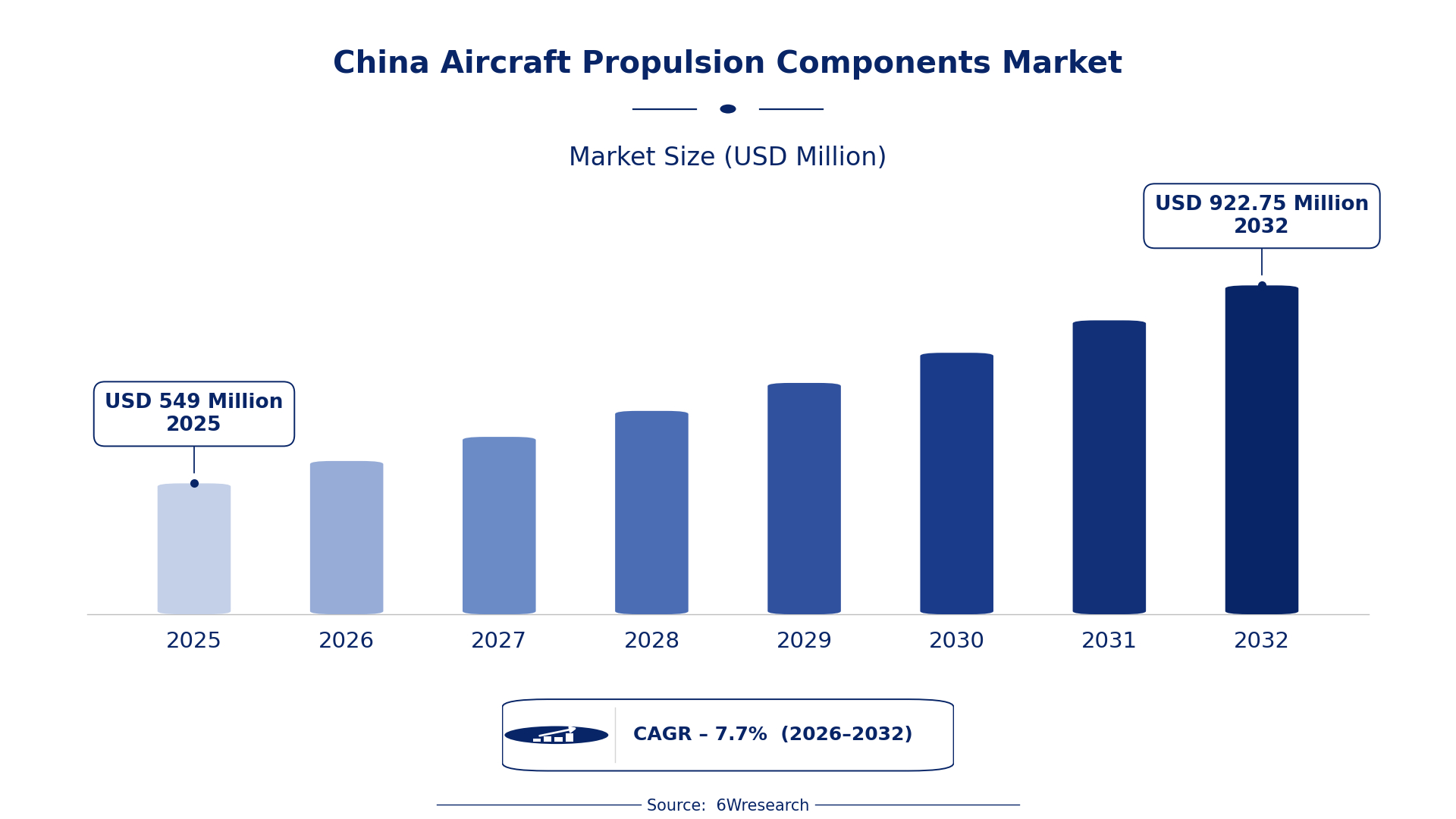
According to 6Wresearch internal database and industry insights, the China Aircraft Propulsion Components Market was valued at USD 549.0 million in 2025 and is projected to reach USD 922.75 million by 2032, growing at a CAGR of approximately 7.7% during 2026–2032.
China Aircraft Propulsion Components Market Highlights
| Report Metric | Details |
| Report Name | China Aircraft Propulsion Components Market |
| Market Size 2025 | USD 549.0 million |
| Market Size 2032 | USD 922.75 million |
| Absolute Growth 2025–2032 | USD 373.75 million |
| CAGR 2026–2032 | 7.7% |
| Peak Annual Growth | 8.9% in 2030 |
| Forecast Period | 2026–2032 |
| Historical Data | 2022–2025 |
| Base Year | 2025 |
| Leading Component Type, 2025 | Turbofan Blades (46% share) |
| Leading Engine Type, 2025 | Jet Engine (43% share) |
| Leading Distribution Channel, 2025 | Direct Sales (45% share) |
| Leading End User, 2025 | Commercial Aircraft (45% share) |
| Fastest-Growing Component Type | Afterburners (10.4% CAGR) |
| Fastest-Growing Engine Type | Turbojet (9.1% CAGR) |
| Fastest-Growing Distribution Channel | Industrial Suppliers (9.9% CAGR) |
| Fastest-Growing End User | Military Aircraft (9.1% CAGR) |
| Growing Sector | Military Aircraft |
| Key End Users | Commercial Aircraft, Military Aircraft, Business Jets, Fighter Jets |
China Aircraft Propulsion Components Market Year-wise Growth Rate and Key Drivers (2022–2032)
This graph illustrates the annual growth rates of the market from 2022 to 2032, highlighting a steady upward trajectory and projected market expansion over the forecast period.
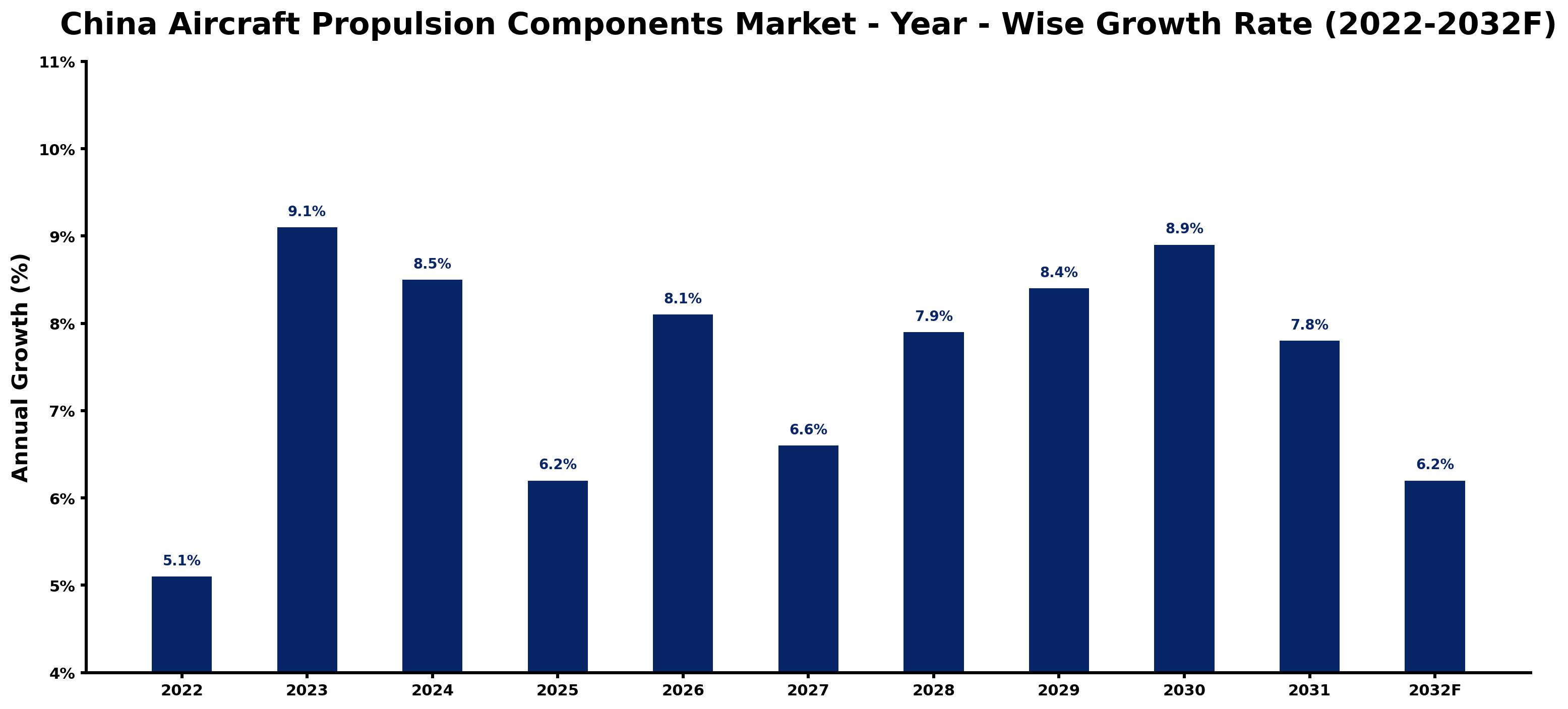
The table below sets out the estimated growth rate for each year and the main factor behind it.
| Year | Estimated Annual Growth (%) | Market Rationale |
| 2022 | 5.1 | The market experienced steady demand due to ongoing aircraft production. |
| 2023 | 9.1 | Growth accelerated as domestic manufacturers increased output due to military requirements. |
| 2024 | 8.5 | Demand growth slowed slightly as manufacturers adjusted to new standards. |
| 2025 | 6.2 | Market growth continued to slow as producers adapted to the 'Made in China 2025' initiative. |
| 2026 | 8.1 | An increase in military aircraft production is projected to drive demand higher again. |
| 2027 | 6.6 | Demand growth decelerated as manufacturers faced supply chain challenges from global disruptions. |
| 2028 | 7.9 | A resurgence in commercial aircraft orders is expected to boost market growth. |
| 2029 | 8.4 | Demand rose again as military investments in advanced systems continued to expand. |
| 2030 | 8.9 | The market peaked as advanced propulsion technologies gained traction among manufacturers. |
| 2031 | 7.8 | Growth slowed as the market adjusted to high production levels and demand stabilised. |
| 2032 | 6.2 | Demand stabilised as the market matures and production aligns with the 'Made in China 2025' initiative. |
Note: Market size estimations and growth projections presented in this report are based on 6Wresearch's proprietary forecasting methodology, utilizing the latest available industry data, government publications, and primary research inputs.
China Aircraft Propulsion Components Market Synopsis
The Aircraft Propulsion Components Market in China includes essential parts of aircraft engines, made from advanced alloys and composites for high performance. These components are critical for both commercial and military aircraft applications. The market is expanding due to increased domestic production, military requirements, and a focus on aerospace innovation. In 2023, the government allocated $5 billion for aerospace technology development, driving demand. The introduction of the C919 large passenger aircraft by 2025 is expected to increase component needs.
Market Dynamics Impact Analysis (2026–2032)
| Factor | Type | Impact | Primary Segment Affected |
| Increased domestic aircraft production drives demand for propulsion components. | Driver | High | Jet Engine |
| Growing military investments in next-generation aircraft boost demand for advanced components. | Driver | High | Military Aircraft |
| Investment in aerospace technology creates opportunities for suppliers of advanced components. | Opportunity | High | Commercial Aircraft |
| The introduction of new aircraft types opens up markets for innovative propulsion solutions. | Opportunity | High | Business Jets |
| Stringent safety and performance standards may limit market entry for new suppliers. | Restraint | High | Turbofan Blades |
| Supply chain disruptions can delay component availability, affecting production schedules. | Restraint | Medium | Turbofan Blades |
| High production costs challenge profitability for manufacturers in the competitive market. | Challenge | High | Turbofan Blades |
| Regulatory approvals for new components can extend lead times, impacting delivery schedules. | Challenge | Medium | Turbofan Blades |
Evaluation of Drivers in China Aircraft Propulsion Components Market (2026–2032)
The factors lifting demand, and the evidence behind each, are summarised below.
| Drivers | Primary Segment Affected | Why It Matters (Evidence) |
| Increased production of commercial aircraft leads to higher demand for propulsion components. | Commercial Aircraft | China produced over 300 commercial aircraft in 2022, necessitating more components. |
| Military aircraft modernization programs boost demand for advanced propulsion systems. | Military Aircraft | The Chinese military is investing heavily in next-generation fighter jets. |
| The 'Made in China 2025' initiative promotes domestic aerospace manufacturing growth. | Jet Engine | This strategy aims to improve local production capabilities, increasing component demand. |
| The introduction of the C919 large passenger aircraft will raise component needs. | Jet Engine | The aircraft is set to enter service by 2025, driving further component purchases. |
| ISO 9001 certification adoption among manufacturers ensures quality assurance in components. | Turbofan Blades | This certification is widely adopted, ensuring compliance with international standards. |
In 2022, over 300 commercial aircraft were produced, driving demand for propulsion components. Heavy investment in next-generation fighter jets is expected to boost demand for advanced systems. The upcoming C919 large passenger aircraft, entering service by 2025, will raise component requirements.
Evaluation of Restraints in China Aircraft Propulsion Components Market
The following restraints limit how fast demand can grow.
| Market Restraint | Primary Segment Affected | Why It Matters (Evidence) |
| Stringent safety regulations may restrict new market entrants. | Turbofan Blades | The CAAC sets national standards for aircraft components, ensuring compliance. |
| Supply chain disruptions can impact timely delivery of components. | Turbofan Blades | Ongoing global supply chain issues have affected many manufacturers. |
| High production costs challenge profitability for component manufacturers. | Turbofan Blades | The aviation sector in China is projected to employ over 1 million people by 2025. |
| Regulatory approvals can extend lead times for new components. | Turbofan Blades | Manufacturers must navigate complex approval pathways to ensure compliance. |
| Limited access to advanced materials may hinder production capabilities. | Turbofan Blades | Producers rely on specific alloys and composites for high-performance components. |
China Aircraft Propulsion Components Market Challenges
Buyers in the China Aircraft Propulsion Components market face a skills shortage, as the rapid growth of the aerospace sector outpaces the availability of qualified engineers. This gap can delay production timelines, costing manufacturers up to 20% in lost revenue. Suppliers encounter fierce competition from state-supported enterprises, which can drive down prices and squeeze margins for smaller firms. This competitive pressure forces suppliers to invest in innovation, often leading to increased costs. Additionally, buyers experience supply chain disruptions due to geopolitical tensions, resulting in potential project delays and a rise in logistics costs of 15%.
Trends in the China Aircraft Propulsion Components Market
Below mentioned are some of the trends shaping the China Aircraft Propulsion Components Market growth.
- Launch of Indigenous Aircraft: The introduction of the C919 large passenger aircraft by 2025 is poised to transform the market. This initiative is expected to generate demand for over 1,000 engines, influencing propulsion components.
- Military Modernisation Initiatives: China's military is making substantial investments in next-generation fighter jets, particularly in Sichuan. This emphasis on advanced systems is projected to boost demand for high-performance propulsion components by over 15% annually.
- Shift towards Advanced Alloys: Manufacturers are increasingly incorporating advanced alloys in component production. This shift is driven by the need for improved performance and durability, with over 70% of new components anticipated to utilise these materials by 2025.
- Expansion of Direct Sales Channels: Direct Sales accounted for 45% of the distribution channels in 2025. This transition improves accessibility for manufacturers and streamlines the procurement process for buyers.
Investment Opportunities in the China Aircraft Propulsion Components Market
Several openings in the China Aircraft Propulsion Components Market merit attention from investors.
- Supply of Advanced Propulsion Components: The military's investment in next-generation aircraft is projected to create a market worth $1 billion by 2025. Suppliers should focus on advanced propulsion components to meet this demand.
- Investment in Aerospace Technology: With the government allocating $5 billion for aerospace technology development, suppliers can tap into this funding. Collaborating with local manufacturers will be vital for entering this expanding market.
- Growing Demand from Commercial Aircraft: The commercial aircraft sector is expanding rapidly, necessitating more propulsion components. With over 300 aircraft produced in 2022, suppliers should focus on partnerships with domestic manufacturers.
- Emerging Market for Business Jets: The business jets segment is set for growth, with increasing demand for luxury travel. Suppliers should consider entering this market through joint ventures with local firms.
Government Initiatives in the China Aircraft Propulsion Components Market
The 'Made in China 2025' initiative, launched by the Ministry of Industry and Information Technology in 2017, aims to enhance domestic aerospace manufacturing capabilities. This policy encourages investment in advanced technologies and local production, ultimately improving the competitiveness of Chinese manufacturers. The initiative also supports research and development efforts, ensuring that manufacturers can meet international standards and demands.
In 2023, the Chinese government allocated $5 billion for aerospace technology development through the National Development and Reform Commission. This funding supports innovation and strengthens the capabilities of domestic manufacturers. The commission oversees various projects that promote the growth of the aerospace sector, ensuring that manufacturers have access to the necessary resources and support for development.
Future Insight of the China Aircraft Propulsion Components Market
The China Aircraft Propulsion Components market will experience substantial changes by 2032, driven by advancements in aerospace technology and strong government support. The 'Made in China 2025' initiative will enhance manufacturing capabilities, allowing suppliers to produce high-quality components more efficiently. The introduction of new military aircraft will escalate demand for advanced propulsion components, supporting further innovation. An investment of $5 billion in aerospace technology development will facilitate access to superior products for buyers, while the growth of the aviation sector is expected to create over 1 million jobs by 2025.
Market Segmentation Analysis
Each segment group is reviewed below, with the leader by share and the fastest grower by CAGR.
By Component Type – Turbofan Blades Dominated, Afterburners Expected to Grow Fastest
According to Shubham Padhi, Research Analyst at 6Wresearch, in 2025, Turbofan Blades led the component type split with a 46% share. Turbofan blades dominate the market share due to their critical role in jet engine performance, essential for both commercial and military aircraft. The significant production of over 300 commercial aircraft in 2022 has driven the demand for these vital components. Afterburners are projected to grow fastest, at a CAGR of 10.4% during 2026–2032. Afterburners are rapidly growing in demand as military aircraft increasingly require advanced propulsion systems for enhanced thrust capabilities. The Chinese military's substantial investments in next-generation fighter jets are a key factor behind this surge. Suppliers should enhance their turbofan blade offerings while exploring opportunities in afterburners to address rising demand.
By Engine Type – Jet Engine Dominated, Turbojet Expected to Grow Fastest
Jet Engine took a 43% share of engine type in 2025, more than any other category. Jet engines hold the largest market share as they serve as the primary propulsion system for both commercial and military aircraft, reflecting the substantial volume of aircraft production. The robust growth of China's aviation sector significantly supports the demand for these engines. Turbojet is set to record the highest CAGR in this split, 9.1% over 2026–2032. Turbojets are witnessing the fastest growth due to their specific applications in military operations, where performance and speed are critical. Ongoing military investments are likely to further accelerate this trend. Manufacturers should prioritise jet engine production while also catering to the growing turbojet segment to capture emerging opportunities.
By Distribution Channel – Direct Sales Dominated, Industrial Suppliers Expected to Grow Fastest
Direct Sales held a 45% share of the China Aircraft Propulsion Components Market by distribution channel in 2025. Direct sales lead the market share as the primary method for large component sales, allowing manufacturers to establish strong relationships with buyers. This channel is essential for efficiently meeting the needs of both domestic and international clients. Over 2026–2032, Industrial Suppliers are expected to post the fastest growth, at a CAGR of 9.9%. Industrial suppliers are rapidly expanding as they provide essential components directly to manufacturers, streamlining the supply chain. Their increasing significance in supporting the aerospace industry's growth cannot be overlooked. Suppliers must strengthen their direct sales strategies while also partnering with industrial suppliers to enhance market reach.
By End User – Commercial Aircraft Dominated, Military Aircraft Expected to Grow Fastest
The largest end user category in 2025 was Commercial Aircraft, with a 45% share of total revenue. Commercial aircraft represent the largest segment for propulsion components, driven by the high demand for air travel and the production of new aircraft. This segment's growth is supported by China's expanding aviation infrastructure. The quickest growth will come from Military Aircraft, forecast to expand at a CAGR of 9.1% between 2026 and 2032. Military aircraft are seeing the fastest growth due to the increasing demand for advanced systems amidst rising military investments. The focus on modernisation in the military sector is propelling this segment forward. Suppliers should align their strategies to cater to both commercial and military aircraft needs, ensuring they meet the diverse demands of the market.
Key Attractiveness of the Report
- 10 Years of Market Numbers
- Historical Data Starting from 2022 to 2025
- Base Year 2025
- Forecast Data until 2032
- Key Performance Indicators Impacting the Market
- Major Upcoming Developments and Projects
Key Highlights of the Report:
- China Aircraft Propulsion Components Market Outlook
- Market Size of China Aircraft Propulsion Components Market, 2025
- Forecast of China Aircraft Propulsion Components Market, 2032
- Historical Data and Forecast of China Aircraft Propulsion Components Revenues & Volume for the Period 2022 - 2032F
- China Aircraft Propulsion Components Market Trend Evolution
- China Aircraft Propulsion Components Market Drivers and Challenges
- China Aircraft Propulsion Components Price Trends
- China Aircraft Propulsion Components Porter's Five Forces
- China Aircraft Propulsion Components Industry Life Cycle
- Historical Data and Forecast of China Aircraft Propulsion Components Market Revenues & Volume By Component Type for the Period 2022 - 2032F
- Historical Data and Forecast of China Aircraft Propulsion Components Market Revenues & Volume By Turbofan Blades for the Period 2022 - 2032F
- Historical Data and Forecast of China Aircraft Propulsion Components Market Revenues & Volume By Afterburners for the Period 2022 - 2032F
- Historical Data and Forecast of China Aircraft Propulsion Components Market Revenues & Volume By Nozzles for the Period 2022 - 2032F
- Historical Data and Forecast of China Aircraft Propulsion Components Market Revenues & Volume By Combustion Chambers for the Period 2022 - 2032F
- Historical Data and Forecast of China Aircraft Propulsion Components Market Revenues & Volume By Engine Type for the Period 2022 - 2032F
- Historical Data and Forecast of China Aircraft Propulsion Components Market Revenues & Volume By Jet Engine for the Period 2022 - 2032F
- Historical Data and Forecast of China Aircraft Propulsion Components Market Revenues & Volume By Turbojet for the Period 2022 - 2032F
- Historical Data and Forecast of China Aircraft Propulsion Components Market Revenues & Volume By Turboprop for the Period 2022 - 2032F
- Historical Data and Forecast of China Aircraft Propulsion Components Market Revenues & Volume By Ramjet for the Period 2022 - 2032F
- Historical Data and Forecast of China Aircraft Propulsion Components Market Revenues & Volume By Distribution Channel for the Period 2022 - 2032F
- Historical Data and Forecast of China Aircraft Propulsion Components Market Revenues & Volume By Direct Sales for the Period 2022 - 2032F
- Historical Data and Forecast of China Aircraft Propulsion Components Market Revenues & Volume By Industrial Suppliers for the Period 2022 - 2032F
- Historical Data and Forecast of China Aircraft Propulsion Components Market Revenues & Volume By Online Platforms for the Period 2022 - 2032F
- Historical Data and Forecast of China Aircraft Propulsion Components Market Revenues & Volume By Specialty Stores for the Period 2022 - 2032F
- Historical Data and Forecast of China Aircraft Propulsion Components Market Revenues & Volume By End User for the Period 2022 - 2032F
- Historical Data and Forecast of China Aircraft Propulsion Components Market Revenues & Volume By Commercial Aircraft for the Period 2022 - 2032F
- Historical Data and Forecast of China Aircraft Propulsion Components Market Revenues & Volume By Military Aircraft for the Period 2022 - 2032F
- Historical Data and Forecast of China Aircraft Propulsion Components Market Revenues & Volume By Business Jets for the Period 2022 - 2032F
- Historical Data and Forecast of China Aircraft Propulsion Components Market Revenues & Volume By Fighter Jets for the Period 2022 - 2032F
- China Aircraft Propulsion Components Import Export Trade Statistics
- Market Opportunity Assessment By Component Type
- Market Opportunity Assessment By Engine Type
- Market Opportunity Assessment By Distribution Channel
- Market Opportunity Assessment By End User
- China Aircraft Propulsion Components Top Companies Market Share
- China Aircraft Propulsion Components Competitive Benchmarking By Technical and Operational Parameters
- China Aircraft Propulsion Components Company Profiles
- China Aircraft Propulsion Components Key Strategic Recommendations
Market Covered
Segments analysed in this report are listed below.
By Component Type
- Turbofan Blades
- Afterburners
- Nozzles
- Combustion Chambers
By Engine Type
- Jet Engine
- Turbojet
- Turboprop
- Ramjet
By Distribution Channel
- Direct Sales
- Industrial Suppliers
- Online Platforms
- Specialty Stores
By End User
- Commercial Aircraft
- Military Aircraft
- Business Jets
- Fighter Jets






































