China Aircraft Structural Components Market Size & Growth Rate
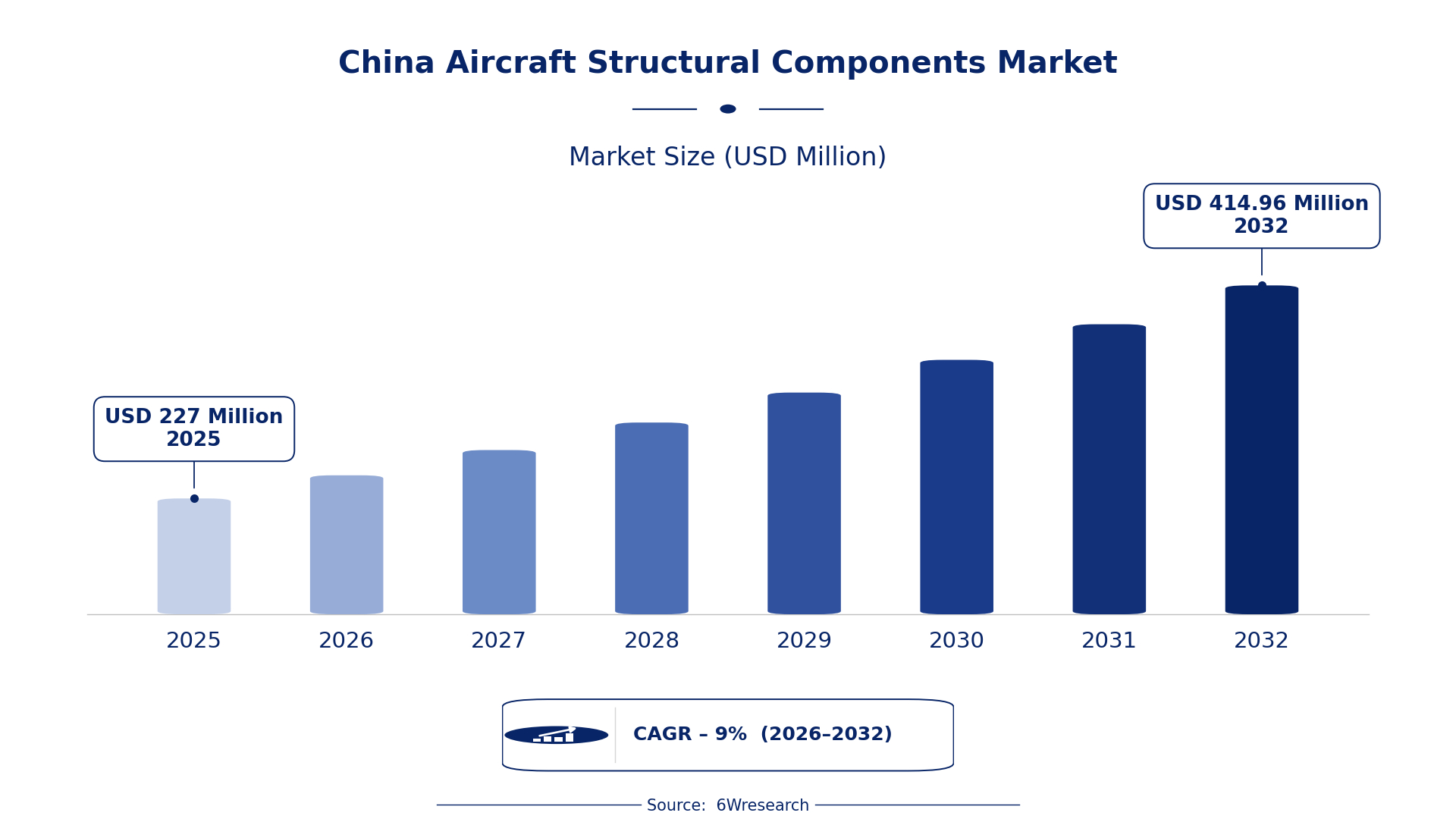
According to 6Wresearch internal database and industry insights, the China Aircraft Structural Components Market was valued at USD 227.0 million in 2025 and is projected to reach USD 414.96 million by 2032, growing at a CAGR of approximately 9% during 2026–2032.
China Aircraft Structural Components Market Highlights
| Report Metric | Details |
| Report Name | China Aircraft Structural Components Market |
| Market Size 2025 | USD 227.0 million |
| Market Size 2032 | USD 414.96 million |
| Absolute Growth 2025–2032 | USD 187.96 million |
| CAGR 2026–2032 | 9% |
| Peak Annual Growth | 11.7% in 2032 |
| Forecast Period | 2026–2032 |
| Historical Data | 2022–2025 |
| Base Year | 2025 |
| Leading Component Type, 2025 | Fuselage Frames (45% share) |
| Leading Material Type, 2025 | Aluminum Alloy (43% share) |
| Leading Distribution Channel, 2025 | Direct Sales (45% share) |
| Leading End User, 2025 | Aircraft OEMs (48% share) |
| Fastest-Growing Component Type | Wing Spars (11.0% CAGR) |
| Fastest-Growing Material Type | Titanium (10.9% CAGR) |
| Fastest-Growing Distribution Channel | Industrial Suppliers (11.2% CAGR) |
| Fastest-Growing End User | Commercial Aircraft (11.2% CAGR) |
| Growing Sector | Military Aircraft Production |
| Key End Users | Aircraft OEMs, Military Aircraft Manufacturers, Commercial Aircraft Builders |
China Aircraft Structural Components Market Year-wise Growth Rate and Key Drivers (2022–2032)
This graph illustrates the annual growth rates of the market from 2022 to 2032, highlighting a steady upward trajectory and projected market expansion over the forecast period.
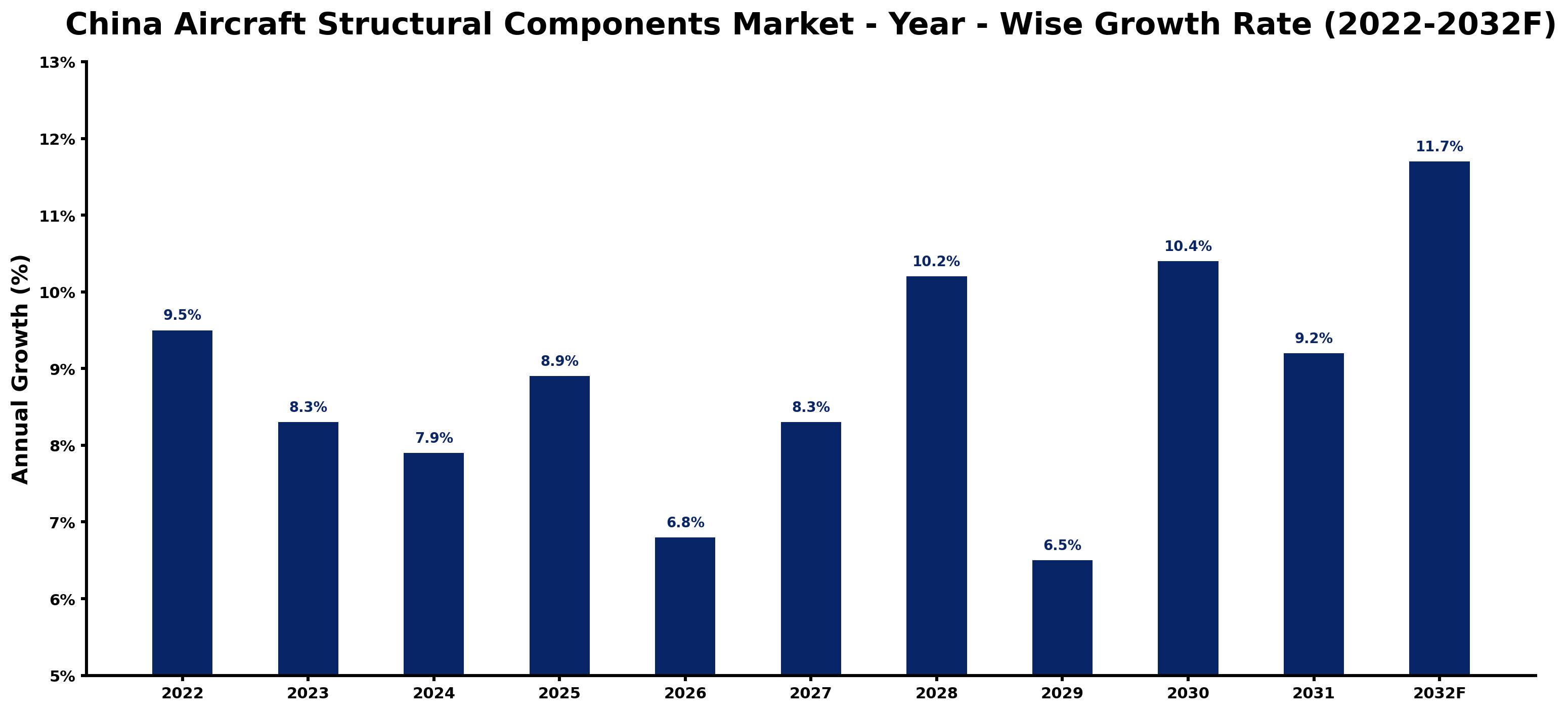
Each row of the following table gives one year's estimated growth and the event or demand shift that explains it.
| Year | Estimated Annual Growth (%) | Market Rationale |
| 2022 | 9.5 | The market experienced growth due to rising domestic aircraft production. |
| 2023 | 8.3 | Demand growth slowed as manufacturers adjusted to supply chain challenges. |
| 2024 | 7.9 | Market growth continued to decelerate amid fluctuating material costs. |
| 2025 | 8.9 | A resurgence in military aircraft production boosted demand for components. |
| 2026 | 6.8 | Growth is expected to slow as the market faces increasing competition from imports. |
| 2027 | 8.3 | A recovery in commercial aircraft orders will lead to increased demand. |
| 2028 | 10.2 | Demand is projected to accelerate as new aircraft models enter production phases. |
| 2029 | 6.5 | Growth is expected to moderate as manufacturers face supply chain disruptions again. |
| 2030 | 10.4 | Increased domestic production targets will spur demand for structural components. |
| 2031 | 9.2 | Market growth is projected to slow as manufacturers adjust to new regulatory standards. |
| 2032 | 11.7 | The market is expected to peak as investments in aerospace technology surge. |
Note: Market size estimations and growth projections presented in this report are based on 6Wresearch's proprietary forecasting methodology, utilizing the latest available industry data, government publications, and primary research inputs.
China Aircraft Structural Components Market Synopsis
The Aircraft Structural Components Market in China includes essential parts for aircraft construction, primarily crafted from aluminium alloys, titanium, and composites. These components are crucial for ensuring structural integrity and safety during flight. The market is growing due to the increase in domestic aircraft production, driven by both aircraft OEMs and military aircraft orders. By 2035, China's aviation market is projected to reach 1,000 commercial aircraft, further elevating the demand for structural components. The emphasis on local manufacturing capabilities boosts the industry's growth potential.
Market Dynamics Impact Analysis (2026–2032)
| Factor | Type | Impact | Primary Segment Affected |
| Rising domestic aircraft production targets | Driver | High | Fuselage Frames |
| Increased military aircraft production | Driver | High | Wing Spars |
| Growing demand for lightweight materials | Opportunity | High | Titanium |
| Expansion of manufacturing capabilities in Guangdong | Opportunity | Medium | Aluminum Alloy |
| Fluctuating material costs | Restraint | High | Composite |
| Supply chain disruptions impacting production schedules | Restraint | Medium | Carbon Fiber |
| Regulatory compliance affecting production timelines | Challenge | High | Bulkheads |
| Competition from international manufacturers | Challenge | Medium | Empennage Sections |
Evaluation of Drivers in China Aircraft Structural Components Market (2026–2032)
The table below links each growth driver to the segment it affects and the evidence for it.
| Drivers | Primary Segment Affected | Why It Matters (Evidence) |
| Increasing domestic aircraft production | Fuselage Frames | The government aims to produce 1,500 aircraft annually by 2030, boosting demand for structural components. |
| Growing military aircraft orders | Wing Spars | In 2022, 300 military aircraft were produced, increasing the need for essential structural components. |
| Demand for lightweight materials | Titanium | Titanium is valued for its strength-to-weight ratio, driving its adoption in aircraft manufacturing. |
| Expansion of manufacturing capabilities | Aluminum Alloy | Guangdong province is a major hub, supporting increased production capacity for aluminum components. |
| Technological advancements in manufacturing processes | Composite | Innovations in composite layup techniques are improving production efficiency and component performance. |
Expansion of the Aircraft Structural Components market in China is backed by increasing domestic aircraft production and growing military aircraft orders. In 2022, 300 military aircraft were produced, leading to a heightened need for essential components. The Guangdong province serves as a major manufacturing hub, enhancing production capabilities. Additionally, advancements in manufacturing processes are improving efficiency and attracting investments into the sector.
Evaluation of Restraints in China Aircraft Structural Components Market
The main factors holding the market back are set out below.
| Market Restraint | Primary Segment Affected | Why It Matters (Evidence) |
| Fluctuating material costs | Composite | Material price volatility affects production budgets, leading to potential project delays. |
| Supply chain disruptions | Carbon Fiber | Ongoing global supply chain issues hinder timely procurement of essential materials. |
| Regulatory compliance costs | Bulkheads | New regulations increase testing and certification expenses for manufacturers. |
| Limited availability of skilled workforce | Empennage Sections | A shortage of qualified workers impacts production timelines and quality. |
| Competition from international manufacturers | Fuselage Frames | Increased foreign competition pressures local manufacturers to lower prices. |
China Aircraft Structural Components Market Challenges
In the China Aircraft Structural Components market, buyers face a technology gap, as many manufacturers still rely on outdated production techniques, leading to potential delivery delays of up to six months. Rising raw material costs, particularly for aluminum alloys which constitute 70% of structural components, compel buyers to reassess their procurement strategies. Suppliers experience supply chain disruptions due to fluctuating demand from military aircraft production, which saw 300 units produced in 2022, resulting in unpredictable inventory levels. Intense competition among over 100 certified manufacturers in China drives prices down, complicating profitability for suppliers while maintaining compliance with CAAC standards.
Trends in the China Aircraft Structural Components Market
Below mentioned are some of the trends shaping the China Aircraft Structural Components Market growth.
- Shift towards Lightweight Materials: Aluminium alloys constitute 70% of structural materials used in China, with titanium gaining popularity for its strength-to-weight ratio. This shift highlights a growing emphasis on fuel efficiency and performance in aircraft design.
- Increase in Military Aircraft Production: The Chinese government has escalated military aircraft production, with 300 units produced in 2022. This trend is expected to persist, driving demand for structural components.
- Adoption of Advanced Manufacturing Techniques: The introduction of automated manufacturing processes in Guangdong province is enhancing production efficiency. This shift is anticipated to improve output quality and reduce lead times.
- Growth of Online Procurement Channels: Online platforms are increasingly favoured for smaller orders, reflecting changing buyer preferences. This trend is expected to capture a larger share of the market in the coming years.
Investment Opportunities in the China Aircraft Structural Components Market
The following opportunities in the China Aircraft Structural Components Market pair current demand with a clear way in.
- Investment in Manufacturing Facilities: Guangdong province serves as a key hub for aircraft manufacturing, attracting investments to expand production capacity. With a projected $100 billion in investments by 2025, suppliers can benefit from local partnerships.
- Certification for Advanced Materials: The demand for titanium is on the rise, with a projected CAGR of 10.9% through 2032. Suppliers should focus on obtaining necessary certifications to meet industry standards.
- Joint Ventures with Local Manufacturers: Collaborating with local manufacturers can facilitate market entry, particularly in regions like Guangdong. This approach can help navigate regulatory landscapes and improve distribution.
- Focus on Military Contracts: With military aircraft production increasing, suppliers should target defence contracts. The growing defence budget presents a substantial opportunity for structural component manufacturers.
Government Initiatives in the China Aircraft Structural Components Market
The Civil Aviation Administration of China (CAAC) has implemented updated safety standards in 2023, which enhance compliance requirements for aircraft manufacturers. This measure builds on previous regulations, ensuring higher safety and quality in aircraft production. Manufacturers must now adhere to stricter testing and certification processes, which may increase operational costs but ultimately improve product reliability. The CAAC aims to ensure that all components meet safety and performance criteria, vital for maintaining market integrity. By funding the development of new technologies, the CAAC supports innovation within the aerospace sector.
The CAAC oversees compliance with international aviation standards and approves new aircraft designs. The agency's rigorous review process ensures that all components meet safety and performance criteria, which is vital for maintaining market integrity. By funding the development of new technologies, the CAAC supports innovation within the aerospace sector. This funding enhances the capabilities of manufacturers and allows them to meet evolving industry standards.
Future Insight of the China Aircraft Structural Components Market
Several forward-looking factors should support the China Aircraft Structural Components market in the coming years. The government's goal to increase domestic aircraft production to 1,500 units annually by 2030 will drive demand for structural components. Anticipated investments of $100 billion into the aerospace industry by 2025 will enhance manufacturing capabilities. Advancements in production technologies will likely improve efficiency and quality, benefiting both buyers and suppliers as they adapt to evolving market needs.
Market Segmentation Analysis
The analysis below covers each segmentation, its leading category in 2025 and its fastest-growing category through 2032.
By Component Type – Fuselage Frames Dominated, Wing Spars Expected to Grow Fastest
According to Shubham Padhi, Research Analyst at 6Wresearch, in 2025, Fuselage Frames led the component type split with a 45% share. Fuselage frames hold the largest market share as they are vital for maintaining the structural integrity of aircraft. Their essential role in both commercial and military aircraft production, especially in Guangdong, a prominent manufacturing hub, reinforces their leading status. Wing Spars are projected to grow fastest, at a CAGR of 11.0% during 2026–2032. Wing spars are experiencing rapid growth due to their critical function in wing support, which becomes increasingly important as aircraft production accelerates. With the target of producing 1,500 aircraft annually by 2030, the demand for wing spars is expected to surge significantly. Suppliers must enhance their production capabilities for wing spars to effectively respond to the rising demand.
By Material Type – Aluminum Alloy Dominated, Titanium Expected to Grow Fastest
Aluminum Alloy accounted for a 43% market share by material type in 2025. Aluminum alloy holds the largest market share because it is extensively used for lightweight structures in aircraft manufacturing. With 70% of aircraft structural materials in China being aluminium alloys, their widespread application ensures continued dominance in the market. Over 2026–2032, Titanium is expected to post the fastest growth, at a CAGR of 10.9%. Titanium is the fastest-growing material type, prized for its superior strength-to-weight ratio, which is becoming increasingly important in modern aircraft design. As the aerospace sector is projected to attract $100 billion in investments by 2025, the demand for titanium is expected to surge. Buyers should consider sourcing titanium to meet the specific requirements of advanced aircraft design and production.
By Distribution Channel – Direct Sales Dominated, Industrial Suppliers Expected to Grow Fastest
Direct Sales took a 45% share of distribution channel in 2025, more than any other category. Direct sales dominate the market as they serve as the primary channel for OEMs procuring structural components. This method ensures a streamlined supply chain directly connecting manufacturers with the end-users. Industrial Suppliers are set to record the highest CAGR in this split, 11.2% over 2026–2032. Industrial suppliers are rapidly gaining traction as they facilitate bulk procurement, which is essential for meeting the growing demands of aircraft production. With over 100 certified aircraft manufacturers in China, the reliance on industrial suppliers is set to increase. Suppliers must strengthen relationships with industrial suppliers to effectively reach a broader customer base.
By End User – Aircraft OEMs Dominated, Commercial Aircraft Expected to Grow Fastest
Aircraft OEMs held a 48% share of the China Aircraft Structural Components Market by end user in 2025. Aircraft OEMs represent the largest consumer group for structural components, significantly impacting market share through their extensive production activities. Their ongoing projects and production schedules create a robust demand for various aircraft structural components, solidifying their leading position. The quickest growth will come from Commercial Aircraft, forecast to expand at a CAGR of 11.2% between 2026 and 2032. Commercial aircraft are the fastest-growing end-user segment, driven by projections that China's aviation market will reach 1,000 commercial aircraft by 2035. This anticipated growth in commercial aircraft production will further increase the demand for structural components. Suppliers should focus on aligning their offerings with the specific requirements of commercial aircraft manufacturers to seize market opportunities.
Key Attractiveness of the Report
- 10 Years of Market Numbers
- Historical Data Starting from 2022 to 2025
- Base Year 2025
- Forecast Data until 2032
- Key Performance Indicators Impacting the Market
- Major Upcoming Developments and Projects
Key Highlights of the Report:
- China Aircraft Structural Components Market Outlook
- Market Size of China Aircraft Structural Components Market, 2025
- Forecast of China Aircraft Structural Components Market, 2032
- Historical Data and Forecast of China Aircraft Structural Components Revenues & Volume for the Period 2022 - 2032F
- China Aircraft Structural Components Market Trend Evolution
- China Aircraft Structural Components Market Drivers and Challenges
- China Aircraft Structural Components Price Trends
- China Aircraft Structural Components Porter's Five Forces
- China Aircraft Structural Components Industry Life Cycle
- Historical Data and Forecast of China Aircraft Structural Components Market Revenues & Volume By Component Type for the Period 2022 - 2032F
- Historical Data and Forecast of China Aircraft Structural Components Market Revenues & Volume By Fuselage Frames for the Period 2022 - 2032F
- Historical Data and Forecast of China Aircraft Structural Components Market Revenues & Volume By Wing Spars for the Period 2022 - 2032F
- Historical Data and Forecast of China Aircraft Structural Components Market Revenues & Volume By Bulkheads for the Period 2022 - 2032F
- Historical Data and Forecast of China Aircraft Structural Components Market Revenues & Volume By Empennage Sections for the Period 2022 - 2032F
- Historical Data and Forecast of China Aircraft Structural Components Market Revenues & Volume By Material Type for the Period 2022 - 2032F
- Historical Data and Forecast of China Aircraft Structural Components Market Revenues & Volume By Aluminum Alloy for the Period 2022 - 2032F
- Historical Data and Forecast of China Aircraft Structural Components Market Revenues & Volume By Titanium for the Period 2022 - 2032F
- Historical Data and Forecast of China Aircraft Structural Components Market Revenues & Volume By Composite for the Period 2022 - 2032F
- Historical Data and Forecast of China Aircraft Structural Components Market Revenues & Volume By Carbon Fiber for the Period 2022 - 2032F
- Historical Data and Forecast of China Aircraft Structural Components Market Revenues & Volume By Distribution Channel for the Period 2022 - 2032F
- Historical Data and Forecast of China Aircraft Structural Components Market Revenues & Volume By Direct Sales for the Period 2022 - 2032F
- Historical Data and Forecast of China Aircraft Structural Components Market Revenues & Volume By Industrial Suppliers for the Period 2022 - 2032F
- Historical Data and Forecast of China Aircraft Structural Components Market Revenues & Volume By Online Platforms for the Period 2022 - 2032F
- Historical Data and Forecast of China Aircraft Structural Components Market Revenues & Volume By Specialty Stores for the Period 2022 - 2032F
- Historical Data and Forecast of China Aircraft Structural Components Market Revenues & Volume By End User for the Period 2022 - 2032F
- Historical Data and Forecast of China Aircraft Structural Components Market Revenues & Volume By Aircraft OEMs for the Period 2022 - 2032F
- Historical Data and Forecast of China Aircraft Structural Components Market Revenues & Volume By Commercial Aircraft for the Period 2022 - 2032F
- Historical Data and Forecast of China Aircraft Structural Components Market Revenues & Volume By Private Jet Builders for the Period 2022 - 2032F
- Historical Data and Forecast of China Aircraft Structural Components Market Revenues & Volume By Military Aircraft for the Period 2022 - 2032F
- China Aircraft Structural Components Import Export Trade Statistics
- Market Opportunity Assessment By Component Type
- Market Opportunity Assessment By Material Type
- Market Opportunity Assessment By Distribution Channel
- Market Opportunity Assessment By End User
- China Aircraft Structural Components Top Companies Market Share
- China Aircraft Structural Components Competitive Benchmarking By Technical and Operational Parameters
- China Aircraft Structural Components Company Profiles
- China Aircraft Structural Components Key Strategic Recommendations
Market Covered
This report examines the market across the segments below.
By Component Type
- Fuselage Frames
- Wing Spars
- Bulkheads
- Empennage Sections
By Material Type
- Aluminum Alloy
- Titanium
- Composite
- Carbon Fiber
By Distribution Channel
- Direct Sales
- Industrial Suppliers
- Online Platforms
- Specialty Stores
By End User
- Aircraft OEMs
- Commercial Aircraft
- Private Jet Builders
- Military Aircraft






































