China Airport Operations Automation Market Size & Growth Rate
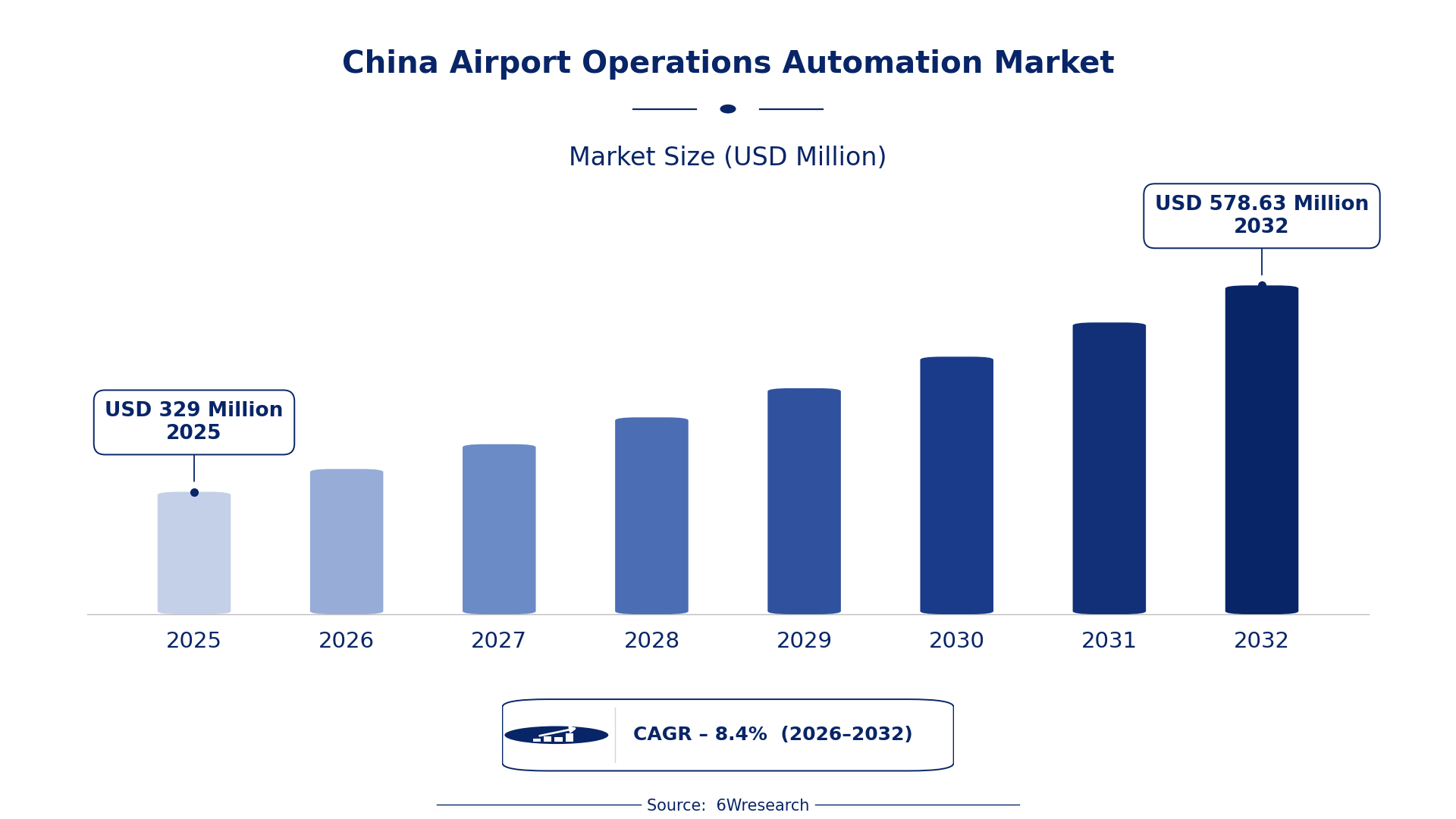
According to 6Wresearch internal database and industry insights, the China Airport Operations Automation Market was valued at USD 329.0 million in 2025 and is projected to reach USD 578.63 million by 2032, growing at a CAGR of approximately 8.4% during 2026–2032.
China Airport Operations Automation Market Highlights
| Report Metric | Details |
| Report Name | China Airport Operations Automation Market |
| Market Size 2025 | USD 329.0 million |
| Market Size 2032 | USD 578.63 million |
| Absolute Growth 2025–2032 | USD 249.63 million |
| CAGR 2026–2032 | 8.4% |
| Peak Annual Growth | 10.7% in 2028 |
| Forecast Period | 2026–2032 |
| Historical Data | 2022–2025 |
| Base Year | 2025 |
| Leading Operation Type, 2025 | Check-In & Boarding (39% share) |
| Leading Automation Level, 2025 | Self-Service Kiosks (45% share) |
| Leading Distribution Channel, 2025 | Direct Sales (41% share) |
| Leading End User, 2025 | Hub Airports (42% share) |
| Fastest-Growing Operation Type | Passenger Tracking (9.9% CAGR) |
| Fastest-Growing Automation Level | Fully Automated (10.5% CAGR) |
| Fastest-Growing End User | Passenger Terminals (9.4% CAGR) |
| Growing Sector | Passenger Terminals |
| Key End Users | Hub Airports, Passenger Terminals, Airport Operators, Ground Teams |
China Airport Operations Automation Market Year-wise Growth Rate and Key Drivers (2022–2032)
This graph illustrates the annual growth rates of the market from 2022 to 2032, highlighting a steady upward trajectory and projected market expansion over the forecast period.
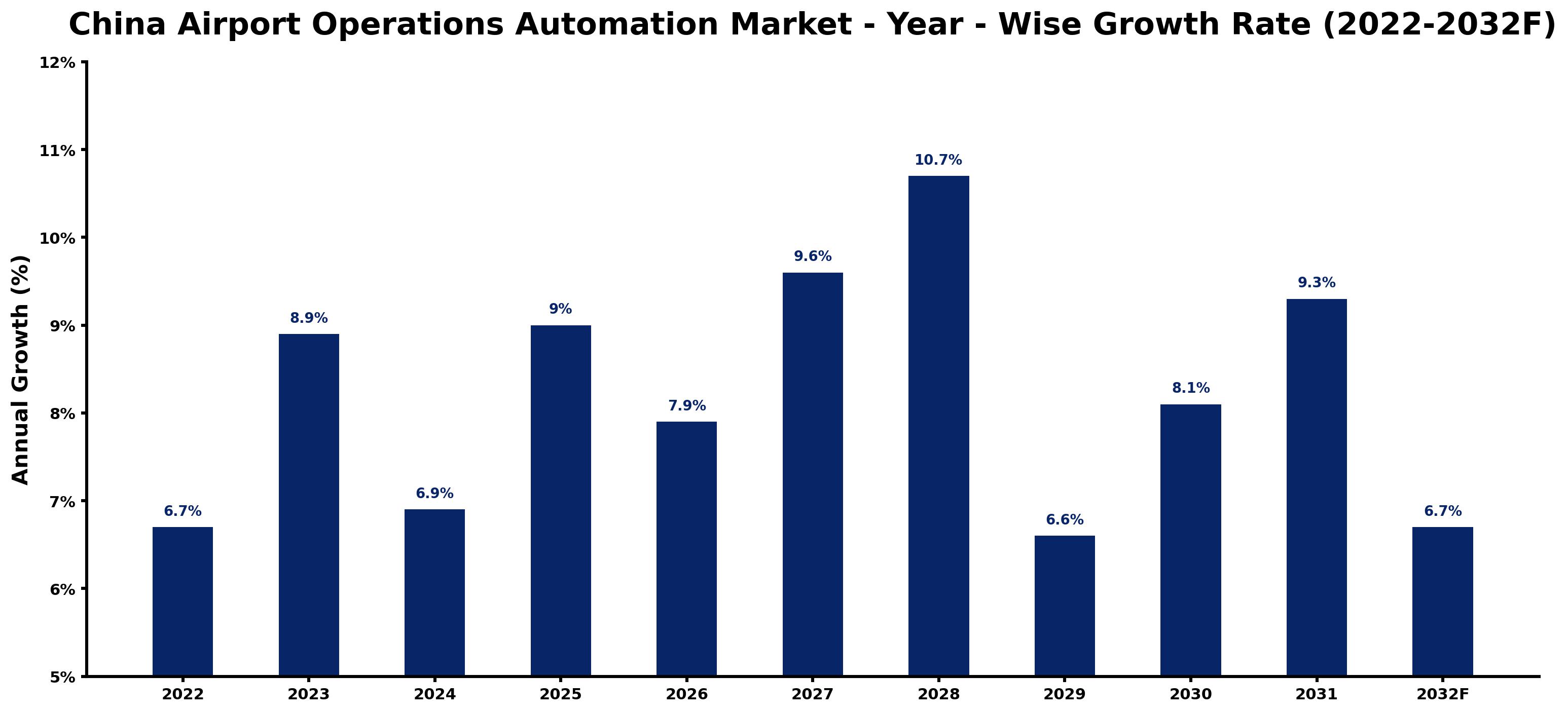
The table below sets out the estimated growth rate for each year and the main factor behind it.
| Year | Estimated Annual Growth (%) | Market Rationale |
| 2022 | 6.7 | The market experienced steady growth as automation adoption increased across airports. |
| 2023 | 8.9 | Demand surged due to heightened investments in airport infrastructure and technology. |
| 2024 | 6.9 | Growth slowed slightly as some airports completed initial automation phases. |
| 2025 | 9.0 | The market peaked with significant advancements in passenger processing systems. |
| 2026 | 7.9 | A slowdown occurred as airports focused on optimising existing automation solutions. |
| 2027 | 9.6 | Growth accelerated again with new technology implementations in major hubs. |
| 2028 | 10.7 | The market reached its highest growth rate as automation technologies became standard. |
| 2029 | 6.6 | Growth slowed as many airports began to consolidate automation investments. |
| 2030 | 8.1 | Demand increased as passenger tracking systems became standard in new terminals. |
| 2031 | 9.3 | The market experienced a rebound due to renewed investments in automation. |
| 2032 | 6.7 | Growth slowed as the market matured and focused on efficiency improvements. |
Note: Market size estimations and growth projections presented in this report are based on 6Wresearch's proprietary forecasting methodology, utilizing the latest available industry data, government publications, and primary research inputs.
China Airport Operations Automation Market Synopsis
Airport Operations Automation in China involves the integration of technology into airport processes to improve efficiency and enhance the passenger experience. This encompasses systems for check-in, baggage handling, and passenger tracking. The China Airport Operations Automation Market is growing, driven by a forecasted handling of over 1.5 billion passengers by 2030 and substantial government investment. The Civil Aviation Administration is promoting automation through national guidelines, which bolsters demand from both domestic and international travellers.
Market Dynamics Impact Analysis (2026–2032)
| Factor | Type | Impact | Primary Segment Affected |
| Increased government investment in airport automation technologies | Driver | High | Check-In & Boarding |
| Growing passenger numbers leading to higher efficiency needs | Driver | High | Baggage Handling |
| High demand for modernised airport facilities | Opportunity | High | Passenger Tracking |
| Need for enhanced passenger experience in airports | Opportunity | High | Self-Service Kiosks |
| Limited budget allocations for automation upgrades | Restraint | Medium | Aircraft Docking |
| Slow adoption of fully automated systems in smaller airports | Restraint | Medium | Fully Automated |
| Buyers face challenges in integrating new technologies with legacy systems | Challenge | High | Airport Operators |
| Suppliers encounter delays in meeting regulatory standards for new technologies | Challenge | Medium | Airport Operators |
Evaluation of Drivers in China Airport Operations Automation Market (2026–2032)
Key forces behind demand, with the segment each one moves most, are listed below.
| Drivers | Primary Segment Affected | Why It Matters (Evidence) |
| Government investment plan of 100 billion yuan by 2025 | Baggage Handling | This funding supports the development and implementation of advanced baggage handling systems across airports. |
| Self-service kiosks increased by 30% since 2021 | Self-Service Kiosks | This rise reflects the demand for faster check-in processes and reduced wait times for passengers. |
| Integration of passenger tracking systems in 80% of new terminals | Passenger Tracking | This integration improves security and the overall passenger experience at airports. |
| The Civil Aviation Administration promotes automation through national guidelines | Check-In & Boarding | These guidelines encourage airports to adopt automated solutions, improving efficiency and passenger flow. |
| The Guangdong province leads in airport automation advancements | Aircraft Docking | This regional focus on automation drives demand for modern docking solutions in major airports. |
In 2022, over 70% of airports adopted some form of automation, reflecting the urgency for modernisation. Self-service kiosks have increased by 30% since 2021, significantly improving passenger flow. The integration of passenger tracking systems in 80% of new terminals enhances security and improves the overall passenger experience.
Evaluation of Restraints in China Airport Operations Automation Market
The table below lists the restraints and the evidence behind each.
| Market Restraint | Primary Segment Affected | Why It Matters (Evidence) |
| Limited budget allocations for automation upgrades | Aircraft Docking | Budget constraints hinder airport operators from investing in necessary automation technologies. |
| Slow adoption of fully automated systems in smaller airports | Fully Automated | Smaller airports often lack the resources to implement fully automated solutions, delaying progress. |
| Integration challenges with existing legacy systems | Airport Operators | Buyers struggle to integrate new technologies with outdated systems, complicating automation efforts. |
| Regulatory hurdles in implementing new technologies | Airport Operators | Suppliers face delays in meeting regulatory standards, impacting project timelines. |
| High initial investment costs for advanced automation technologies | Passenger Tracking | The upfront costs deter some airports from adopting the latest automation solutions. |
China Airport Operations Automation Market Challenges
Buyers and suppliers in the China Airport Operations Automation market encounter a significant challenge due to outdated technology, as many airports still depend on legacy systems. This reliance delays the integration of advanced solutions like RFID and smart sensors, which can affect passenger satisfaction. Competition is intensifying, with over 70% of airports adopting some automation, compelling others to invest quickly or risk losing market share. Regulatory changes, such as the updated National Standard for Airport Operations Automation, impose costly upgrades, particularly affecting smaller airports that struggle with tight budgets. The financial burden of implementing these automation technologies can strain resources, especially for regional airports with limited funding.
Trends in the China Airport Operations Automation Market
Buyers and suppliers in the China Airport Operations Automation Market are adjusting to the following trends.
- Shift to Digital Solutions in Airport Operations: In 2022, the Digital Airport Initiative was introduced to promote digital solutions in airport operations. This shift is seen as 80% of new terminals integrate passenger tracking systems, improving efficiency and security.
- Increase in Self-Service Kiosks Adoption: Since 2021, major airports have seen a 30% increase in self-service kiosks. This trend is driven by the need for faster check-in processes, significantly improving passenger experience.
- Expansion of Automation in Hub Airports: Hub airports are leading the way in automation advancements, with a 42% market share in 2025. This focus on automation is essential for managing increasing passenger volumes effectively.
- Integration of Smart Sensors for Environmental Monitoring: Smart sensors are increasingly being used in airports for environmental monitoring. This trend is supported by the CAAC's guidelines, promoting sustainability and efficiency.
Investment Opportunities in the China Airport Operations Automation Market
Some of the investment opportunities in the China Airport Operations Automation Market are mentioned below.
- Guangdong Province: Guangdong province is at the forefront of airport automation advancements, with a projected investment gap of 50 billion yuan by 2025. Suppliers can penetrate this market by partnering with local airport operators to implement automation solutions.
- Passenger Terminals: With over 70% of airports adopting automation, there is a rising demand for advanced passenger tracking systems. Suppliers should concentrate on delivering these technologies to major passenger terminals, enhancing operational efficiency.
- Airport Operators: The ongoing government investment of 100 billion yuan by 2025 presents opportunities for suppliers to provide advanced automation solutions. Collaborating with airport operators can facilitate the adoption of these technologies.
- Direct Sales Channels: As Direct Sales remains the leading distribution channel with a 41% share, suppliers should focus on strengthening relationships with distributors. This strategy will help in effectively reaching a broader customer base.
Government Initiatives in the China Airport Operations Automation Market
The 'Smart Airport Development Plan' launched by the Civil Aviation Administration of China in 2021 aims to enhance automation in 50 airports by 2025. This initiative encourages investment in advanced technologies, ensuring that airports can meet the rising demand for efficient operations. The updated 'National Standard for Airport Automation' in 2022 includes new technologies, improving operational efficiency and compliance for airport operators. These measures significantly impact how automation is implemented across the country, promoting a more streamlined approach to airport operations.
Airport operators are utilising the 'Digital Airport Initiative' introduced in 2022 to adopt digital solutions in their operations. The Ministry of Transport's approved budget of 200 million yuan for research on airport automation technologies in 2023 supports innovation in this sector. This funding enables airports to improve their automation capabilities, ensuring they remain competitive and efficient in handling increasing passenger numbers. The collaboration between government agencies and airport operators is vital for the successful implementation of these initiatives.
Future Insight of the China Airport Operations Automation Market
Several forward-looking factors should support the China Airport Operations Automation market in the coming years. The aviation sector is projected to manage over 1.5 billion passengers by 2030, creating a pressing need for efficient automation solutions. A government investment plan of 80 billion yuan by 2025 will promote infrastructure advancements and technology integration. The integration of passenger tracking systems in 80% of new terminals will streamline operations. These developments will provide suppliers with new opportunities and significantly improve the passenger experience.
Market Segmentation Analysis
The analysis below covers each segmentation, its leading category in 2025 and its fastest-growing category through 2032.
By Operation Type – Check-In & Boarding Dominated, Passenger Tracking Expected to Grow Fastest
According to Shubham Padhi, Research Analyst at 6Wresearch, Check-In & Boarding held a 39% share of the China Airport Operations Automation Market by operation type in 2025. Check-In & Boarding holds the largest share because it is crucial for managing passenger flow effectively. Major airports have widely adopted these systems, ensuring smooth travel experiences for millions of passengers annually. Passenger Tracking is set to record the highest CAGR in this split, 9.9% over 2026–2032. Passenger Tracking is growing rapidly as airports integrate advanced systems to enhance security and improve passenger experience. With 80% of new terminals incorporating these technologies, demand for such solutions is expected to rise significantly. This trend indicates that suppliers should focus on developing advanced solutions for passenger tracking to meet increasing demand.
By Automation Level – Self-Service Kiosks Dominated, Fully Automated Expected to Grow Fastest
In 2025, Self-Service Kiosks led the automation level split with a 45% share. Self-Service Kiosks dominate the market share as they are extensively implemented in airports to reduce wait times for passengers. Their popularity stems from the growing need for efficiency in airport operations, particularly in high-traffic areas. Fully Automated is projected to grow fastest, at a CAGR of 10.5% during 2026–2032. Fully Automated systems are gaining traction, driven by technological advancements and increasing investments in automation. As airports seek to improve operational efficiency, this segment is poised for rapid growth in the coming years. Suppliers should invest in research and development for fully automated solutions to capitalise on this emerging growth opportunity.
By Distribution Channel – Direct Sales Dominated and Is Expected to Record the Fastest Growth
With a 41% revenue share in 2025, Direct Sales was the largest distribution channel category. Direct Sales is the primary channel for airport automation solutions, enabling suppliers to engage directly with airport authorities and decision-makers. This approach ensures tailored solutions that effectively address the operational needs of airports. Direct Sales is also forecast to expand faster than any other category, at a CAGR of 9.8% over 2026–2032. Direct Sales remains the fastest-growing channel as it allows for immediate feedback and adaptation of products to meet evolving market demands. This direct engagement strengthens customer relationships and drives overall sales growth. This suggests that suppliers should enhance their direct sales strategies to maximise market share and improve customer satisfaction.
By End User – Hub Airports Dominated, Passenger Terminals Expected to Grow Fastest
Hub Airports took a 42% share of end user in 2025, more than any other category. Hub Airports account for the largest share in the market as they play a crucial role in implementing advanced automation technologies. These key locations are major transit points, necessitating efficient operations to manage high passenger volumes. Over 2026–2032, Passenger Terminals are expected to post the fastest growth, at a CAGR of 9.4%. Passenger Terminals are experiencing the fastest growth as they are the primary venues for deploying automation solutions. The focus on enhancing passenger experience and operational efficiency is driving this segment's rapid expansion. This indicates that suppliers should tailor their offerings to meet the specific needs of passenger terminals to capture this growing market segment.
Key Attractiveness of the Report
- 10 Years of Market Numbers
- Historical Data Starting from 2022 to 2025
- Base Year 2025
- Forecast Data until 2032
- Key Performance Indicators Impacting the Market
- Major Upcoming Developments and Projects
Key Highlights of the Report:
- China Airport Operations Automation Market Outlook
- Market Size of China Airport Operations Automation Market, 2025
- Forecast of China Airport Operations Automation Market, 2032
- Historical Data and Forecast of China Airport Operations Automation Revenues & Volume for the Period 2022 - 2032F
- China Airport Operations Automation Market Trend Evolution
- China Airport Operations Automation Market Drivers and Challenges
- China Airport Operations Automation Price Trends
- China Airport Operations Automation Porter's Five Forces
- China Airport Operations Automation Industry Life Cycle
- Historical Data and Forecast of China Airport Operations Automation Market Revenues & Volume By Operation Type for the Period 2022 - 2032F
- Historical Data and Forecast of China Airport Operations Automation Market Revenues & Volume By Check-In & Boarding for the Period 2022 - 2032F
- Historical Data and Forecast of China Airport Operations Automation Market Revenues & Volume By Baggage Handling for the Period 2022 - 2032F
- Historical Data and Forecast of China Airport Operations Automation Market Revenues & Volume By Aircraft Docking for the Period 2022 - 2032F
- Historical Data and Forecast of China Airport Operations Automation Market Revenues & Volume By Passenger Tracking for the Period 2022 - 2032F
- Historical Data and Forecast of China Airport Operations Automation Market Revenues & Volume By Automation Level for the Period 2022 - 2032F
- Historical Data and Forecast of China Airport Operations Automation Market Revenues & Volume By Self-Service Kiosks for the Period 2022 - 2032F
- Historical Data and Forecast of China Airport Operations Automation Market Revenues & Volume By Fully Automated for the Period 2022 - 2032F
- Historical Data and Forecast of China Airport Operations Automation Market Revenues & Volume By Smart Sensors for the Period 2022 - 2032F
- Historical Data and Forecast of China Airport Operations Automation Market Revenues & Volume By RFID & Beacon for the Period 2022 - 2032F
- Historical Data and Forecast of China Airport Operations Automation Market Revenues & Volume By Distribution Channel for the Period 2022 - 2032F
- Historical Data and Forecast of China Airport Operations Automation Market Revenues & Volume By Direct Sales for the Period 2022 - 2032F
- Historical Data and Forecast of China Airport Operations Automation Market Revenues & Volume By Industrial Suppliers for the Period 2022 - 2032F
- Historical Data and Forecast of China Airport Operations Automation Market Revenues & Volume By Online Platforms for the Period 2022 - 2032F
- Historical Data and Forecast of China Airport Operations Automation Market Revenues & Volume By Specialty Stores for the Period 2022 - 2032F
- Historical Data and Forecast of China Airport Operations Automation Market Revenues & Volume By End User for the Period 2022 - 2032F
- Historical Data and Forecast of China Airport Operations Automation Market Revenues & Volume By Passenger Terminals for the Period 2022 - 2032F
- Historical Data and Forecast of China Airport Operations Automation Market Revenues & Volume By Hub Airports for the Period 2022 - 2032F
- Historical Data and Forecast of China Airport Operations Automation Market Revenues & Volume By Ground Teams for the Period 2022 - 2032F
- Historical Data and Forecast of China Airport Operations Automation Market Revenues & Volume By Airport Operators for the Period 2022 - 2032F
- China Airport Operations Automation Import Export Trade Statistics
- Market Opportunity Assessment By Operation Type
- Market Opportunity Assessment By Automation Level
- Market Opportunity Assessment By Distribution Channel
- Market Opportunity Assessment By End User
- China Airport Operations Automation Top Companies Market Share
- China Airport Operations Automation Competitive Benchmarking By Technical and Operational Parameters
- China Airport Operations Automation Company Profiles
- China Airport Operations Automation Key Strategic Recommendations
Market Covered
This report examines the market across the segments below.
By Operation Type
- Check-In & Boarding
- Baggage Handling
- Aircraft Docking
- Passenger Tracking
By Automation Level
- Self-Service Kiosks
- Fully Automated
- Smart Sensors
- RFID & Beacon
By Distribution Channel
- Direct Sales
- Industrial Suppliers
- Online Platforms
- Specialty Stores
By End User
- Passenger Terminals
- Hub Airports
- Ground Teams
- Airport Operators































