China Airport Sustainability Market Size & Growth Rate
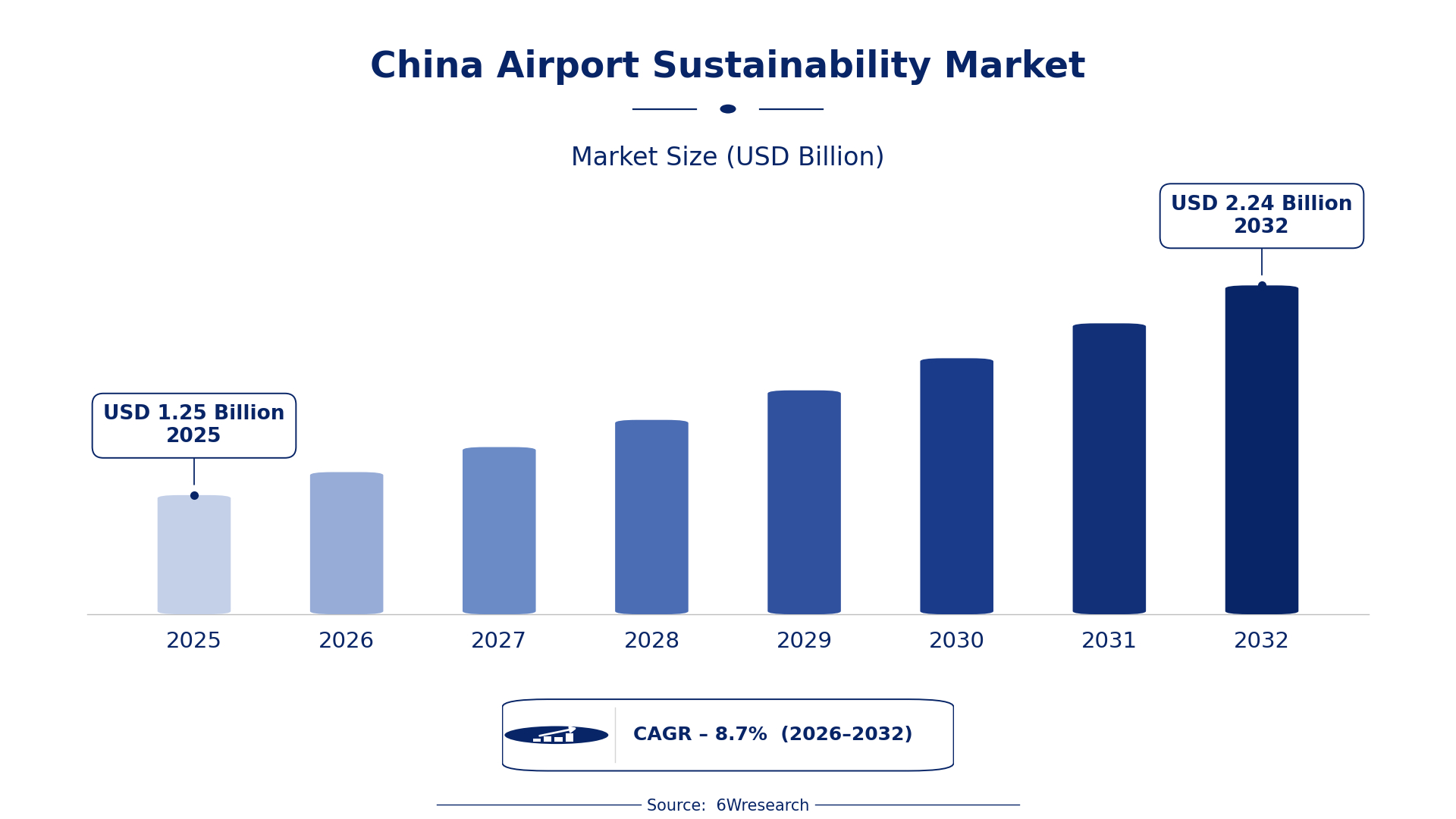
According to 6Wresearch internal database and industry insights, the China Airport Sustainability Market was valued at USD 1.25 billion in 2025 and is projected to reach USD 2.24 billion by 2032, growing at a CAGR of approximately 8.7% during 2026–2032.
China Airport Sustainability Market Highlights
| Report Metric | Details |
| Report Name | China Airport Sustainability Market |
| Market Size 2025 | USD 1.25 billion |
| Market Size 2032 | USD 2.24 billion |
| Absolute Growth 2025–2032 | USD 0.99 billion |
| CAGR 2026–2032 | 8.7% |
| Peak Annual Growth | 10.8% in 2027 |
| Forecast Period | 2026–2032 |
| Historical Data | 2022–2025 |
| Base Year | 2025 |
| Leading Initiative Type, 2025 | Renewable Energy Systems (41% share) |
| Leading Focus Area, 2025 | Solar/Wind (44% share) |
| Leading Distribution Channel, 2025 | Direct Sales (39% share) |
| Leading End User, 2025 | Airport Infrastructure (37% share) |
| Fastest-Growing Initiative Type | Waste Management Systems (10.8% CAGR) |
| Fastest-Growing Focus Area | Recycling/Composting (9.8% CAGR) |
| Fastest-Growing Distribution Channel | Industrial Suppliers (10.3% CAGR) |
| Fastest-Growing End User | Airport Facilities (10.3% CAGR) |
| Growing Sector | Airport Infrastructure |
| Key End Users | Airport Authorities, Airport Contractors, Airport Infrastructure, Airport Facilities |
China Airport Sustainability Market Year-wise Growth Rate and Key Drivers (2022–2032)
This graph illustrates the annual growth rates of the market from 2022 to 2032, highlighting a steady upward trajectory and projected market expansion over the forecast period.
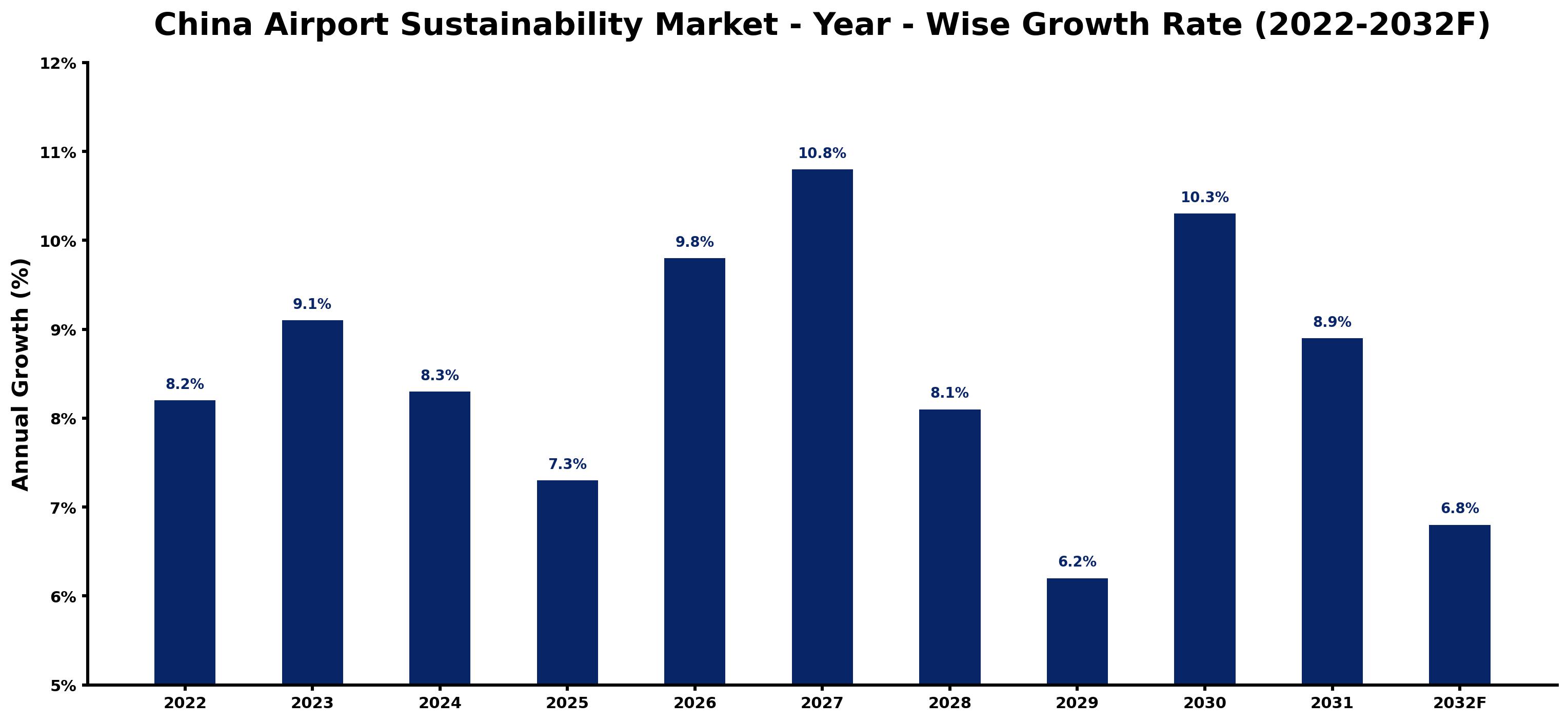
Below, each year's estimated growth is shown next to the factor that most influenced it.
| Year | Estimated Annual Growth (%) | Market Rationale |
| 2022 | 8.2 | The market experienced solid growth as airport authorities began implementing sustainability measures. |
| 2023 | 9.1 | Demand accelerated due to increased investments in renewable energy systems across major airports. |
| 2024 | 8.3 | Growth slowed as some projects faced delays in regulatory approvals and funding. |
| 2025 | 7.3 | The market continued to grow, albeit at a slower pace, as recycling initiatives were rolled out. |
| 2026 | 9.8 | A surge in airport infrastructure investment led to a faster growth rate this year. |
| 2027 | 10.8 | The peak growth year was driven by heightened focus on carbon emission control technologies. |
| 2028 | 8.1 | Growth decelerated as attention shifted towards long-term sustainability planning. |
| 2029 | 6.2 | The market saw a further slowdown as competition among suppliers intensified. |
| 2030 | 10.3 | Renewable energy adoption increased, driving a resurgence in growth rates this year. |
| 2031 | 8.9 | Demand stabilised as airport facilities implemented comprehensive waste management systems. |
| 2032 | 6.8 | Growth moderated as the market adjusted to new sustainability metrics and standards. |
Note: Market size estimations and growth projections presented in this report are based on 6Wresearch's proprietary forecasting methodology, utilizing the latest available industry data, government publications, and primary research inputs.
China Airport Sustainability Market Synopsis
Airport Sustainability in China encompasses technologies aimed at reducing environmental impact in airport operations. This includes renewable energy systems, waste management, and carbon emission control. The China Airport Sustainability Market is expanding due to rising passenger traffic and regulatory support for green initiatives. By 2035, the aviation sector is projected to reach 1.6 billion passengers, driving demand for sustainable practices. The Green Airport Construction Plan illustrates the government’s commitment to improving sustainability in airport projects nationwide.
Market Dynamics Impact Analysis (2026–2032)
| Factor | Type | Impact | Primary Segment Affected |
| Increasing passenger traffic drives demand for sustainable airport operations. | Driver | High | Airport Infrastructure |
| Government initiatives promote renewable energy adoption in airports. | Driver | High | Renewable Energy Systems |
| The growing focus on waste management systems presents investment opportunities. | Opportunity | High | Waste Management Systems |
| The push for LEED certification in new airport projects creates demand for green materials. | Opportunity | High | Green Building Materials |
| High initial investment costs for sustainability technologies may deter some airports. | Restraint | Medium | Airport Facilities |
| Limited availability of advanced recycling technologies can hinder waste management efforts. | Restraint | Medium | Waste Management Systems |
| The Airport Sustainability Market in China faces practical problems related to funding. | Challenge | High | Airport Authorities |
| Regulatory compliance can be complex and time-consuming for airport operators. | Challenge | Medium | Airport Contractors |
Evaluation of Drivers in China Airport Sustainability Market (2026–2032)
The main growth drivers and the segments they affect most are set out below.
| Drivers | Primary Segment Affected | Why It Matters (Evidence) |
| Rising passenger numbers increase the need for sustainable airport operations. | Airport Infrastructure | China's aviation sector is projected to reach 1.6 billion passengers by 2035, prompting investments in sustainability. |
| Government support for renewable energy systems boosts market growth. | Renewable Energy Systems | The National Development and Reform Commission's directive encourages renewable energy integration in airport operations. |
| The Green Airport Construction Plan promotes sustainable practices in new projects. | Carbon Emission Control | This plan outlines goals for reducing emissions, driving demand for related technologies. |
| Increased focus on waste management systems enhances recycling efforts. | Waste Management Systems | Airports aim for a 50% recycling rate by 2025, necessitating advanced waste management solutions. |
| Investment in solar energy systems supports sustainability initiatives. | Solar/Wind | China's solar energy capacity reached 392 GW in 2022, benefiting airport sustainability projects. |
The aviation sector is set to reach 1.6 billion passengers by 2035, prompting substantial investments in sustainable practices. Airports aim for a 50% recycling rate by 2025, necessitating advanced waste management technologies. China's solar energy capacity reached 392 GW in 2022, further supporting airport sustainability efforts.
Evaluation of Restraints in China Airport Sustainability Market
The following restraints limit how fast demand can grow.
| Market Restraint | Primary Segment Affected | Why It Matters (Evidence) |
| High initial investment costs for sustainability technologies may deter some airports. | Airport Facilities | The substantial capital required for implementing sustainability measures can limit participation from smaller airports. |
| Limited availability of advanced recycling technologies can hinder waste management efforts. | Waste Management Systems | The lack of effective recycling solutions may prevent airports from achieving their waste reduction targets. |
| Regulatory compliance can be complex and time-consuming for airport operators. | Airport Contractors | Navigating regulatory requirements can delay project timelines and increase costs for contractors. |
| Market competition among suppliers may lead to price pressures. | Airport Infrastructure | Increased competition can drive down prices, affecting profitability for suppliers of sustainability technologies. |
| Supply chain disruptions can impact the availability of essential components. | Renewable Energy Systems | Global supply chain issues may delay the procurement of critical renewable energy technologies. |
China Airport Sustainability Market Challenges
The China Airport Sustainability Market faces several practical problems, starting with high implementation costs for sustainable technologies. Many airports encounter initial investments exceeding 500 million CNY for upgrades, which delays project timelines for airport authorities. Funding competition presents another hurdle; only 30% of new projects aimed for LEED certification in 2022, limiting options for suppliers. Technological integration issues arise as outdated infrastructure can obstruct the adoption of renewable energy systems, reducing efficiency for airport operators. Regulatory compliance complicates matters, with evolving standards necessitating ongoing adjustments from airport management, leading to increased operational costs.
Trends in the China Airport Sustainability Market
Buyers and suppliers in the China Airport Sustainability Market are adjusting to the following trends.
- Shift towards Advanced Waste Management Systems: Airports are increasingly adopting advanced waste management systems, with the Beijing Daxing International Airport incorporating innovative technologies. This trend aims for a 50% recycling rate by 2025, strengthening sustainability efforts.
- Growing Adoption of Solar Energy: Solar energy capacity in China reached 392 GW in 2022, with Shanghai Pudong International Airport implementing solar panels generating 10 MW. This shift supports airport sustainability initiatives and reduces carbon footprints.
- Increased Focus on LEED Certification: New airport projects are increasingly aiming for LEED certification, with 30% of new projects targeting this standard in 2022. This focus promotes sustainable building practices across the sector.
- Implementation of Low-Emission Zones: Shanghai International Airport has adopted a low-emission zone policy since 2021, reducing emissions from vehicles. This initiative aligns with national goals for sustainable airport operations.
Investment Opportunities in the China Airport Sustainability Market
Some of the investment opportunities in the China Airport Sustainability Market are mentioned below.
- Investment in Waste Management Technologies: With a goal of achieving a 50% recycling rate by 2025, airports require advanced waste management solutions. This presents an opportunity for suppliers in the waste management sector to partner with airport authorities.
- Renewable Energy System Integration: The 2021 directive encourages airports to integrate renewable energy systems, creating demand for solar and wind technologies. Suppliers can enter through partnerships with airport contractors for project implementation.
- Green Building Materials for New Projects: As 30% of new airport projects aim for LEED certification, there is a growing need for green building materials. Suppliers can engage with airport construction groups to provide sustainable materials.
- Expansion of Carbon Emission Control Technologies: The Green Airport Initiative aims to reduce emissions by 20% by 2025, presenting an opportunity for technology providers. Collaborating with airport authorities can facilitate market entry.
Government Initiatives in the China Airport Sustainability Market
The Green Airport Construction Plan by the Civil Aviation Administration of China, launched in 2021, establishes guidelines for improving sustainability in airport projects nationwide. This measure sets clear directives for integrating renewable energy systems and waste management practices in airport operations. Additionally, the updated National Standard for Green Airport Construction includes metrics for sustainable building practices, ensuring compliance with environmental standards in new developments.
The Ministry of Ecology and Environment oversees the Green Airport Initiative, which aims to reduce emissions by 20% by 2025. This initiative provides funding for airport sustainability projects, supporting the implementation of renewable energy and waste management systems. The National Development and Reform Commission also plays a role by approving directives that encourage renewable energy use in airport operations, promoting a more sustainable aviation sector.
Future Insight of the China Airport Sustainability Market
By 2032, buyers and suppliers in the China Airport Sustainability Market can expect substantial advancements driven by government initiatives and technological progress. The National Development and Reform Commission's support for renewable energy will likely enhance solar energy capacity, with 10 MW already generated at Shanghai Pudong International Airport. Waste management improvements will target a recycling rate of 50%, streamlining operations for airport management. The Green Airport Initiative will further promote emission reductions, creating a more sustainable aviation environment.
Market Segmentation Analysis
The report offers a comprehensive study of the following market segments and their leading categories in the market.
By Initiative Type – Renewable Energy Systems Dominated, Waste Management Systems Expected to Grow Fastest
According to Shubham Padhi, Research Analyst at 6Wresearch, with a 41% revenue share in 2025, Renewable Energy Systems was the largest initiative type category. Renewable energy systems hold the largest market share due to their critical role in reducing the carbon footprint of airport operations. The Civil Aviation Administration of China's Green Airport Construction Plan underscores the importance of these systems in new airport developments. Waste Management Systems are projected to grow fastest, at a CAGR of 10.8% during 2026–2032. The rapid growth of waste management systems is propelled by the government's ambitious goal of achieving a 50% recycling rate by 2025. This initiative is part of the broader Green Airport Initiative, which seeks to significantly lower emissions across the aviation sector. Suppliers must focus on advancing waste management technologies to align with regulatory standards and enhance their competitive edge.
By Focus Area – Solar/Wind Dominated, Recycling/Composting Expected to Grow Fastest
Solar/Wind took a 44% share of focus area in 2025, more than any other category. Solar and wind energy sources lead the market share as they are the primary renewable energy solutions implemented in airports across China. The installation of solar panels at Shanghai Pudong International Airport exemplifies the widespread adoption of these renewable technologies. Over 2026–2032, Recycling/Composting is expected to post the fastest growth, at a CAGR of 9.8%. The growth of recycling and composting initiatives is accelerating, driven by comprehensive recycling efforts like those at Chengdu Airport. This emphasis on waste reduction is essential for meeting local sustainability targets established by government authorities. Buyers should prioritise sustainable energy solutions to comply with regulatory mandates and improve operational efficiency.
By Distribution Channel – Direct Sales Dominated, Industrial Suppliers Expected to Grow Fastest
Direct Sales accounted for a 39% market share by distribution channel in 2025. Direct sales hold the largest share of the distribution channel because they represent the most common method for delivering sustainability products to airports. This approach enables tailored solutions that cater to the specific needs of each airport. Industrial Suppliers are set to record the highest CAGR in this split, 10.3% over 2026–2032. Industrial suppliers are experiencing the fastest growth due to their critical role in providing the necessary components for sustainable airport operations. Their involvement is increasingly important as airports seek to incorporate advanced technologies into their infrastructure. Suppliers should cultivate strong relationships with industrial suppliers to ensure a reliable supply of components for sustainability initiatives.
By End User – Airport Infrastructure Dominated, Airport Facilities Expected to Grow Fastest
In 2025, Airport Infrastructure led the end user split with a 37% share. Airport infrastructure commands the largest market share as it is the main user of sustainability products and technologies. The substantial investment in airport infrastructure throughout China reinforces the significance of incorporating sustainable practices. The quickest growth will come from Airport Facilities, forecast to expand at a CAGR of 10.3% between 2026 and 2032. Airport facilities represent the fastest-growing end user segment, driven by increasing demand for sustainable solutions that improve operational efficiency. This trend reflects a broader commitment to sustainability within airport management and operations. Buyers need to invest in sustainable solutions for airport facilities to meet evolving environmental standards and enhance overall performance.
Key Attractiveness of the Report
- 10 Years of Market Numbers
- Historical Data Starting from 2022 to 2025
- Base Year 2025
- Forecast Data until 2032
- Key Performance Indicators Impacting the Market
- Major Upcoming Developments and Projects
Key Highlights of the Report:
- China Airport Sustainability Market Outlook
- Market Size of China Airport Sustainability Market, 2025
- Forecast of China Airport Sustainability Market, 2032
- Historical Data and Forecast of China Airport Sustainability Revenues & Volume for the Period 2022 - 2032F
- China Airport Sustainability Market Trend Evolution
- China Airport Sustainability Market Drivers and Challenges
- China Airport Sustainability Price Trends
- China Airport Sustainability Porter's Five Forces
- China Airport Sustainability Industry Life Cycle
- Historical Data and Forecast of China Airport Sustainability Market Revenues & Volume By Initiative Type for the Period 2022 - 2032F
- Historical Data and Forecast of China Airport Sustainability Market Revenues & Volume By Renewable Energy Systems for the Period 2022 - 2032F
- Historical Data and Forecast of China Airport Sustainability Market Revenues & Volume By Waste Management Systems for the Period 2022 - 2032F
- Historical Data and Forecast of China Airport Sustainability Market Revenues & Volume By Carbon Emission Control for the Period 2022 - 2032F
- Historical Data and Forecast of China Airport Sustainability Market Revenues & Volume By Green Building Materials for the Period 2022 - 2032F
- Historical Data and Forecast of China Airport Sustainability Market Revenues & Volume By Focus Area for the Period 2022 - 2032F
- Historical Data and Forecast of China Airport Sustainability Market Revenues & Volume By Solar/Wind for the Period 2022 - 2032F
- Historical Data and Forecast of China Airport Sustainability Market Revenues & Volume By Recycling/Composting for the Period 2022 - 2032F
- Historical Data and Forecast of China Airport Sustainability Market Revenues & Volume By Low-Emission Zones for the Period 2022 - 2032F
- Historical Data and Forecast of China Airport Sustainability Market Revenues & Volume By LEED-Certified for the Period 2022 - 2032F
- Historical Data and Forecast of China Airport Sustainability Market Revenues & Volume By Distribution Channel for the Period 2022 - 2032F
- Historical Data and Forecast of China Airport Sustainability Market Revenues & Volume By Direct Sales for the Period 2022 - 2032F
- Historical Data and Forecast of China Airport Sustainability Market Revenues & Volume By Industrial Suppliers for the Period 2022 - 2032F
- Historical Data and Forecast of China Airport Sustainability Market Revenues & Volume By Online Platforms for the Period 2022 - 2032F
- Historical Data and Forecast of China Airport Sustainability Market Revenues & Volume By Specialty Stores for the Period 2022 - 2032F
- Historical Data and Forecast of China Airport Sustainability Market Revenues & Volume By End User for the Period 2022 - 2032F
- Historical Data and Forecast of China Airport Sustainability Market Revenues & Volume By Airport Infrastructure for the Period 2022 - 2032F
- Historical Data and Forecast of China Airport Sustainability Market Revenues & Volume By Airport Facilities for the Period 2022 - 2032F
- Historical Data and Forecast of China Airport Sustainability Market Revenues & Volume By Airport Authorities for the Period 2022 - 2032F
- Historical Data and Forecast of China Airport Sustainability Market Revenues & Volume By Airport Contractors for the Period 2022 - 2032F
- China Airport Sustainability Import Export Trade Statistics
- Market Opportunity Assessment By Initiative Type
- Market Opportunity Assessment By Focus Area
- Market Opportunity Assessment By Distribution Channel
- Market Opportunity Assessment By End User
- China Airport Sustainability Top Companies Market Share
- China Airport Sustainability Competitive Benchmarking By Technical and Operational Parameters
- China Airport Sustainability Company Profiles
- China Airport Sustainability Key Strategic Recommendations
Market Covered
This report examines the market across the segments below.
By Initiative Type
- Renewable Energy Systems
- Waste Management Systems
- Carbon Emission Control
- Green Building Materials
By Focus Area
- Solar/Wind
- Recycling/Composting
- Low-Emission Zones
- LEED-Certified
By Distribution Channel
- Direct Sales
- Industrial Suppliers
- Online Platforms
- Specialty Stores
By End User
- Airport Infrastructure
- Airport Facilities
- Airport Authorities
- Airport Contractors































