China Airport Wireless Infrastructure Market Size & Growth Rate
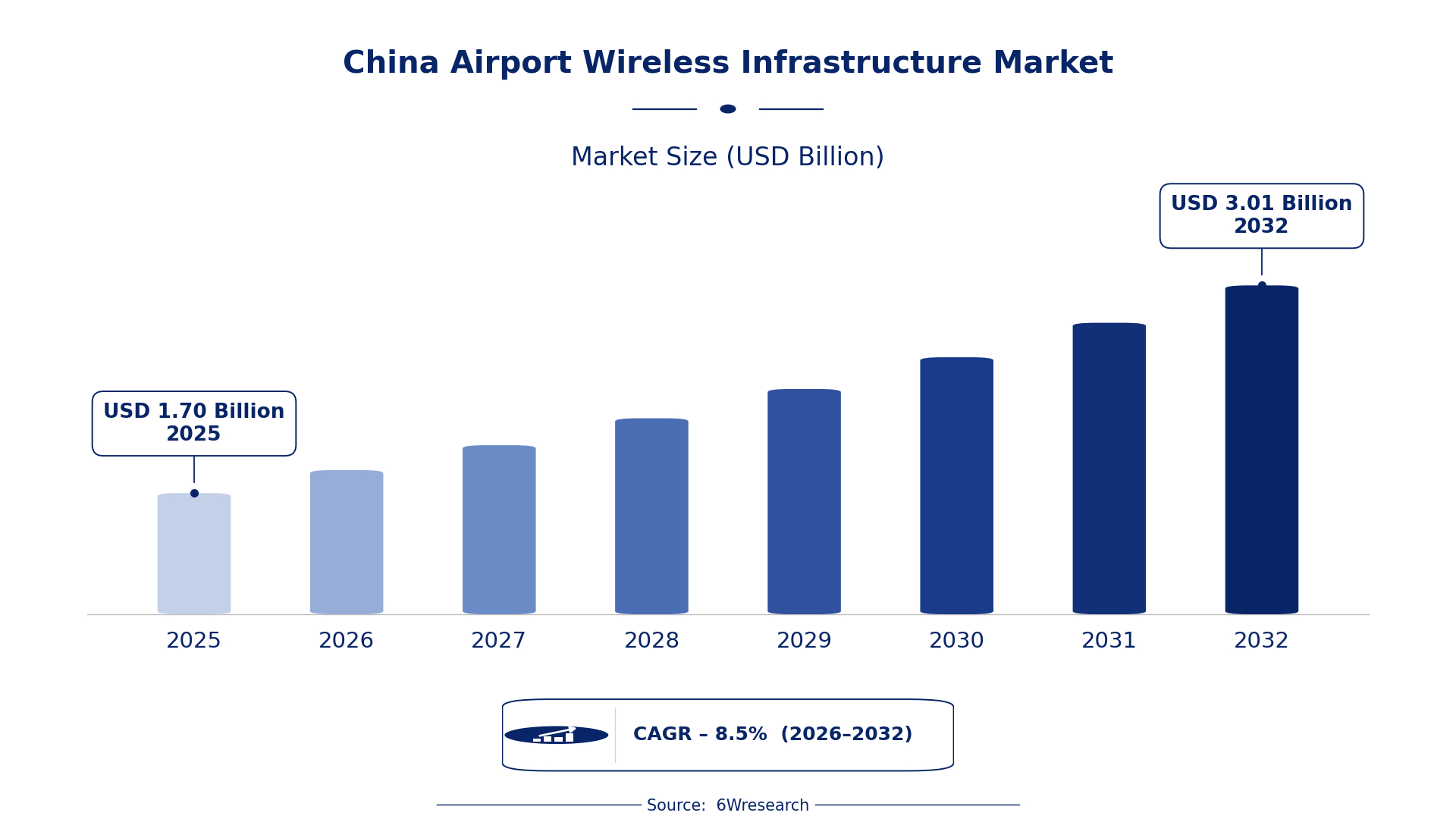
According to 6Wresearch internal database and industry insights, the China Airport Wireless Infrastructure Market was valued at USD 1.70 billion in 2025 and is projected to reach USD 3.01 billion by 2032, growing at a CAGR of approximately 8.5% during 2026–2032.
China Airport Wireless Infrastructure Market Highlights
| Report Metric | Details |
| Report Name | China Airport Wireless Infrastructure Market |
| Market Size 2025 | USD 1.70 billion |
| Market Size 2032 | USD 3.01 billion |
| Absolute Growth 2025–2032 | USD 1.31 billion |
| CAGR 2026–2032 | 8.5% |
| Peak Annual Growth | 10.9% in 2027 |
| Forecast Period | 2026–2032 |
| Historical Data | 2022–2025 |
| Base Year | 2025 |
| Leading Infrastructure Type, 2025 | Wi-Fi Access Points (43% share) |
| Leading Network Type, 2025 | 5 GHz/2.4 GHz (41% share) |
| Leading Distribution Channel, 2025 | Direct Sales (35% share) |
| Leading End User, 2025 | Public Terminals (47% share) |
| Fastest-Growing Infrastructure Type | IoT Sensor Networks (11.3% CAGR) |
| Fastest-Growing Distribution Channel | Industrial Suppliers (11.2% CAGR) |
| Fastest-Growing End User | Smart Gateways (9.6% CAGR) |
| Growing Sector | Airport Infrastructure |
| Key End Users | Public Terminals, Airport Authorities, Technology Providers |
China Airport Wireless Infrastructure Market Year-wise Growth Rate and Key Drivers (2022–2032)
This graph illustrates the annual growth rates of the market from 2022 to 2032, highlighting a steady upward trajectory and projected market expansion over the forecast period.
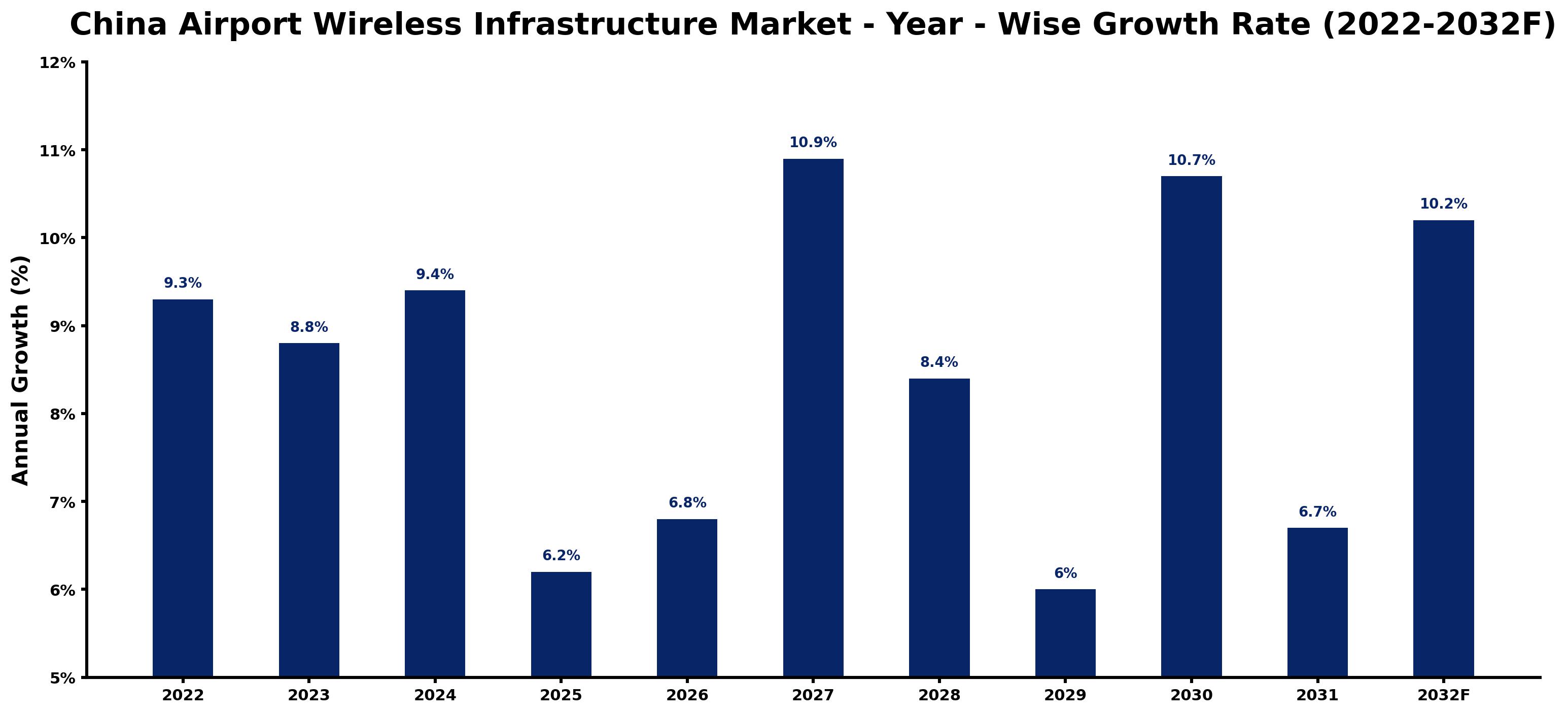
Annual growth estimates for each year appear below with the principal reason behind them, explaining the shifts that set the pace of the market.
| Year | Estimated Annual Growth (%) | Market Rationale |
| 2022 | 9.3 | Passenger traffic increased, boosting demand for wireless infrastructure. |
| 2023 | 8.8 | Growth slowed as airport modernization projects faced delays in implementation. |
| 2024 | 9.4 | A surge in passenger numbers led to heightened infrastructure investments. |
| 2025 | 6.2 | Market growth decelerated as some airports completed major upgrades. |
| 2026 | 6.8 | Investment in IoT sensor networks is expected to accelerate demand for infrastructure. |
| 2027 | 10.9 | Peak growth will occur as the 5G in Airports program gains momentum. |
| 2028 | 8.4 | Demand slowed as the market adjusted to new technological standards. |
| 2029 | 6.0 | Growth continued but at a reduced pace due to the '5G in Airports' initiative. |
| 2030 | 10.7 | Technological advancements in indoor navigation will spur renewed investment. |
| 2031 | 6.7 | Market growth slowed as infrastructure upgrades reached completion. |
| 2032 | 10.2 | Increased focus on encrypted WLAN systems will drive demand higher. |
Note: Market size estimations and growth projections presented in this report are based on 6Wresearch's proprietary forecasting methodology, utilizing the latest available industry data, government publications, and primary research inputs.
China Airport Wireless Infrastructure Market Synopsis
The China Airport Wireless Infrastructure Market includes technologies like Wi-Fi access points and IoT sensor networks, which are key to enhancing connectivity and operational efficiency in airports. These systems work alongside existing infrastructure to improve passenger services. The market is growing due to substantial investments in airport modernisation and increasing passenger traffic, with over 200 international airports needing advanced wireless solutions. The 2023 National Airport Development Plan highlights digital transformation, further boosting demand for these technologies.
Market Dynamics Impact Analysis (2026–2032)
| Factor | Type | Impact | Primary Segment Affected |
| Investment in airport modernization projects is increasing demand for advanced wireless infrastructure. | Driver | High | Wi-Fi Access Points |
| Growing passenger traffic necessitates improved connectivity solutions in airports. | Driver | High | IoT Sensor Networks |
| The upcoming 5G in Airports program will create opportunities for infrastructure upgrades. | Opportunity | High | 5 GHz/2.4 GHz |
| Public terminals are increasingly seeking advanced navigation systems to enhance passenger experience. | Opportunity | Medium | Indoor Navigation |
| High costs associated with infrastructure upgrades can limit investment. | Restraint | High | Staff Communication |
| Supply chain disruptions for wireless components can delay project timelines. | Restraint | Medium | Encrypted WLAN |
| Regulatory compliance can complicate infrastructure upgrades. | Challenge | High | IoT Sensor Networks |
| Limited availability of skilled technicians can impact project timelines. | Challenge | Medium | Indoor Navigation |
Evaluation of Drivers in China Airport Wireless Infrastructure Market (2026–2032)
The table below links each growth driver to the segment it affects and the evidence for it.
| Drivers | Primary Segment Affected | Why It Matters (Evidence) |
| Increased passenger traffic drives demand for Wi-Fi access points. | Wi-Fi Access Points | In 2022, passenger traffic rose by 10%, prompting airports to improve connectivity. |
| Investment in IoT sensor networks improves operational efficiency. | IoT Sensor Networks | The Shanghai Hongqiao International Airport's implementation of IoT systems improved management. |
| 5G technology deployment boosts wireless communication capabilities. | 5 GHz/2.4 GHz | The '5G in Airports' initiative aims to deploy advanced networks by 2025. |
| Public terminals are investing in advanced navigation systems. | Indoor Navigation | The 2023 Smart Airport Technology Conference highlighted advancements in navigation. |
| Encrypted WLAN systems are essential for data security in airports. | Encrypted WLAN | The Civil Aviation Administration updated security standards to include encrypted WLAN. |
Expansion of the Airport Wireless Infrastructure market in China is backed by rising passenger traffic, substantial investments in technology, and the push for operational efficiency. In 2022, the Civil Aviation Administration reported a 10% increase in passenger traffic, leading to greater demand for Wi-Fi access points. The implementation of IoT sensor networks at major airports improves operational management, further driving demand. With over 1,000 Wi-Fi access points installed, airports are prioritising infrastructure upgrades to improve passenger experience.
Evaluation of Restraints in China Airport Wireless Infrastructure Market
The main factors holding the market back are set out below.
| Market Restraint | Primary Segment Affected | Why It Matters (Evidence) |
| High costs of infrastructure upgrades can deter investment. | Staff Communication | Upgrading communication systems can require substantial financial resources, limiting some airports' ability to invest. |
| Supply chain disruptions for wireless components can delay projects. | Encrypted WLAN | Delays in obtaining necessary components can extend timelines for implementing security measures. |
| Market saturation in major airports may limit growth opportunities. | Wi-Fi Access Points | As most major airports have implemented basic wireless infrastructure, growth potential is constrained. |
| Regulatory compliance can complicate infrastructure upgrades. | IoT Sensor Networks | Meeting updated security standards can slow down the deployment of new technologies. |
| Limited availability of skilled technicians can impact project timelines. | Indoor Navigation | A shortage of qualified personnel can delay the installation of advanced navigation systems. |
China Airport Wireless Infrastructure Market Challenges
The China Airport Wireless Infrastructure Market faces notable regulatory challenges, as compliance with the National Standard GB/T 32960-2016 can postpone project approvals by up to six months, disrupting producers' timelines. Supply issues stem from dependence on imported components, leading to cost increases of around 15% for buyers when tariffs are applied. A shortage of skilled professionals in advanced networking technologies complicates the deployment of airport wireless infrastructure, resulting in project delays averaging three months for producers. Intense competition among suppliers for contracts leads to aggressive pricing strategies, which can erode profit margins and limit investment in quality upgrades for buyers.
Trends in the China Airport Wireless Infrastructure Market
Four trends stand out in the China Airport Wireless Infrastructure Market.
- Shift towards IoT Integration in Airports: Since 2022, airports have increasingly adopted IoT sensor networks to improve operational efficiency. The Shanghai Hongqiao International Airport serves as a leading example, utilising these networks to streamline operations.
- Increased Focus on Encrypted WLAN Systems: The 2023 update to the Airport Security Standards has led to a greater emphasis on encrypted WLAN systems for data security. This shift is vital for ensuring passenger information is protected.
- Growth in Indoor Navigation Technologies: The 2023 Smart Airport Technology Conference showcased advancements in indoor navigation systems, with a notable increase in installations at major airports, improving passenger experience.
- Expansion of 5G Networks in Airports: The '5G in Airports' initiative initiated in 2022 is set to revolutionise connectivity, with plans to deploy 5G networks across all major airports by 2025.
Investment Opportunities in the China Airport Wireless Infrastructure Market
The following opportunities in the China Airport Wireless Infrastructure Market pair current demand with a clear way in.
- Investment in Smart Gateways: With the 2023 budget earmarking funds for wireless upgrades, there is a strong opportunity to invest in smart gateways. Public terminals are seeking solutions to manage connectivity efficiently.
- Demand for Advanced Navigation Systems: The focus on enhancing passenger experience creates a need for advanced navigation systems. Airports in Guangdong province are actively searching for suppliers of these technologies.
- Growth in IoT Sensor Networks: Ongoing investments in airport modernisation projects provide an opportunity to supply IoT sensor networks. Major airports aim to boost operational efficiency through these systems.
- Focus on Encrypted WLAN Solutions: The updated Airport Security Standards generate demand for encrypted WLAN solutions. Suppliers can enter the market by partnering with public terminals to ensure compliance.
Government Initiatives in the China Airport Wireless Infrastructure Market
The Smart Airport Initiative launched by the National Development and Reform Commission in 2021 aims to improve digital infrastructure in airports, focusing on wireless technologies. This initiative is expected to drive investments in airport wireless infrastructure, ensuring that airports meet modern connectivity demands. The 2023 budget allocated substantial funding for upgrading wireless infrastructure, supporting the initiative's goals. Furthermore, the Digital Economy Development Plan by the State Council includes provisions for improving wireless infrastructure in transportation hubs, including airports.
The Airport Wireless Connectivity Plan, overseen by the Ministry of Transport and approved in 2022, aims to improve passenger services and operational efficiency across major airports. This plan provides guidelines for implementing advanced wireless solutions, ensuring that airports can meet the growing demand for connectivity. Additionally, the Civil Aviation Administration of China enforces updated security standards, including requirements for encrypted WLAN systems, improving data security for airport operations. These measures collectively support the development of a strong wireless infrastructure in airports.
Future Insight of the China Airport Wireless Infrastructure Market
Several forward-looking factors should support the China Airport Wireless Infrastructure Market in the coming years. The 2023 National Airport Development Plan emphasises digital transformation, prompting investments in modern technologies. By 2032, major airports are projected to install over 1,000 Wi-Fi access points, improving connectivity for passengers. The focus on encrypted WLAN for security will drive demand, ensuring safer services for users. Innovations in indoor navigation systems will enhance passenger experiences, contributing to more efficient airport operations.
Market Segmentation Analysis
The report offers a comprehensive study of the following market segments and their leading categories in the market.
By Infrastructure Type – Wi-Fi Access Points Dominated, IoT Sensor Networks Expected to Grow Fastest
According to Shubham Padhi, Research Analyst at 6Wresearch, in 2025, Wi-Fi Access Points led the infrastructure type split with a 43% share. Wi-Fi access points dominate the market as they are essential for providing internet access across more than 200 international airports in China. Facilities like Beijing Capital International Airport exemplify their extensive use, significantly enhancing connectivity for both passengers and staff. IoT Sensor Networks are set to record the highest CAGR in this split, 11.3% over 2026–2032. IoT sensor networks are experiencing rapid growth as airports increasingly adopt these technologies for operational management, with Shanghai Hongqiao International Airport demonstrating their efficiency. This trend is expected to continue as airports modernise to boost overall operational performance. Suppliers should enhance their Wi-Fi access point offerings while also investing in IoT sensor technologies to meet the rising demand.
By Network Type – 5 GHz/2.4 GHz Dominated and Is Expected to Record the Fastest Growth
With a 41% revenue share in 2025, 5 GHz/2.4 GHz was the largest network type category. The 5 GHz/2.4 GHz network type holds the largest market share as it is fundamental for wireless communication in airports, ensuring seamless connectivity for passengers and operational systems. This technology aligns with the National Standard GB/T 32960-2016, guaranteeing compliance and reliability. The same category is also set to grow fastest, at a CAGR of 10.4% during 2026–2032. The 5 GHz/2.4 GHz network type is also the fastest-growing segment due to its critical role in supporting the increasing number of connected devices in airports, ensuring high-speed internet access. As digital transformation initiatives accelerate, this network type's lead will continue to widen. Buyers should focus on investing in 5 GHz/2.4 GHz network solutions to ensure robust connectivity as passenger traffic rises.
By Distribution Channel – Direct Sales Dominated, Industrial Suppliers Expected to Grow Fastest
Direct Sales took a 35% share of distribution channel in 2025, more than any other category. Direct sales lead the distribution channel as the primary procurement method for airport wireless infrastructure. This approach allows for tailored solutions that meet the specific needs of major hubs, particularly in regions like Guangdong province. Industrial Suppliers are projected to grow fastest, at a CAGR of 11.2% during 2026–2032. Industrial suppliers are the fastest-growing channel, supplying essential equipment for airport wireless infrastructure projects. Their growth is driven by the increasing demand for modernisation and the substantial investments highlighted in the 2023 budget. Suppliers should strengthen partnerships with industrial suppliers to expand market reach and address the growing need for wireless infrastructure.
By End User – Public Terminals Dominated, Smart Gateways Expected to Grow Fastest
The largest end user category in 2025 was Public Terminals, with a 47% share of total revenue. Public terminals represent the largest end-user segment as they are the primary deployment sites for airport wireless infrastructure, directly impacting passenger experience across China's extensive airport network. This segment's significance is underscored by the ongoing investments in airport modernisation. The quickest growth will come from Smart Gateways, forecast to expand at a CAGR of 9.6% between 2026 and 2032. Smart gateways are the fastest-growing end-user segment, integral for managing connectivity and data flow in modern airport environments. As airports implement more advanced technologies, the demand for smart gateways will continue to rise, further widening the lead of public terminals. Suppliers should develop solutions tailored for public terminals while also addressing the emerging needs of smart gateways to capture market opportunities.
Key Attractiveness of the Report
- 10 Years of Market Numbers
- Historical Data Starting from 2022 to 2025
- Base Year 2025
- Forecast Data until 2032
- Key Performance Indicators Impacting the Market
- Major Upcoming Developments and Projects
Key Highlights of the Report:
- China Airport Wireless Infrastructure Market Outlook
- Market Size of China Airport Wireless Infrastructure Market, 2025
- Forecast of China Airport Wireless Infrastructure Market, 2032
- Historical Data and Forecast of China Airport Wireless Infrastructure Revenues & Volume for the Period 2022 - 2032F
- China Airport Wireless Infrastructure Market Trend Evolution
- China Airport Wireless Infrastructure Market Drivers and Challenges
- China Airport Wireless Infrastructure Price Trends
- China Airport Wireless Infrastructure Porter's Five Forces
- China Airport Wireless Infrastructure Industry Life Cycle
- Historical Data and Forecast of China Airport Wireless Infrastructure Market Revenues & Volume By Infrastructure Type for the Period 2022 - 2032F
- Historical Data and Forecast of China Airport Wireless Infrastructure Market Revenues & Volume By Wi-Fi Access Points for the Period 2022 - 2032F
- Historical Data and Forecast of China Airport Wireless Infrastructure Market Revenues & Volume By IoT Sensor Networks for the Period 2022 - 2032F
- Historical Data and Forecast of China Airport Wireless Infrastructure Market Revenues & Volume By Indoor Navigation for the Period 2022 - 2032F
- Historical Data and Forecast of China Airport Wireless Infrastructure Market Revenues & Volume By Staff Communication for the Period 2022 - 2032F
- Historical Data and Forecast of China Airport Wireless Infrastructure Market Revenues & Volume By Network Type for the Period 2022 - 2032F
- Historical Data and Forecast of China Airport Wireless Infrastructure Market Revenues & Volume By 5 GHz/2.4 GHz for the Period 2022 - 2032F
- Historical Data and Forecast of China Airport Wireless Infrastructure Market Revenues & Volume By LPWAN/Bluetooth for the Period 2022 - 2032F
- Historical Data and Forecast of China Airport Wireless Infrastructure Market Revenues & Volume By Beacon Technology for the Period 2022 - 2032F
- Historical Data and Forecast of China Airport Wireless Infrastructure Market Revenues & Volume By Encrypted WLAN for the Period 2022 - 2032F
- Historical Data and Forecast of China Airport Wireless Infrastructure Market Revenues & Volume By Distribution Channel for the Period 2022 - 2032F
- Historical Data and Forecast of China Airport Wireless Infrastructure Market Revenues & Volume By Direct Sales for the Period 2022 - 2032F
- Historical Data and Forecast of China Airport Wireless Infrastructure Market Revenues & Volume By Online Platforms for the Period 2022 - 2032F
- Historical Data and Forecast of China Airport Wireless Infrastructure Market Revenues & Volume By Industrial Suppliers for the Period 2022 - 2032F
- Historical Data and Forecast of China Airport Wireless Infrastructure Market Revenues & Volume By Specialty Stores for the Period 2022 - 2032F
- Historical Data and Forecast of China Airport Wireless Infrastructure Market Revenues & Volume By End User for the Period 2022 - 2032F
- Historical Data and Forecast of China Airport Wireless Infrastructure Market Revenues & Volume By Public Terminals for the Period 2022 - 2032F
- Historical Data and Forecast of China Airport Wireless Infrastructure Market Revenues & Volume By Smart Gateways for the Period 2022 - 2032F
- Historical Data and Forecast of China Airport Wireless Infrastructure Market Revenues & Volume By Passenger Assistance for the Period 2022 - 2032F
- Historical Data and Forecast of China Airport Wireless Infrastructure Market Revenues & Volume By Operations Control for the Period 2022 - 2032F
- China Airport Wireless Infrastructure Import Export Trade Statistics
- Market Opportunity Assessment By Infrastructure Type
- Market Opportunity Assessment By Network Type
- Market Opportunity Assessment By Distribution Channel
- Market Opportunity Assessment By End User
- China Airport Wireless Infrastructure Top Companies Market Share
- China Airport Wireless Infrastructure Competitive Benchmarking By Technical and Operational Parameters
- China Airport Wireless Infrastructure Company Profiles
- China Airport Wireless Infrastructure Key Strategic Recommendations
Market Covered
The report offers an extensive study of the following market segments.
By Infrastructure Type
- Wi-Fi Access Points
- IoT Sensor Networks
- Indoor Navigation
- Staff Communication
By Network Type
- 5 GHz/2.4 GHz
- LPWAN/Bluetooth
- Beacon Technology
- Encrypted WLAN
By Distribution Channel
- Direct Sales
- Online Platforms
- Industrial Suppliers
- Specialty Stores
By End User
- Public Terminals
- Smart Gateways
- Passenger Assistance
- Operations Control































