China Airport Systems Integration Market Size & Growth Rate
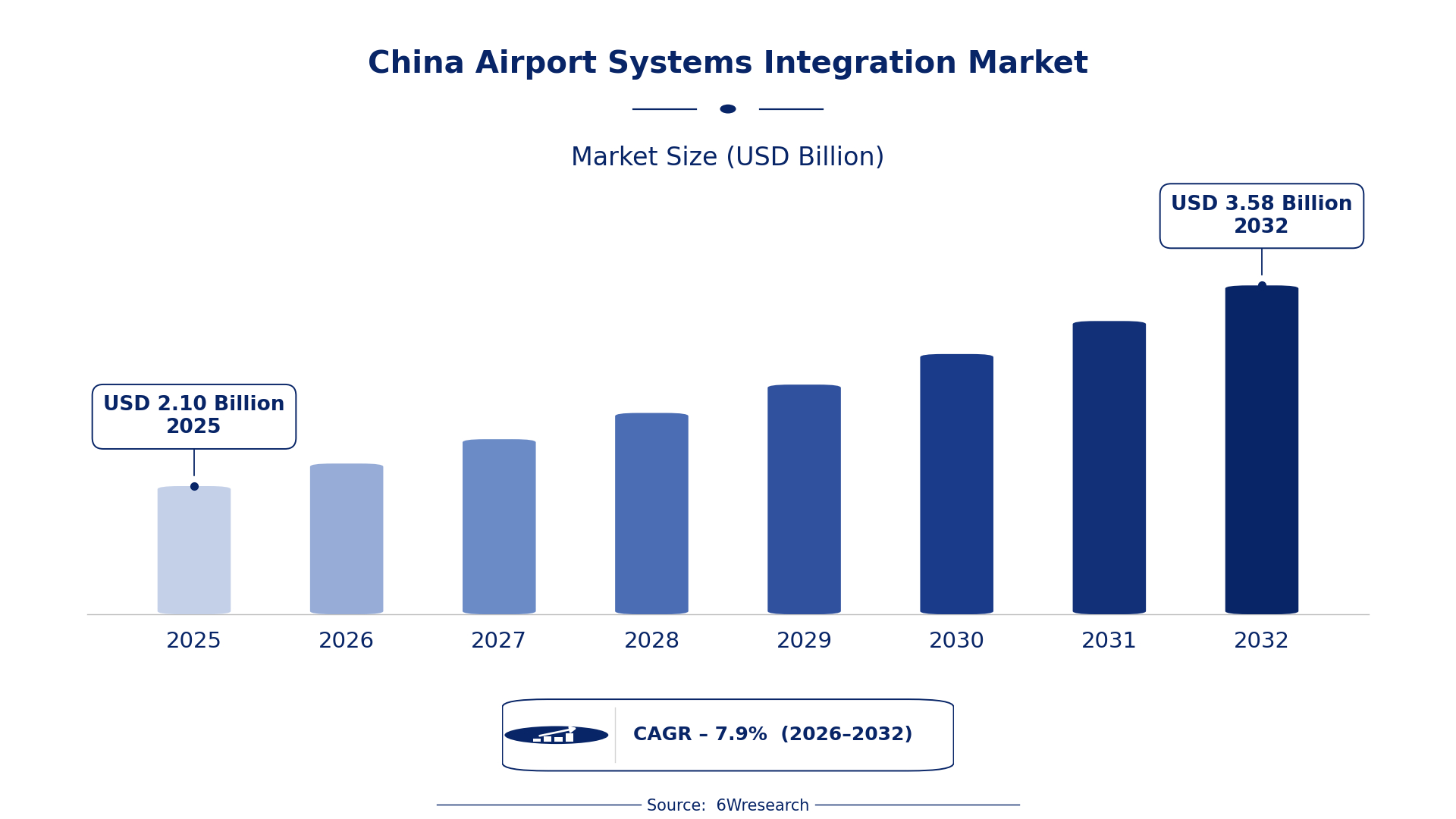
According to 6Wresearch internal database and industry insights, the China Airport Systems Integration Market was valued at USD 2.10 billion in 2025 and is projected to reach USD 3.58 billion by 2032, growing at a CAGR of approximately 7.9% during 2026–2032.
China Airport Systems Integration Market Highlights
| Report Metric | Details |
| Report Name | China Airport Systems Integration Market |
| Market Size 2025 | USD 2.10 billion |
| Market Size 2032 | USD 3.58 billion |
| Absolute Growth 2025–2032 | USD 1.48 billion |
| CAGR 2026–2032 | 7.9% |
| Peak Annual Growth | 10.2% in 2027 |
| Forecast Period | 2026–2032 |
| Historical Data | 2022–2025 |
| Base Year | 2025 |
| Leading Integration Type, 2025 | IT Infrastructure (47% share) |
| Leading System Level, 2025 | Centralized (41% share) |
| Leading Distribution Channel, 2025 | Direct Sales (44% share) |
| Leading End User, 2025 | Smart Airports (38% share) |
| Fastest-Growing Integration Type | Building Automation (9.2% CAGR) |
| Fastest-Growing System Level | Security Systems (9.6% CAGR) |
| Fastest-Growing Distribution Channel | Online Platforms (9.8% CAGR) |
| Growing Sector | Smart Airports |
| Key End Users | Airport Security Teams, Airside Operations, Terminal Management |
China Airport Systems Integration Market Year-wise Growth Rate and Key Drivers (2022–2032)
This graph illustrates the annual growth rates of the market from 2022 to 2032, highlighting a steady upward trajectory and projected market expansion over the forecast period.
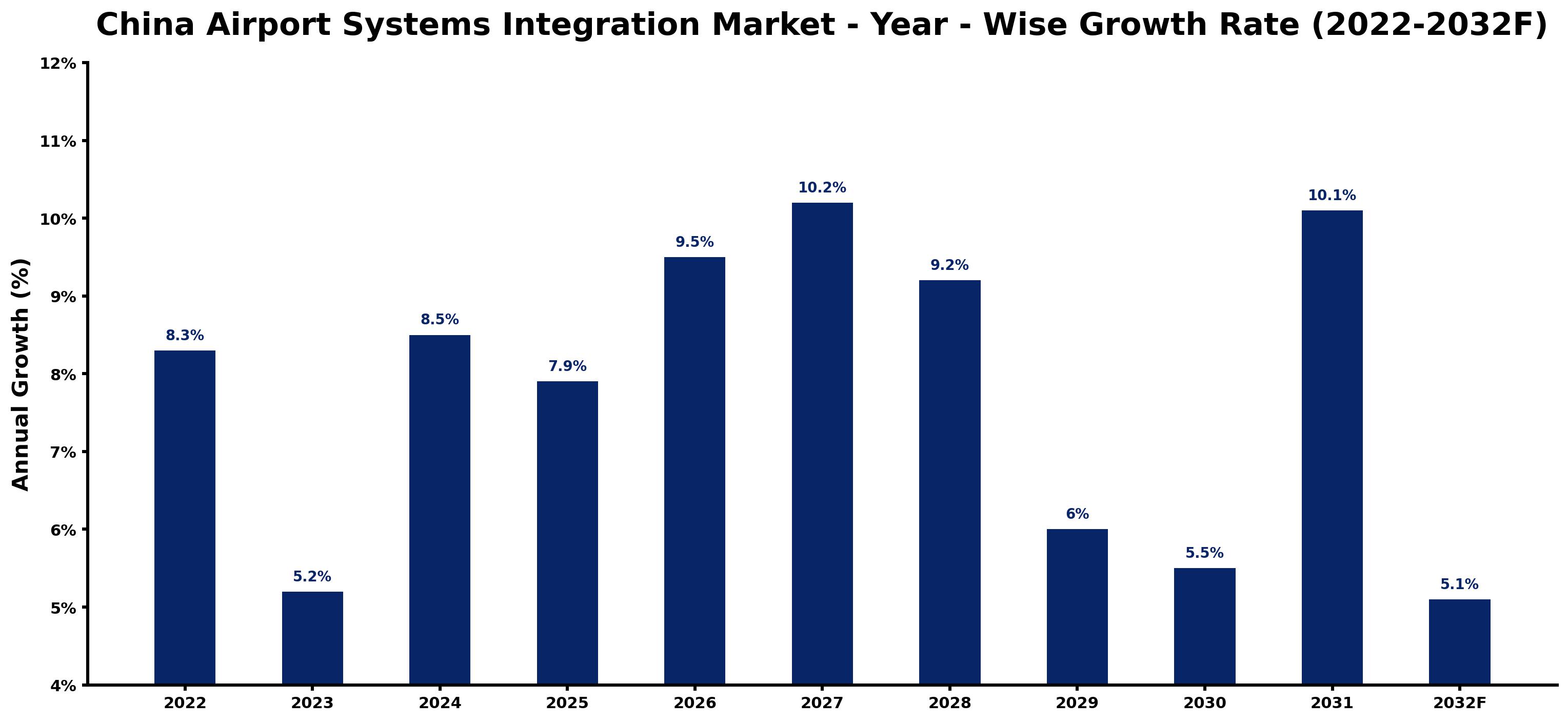
Below, each year's estimated growth is shown next to the factor that most influenced it.
| Year | Estimated Annual Growth (%) | Market Rationale |
| 2022 | 8.3 | The market experienced steady growth driven by increased airport passenger traffic, with 1.3 billion passengers recorded. |
| 2023 | 5.2 | Growth slowed due to the impact of global economic uncertainties and operational adjustments in airport projects. |
| 2024 | 8.5 | The market rebounded with faster growth as investments in smart technologies surged under the National Civil Aviation Development Strategy. |
| 2025 | 7.9 | Growth slowed again as projects faced delays from supply chain disruptions affecting integration timelines. |
| 2026 | 9.5 | The market is expected to rise with heightened investments in digital transformation initiatives across airports. |
| 2027 | 10.2 | A peak growth year is anticipated as smart airport projects gain momentum under the Smart Airport Development Plan. |
| 2028 | 9.2 | Growth is projected to slow as initial project implementations stabilise following the surge in investments. |
| 2029 | 6.0 | A further slowdown is expected as market adjustments take place post-peak in technology adoption. |
| 2030 | 5.5 | Growth will continue to decelerate as market maturity sets in, leading to more focused investments. |
| 2031 | 10.1 | The market is projected to experience a resurgence with renewed investments in airport technologies driven by increased passenger traffic. |
| 2032 | 5.1 | Growth will normalise as the market stabilises after a period of high activity and investment. |
Note: Market size estimations and growth projections presented in this report are based on 6Wresearch's proprietary forecasting methodology, utilizing the latest available industry data, government publications, and primary research inputs.
China Airport Systems Integration Market Synopsis
Airport Systems Integration in China focuses on merging various technologies to enhance airport operations and security. This collaboration among technology providers aims to streamline passenger flow and boost operational efficiency. The China Airport Systems Integration Market is expanding due to substantial investments in smart airport initiatives and an increase in passenger volume, which reached 1.3 billion in 2022. The Civil Aviation Administration of China is driving demand for advanced integration solutions and technologies through initiatives outlined in the National Civil Aviation Development Strategy.
Market Dynamics Impact Analysis (2026–2032)
| Factor | Type | Impact | Primary Segment Affected |
| Increasing passenger traffic drives demand for efficient airport operations. | Driver | High | IT Infrastructure |
| Ongoing smart airport initiatives create opportunities for advanced integration solutions. | Driver | High | Smart Airports |
| The gap in energy-efficient solutions presents a chance for building automation investments. | Opportunity | Medium | Building Automation |
| Growing demand for enhanced security systems opens new markets for integration solutions. | Opportunity | Medium | Access Control Integration |
| High initial investment costs can deter smaller airports from upgrading systems. | Restraint | High | Communications Integration |
| Regulatory compliance requirements may slow down project implementations. | Restraint | Medium | Security Systems |
| The need for skilled professionals in integration technology is a major challenge. | Challenge | High | IT Infrastructure |
| Supply chain disruptions can delay project timelines and increase costs. | Challenge | Medium | Centralized |
Evaluation of Drivers in China Airport Systems Integration Market (2026–2032)
Below mentioned are some major drivers and their influence on market dynamics.
| Drivers | Primary Segment Affected | Why It Matters (Evidence) |
| Rising passenger traffic necessitates advanced IT infrastructure for operational efficiency. | IT Infrastructure | In 2022, passenger volume reached 1.3 billion, prompting airports to improve operations. |
| Smart airport initiatives drive demand for integrated systems and technologies. | Smart Airports | The CAAC reported that 80% of airports will adopt smart technologies by 2025, increasing integration needs. |
| Increased focus on security protocols drives demand for advanced access control systems. | Access Control Integration | The National Standard GB/T 32960-2016 outlines stringent security requirements, necessitating upgrades. |
| Investment in energy-efficient solutions boosts demand for building automation systems. | Building Automation | The National Energy Administration supports energy-efficient initiatives with subsidies, encouraging airport upgrades. |
| The need for improved communications integration enhances operational coordination at airports. | Communications Integration | The Shanghai International Airport has invested in advanced communications systems to streamline operations. |
In 2022, the total passenger volume reached 1.3 billion, necessitating improved operational efficiency across airports. The Civil Aviation Administration of China reported that 80% of airports are expected to adopt smart technologies by 2025, increasing demand for integrated systems. The National Standard GB/T 32960-2016 has established stringent requirements for security systems, further propelling market growth.
Evaluation of Restraints in China Airport Systems Integration Market
Below mentioned are some major restraints and their influence on market dynamics.
| Market Restraint | Primary Segment Affected | Why It Matters (Evidence) |
| High initial investment costs deter smaller airports from upgrading systems. | Communications Integration | Many smaller airports face budget constraints, limiting their ability to invest in advanced systems. |
| Regulatory compliance requirements may slow down project implementations. | Security Systems | Strict adherence to updated guidelines can extend project timelines and increase costs. |
| Limited availability of skilled professionals affects project execution timelines. | IT Infrastructure | The shortage of qualified personnel in integration technology hampers operational efficiency. |
| Supply chain disruptions can delay project timelines and increase costs. | Centralized | Global supply chain issues have led to delays in receiving necessary components for integration. |
| Market maturity may lead to reduced investment in new technologies. | Access Control Integration | As airports modernise, the focus may shift towards maintenance rather than new installations. |
China Airport Systems Integration Market Challenges
The Airport Systems Integration market in China faces a major technological challenge as many producers struggle to adopt the latest integration technologies. This gap in technology leads to outdated systems, causing inefficiencies that can reduce operational effectiveness for airports. Cost overruns are prevalent, with some integration projects exceeding budgets by 20%, which directly impacts profitability for suppliers. Increased competition from both domestic and international firms forces producers to innovate while maintaining competitive pricing, complicating their financial strategies. Compliance with the National Standard GB/T 32960-2016 can delay project timelines, affecting buyers' ability to enhance operational efficiency.
Trends in the China Airport Systems Integration Market
Several trends are reshaping the China Airport Systems Integration Market; the most important are set out below.
- Shift from Traditional to Smart Airports: Since 2021, there has been a marked shift towards smart airports in China. The Smart Airport Development Plan aims to enhance operational efficiency, with 80% of airports expected to adopt smart technologies by 2025.
- Transition from Manual to Automated Security Systems: The implementation of the National Standard GB/T 32960-2016 in 2022 has accelerated the shift towards automated security systems in airports. This transition improves safety protocols and operational efficiency across the sector.
- Emergence of Energy-Efficient Building Automation: The National Energy Administration's backing for energy-efficient solutions has led to an increase in building automation systems in airports. This trend seeks to lower operational costs and enhance sustainability in airport operations.
- Prioritisation of Integrated Communications Systems: The emphasis on integrated communications systems has grown since the Shanghai International Airport's investment in advanced technologies. This focus enhances operational coordination and improves the passenger experience.
Investment Opportunities in the China Airport Systems Integration Market
Several openings in the China Airport Systems Integration Market merit attention from investors.
- Growing Demand for Energy-Efficient Solutions: With a projected 5% annual growth rate until 2030, there is an opportunity to invest in energy-efficient building automation solutions. Airports aiming to cut operational costs will be key purchasers.
- Investment in Smart Airport Technologies: The Smart Airport Development Plan, with a budget of 500 million RMB, offers an opportunity to supply advanced integration solutions. Partnering with local entities can ease market entry.
- Expansion of Security Systems Integration: As 80% of airports adopt smart technologies by 2025, there is a considerable opportunity to provide advanced security systems. Collaborating with airport security teams will be crucial for successful integration.
- Market for Communications Integration Solutions: The demand for improved operational coordination drives the need for communications integration solutions. Targeting airports in economically active regions like Guangdong can yield substantial returns.
Government Initiatives in the China Airport Systems Integration Market
The 'Smart Airport Development Plan' launched in 2021 allocates 500 million RMB for airport technology integration. This initiative aims to enhance operational efficiency and promote advanced technologies across airports. Additionally, the updated 'Guidelines for Airport Security Systems' by the CAAC in 2022 set strict safety protocols, ensuring that airport operators invest in compliant systems.
The 'Airport Technology Innovation Fund' established by the CAAC in 2020 supports research and development in airport systems integration, enabling progress in the sector. Furthermore, the 'Digital Airport Initiative' introduced by the Ministry of Industry and Information Technology in 2022 encourages digital transformation, funding projects that improve operational capabilities.
Future Insight of the China Airport Systems Integration Market
Several forward-looking factors should support the Airport Systems Integration market in China over the coming years. The Smart Airport Development Plan will drive investments in advanced technologies, improving operational workflows across airports. By 2032, the average annual growth rate for airport passenger traffic is projected at 5%, creating a greater demand for integrated systems. Increased support for energy-efficient infrastructure through subsidies will encourage airports to modernise their systems, ultimately benefiting both buyers and suppliers.
Market Segmentation Analysis
The analysis below covers each segmentation, its leading category in 2025 and its fastest-growing category through 2032.
By Integration Type – IT Infrastructure Dominated, Building Automation Expected to Grow Fastest
According to Shubham Padhi, Research Analyst at 6Wresearch, IT Infrastructure accounted for a 47% market share by integration type in 2025. IT Infrastructure holds the largest market share due to its essential role in ensuring the functionality of various airport systems. As China invests heavily in smart technologies across its 240 airports, IT Infrastructure becomes critical for seamless operations and enhanced passenger experiences. Over 2026–2032, Building Automation is expected to post the fastest growth, at a CAGR of 9.2%. Building Automation is experiencing rapid growth, spurred by increasing focus on energy efficiency in airports. The National Energy Administration's subsidies for energy-efficient building automation are driving this segment's expansion, making it a priority for airport upgrades. Suppliers should prioritise IT Infrastructure solutions while also developing energy-efficient building automation technologies to meet rising demands.
By System Level – Centralized Dominated, Security Systems Expected to Grow Fastest
With a 41% revenue share in 2025, Centralized was the largest system level category. Centralized systems dominate the market share as they enable unified control across diverse airport operations. This approach is crucial for managing the complexities associated with over 1.3 billion passengers annually, ensuring smooth and efficient airport functioning. Security Systems are set to record the highest CAGR in this split, 9.6% over 2026–2032. Security Systems are witnessing the fastest growth due to the heightened emphasis on safety protocols in response to increasing passenger volumes. The National Standard GB/T 32960-2016 highlights the necessity for robust security measures, propelling this segment forward. Buyers must invest in Centralized systems while ensuring compliance with security standards to enhance operational safety and efficiency.
By Distribution Channel – Direct Sales Dominated, Online Platforms Expected to Grow Fastest
Direct Sales held a 44% share of the China Airport Systems Integration Market by distribution channel in 2025. Direct Sales leads the market share as it serves as the primary channel for delivering integration solutions directly to airports. This method allows for tailored solutions that effectively address the specific needs of airport operations across China. The quickest growth will come from Online Platforms, forecast to expand at a CAGR of 9.8% between 2026 and 2032. Online Platforms are rapidly growing as more airports explore digital avenues for procurement. This shift towards online purchasing reflects the changing dynamics of distribution in the airport systems integration market. Suppliers should enhance their online presence to capture the growing interest in digital procurement channels among airport operators.
By End User – Smart Airports Dominated and Is Expected to Record the Fastest Growth
Smart Airports took a 38% share of end user in 2025, more than any other category. Smart Airports command the largest share as they are the focal point of modernisation efforts within China's airport landscape. With the CAAC reporting that 80% of airports will adopt smart technologies by 2025, this segment is vital for future developments. Smart Airports are also forecast to expand faster than any other category, at a CAGR of 9.7% over 2026–2032. Smart Airports are also the fastest-growing segment, driven by ongoing investments in smart technologies and operational efficiency. The Ministry of Transport's 'Smart Airport Development Plan' further supports this growth trajectory. Suppliers must align their offerings with the needs of Smart Airports to capitalise on the rapid advancements in airport technology.
Key Attractiveness of the Report
- 10 Years of Market Numbers
- Historical Data Starting from 2022 to 2025
- Base Year 2025
- Forecast Data until 2032
- Key Performance Indicators Impacting the Market
- Major Upcoming Developments and Projects
Key Highlights of the Report:
- China Airport Systems Integration Market Outlook
- Market Size of China Airport Systems Integration Market, 2025
- Forecast of China Airport Systems Integration Market, 2032
- Historical Data and Forecast of China Airport Systems Integration Revenues & Volume for the Period 2022 - 2032F
- China Airport Systems Integration Market Trend Evolution
- China Airport Systems Integration Market Drivers and Challenges
- China Airport Systems Integration Price Trends
- China Airport Systems Integration Porter's Five Forces
- China Airport Systems Integration Industry Life Cycle
- Historical Data and Forecast of China Airport Systems Integration Market Revenues & Volume By Integration Type for the Period 2022 - 2032F
- Historical Data and Forecast of China Airport Systems Integration Market Revenues & Volume By IT Infrastructure for the Period 2022 - 2032F
- Historical Data and Forecast of China Airport Systems Integration Market Revenues & Volume By Access Control Integration for the Period 2022 - 2032F
- Historical Data and Forecast of China Airport Systems Integration Market Revenues & Volume By Communications Integration for the Period 2022 - 2032F
- Historical Data and Forecast of China Airport Systems Integration Market Revenues & Volume By Building Automation for the Period 2022 - 2032F
- Historical Data and Forecast of China Airport Systems Integration Market Revenues & Volume By System Level for the Period 2022 - 2032F
- Historical Data and Forecast of China Airport Systems Integration Market Revenues & Volume By Centralized for the Period 2022 - 2032F
- Historical Data and Forecast of China Airport Systems Integration Market Revenues & Volume By Security Systems for the Period 2022 - 2032F
- Historical Data and Forecast of China Airport Systems Integration Market Revenues & Volume By VoIP & Radio for the Period 2022 - 2032F
- Historical Data and Forecast of China Airport Systems Integration Market Revenues & Volume By HVAC, Lighting, Alarms for the Period 2022 - 2032F
- Historical Data and Forecast of China Airport Systems Integration Market Revenues & Volume By Distribution Channel for the Period 2022 - 2032F
- Historical Data and Forecast of China Airport Systems Integration Market Revenues & Volume By Direct Sales for the Period 2022 - 2032F
- Historical Data and Forecast of China Airport Systems Integration Market Revenues & Volume By Industrial Suppliers for the Period 2022 - 2032F
- Historical Data and Forecast of China Airport Systems Integration Market Revenues & Volume By Online Platforms for the Period 2022 - 2032F
- Historical Data and Forecast of China Airport Systems Integration Market Revenues & Volume By Specialty Stores for the Period 2022 - 2032F
- Historical Data and Forecast of China Airport Systems Integration Market Revenues & Volume By End User for the Period 2022 - 2032F
- Historical Data and Forecast of China Airport Systems Integration Market Revenues & Volume By Smart Airports for the Period 2022 - 2032F
- Historical Data and Forecast of China Airport Systems Integration Market Revenues & Volume By Airport Security Teams for the Period 2022 - 2032F
- Historical Data and Forecast of China Airport Systems Integration Market Revenues & Volume By Airside Operations for the Period 2022 - 2032F
- Historical Data and Forecast of China Airport Systems Integration Market Revenues & Volume By Terminal Management for the Period 2022 - 2032F
- China Airport Systems Integration Import Export Trade Statistics
- Market Opportunity Assessment By Integration Type
- Market Opportunity Assessment By System Level
- Market Opportunity Assessment By Distribution Channel
- Market Opportunity Assessment By End User
- China Airport Systems Integration Top Companies Market Share
- China Airport Systems Integration Competitive Benchmarking By Technical and Operational Parameters
- China Airport Systems Integration Company Profiles
- China Airport Systems Integration Key Strategic Recommendations
Market Covered
Segments analysed in this report are listed below.
By Integration Type
- IT Infrastructure
- Access Control Integration
- Communications Integration
- Building Automation
By System Level
- Centralized
- Security Systems
- VoIP & Radio
- HVAC
- Lighting
- Alarms
By Distribution Channel
- Direct Sales
- Industrial Suppliers
- Online Platforms
- Specialty Stores
By End User
- Smart Airports
- Airport Security Teams
- Airside Operations
- Terminal Management































