China Alcohol Testing Market Summary
The china alcohol testing market was estimated at USD 163 Million in 2025 and is projected to reach USD 189 Million by 2032, growing at a CAGR of 4.5% from 2026 to 2032.
China Alcohol Testing Market Year-wise Growth Rate and Key Drivers
This graph highlights how the China Alcohol Testing Market has steadily grown over the past five years, supported by major growth factors.
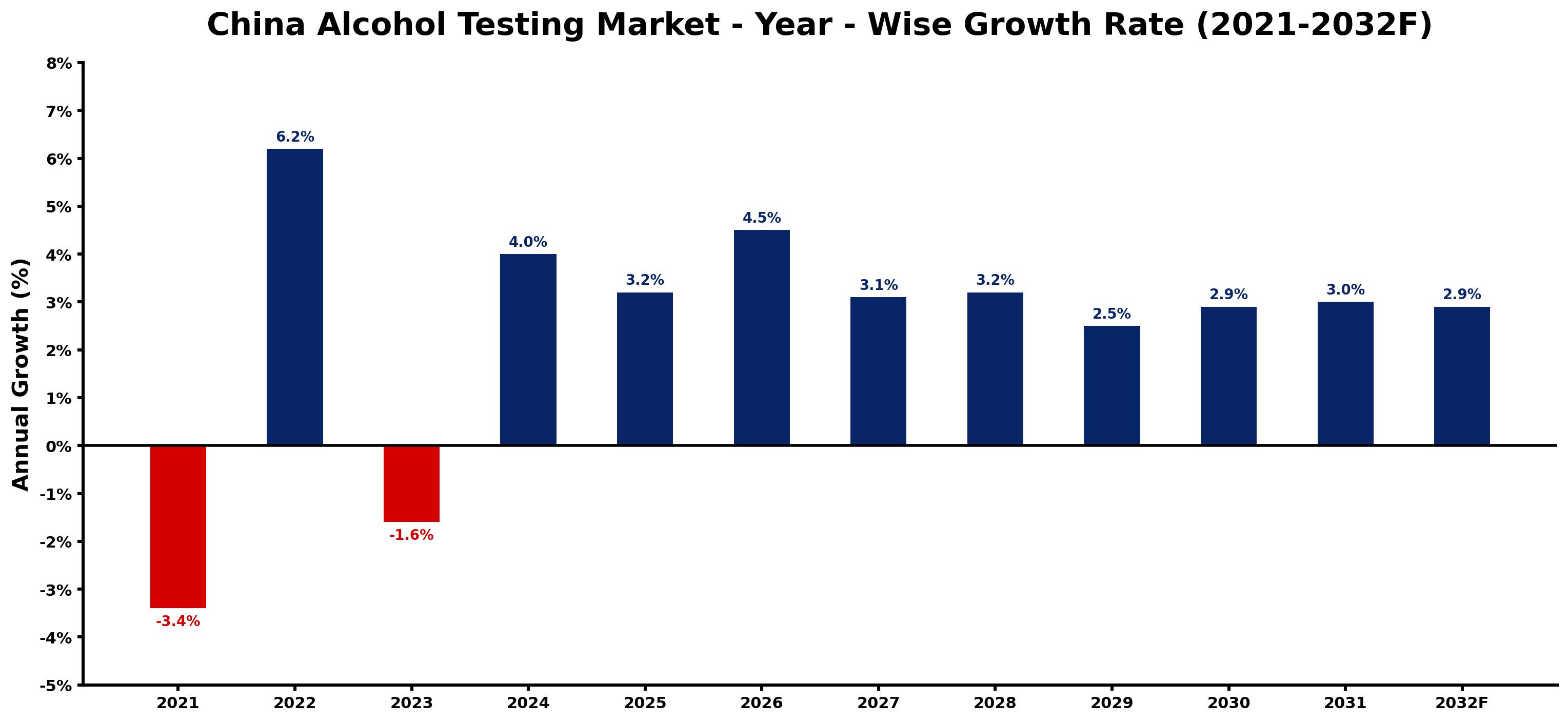
The table below presents the year wise growth rates along with the key drivers influencing the market
| Year | Growth Rate | Major Drivers |
| 2021 | -3.4% | Increased public awareness of health issues associated with alcohol consumption deterred demand for testing devices. |
| 2022 | 6.2% | Corporate responsibility initiatives highlight the need for better employee safety measures. |
| 2023 | -1.6% | Increased awareness of health risks associated with alcohol consumption led to reduced testing demand in 2023. |
| 2024 | 4.0% | Technological enhancements in testing devices improve accuracy and user-friendliness. |
| 2025 | 3.2% | Rising concerns over drunk driving incidents prompt calls for stricter enforcement measures. |
| 2026 | 4.5% | Educational campaigns targeting youth foster understanding of responsible alcohol consumption. |
| 2027 | 3.1% | Partnerships between tech firms and healthcare providers enhance product development strategies. |
| 2028 | 3.2% | Wider availability of testing devices in retail stores captures consumer interest effectively. |
| 2029 | 2.5% | Local manufacturers begin focusing on producing affordable testing devices for mass markets. |
| 2030 | 2.9% | Global collaborations introduce innovative products tailored to Chinese consumer preferences. |
| 2031 | 3.0% | Increased investment in public health infrastructure supports alcohol testing market expansion. |
| 2032 | 2.9% | Shifts in cultural attitudes towards alcohol consumption create new market opportunities. |
Note - Market size estimations and growth projections presented in this report are based on 6Wresearch's advanced forecasting approach, validated with industry datasets as of June 2026.
China Alcohol Testing Market Synopsis
The China Alcohol Testing Market is projected to reach 4.5% and witness significant growth during the forecast period (2026-2032). This growth is largely driven by heightened awareness of the dangers associated with drunk driving, coupled with stringent governmental regulations aimed at promoting responsible alcohol consumption. The predominant segment in this market is breathalyzers, which are favored for their user-friendly operation and rapid results. Additionally, increasing adoption of alcohol testing devices in various sectors, such as workplaces and law enforcement, reflects a broader commitment to safety and regulatory compliance.
China Alcohol Testing Market Growth Drivers
The growth of the China Alcohol Testing Market is influenced by multiple factors. Firstly, the rise in public awareness campaigns about the dangers of driving under the influence has spurred demand for effective alcohol testing solutions. Secondly, the government's firm stance on enforcing drunk-driving laws through strict penalties cultivates a robust environment for alcohol testing usage. Thirdly, an increase in road traffic accidents linked to alcohol consumption underscores the need for reliable testing devices.
- Regulatory frameworks reinforcing testing procedures have boosted the market, leading to widespread breathalyzer deployments across transportation sectors.
- The rise in corporate initiatives aimed at ensuring workplace safety has further propelled the demand for portable alcohol testing devices.
- Technological advancements have led to the development of more efficient testing solutions, enhancing user appeal and operational efficiency.
- Growing investments in public health initiatives targeting alcohol-related education are creating a more proactive approach toward prevention.
- The expanding distribution networks for testing devices, including online platforms, are making these products more accessible to a broader audience.
China Alcohol Testing Market Trends and Opportunities
One of the notable trends in the China Alcohol Testing Market is the shift toward advanced portable testing devices that deliver quick and precise results. The demand for these devices is expanding beyond law enforcement and into workplaces, educational institutions, and public venues where safety compliance is essential. Moreover, the market has seen a notable rise in the popularity of saliva-based testing kits, as they offer convenience and non-invasiveness. The growing preference for alcohol testing services indicates a proactive approach to safety across various sectors.
- The convenience of rapid testing devices is making them a preferred choice for both consumers and businesses.
- Adoption of alcohol testing protocols in schools and public events emphasizes a community-wide commitment to maintaining safety.
- Integration of digital technologies in alcohol testing could lead to improved tracking and reporting capabilities.
- Increased collaboration between manufacturers and public health organizations can lead to more effective educational initiatives.
- Innovation in product design is likely to enhance user engagement and satisfaction.
China Alcohol Testing Market Challenges and Restraints
Despite its growth potential, the China Alcohol Testing Market faces certain challenges that may hinder its expansion. A significant concern is the prevalence of counterfeit and unreliable alcohol testing devices that can compromise safety and accuracy. Furthermore, cultural attitudes towards alcohol in China may influence the acceptance of testing measures, potentially leading to resistance among certain population segments. Regulatory discrepancies and a lack of unified standards for testing methods create additional hurdles for market stakeholders striving for consistency and reliability.
- Counterfeit products not only undermine consumer trust but also pose significant risks to public safety.
- Resistance to alcohol testing measures may arise from entrenched social norms regarding alcohol consumption.
- Varying regional regulations can complicate compliance and operational procedures for businesses.
- Continued changes in alcohol consumption patterns necessitate ongoing innovation to meet evolving consumer expectations.
- The sourcing of reliable data for market analysis can be challenging due to varying standards of practice.
China Alcohol Testing Market Government Investment and Initiatives
The Chinese government has instituted numerous policies and initiatives aimed at reducing drunk driving incidents and enhancing road safety. This includes mandatory alcohol testing for drivers, especially those operating commercial vehicles. Public spending has been directed towards improving awareness campaigns and funding the procurement of testing devices for use in public spaces and workplaces. Furthermore, ongoing government efforts encourage businesses to adopt alcohol testing as part of their safety protocols, reflecting a commitment to public health and safety.
- Government policies mandate regular alcohol testing at checkpoints, alongside random testing initiatives designed to deter drunk driving.
- Funding for community education programs emphasizes the dangers of alcohol consumption while driving.
- Incentives for businesses that implement alcohol safety measures further illustrate government backing for responsible alcohol consumption.
- Collaboration between law enforcement and public health agencies facilitates the development of comprehensive alcohol control strategies.
- Efforts to enhance testing regulations aim to standardize practices across different regions, improving overall market consistency.
China Alcohol Testing Market Latest Developments (May 2025 - June 2026)
During the period from May 2025 to June 2026, the China Alcohol Testing Market has seen several significant developments. Key changes include advancements in portable alcohol testing technologies, which have become more precise and user-friendly, meeting the demands of both consumers and regulatory bodies. Furthermore, there has been a marked increase in partnerships between public institutions and private companies aimed at enhancing the distribution and accessibility of testing devices. Notably, government initiatives focused on road safety have intensified, leading to an upsurge in regulatory frameworks surrounding alcohol testing practices.
- Innovative testing methodologies are being implemented to improve accuracy and user experience.
- Enhanced collaboration between sectors aims to promote widespread adoption of alcohol testing devices.
- The regulatory landscape has evolved, with new mandates supporting alcohol testing in various environments.
- Increased public health campaigns highlight the importance of responsible alcohol consumption.
- Technological integration in testing devices is paving the way for more effective safety measures.
China Alcohol Testing Market - Key Attractiveness of the Report
- 10 Years of Market Numbers
- Historical Data Starting from 2022 to 2025
- Base Year: 2025
- Forecast Data until 2032
- Key Performance Indicators Impacting the Market
- Major Upcoming Developments and Projects
Key Highlights of the Report:
- China Alcohol Testing Market Outlook
- Market Size of China Alcohol Testing Market, 2025
- Forecast of China Alcohol Testing Market, 2032F
- Historical Data and Forecast of China Alcohol Testing Revenues & Volume for the Period 2022-2032F
- China Alcohol Testing Market Trend Evolution
- China Alcohol Testing Market Drivers and Challenges
- China Alcohol Testing Price Trends
- China Alcohol Testing Porter's Five Forces
- China Alcohol Testing Industry Life Cycle
- Historical Data and Forecast of China Alcohol Testing Market Revenues & Volume By Testing Equipment Types for the Period 2022-2032F
- Historical Data and Forecast of China Alcohol Testing Market Revenues & Volume By Infrared Based Breathalyzer for the Period 2022-2032F
- Historical Data and Forecast of China Alcohol Testing Market Revenues & Volume By Semi-conductor Based Breathalyzer for the Period 2022-2032F
- Historical Data and Forecast of China Alcohol Testing Market Revenues & Volume By Immunoassay Analyzers for the Period 2022-2032F
- Historical Data and Forecast of China Alcohol Testing Market Revenues & Volume By Fuel Cell Based Breathalyzer for the Period 2022-2032F
- Historical Data and Forecast of China Alcohol Testing Market Revenues & Volume By Oral Fluid Testing Devices for the Period 2022-2032F
- Historical Data and Forecast of China Alcohol Testing Market Revenues & Volume By Hair Testing Devices for the Period 2022-2032F
- Historical Data and Forecast of China Alcohol Testing Market Revenues & Volume By Urine Testing Devices for the Period 2022-2032F
- Historical Data and Forecast of China Infrared Based Breathalyzer Alcohol Testing Market Revenues & Volume By Others for the Period 2022-2032F
- Historical Data and Forecast of China Alcohol Testing Market Revenues & Volume By Applications for the Period 2022-2032F
- Historical Data and Forecast of China Alcohol Testing Market Revenues & Volume By Alcohol Detection for the Period 2022-2032F
- Historical Data and Forecast of China Alcohol Testing Market Revenues & Volume By Drug Detection for the Period 2022-2032F
- China Alcohol Testing Import Export Trade Statistics
- Market Opportunity Assessment By Testing Equipment Types
- Market Opportunity Assessment By Applications
- China Alcohol Testing Top Companies Market Share
- China Alcohol Testing Competitive Benchmarking By Technical and Operational Parameters
- China Alcohol Testing Company Profiles
- China Alcohol Testing Key Strategic Recommendations






































