China Automotive Wheel Rims Market Top 5 Importing Countries and Market Competition (HHI) Analysis
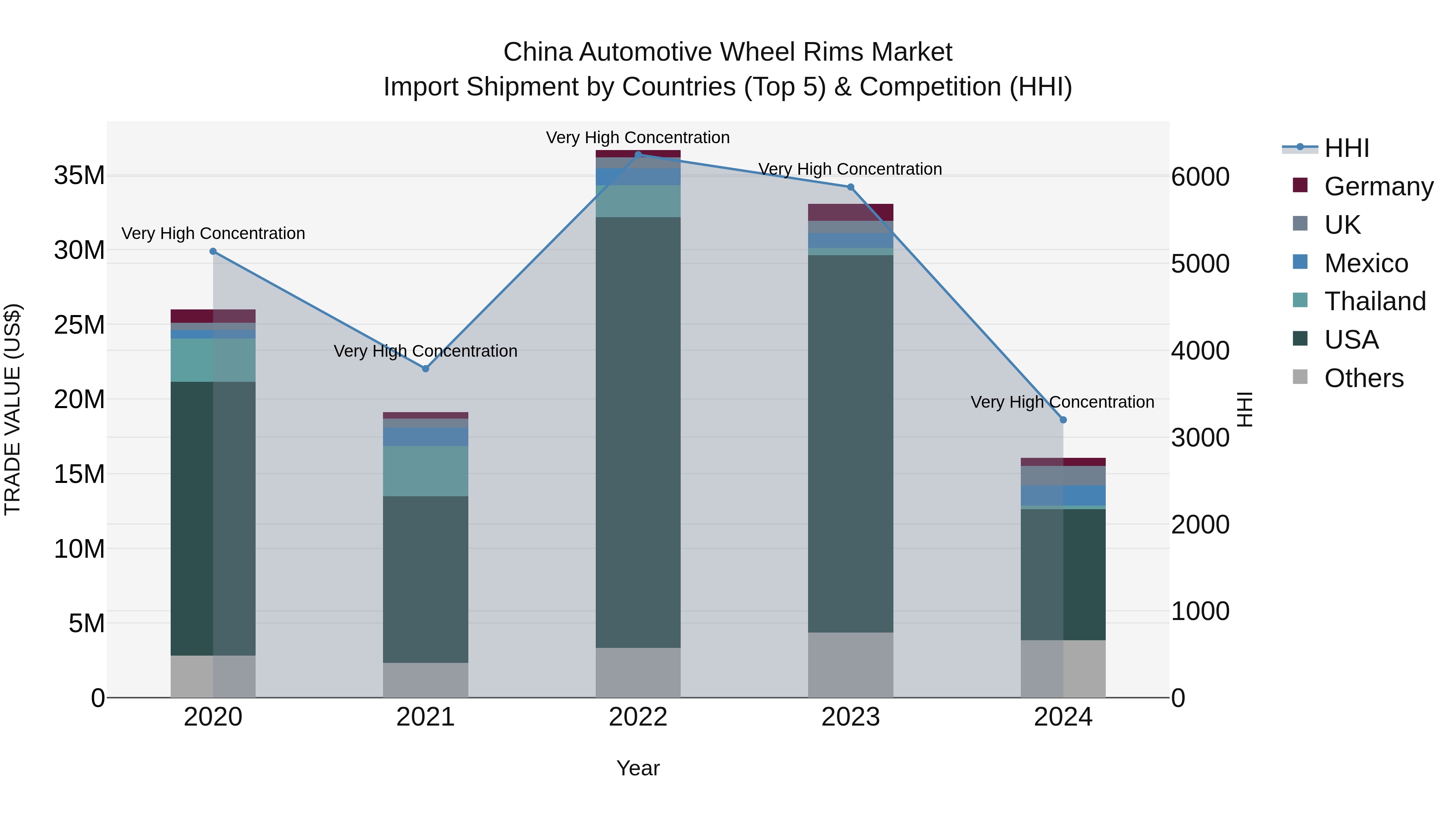
In 2024, China continued to see a high concentration of automotive wheel rims imports from top countries like the USA, Mexico, UK, Japan, and Germany, indicating strong trade relationships. However, the industry experienced a significant decline with a CAGR of -11.36% from 2020 to 2024, and a sharp drop in growth rate by -51.47% from 2023 to 2024. This suggests a challenging period for the automotive wheel rims import market in China, highlighting the need for strategic adaptations and market insights to navigate the shifting landscape.
China Automotive Wheel Rims Market Overview
The China Automotive Wheel Rims Market is experiencing steady growth driven by the increasing demand for passenger and commercial vehicles in the country. The market is characterized by intense competition among key players such as CITIC Dicastal, Zhejiang Wanfeng Auto Wheel, and Lizhong Group. Factors driving market growth include a growing middle-class population, urbanization, and infrastructure development. Additionally, the trend towards customization and aesthetics in vehicle design is boosting the demand for premium and alloy wheel rims. The market is also witnessing a shift towards lightweight materials such as aluminum alloys to improve fuel efficiency and performance. Overall, the China Automotive Wheel Rims Market is poised for further expansion with continued investments in technology and innovation to meet evolving consumer preferences and regulatory standards.
China Automotive Wheel Rims Market Trends
The China Automotive Wheel Rims Market is experiencing several key trends. Firstly, there is a growing demand for lightweight and durable wheel rims to improve fuel efficiency and overall vehicle performance. Manufacturers are increasingly focusing on using advanced materials such as carbon fiber and aluminum alloys to meet this demand. Secondly, there is a rising trend towards customization and personalization, with consumers seeking unique and stylish wheel rim designs to enhance the aesthetic appeal of their vehicles. This has led to an increase in the availability of customizable options in the market. Lastly, there is a shift towards the adoption of smart wheel rims equipped with sensors to monitor tire pressure and temperature, enhancing safety and performance. Overall, these trends are shaping the China Automotive Wheel Rims Market towards innovation and customization.
China Automotive Wheel Rims Market Challenges
The China Automotive Wheel Rims Market faces several challenges, including intense competition from both domestic and international manufacturers, fluctuating raw material prices, and increasing production costs. Another key challenge is the need for continuous innovation and technological advancements to meet the evolving demands of consumers for lighter, stronger, and more visually appealing wheel rims. Additionally, regulatory changes and policies related to environmental protection and safety standards can impact the market dynamics. Market saturation and a slowdown in the overall automotive industry growth in China also present challenges for manufacturers in this sector. Overall, navigating these challenges requires companies to adopt a strategic approach that focuses on product differentiation, operational efficiency, and maintaining strong relationships with suppliers and distributors.
China Automotive Wheel Rims Market Investment Opportunities
The China Automotive Wheel Rims Market presents several investment opportunities for both domestic and international investors. With the increasing demand for automobiles in China, the market for wheel rims is experiencing steady growth. Investing in established wheel rim manufacturers in China can be a lucrative opportunity, especially those companies that offer innovative designs and advanced manufacturing technologies to meet the evolving needs of the automotive industry. Additionally, there is potential for investment in research and development initiatives focused on developing lightweight and durable wheel rims to improve fuel efficiency and performance of vehicles. With the Chinese government`s focus on promoting electric vehicles, investing in wheel rim manufacturers catering to this segment could also be a promising avenue for growth in the China Automotive Wheel Rims Market.
China Automotive Wheel Rims Market Government Policy
Government policies related to the China Automotive Wheel Rims Market are focused on promoting the development of green and sustainable manufacturing practices, improving product quality and safety standards, and enhancing technological innovation in the industry. Regulations such as the China VI emission standards aim to reduce pollution and promote the use of cleaner energy sources in the automotive sector. Additionally, initiatives to encourage the adoption of lightweight materials for wheel rims to improve fuel efficiency and reduce carbon emissions are being implemented. The government also supports the development of smart manufacturing technologies to increase productivity and competitiveness in the market. Overall, these policies are aimed at driving the growth and sustainability of the China Automotive Wheel Rims Market through environmentally friendly practices and technological advancements.
China Automotive Wheel Rims Market Future Outlook
The China Automotive Wheel Rims Market is expected to witness steady growth in the coming years due to factors such as increasing vehicle production, rising demand for lightweight and durable wheel rims, and advancements in automotive technology. The market is likely to be driven by the growing automotive industry in China, as well as the rising popularity of electric vehicles which require specialized wheel rims. Additionally, the government initiatives promoting the adoption of electric vehicles and stricter regulations on vehicle emissions are expected to further boost the demand for automotive wheel rims in China. Overall, the market is forecasted to experience sustained growth with opportunities for innovation and development in materials and design to meet the evolving needs of the automotive industry in China.
Key Highlights of the Report:
- China Automotive Wheel Rims Market Outlook
- Market Size of China Automotive Wheel Rims Market, 2024
- Forecast of China Automotive Wheel Rims Market, 2031
- Historical Data and Forecast of China Automotive Wheel Rims Revenues & Volume for the Period 2021 - 2031
- China Automotive Wheel Rims Market Trend Evolution
- China Automotive Wheel Rims Market Drivers and Challenges
- China Automotive Wheel Rims Price Trends
- China Automotive Wheel Rims Porter's Five Forces
- China Automotive Wheel Rims Industry Life Cycle
- Historical Data and Forecast of China Automotive Wheel Rims Market Revenues & Volume By Material Type for the Period 2021 - 2031
- Historical Data and Forecast of China Automotive Wheel Rims Market Revenues & Volume By Alloy for the Period 2021 - 2031
- Historical Data and Forecast of China Automotive Wheel Rims Market Revenues & Volume By Steel for the Period 2021 - 2031
- Historical Data and Forecast of China Automotive Wheel Rims Market Revenues & Volume By Carbon Fiber for the Period 2021 - 2031
- Historical Data and Forecast of China Automotive Wheel Rims Market Revenues & Volume By Sales Channel for the Period 2021 - 2031
- Historical Data and Forecast of China Automotive Wheel Rims Market Revenues & Volume By OEM for the Period 2021 - 2031
- Historical Data and Forecast of China Automotive Wheel Rims Market Revenues & Volume By Aftermarket for the Period 2021 - 2031
- Historical Data and Forecast of China Automotive Wheel Rims Market Revenues & Volume By Vehicle Type for the Period 2021 - 2031
- Historical Data and Forecast of China Automotive Wheel Rims Market Revenues & Volume By Passenger Cars for the Period 2021 - 2031
- Historical Data and Forecast of China Automotive Wheel Rims Market Revenues & Volume By Commercial Vehicles for the Period 2021 - 2031
- China Automotive Wheel Rims Import Export Trade Statistics
- Market Opportunity Assessment By Material Type
- Market Opportunity Assessment By Sales Channel
- Market Opportunity Assessment By Vehicle Type
- China Automotive Wheel Rims Top Companies Market Share
- China Automotive Wheel Rims Competitive Benchmarking By Technical and Operational Parameters
- China Automotive Wheel Rims Company Profiles
- China Automotive Wheel Rims Key Strategic Recommendations






































