China Autonomous Trucks Market Size, Share & Growth Rate
The China Autonomous Trucks Market was estimated at USD 237 Million in 2025 and is projected to reach USD 276 Million by 2032, growing at a CAGR of 2.2% from 2026 to 2032. This growth trajectory reflects the increasing need for logistics efficiency, driven by both rising demand for seamless supply chain solutions and substantial advancements in autonomous driving technologies. The push from the Chinese government toward innovative transportation solutions further solidifies the market's promising outlook.
China Autonomous Trucks Market Year-wise Growth Rate and Key Drivers
This graph highlights how the China Autonomous Trucks Market has steadily grown over the years, supported by major growth factors.
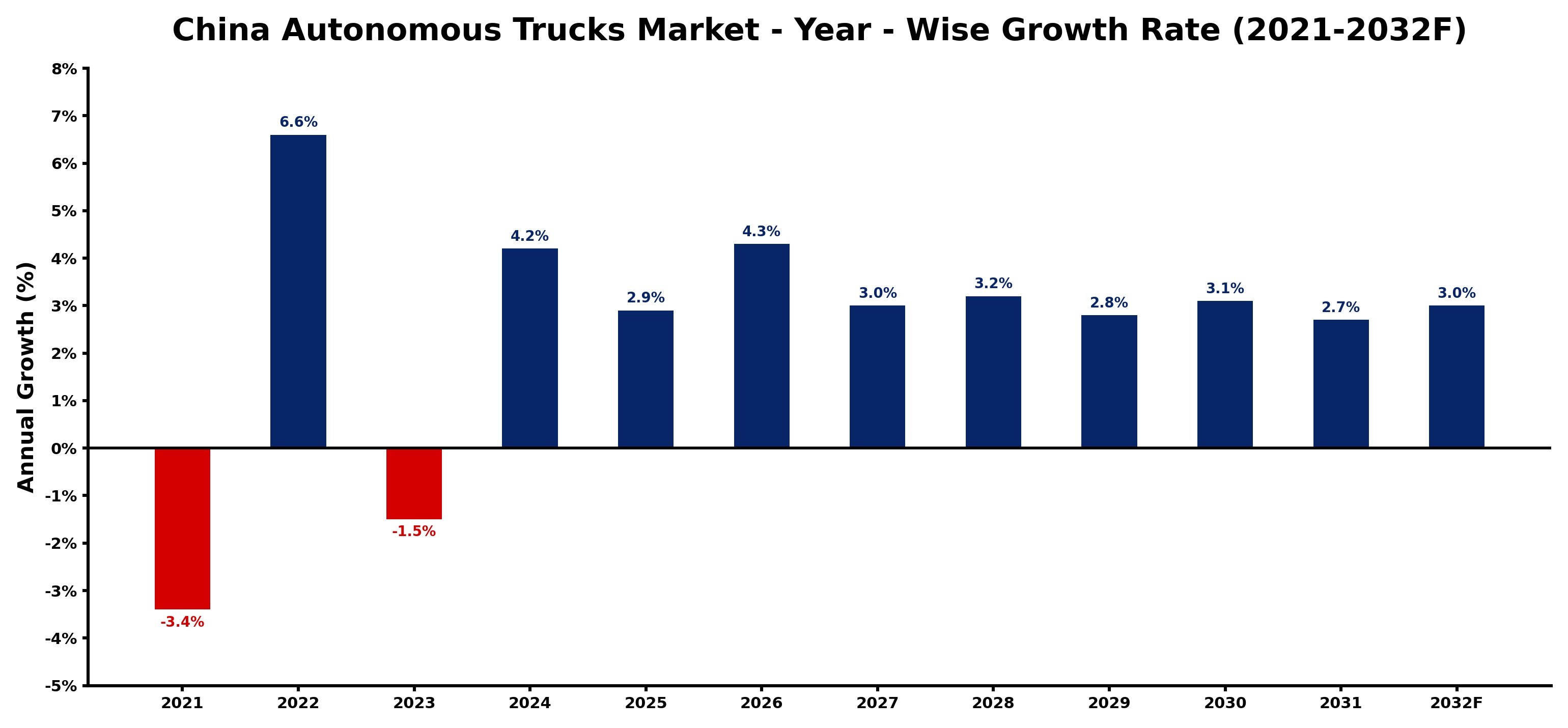
The table below presents the year‑wise growth rates along with the key drivers influencing the market
| Year | Growth Rate | Major Drivers |
| 2021 | -3.4% | Weak activity constrained sales |
| 2022 | 6.6% | Technological advancements enhanced efficiency |
| 2023 | -1.5% | Market uncertainty affected investments |
| 2024 | 4.2% | Infrastructure improvements supported deployment |
| 2025 | 2.9% | Partnerships expanded market reach |
| 2026 | 4.3% | Consumer demand for automation increased |
| 2027 | 3.0% | Logistics sector embraced innovation |
| 2028 | 3.2% | Sustainability initiatives drove interest |
| 2029 | 2.8% | Urbanization fueled transportation needs |
| 2030 | 3.1% | E-commerce growth necessitated automation |
| 2031 | 2.7% | Cost savings attracted new players |
| 2032 | 3.0% | Global collaborations enhanced technology transfer |
Note - Market size estimations and growth projections presented in this report are based on 6Wresearch's advanced forecasting approach, validated with industry datasets as of June 2026.
China Autonomous Trucks Market Synopsis
The rising demand for autonomous trucks in China is primarily fueled by the logistics sector's urgent need to address labor shortages and operational inefficiencies. As e-commerce continues to proliferate, there is a parallel need for advanced transportation solutions that can meet the speed and reliability expectations of modern consumers.
Furthermore, the introduction of level 4 and 5 autonomous systems indicates a significant shift in technological capabilities, enabling vehicles to operate without human intervention in a wider range of conditions. This evolution not only enhances safety but also positions the logistics industry to optimize costs and improve delivery timelines.
China Autonomous Trucks Market Key Takeaways
- The market is driven by advancements in autonomous technology and the urgent need for efficient logistics solutions.
- Partnerships between tech firms and manufacturers are catalyzing innovation and deployment in the sector.
- Safety, reliability, and cost-effectiveness are becoming focal points for companies developing autonomous trucks.
- Regulatory frameworks are evolving but still present significant challenges to widespread adoption.
- China's ambitious government policies aim to foster rapid growth and facilitate the establishment of necessary infrastructure.
Evaluation of Restraints in China Autonomous Trucks Market
Despite the positive outlook, the China Autonomous Trucks Market faces real constraints that could limit its growth. Regulatory hurdles, particularly related to safety standards and the development of requisite road infrastructure, pose challenges to manufacturers and operators alike. Additionally, concerns around data security and privacy must be addressed to foster consumer trust. Limited deployment zones and the need for sophisticated mapping technologies hinder testing and scalability, while the absence of standardized communication protocols contributes to interoperability issues across different autonomous truck models.
China Autonomous Trucks Market Trends
Current trends in the China Autonomous Trucks Market are characterized by the rapid development of sophisticated autonomous driving systems, particularly those reaching level 4 and level 5 capabilities. Collaborations between technology developers and traditional truck manufacturers are becoming increasingly common, as both parties seek to leverage their strengths. Additionally, pilot testing of autonomous fleets in key logistics hubs indicates a shift toward wider deployment as the technology matures. A growing emphasis on safety protocols and cost management is also guiding innovations in truck design and operation.
China Autonomous Trucks Market Opportunities
Investment opportunities abound in the China Autonomous Trucks Market, especially for firms focused on developing autonomous technologies and enhancing logistics operations. As the country embraces automation, sectors such as e-commerce and freight transportation are poised for substantial growth. The burgeoning demand for more efficient and cost-effective logistics solutions highlights the potential for businesses to capitalize on this transition. Furthermore, companies that can integrate data analytics and real-time tracking will be well-positioned to meet market needs and drive further innovation.
Government Initiatives in the China Autonomous Trucks Market
The Chinese government plays a pivotal role in propelling the autonomous trucks sector forward through a range of supportive policies and initiatives. These include establishing regulations for the testing and deployment of autonomous vehicles on public roads, as well as offering financial incentives to manufacturers and operators within this space. Additionally, the government invests in research and development, collaborating closely with industry stakeholders to create standards that ensure the safe operation of autonomous trucks. This concerted effort aims to enhance transportation efficiency and solidify China's position as a leader in autonomous vehicle technology.
Future Insights of the China Autonomous Trucks Market
Looking forward to 2026-2032, the China Autonomous Trucks Market is set to experience significant expansion, driven by continued investments in technology and infrastructure. The demand for effective transportation solutions is likely to increase, prompting greater adoption of autonomous trucks across various industries. While regulatory challenges and public acceptance will shape the pace of growth, the overall outlook remains optimistic, with innovation at the forefront of this transformation in the logistics landscape.
China Autonomous Trucks Market Latest Developments (May 2025 - June 2026)
Recent developments within the China Autonomous Trucks Market have seen accelerated testing and deployment efforts as more companies seek to explore the practical applications of autonomous technology. Key partnerships are being forged to enhance collaborative efforts in research and innovation. Additionally, there is a heightened focus on establishing better regulatory frameworks that can facilitate safe and efficient operations in urban environments. These advancements underscore the sector's dynamic nature and the industry's commitment to addressing emerging challenges.
China Autonomous Trucks Market - Key Attractiveness of the Report
- 10 Years of Market Numbers
- Historical Data Starting from 2022 to 2025
- Base Year: 2025
- Forecast Data until 2032
- Key Performance Indicators Impacting the Market
- Major Upcoming Developments and Projects
Key Highlights of the Report:
- China Autonomous Trucks Market Outlook
- Market Size of China Autonomous Trucks Market, 2025
- Forecast of China Autonomous Trucks Market, 2032
- Historical Data and Forecast of China Autonomous Trucks Revenues & Volume for the Period 2022-2032F
- China Autonomous Trucks Market Trend Evolution
- China Autonomous Trucks Market Drivers and Challenges
- China Autonomous Trucks Price Trends
- China Autonomous Trucks Porter's Five Forces
- China Autonomous Trucks Industry Life Cycle
- Historical Data and Forecast of China Autonomous Trucks Market Revenues & Volume By Level of Autonomy for the Period 2022-2032F
- Historical Data and Forecast of China Autonomous Trucks Market Revenues & Volume By Level 1 for the Period 2022-2032F
- Historical Data and Forecast of China Autonomous Trucks Market Revenues & Volume By Level 2 for the Period 2022-2032F
- Historical Data and Forecast of China Autonomous Trucks Market Revenues & Volume By Level 3 for the Period 2022-2032F
- Historical Data and Forecast of China Autonomous Trucks Market Revenues & Volume By Level 4 for the Period 2022-2032F
- Historical Data and Forecast of China Autonomous Trucks Market Revenues & Volume By Sensor Type for the Period 2022-2032F
- Historical Data and Forecast of China Autonomous Trucks Market Revenues & Volume By Ultrasonic for the Period 2022-2032F
- Historical Data and Forecast of China Autonomous Trucks Market Revenues & Volume By Radar for the Period 2022-2032F
- Historical Data and Forecast of China Autonomous Trucks Market Revenues & Volume By Camera for the Period 2022-2032F
- Historical Data and Forecast of China Autonomous Trucks Market Revenues & Volume By LiDAR for the Period 2022-2032F
- Historical Data and Forecast of China Autonomous Trucks Market Revenues & Volume By Propulsion for the Period 2022-2032F
- Historical Data and Forecast of China Autonomous Trucks Market Revenues & Volume By Diesel for the Period 2022-2032F
- Historical Data and Forecast of China Autonomous Trucks Market Revenues & Volume By Electric for the Period 2022-2032F
- Historical Data and Forecast of China Autonomous Trucks Market Revenues & Volume By Others for the Period 2022-2032F
- Historical Data and Forecast of China Autonomous Trucks Market Revenues & Volume By Truck Type for the Period 2022-2032F
- Historical Data and Forecast of China Autonomous Trucks Market Revenues & Volume By Light Duty Truck for the Period 2022-2032F
- Historical Data and Forecast of China Autonomous Trucks Market Revenues & Volume By Medium Duty Truck for the Period 2022-2032F
- Historical Data and Forecast of China Autonomous Trucks Market Revenues & Volume By Heavy Duty Truck for the Period 2022-2032F
- China Autonomous Trucks Import Export Trade Statistics
- Market Opportunity Assessment By Level of Autonomy
- Market Opportunity Assessment By Sensor Type
- Market Opportunity Assessment By Propulsion
- Market Opportunity Assessment By Truck Type
- China Autonomous Trucks Top Companies Market Share
- China Autonomous Trucks Competitive Benchmarking By Technical and Operational Parameters
- China Autonomous Trucks Company Profiles
- China Autonomous Trucks Key Strategic Recommendations






































