China Bathroom Linen Market Size, Share & Growth Rate
The China Bathroom Linen Market was estimated at USD 224 Million in 2025 and is projected to reach USD 257 Million by 2032, growing at a CAGR of 2.0% from 2026 to 2032. This steady growth is underpinned by increasing urbanization and a rising middle class that is prioritizing quality and style in their home decor choices. As consumer preferences shift towards premium and eco-friendly products, the market is expected to see significant transformation and innovation.
China Bathroom Linen Market Year-wise Growth Rate and Key Drivers
This graph highlights how the China Bathroom Linen Market has steadily grown over the years, supported by major growth factors.
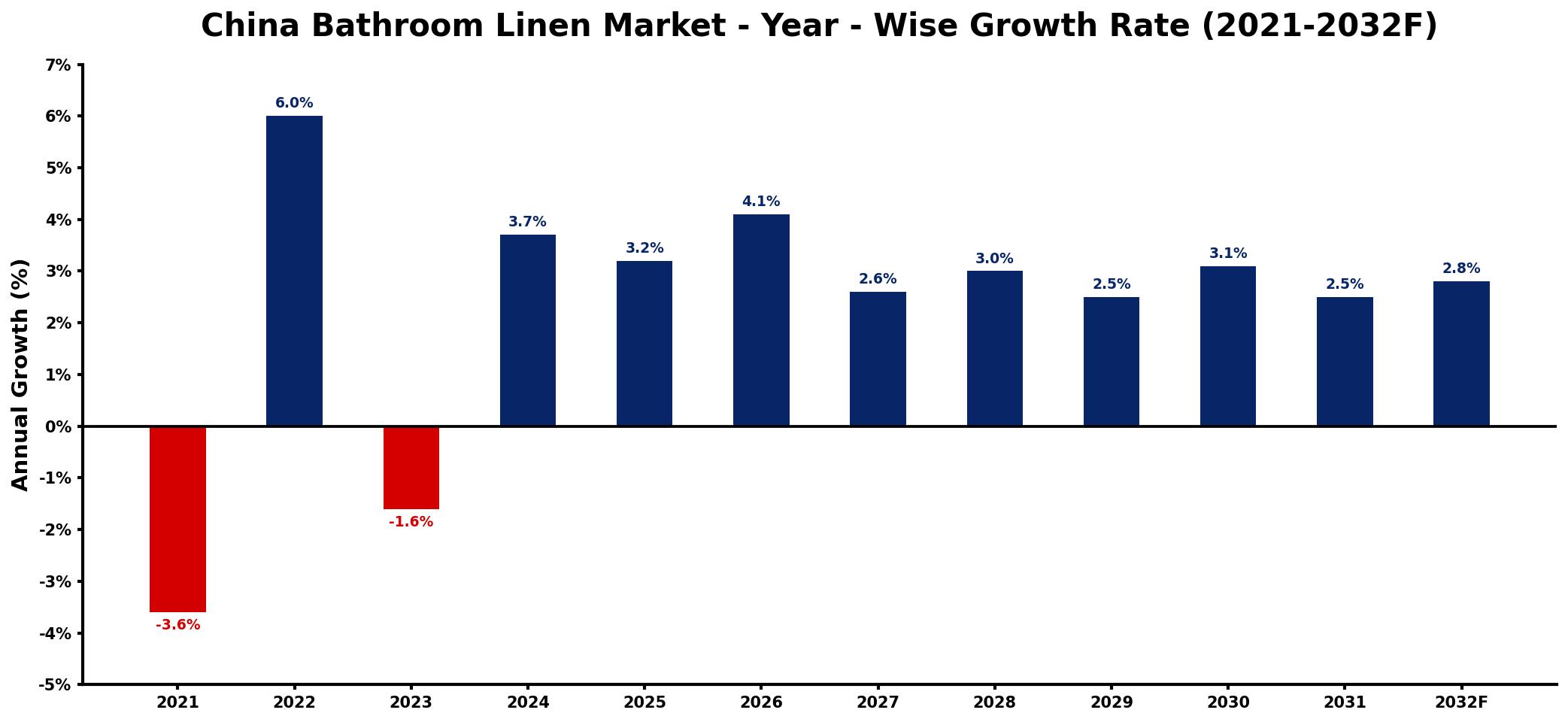
The table below presents the year‑wise growth rates along with the key drivers influencing the market
| Year | Growth Rate | Major Drivers |
| 2021 | -3.6% | decrease in consumer spending |
| 2022 | 6.0% | increased construction activity nationwide |
| 2023 | -1.6% | drop in disposable income levels |
| 2024 | 3.7% | growth in e-commerce platforms |
| 2025 | 3.2% | rise in home renovation projects |
| 2026 | 4.1% | expansion of luxury hotel market |
| 2027 | 2.6% | growing awareness of hygiene |
| 2028 | 3.0% | increase in urban population density |
| 2029 | 2.5% | development of sustainable materials |
| 2030 | 3.1% | surge in international tourism |
| 2031 | 2.5% | strengthening international trade flows |
| 2032 | 2.8% | enhanced product quality standards |
Note: Market size estimations and growth projections presented in this report are based on 6Wresearch's proprietary forecasting methodology, utilizing the latest available industry data, government publications, and primary research inputs.
China Bathroom Linen Market Synopsis
Recently, the China Bathroom Linen Market has gained momentum, fueled by rising disposable incomes and a greater focus on personal wellness and hygiene. As we look ahead, the market is evolving with a pronounced shift towards sustainability and luxury, creating a dynamic landscape for both consumers and businesses.
Consumers are increasingly drawn to high-quality bathroom linens that combine functionality with aesthetics. As awareness of environmental issues grows, there is a significant push towards eco-friendly materials, which is expected to further shape market offerings in the coming years.
China Bathroom Linen Market Key Takeaways
- The market is shifting towards luxury and designer collections in response to changing consumer preferences.
- Demand for eco-friendly and antimicrobial products is on the rise, reflecting a growing awareness of sustainability and hygiene.
- Online retail channels are expanding access, offering convenience and a diverse range of product choices for consumers.
- Investments in product innovation and sustainable practices will be crucial for gaining a competitive edge.
- Collaboration with e-commerce platforms is essential for reaching a broader consumer base across the country.
Evaluation of Restraints in China Bathroom Linen Market
Despite its growth potential, the China Bathroom Linen Market faces notable restraints. Intense competition between domestic and international brands can lead to price wars, which threaten profit margins. Additionally, maintaining high quality amidst rapid innovation demands significant investment. Companies must also navigate the complexities of fluctuating raw material prices and the challenges associated with counterfeiting, necessitating strict quality control measures. The increasing focus on sustainability further complicates the landscape, as brands are required to balance eco-friendly practices with cost management.
China Bathroom Linen Market Trends
A marked trend in the China Bathroom Linen Market is the growing preference for sustainable materials, with consumers actively seeking products made from organic cotton and bamboo. Additionally, there is a noticeable shift towards premium products, reflecting an upscale positioning among consumers who are willing to invest in quality and aesthetic appeal. The influence of e-commerce cannot be overstated, as digital platforms play an increasingly crucial role in consumer purchasing decisions, allowing for greater exposure to a variety of brands and styles. Overall, sustainability, quality, luxury, and digitalization are converging to redefine the market landscape.
China Bathroom Linen Market Opportunities
The market presents several compelling investment opportunities, particularly in high-quality and stylish bathroom linens that resonate with consumers' desires for home decor enhancement. There is a notable opening for eco-friendly product lines made from organic materials, which cater to a growing segment of environmentally conscious buyers. Furthermore, the integration of technology, such as smart textiles and innovative design features, offers avenues for differentiation in a competitive environment. Collaborating with e-commerce platforms will enhance brand visibility and consumer reach, particularly among urban dwellers.
Government Initiatives in the China Bathroom Linen Market
The Chinese government has enacted various policies aimed at promoting sustainability within the bathroom linen market. Regulations focus on ensuring product quality and safety standards, protecting consumers from harmful chemicals while encouraging the use of eco-friendly materials. In line with national initiatives for environmental conservation, the government supports sustainable production processes, thereby fostering a competitive market that prioritizes consumer safety and ecological responsibility.
Future Insights of the China Bathroom Linen Market
Looking ahead, the China Bathroom Linen Market is poised for steady growth, fueled by urbanization and an increasing focus on home aesthetics. The demand for premium, high-quality bathroom products is expected to escalate, driven by consumers willingness to invest in superior options that align with their lifestyles. E-commerce will continue to expand its influence, providing consumers with the convenience of online shopping while broadening product choices. Brands that embrace sustainability and innovation will likely gain a competitive edge, positioning themselves favorably in this dynamic market.
China Bathroom Linen Market Latest Developments (2025 - 2026)
In recent months, the China Bathroom Linen Market has seen a surge in interest towards sustainable product offerings, with manufacturers exploring innovative materials and eco-friendly production methods. The rise of online retail has significantly altered consumer shopping patterns, with many consumers opting for the convenience of digital purchases. Furthermore, collaborations between brands and e-commerce platforms have intensified, enhancing market accessibility and consumer engagement through targeted marketing strategies. These developments signal a transformative phase in the industry as it adapts to evolving consumer preferences.
China Bathroom Linen Market - Key Attractiveness of the Report
- 10 Years of Market Numbers
- Historical Data Starting from 2022 to 2025
- Base Year: 2025
- Forecast Data until 2032
- Key Performance Indicators Impacting the Market
- Major Upcoming Developments and Projects
Key Highlights of the Report:
- China Bathroom Linen Market Outlook
- Market Size of China Bathroom Linen Market, 2025
- Forecast of China Bathroom Linen Market, 2032
- Historical Data and Forecast of China Bathroom Linen Revenues & Volume for the Period 2022-2032F
- China Bathroom Linen Market Trend Evolution
- China Bathroom Linen Market Drivers and Challenges
- China Bathroom Linen Price Trends
- China Bathroom Linen Porter's Five Forces
- China Bathroom Linen Industry Life Cycle
- Historical Data and Forecast of China Bathroom Linen Market Revenues & Volume By Product for the Period 2022-2032F
- Historical Data and Forecast of China Bathroom Linen Market Revenues & Volume By Bath Towels for the Period 2022-2032F
- Historical Data and Forecast of China Bathroom Linen Market Revenues & Volume By Bathrobes for the Period 2022-2032F
- Historical Data and Forecast of China Bathroom Linen Market Revenues & Volume By Others for the Period 2022-2032F
- China Bathroom Linen Import Export Trade Statistics
- Market Opportunity Assessment By Product
- China Bathroom Linen Top Companies Market Share
- China Bathroom Linen Competitive Benchmarking By Technical and Operational Parameters
- China Bathroom Linen Company Profiles
- China Bathroom Linen Key Strategic Recommendations






































