China Centrifugal Industrial Dryer Market Size, Share & Growth Rate
The China Centrifugal Industrial Dryer Market was estimated at USD 210 Million in 2025 and is projected to reach USD 241 Million by 2032, growing at a CAGR of 2.0% from 2026 to 2032. This growth is being primarily driven by the robust expansion of various industrial sectors, including food processing, pharmaceuticals, and textiles. The increasing emphasis on automation and energy-efficient technologies is further propelling the demand for centrifugal dryers, which are recognized for their superior moisture removal capabilities.
China Centrifugal Industrial Dryer Market Year-wise Growth Rate and Key Drivers
This graph highlights how the China Centrifugal Industrial Dryer Market has steadily grown over the years, supported by major growth factors.
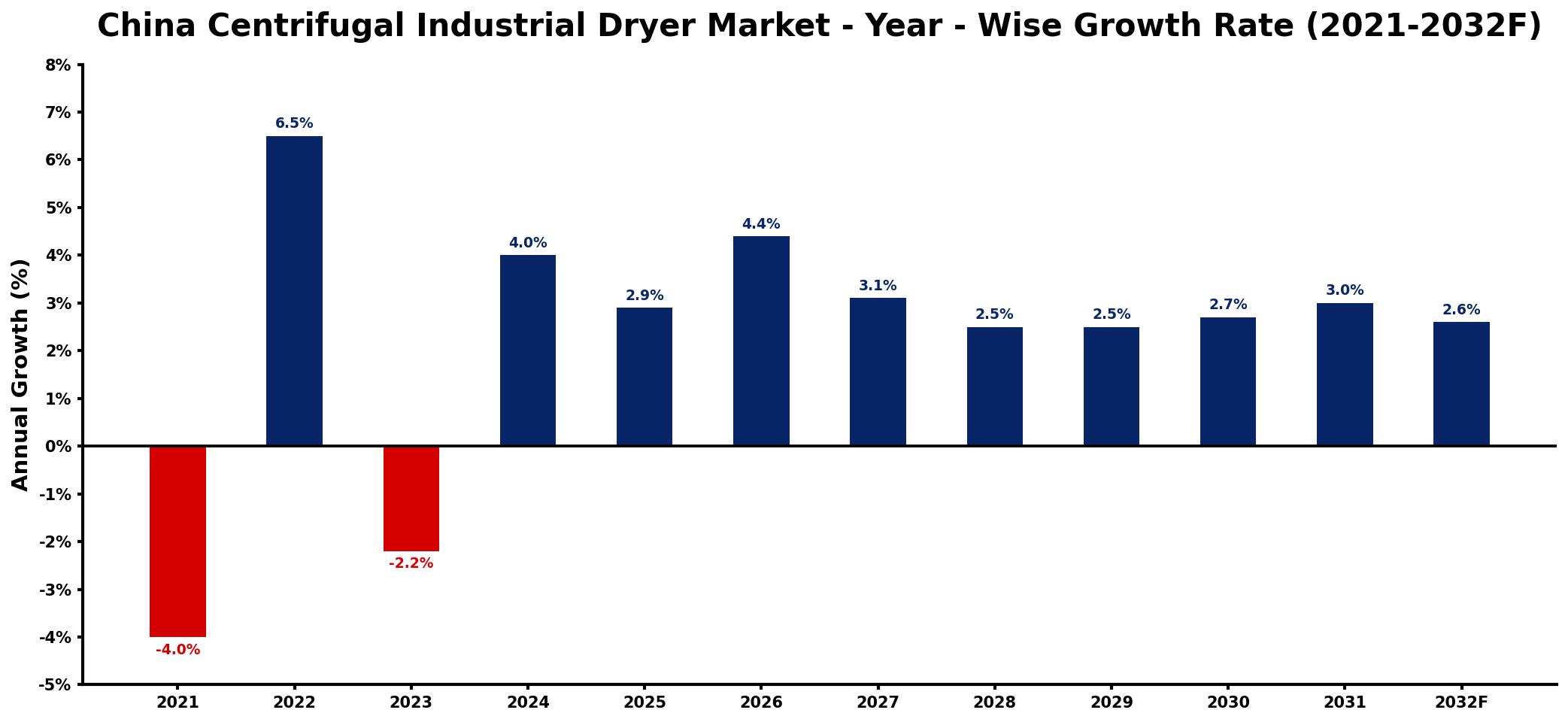
The table below presents the year‑wise growth rates along with the key drivers influencing the market
| Year | Growth Rate | Major Drivers |
| 2021 | -4.0% | decreased demand from manufacturing sector |
| 2022 | 6.5% | expansion in food processing industry |
| 2023 | -2.2% | reduced investments in infrastructure projects |
| 2024 | 4.0% | growth in pharmaceutical applications |
| 2025 | 2.9% | increased exports to emerging markets |
| 2026 | 4.4% | rising demand from textile sector |
| 2027 | 3.1% | growing downstream application demand |
| 2028 | 2.5% | increased capital investment inflows |
| 2029 | 2.5% | increased focus on automation solutions |
| 2030 | 2.7% | rising need for efficient production |
| 2031 | 3.0% | rising end-use demand growth |
| 2032 | 2.6% | increased adoption of eco-friendly technologies |
Note: Market size estimations and growth projections presented in this report are based on 6Wresearch's proprietary forecasting methodology, utilizing the latest available industry data, government publications, and primary research inputs.
China Centrifugal Industrial Dryer Market Synopsis
The demand for centrifugal industrial dryers in China is growing, reflecting a broader trend towards automation and efficiency across manufacturing processes. Industries are increasingly adopting these dryers due to their ability to enhance production speed while minimizing energy costs.
Furthermore, the market is characterized by a shift towards environmentally friendly drying solutions, spurred by both consumer demand and regulatory pressures. This evolution is leading manufacturers to innovate with eco-friendly designs and energy-efficient technologies that align with sustainability goals.
China Centrifugal Industrial Dryer Market Key Takeaways
- The market is currently experiencing steady growth attributed to industrial sector expansion.
- Technological advancements, particularly in automation and IoT integration, are key demand drivers.
- Manufacturers face competitive pricing pressures while striving for continuous innovation.
- Rental and leasing options are becoming increasingly popular for cost-effective solutions.
- The government is promoting energy efficiency and sustainability through supportive policies.
Evaluation of Restraints in China Centrifugal Industrial Dryer Market
Despite the growth prospects, the China Centrifugal Industrial Dryer Market faces several restraints that could impede its trajectory. Intense competition among manufacturers often results in pricing pressures, complicating profitability. Additionally, the need for continuous innovation to keep pace with rapidly evolving customer expectations places an added burden on companies. Navigating stringent regulatory requirements related to emissions and energy efficiency demands significant investment in R&D. Lastly, disruptions in supply chains and fluctuations in raw material prices can pose challenges for stability and planning.
China Centrifugal Industrial Dryer Market Trends
The landscape of the China Centrifugal Industrial Dryer Market is evolving with several key trends. First, the integration of smart technologies, including IoT-enabled monitoring systems, enhances operational efficiency and allows for real-time data management. Second, there is a marked shift towards eco-friendly dryers designed to meet both regulatory and consumer demands for sustainability. Customization is also becoming a priority as manufacturers cater to unique industry requirements, making versatility a selling point. Lastly, the trend towards rental and leasing solutions is gaining momentum, providing businesses with cost-effective access to advanced drying technologies.
China Centrifugal Industrial Dryer Market Opportunities
Investment opportunities abound in the China Centrifugal Industrial Dryer Market, particularly due to the rising demand for efficient drying solutions across key industries. As manufacturers seek to enhance productivity and reduce operational costs, there is an increasing need for high-performance dryers equipped with innovative features such as digital controls and energy-saving capabilities. Additionally, fostering strategic partnerships within the industry and focusing on continuous product innovation can provide a competitive advantage. Companies that prioritize after-sales service and support are likely to strengthen customer loyalty and capitalize on emerging market potential.
Government Initiatives in the China Centrifugal Industrial Dryer Market
The Chinese government has enacted several initiatives aimed at bolstering the centrifugal industrial dryer sector. Policies focusing on energy efficiency standards are designed to encourage sustainable practices while minimizing environmental impacts. Additionally, the government supports research and development in advanced technologies through grants and tax incentives. Regulations on emissions control further shape the market dynamics, pushing manufacturers towards greener production processes. Overall, these government initiatives are essential in creating a competitive and environmentally-friendly market landscape for industrial dryers.
Future Insights of the China Centrifugal Industrial Dryer Market
Looking ahead to the period of 2026-2032, the China Centrifugal Industrial Dryer Market is poised for significant growth. Continued industrialization and the quest for efficient drying solutions will drive demand across various sectors. Innovations in dryer technology will likely focus on enhancing energy efficiency and sustainability, as well as incorporating smart functionalities to facilitate remote monitoring and control. As the automotive, food processing, and pharmaceutical sectors expand, they will further generate robust demand for advanced drying systems, solidifying a positive outlook for market growth.
China Centrifugal Industrial Dryer Market Latest Developments (2025 - 2026)
Recent developments within the China Centrifugal Industrial Dryer Market indicate a trend towards enhanced automation and digitalization. Many manufacturers are investing in smart technologies that improve operational efficiency and facilitate better data management. The focus on sustainable practices is also evident, as companies develop eco-friendly dryer models to meet increasing regulatory standards and consumer expectations. These shifts indicate a dynamic market environment that is rapidly adapting to technological advancements and environmental considerations.
China Centrifugal Industrial Dryer Market - Key Attractiveness of the Report
- 10 Years of Market Numbers
- Historical Data Starting from 2022 to 2025
- Base Year: 2025
- Forecast Data until 2032
- Key Performance Indicators Impacting the Market
- Major Upcoming Developments and Projects
Key Highlights of the Report:
- China Centrifugal Industrial Dryer Market Outlook
- Market Size of China Centrifugal Industrial Dryer Market, 2025
- Forecast of China Centrifugal Industrial Dryer Market, 2032
- Historical Data and Forecast of China Centrifugal Industrial Dryer Revenues & Volume for the Period 2022-2032F
- China Centrifugal Industrial Dryer Market Trend Evolution
- China Centrifugal Industrial Dryer Market Drivers and Challenges
- China Centrifugal Industrial Dryer Price Trends
- China Centrifugal Industrial Dryer Porter's Five Forces
- China Centrifugal Industrial Dryer Industry Life Cycle
- Historical Data and Forecast of China Centrifugal Industrial Dryer Market Revenues & Volume By Application for the Period 2022-2032F
- Historical Data and Forecast of China Centrifugal Industrial Dryer Market Revenues & Volume By Metal Finishing for the Period 2022-2032F
- Historical Data and Forecast of China Centrifugal Industrial Dryer Market Revenues & Volume By Food Processing for the Period 2022-2032F
- Historical Data and Forecast of China Centrifugal Industrial Dryer Market Revenues & Volume By Plastic Recycling for the Period 2022-2032F
- Historical Data and Forecast of China Centrifugal Industrial Dryer Market Revenues & Volume By Chemical for the Period 2022-2032F
- Historical Data and Forecast of China Centrifugal Industrial Dryer Market Revenues & Volume By Pharmaceutical for the Period 2022-2032F
- Historical Data and Forecast of China Centrifugal Industrial Dryer Market Revenues & Volume By Type for the Period 2022-2032F
- Historical Data and Forecast of China Centrifugal Industrial Dryer Market Revenues & Volume By Direct for the Period 2022-2032F
- Historical Data and Forecast of China Centrifugal Industrial Dryer Market Revenues & Volume By Indirect for the Period 2022-2032F
- China Centrifugal Industrial Dryer Import Export Trade Statistics
- Market Opportunity Assessment By Application
- Market Opportunity Assessment By Type
- China Centrifugal Industrial Dryer Top Companies Market Share
- China Centrifugal Industrial Dryer Competitive Benchmarking By Technical and Operational Parameters
- China Centrifugal Industrial Dryer Company Profiles
- China Centrifugal Industrial Dryer Key Strategic Recommendations






































