China Data Center Transformation Market Size & Growth Rate (2026-2032)
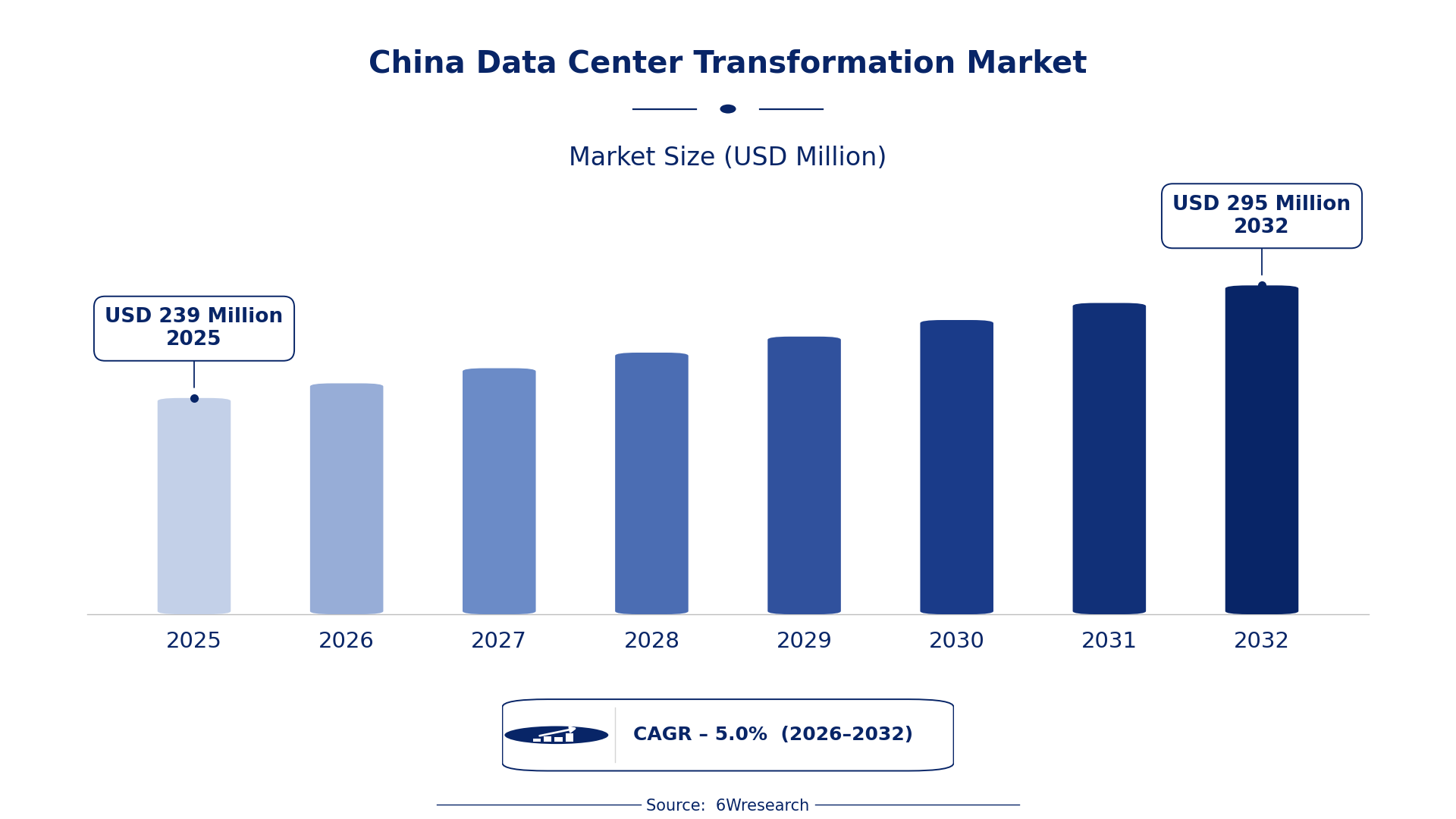
The China Data Center Transformation Market was estimated at USD 239 Million in 2025 and is projected to reach USD 295 Million by 2032, growing at a CAGR of 5.0% from 2026 to 2032.
China Data Center Transformation Market Synopsis
The driving force behind the China Data Center Transformation Market is the imperative need for organizations to modernize their data infrastructures. This modernization is not merely a trend but a necessity as companies strive to enhance efficiency, reduce operational costs, and adapt to new business models that demand flexibility and scalability.
As businesses increasingly migrate to cloud-based solutions and adopt virtualization, the transformation of data center operations has become essential. These efforts are not just about technology upgrades; they are about creating agile environments that can swiftly respond to market demands and technological advancements.
China Data Center Transformation Market Year-wise Growth Rate and Key Drivers
This graph illustrates the annual growth rates of the China Data Center Transformation Market from 2021 to 2032, highlighting a steady upward trajectory and projected expansion over the forecast period.
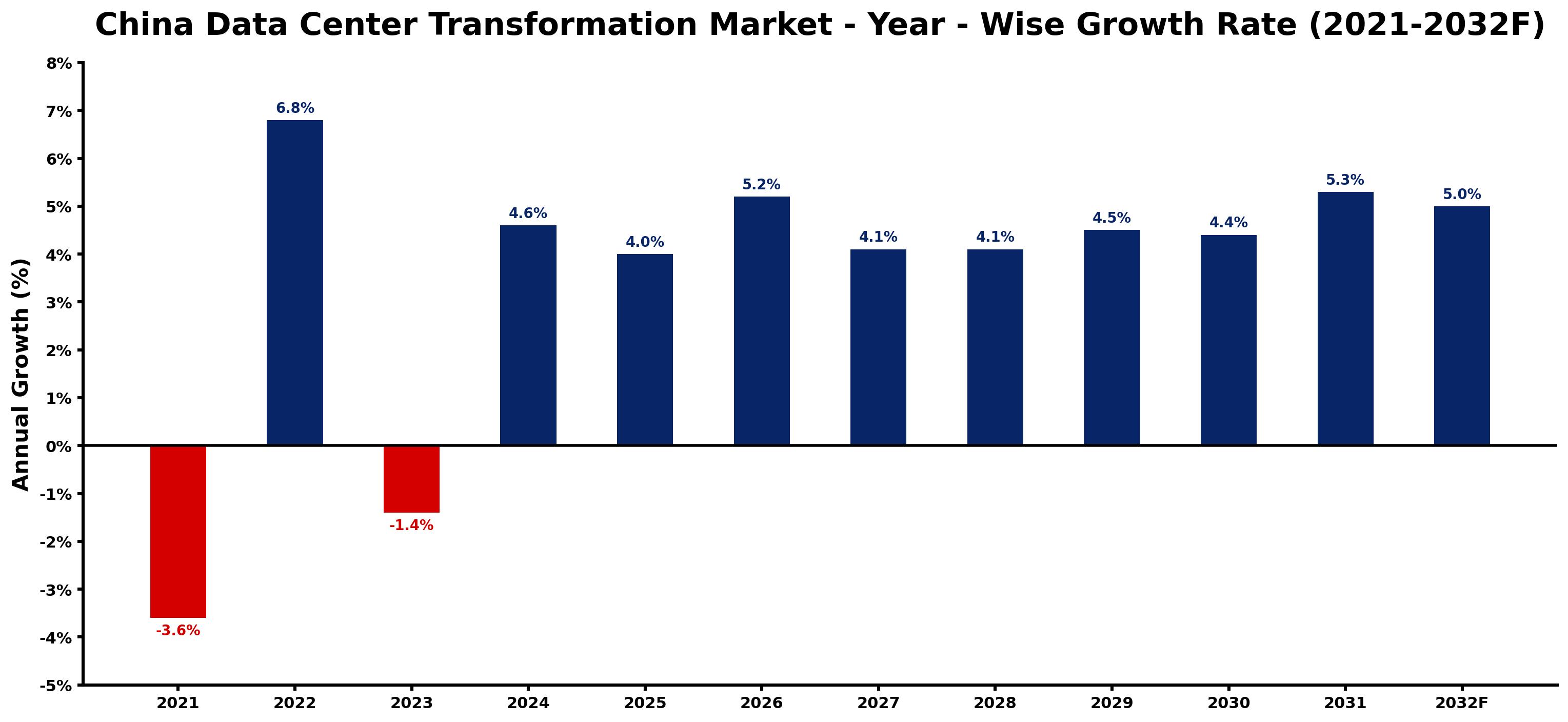
The table below presents the year‑wise growth rates along with the key drivers influencing the market
| Year | Growth Rate | Major Drivers |
| 2021 | -3.6% | Power supply limitations curtailing data center expansion plans. |
| 2022 | 6.8% | China's 14th Five-Year Plan emphasizes digital infrastructure growth. |
| 2023 | -1.4% | Increased compliance costs from new cybersecurity regulations. |
| 2024 | 4.6% | Increased data localization laws boosting domestic data storage needs. |
| 2025 | 4.0% | Surge in AI applications requiring advanced data processing facilities. |
| 2026 | 5.2% | Rising adoption of 5G technology enhancing data traffic capabilities. |
| 2027 | 4.1% | Increased focus on green computing and energy efficiency standards. |
| 2028 | 4.1% | Local cloud services enhancing enterprise reliance on data centers. |
| 2029 | 4.5% | Government incentives promoting renewable energy integration in data centers. |
| 2030 | 4.4% | Cybersecurity regulations mandating improved infrastructure resilience upgrades. |
| 2031 | 5.3% | Growing urbanization driving demand for localized data solutions. |
| 2032 | 5.0% | Rising IoT devices increasing data accumulation and processing needs. |
Note: Market size estimations and growth projections presented in this report are based on 6Wresearch's proprietary forecasting methodology, utilizing the latest available industry data, government publications, and primary research inputs.
China Data Center Transformation Market Key Takeaways
Below are some of the specific key takeaways from the market, including:
- The market is set to experience steady growth, driven by ongoing investments in modern technologies.
- Cloud computing and virtualization are at the forefront of data center transformation initiatives.
- Organizations face challenges in navigating the complexities of upgrading legacy systems.
- Government policies are increasingly supporting the modernization of data center infrastructures.
- Investment in operational efficiency remains a top priority for companies seeking competitive advantages.
Evaluation of Restraints in China Data Center Transformation Market
Transforming existing data center environments presents significant challenges. Organizations often grapple with the financial burden of investing in new technologies, which can slow down progress. on top of that, the complexity involved in ensuring a smooth transition without disrupting ongoing operations can deter many firms from pursuing aggressive transformation strategies. These restraints highlight the necessity for careful planning and resource allocation in data center projects.
China Data Center Transformation Market Trends
Several trends are shaping the China Data Center Transformation Market. A notable shift towards cloud-based solutions is evident as organizations seek to enhance flexibility and reduce costs. Virtualization technologies are becoming more prevalent, allowing for better resource management and operational efficiency. Additionally, advanced management tools are increasingly being adopted to facilitate seamless integration and monitoring of data center operations.
China Data Center Transformation Market Opportunities
The market holds substantial growth and investment opportunities for organizations willing to embrace change. Companies that invest in innovative technologies such as artificial intelligence and machine learning for data management stand to gain a competitive edge. on top of that, the increasing demand for enhanced data security and compliance measures presents avenues for specialized services and solutions in the data center sector.
Government Initiatives in the China Data Center Transformation Market
Government policies in China are significantly influencing the Data Center Transformation Market by promoting digital transformation initiatives and infrastructure upgrades. The regulatory environment is increasingly focused on enhancing data center capabilities, which is crucial for supporting the broader digital economy. This proactive approach by the government not only provides funding but also encourages private sector participation in modernization efforts.
- A national digital infrastructure upgrade programme launched in early 2025 aims to enhance data center capabilities across various sectors.
- Current initiatives are underway to streamline regulations surrounding data center operations, promoting efficiency and sustainability.
- A planned public-private initiative is expected to expand telecom infrastructure access by 2028, facilitating better connectivity for data centers.
- In 2024, the government introduced a regulatory framework mandating transparency in billing practices for data center services.
Future Insights of the China Data Center Transformation Market
Looking ahead, the China Data Center Transformation Market is expected to continue its trajectory of modernization and optimization. With advancements in technology and growing demand for efficient data management solutions, organizations will likely prioritize investments in new infrastructure. The focus on sustainability and energy efficiency will also play a crucial role in shaping the future of data center operations, compelling companies to adopt greener practices.
China Data Center Transformation Market Latest Developments
In recent months, the China Data Center Transformation Market has witnessed a surge in activity as organizations accelerate their modernization efforts. Companies are increasingly focused on integrating advanced technologies and enhancing operational efficiencies to stay competitive. This trend is reflected in the various initiatives being launched and the collaborative efforts between public and private sectors.
- A major technology vendor announced a new virtualization platform in Q1 2025, aimed at simplifying data center management.
- An initiative that began in mid-2025 focuses on deploying energy-efficient cooling solutions across multiple data centers nationwide.
- A leading regional operator is currently upgrading its infrastructure to accommodate cloud-based services, with completion expected by late 2026.
- Plans for a comprehensive training program for data center professionals were announced in early 2025, aiming to enhance skills in emerging technologies.
China Data Center Transformation Market - Key Attractiveness of the Report
- 10 Years of Market Numbers
- Historical Data Starting from 2022 to 2025
- Base Year: 2025
- Forecast Data until 2032
- Key Performance Indicators Impacting the Market
- Major Upcoming Developments and Projects
Key Highlights of the Report:
- China Data Center Transformation Market Outlook
- Market Size of China Data Center Transformation Market, 2025
- Forecast of China Data Center Transformation Market, 2032
- Historical Data and Forecast of China Data Center Transformation Revenues & Volume for the Period 2022-2032F
- China Data Center Transformation Market Trend Evolution
- China Data Center Transformation Market Drivers and Challenges
- China Data Center Transformation Price Trends
- China Data Center Transformation Porter's Five Forces
- China Data Center Transformation Industry Life Cycle
- Historical Data and Forecast of China Data Center Transformation Market Revenues & Volume By Service Type for the Period 2022-2032F
- Historical Data and Forecast of China Data Center Transformation Market Revenues & Volume By Consolidation services for the Period 2022-2032F
- Historical Data and Forecast of China Data Center Transformation Market Revenues & Volume By Optimization services for the Period 2022-2032F
- Historical Data and Forecast of China Data Center Transformation Market Revenues & Volume By Automation services for the Period 2022-2032F
- Historical Data and Forecast of China Data Center Transformation Market Revenues & Volume By Infrastructure management services for the Period 2022-2032F
- Historical Data and Forecast of China Data Center Transformation Market Revenues & Volume By Tier Type for the Period 2022-2032F
- Historical Data and Forecast of China Data Center Transformation Market Revenues & Volume By Tier 1 for the Period 2022-2032F
- Historical Data and Forecast of China Data Center Transformation Market Revenues & Volume By Tier 2 for the Period 2022-2032F
- Historical Data and Forecast of China Data Center Transformation Market Revenues & Volume By Tier 3 for the Period 2022-2032F
- Historical Data and Forecast of China Data Center Transformation Market Revenues & Volume By Tier 4 for the Period 2022-2032F
- Historical Data and Forecast of China Data Center Transformation Market Revenues & Volume By End User for the Period 2022-2032F
- Historical Data and Forecast of China Data Center Transformation Market Revenues & Volume By Cloud Service Providers for the Period 2022-2032F
- Historical Data and Forecast of China Data Center Transformation Market Revenues & Volume By Colocation Providers for the Period 2022-2032F
- Historical Data and Forecast of China Data Center Transformation Market Revenues & Volume By Enterprises for the Period 2022-2032F
- Historical Data and Forecast of China Data Center Transformation Market Revenues & Volume By Data Center Size for the Period 2022-2032F
- Historical Data and Forecast of China Data Center Transformation Market Revenues & Volume By Small Data Centers for the Period 2022-2032F
- Historical Data and Forecast of China Data Center Transformation Market Revenues & Volume By Medium-sized Data Centers for the Period 2022-2032F
- Historical Data and Forecast of China Data Center Transformation Market Revenues & Volume By Large Data Centers for the Period 2022-2032F
- Historical Data and Forecast of China Data Center Transformation Market Revenues & Volume By Vertical for the Period 2022-2032F
- Historical Data and Forecast of China Data Center Transformation Market Revenues & Volume By BFSI for the Period 2022-2032F
- Historical Data and Forecast of China Data Center Transformation Market Revenues & Volume By IT and Telecom for the Period 2022-2032F
- Historical Data and Forecast of China Data Center Transformation Market Revenues & Volume By Government and Defense for the Period 2022-2032F
- Historical Data and Forecast of China Data Center Transformation Market Revenues & Volume By Healthcare for the Period 2022-2032F
- Historical Data and Forecast of China Data Center Transformation Market Revenues & Volume By Transportation for the Period 2022-2032F
- Historical Data and Forecast of China Data Center Transformation Market Revenues & Volume By Retail for the Period 2022-2032F
- Historical Data and Forecast of China Data Center Transformation Market Revenues & Volume By Energy for the Period 2022-2032F
- Historical Data and Forecast of China Data Center Transformation Market Revenues & Volume By Manufacturing for the Period 2022-2032F
- China Data Center Transformation Import Export Trade Statistics
- Market Opportunity Assessment By Service Type
- Market Opportunity Assessment By Tier Type
- Market Opportunity Assessment By End User
- Market Opportunity Assessment By Data Center Size
- Market Opportunity Assessment By Vertical
- China Data Center Transformation Top Companies Market Share
- China Data Center Transformation Competitive Benchmarking By Technical and Operational Parameters
- China Data Center Transformation Company Profiles
- China Data Center Transformation Key Strategic Recommendations






































