China Industrial Flooring Market Size, Share & Growth Rate
The China Industrial Flooring Market was estimated at USD 123 Million in 2025 and is projected to reach USD 141 Million by 2032, growing at a CAGR of 2.0% from 2026 to 2032. This growth trajectory is underpinned by the expanding industrial base in China, as manufacturers and logistics operators seek flooring that can endure heavy traffic and chemical exposures. Furthermore, investments in infrastructure development and a growing emphasis on workplace safety are key drivers, positioning this market for steady growth.
China Industrial Flooring Market Year-wise Growth Rate and Key Drivers
This graph highlights how the China Industrial Flooring Market has steadily grown over the years, supported by major growth factors.
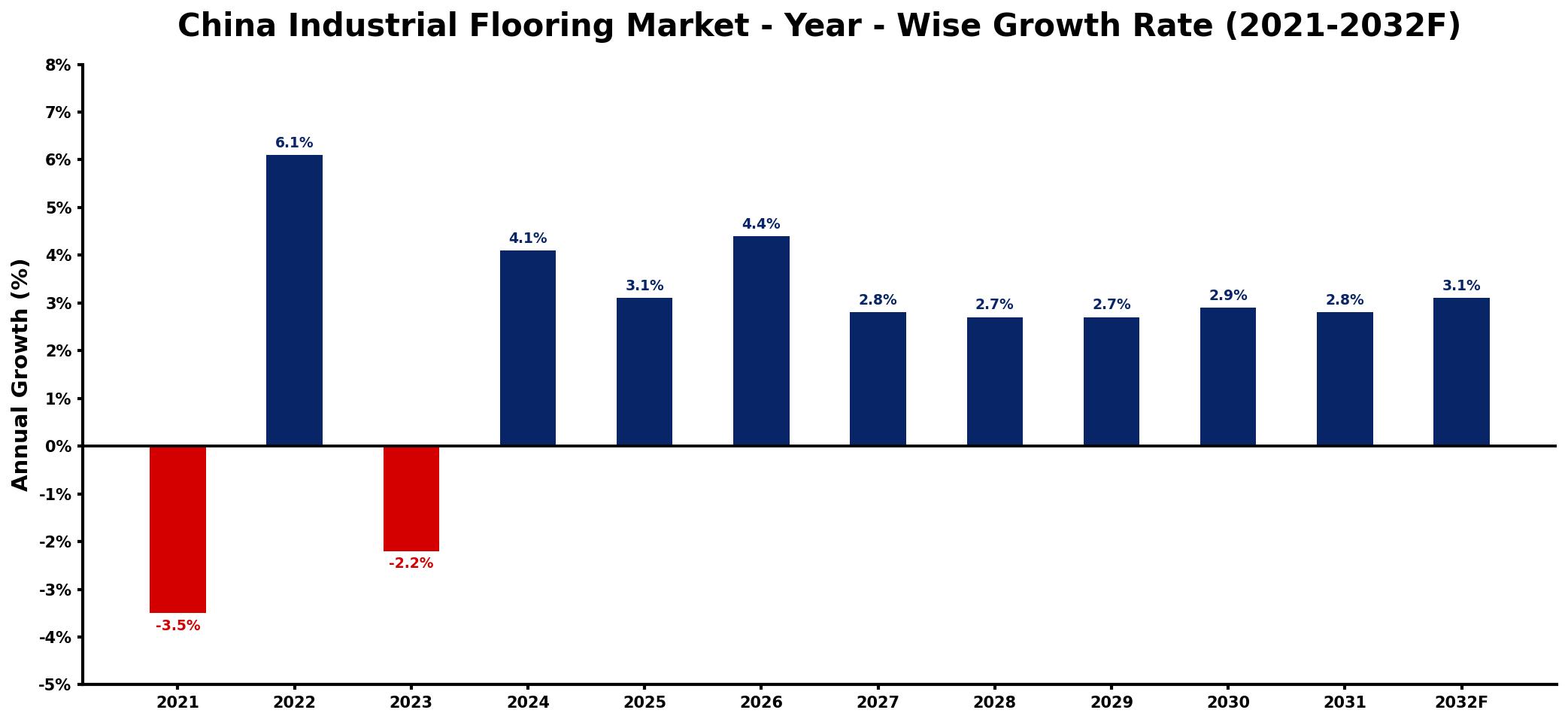
The table below presents the year‑wise growth rates along with the key drivers influencing the market
| Year | Growth Rate | Major Drivers |
| 2021 | -3.5% | Construction sector activity declines significantly |
| 2022 | 6.1% | Manufacturing investments increase substantially |
| 2023 | -2.2% | Infrastructure projects face slowdowns |
| 2024 | 4.1% | Logistics sector experiences expansion |
| 2025 | 3.1% | Automotive industry shows recovery signs |
| 2026 | 4.4% | Technology sector drives higher demand |
| 2027 | 2.8% | Renewable energy initiatives gain traction |
| 2028 | 2.7% | E-commerce growth fuels warehouse needs |
| 2029 | 2.7% | Food and beverage sector expands |
| 2030 | 2.9% | Pharmaceutical manufacturing sees growth |
| 2031 | 2.8% | Retail sector experiences revitalization |
| 2032 | 3.1% | Transportation infrastructure investments rise |
Note: Market size estimations and growth projections presented in this report are based on 6Wresearch's proprietary forecasting methodology, utilizing the latest available industry data, government publications, and primary research inputs.
China Industrial Flooring Market Synopsis
Demand for high-performance flooring solutions in China's industrial sector is surging, fueled by the rapid expansion of warehouses and manufacturing facilities. The move towards durable, maintenance-friendly flooring options not only enhances operational efficiency but also meets rigorous safety standards.
In addition to durability, the aesthetic appeal of industrial flooring is gaining importance. Companies are increasingly looking for flooring that can not only perform under pressure but also contribute positively to the overall workplace environment, thereby driving innovation in material technology and design.
China Industrial Flooring Market Key Takeaways
- The market is benefitting from advancements in flooring materials, enhancing durability and performance.
- Growing investments in infrastructure and industrial facilities are driving demand for innovative flooring solutions.
- There is a noticeable shift toward eco-friendly flooring options, reflecting broader environmental concerns.
- Safety regulations imposed by the government are significantly shaping flooring material choices.
- The competitive landscape emphasizes the importance of cost management alongside quality and performance.
Evaluation of Restraints in China Industrial Flooring Market
While the China Industrial Flooring Market displays promising growth potential, it also faces significant restraints. The primary challenge revolves around the need for flooring solutions that balance durability with cost-effectiveness. High-quality flooring materials, although essential for withstanding demanding industrial conditions, often come with elevated price points. This creates a dilemma for businesses that must manage operational budgets while still providing safe and effective flooring. Additionally, as environmental standards evolve, companies must navigate the complexities of sourcing sustainable materials that also meet performance expectations.
China Industrial Flooring Market Trends
Emerging trends in the China Industrial Flooring Market reflect a growing inclination towards smart flooring technologies. These innovations incorporate sensors and smart materials that enhance safety and operational efficiency. Simultaneously, the aesthetic aspect of flooring is gaining traction, with industries increasingly recognizing the value of appealing work environments. Moreover, sustainability is becoming a priority, leading to a rise in demand for eco-friendly flooring options that align with government regulations and corporate social responsibility initiatives.
China Industrial Flooring Market Opportunities
The industrial flooring sector in China presents substantial opportunities for growth and investment. As industries continue to evolve, there is a burgeoning need for customized flooring solutions tailored to specific operational requirements. Additionally, the ongoing trend of retrofitting older facilities with modern flooring systems opens a new avenue for expansion. Companies that invest in research and development to innovate flooring materials and installation processes stand to gain a competitive advantage in this fast-evolving market.
Government Initiatives in the China Industrial Flooring Market
Chinese government policies increasingly promote workplace safety and environmental sustainability, positively impacting the industrial flooring market. Regulations encourage the use of durable and slip-resistant flooring materials, ensuring safer working environments. Furthermore, public spending aimed at infrastructure development includes support for environmentally friendly flooring solutions, incentivizing companies to adopt sustainable practices in their flooring choices.
Future Insights of the China Industrial Flooring Market
Looking ahead to 2026-2032, the China Industrial Flooring Market is set to experience steady growth driven by evolving industrial needs and technological advancements. Increased automation and the integration of smart technologies into flooring solutions are likely to reshape product offerings, emphasizing both functionality and safety. Additionally, as environmental concerns continue to influence consumer choices, the demand for sustainable flooring options will grow, creating a market ripe for innovation and investment.
China Industrial Flooring Market Latest Developments (2025 - 2026)
Recent developments in the China Industrial Flooring Market indicate a significant shift towards sustainable flooring solutions. Companies are increasingly focusing on the development of eco-friendly materials that meet both performance criteria and environmental standards. Innovations in installation techniques are also being reported, with aims to reduce downtime in manufacturing environments. Overall, industry stakeholders are actively seeking to leverage advancements in technology to enhance product offerings and comply with emerging regulations.
China Industrial Flooring Market - Key Attractiveness of the Report
- 10 Years of Market Numbers
- Historical Data Starting from 2022 to 2025
- Base Year: 2025
- Forecast Data until 2032
- Key Performance Indicators Impacting the Market
- Major Upcoming Developments and Projects
Key Highlights of the Report:
- China Industrial Flooring Market Outlook
- Market Size of China Industrial Flooring Market, 2025
- Forecast of China Industrial Flooring Market, 2032
- Historical Data and Forecast of China Industrial Flooring Revenues & Volume for the Period 2022-2032F
- China Industrial Flooring Market Trend Evolution
- China Industrial Flooring Market Drivers and Challenges
- China Industrial Flooring Price Trends
- China Industrial Flooring Porter's Five Forces
- China Industrial Flooring Industry Life Cycle
- Historical Data and Forecast of China Industrial Flooring Market Revenues & Volume By End User Industry for the Period 2022-2032F
- Historical Data and Forecast of China Industrial Flooring Market Revenues & Volume By Chemical for the Period 2022-2032F
- Historical Data and Forecast of China Industrial Flooring Market Revenues & Volume By Food and Beverages for the Period 2022-2032F
- Historical Data and Forecast of China Industrial Flooring Market Revenues & Volume By Healthcare for the Period 2022-2032F
- Historical Data and Forecast of China Industrial Flooring Market Revenues & Volume By Transportation and Aviation for the Period 2022-2032F
- Historical Data and Forecast of China Industrial Flooring Market Revenues & Volume By Others for the Period 2022-2032F
- Historical Data and Forecast of China Industrial Flooring Market Revenues & Volume By Thickness for the Period 2022-2032F
- Historical Data and Forecast of China Industrial Flooring Market Revenues & Volume By Light duty for the Period 2022-2032F
- Historical Data and Forecast of China Industrial Flooring Market Revenues & Volume By Medium Duty for the Period 2022-2032F
- Historical Data and Forecast of China Industrial Flooring Market Revenues & Volume By Heavy Duty for the Period 2022-2032F
- Historical Data and Forecast of China Industrial Flooring Market Revenues & Volume By Material Type for the Period 2022-2032F
- Historical Data and Forecast of China Industrial Flooring Market Revenues & Volume By Epoxy for the Period 2022-2032F
- Historical Data and Forecast of China Industrial Flooring Market Revenues & Volume By Polyaspartic for the Period 2022-2032F
- Historical Data and Forecast of China Industrial Flooring Market Revenues & Volume By Polyurethane for the Period 2022-2032F
- Historical Data and Forecast of China Industrial Flooring Market Revenues & Volume By Anhydrite for the Period 2022-2032F
- Historical Data and Forecast of China Industrial Flooring Market Revenues & Volume By Others for the Period 2022-2032F
- China Industrial Flooring Import Export Trade Statistics
- Market Opportunity Assessment By End User Industry
- Market Opportunity Assessment By Thickness
- Market Opportunity Assessment By Material Type
- China Industrial Flooring Top Companies Market Share
- China Industrial Flooring Competitive Benchmarking By Technical and Operational Parameters
- China Industrial Flooring Company Profiles
- China Industrial Flooring Key Strategic Recommendations






































