China Industrial Inorganic Chemical Market Size & Growth Rate
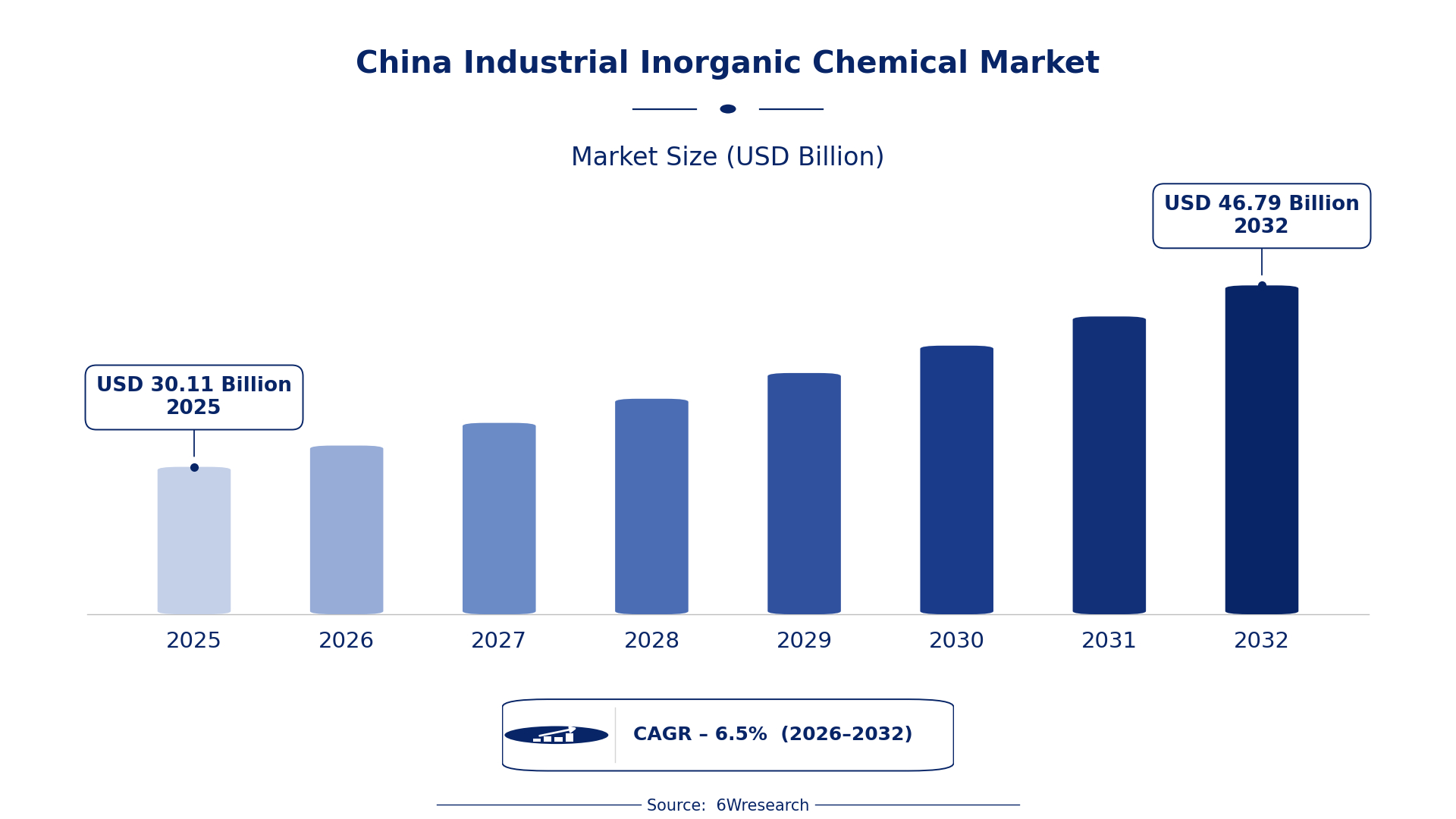
According to 6Wresearch internal database and industry insights, the China Industrial Inorganic Chemical Market was valued at USD 30.11 billion in 2025 and is projected to reach USD 46.79 billion by 2032, growing at a CAGR of approximately 6.5% during 2026–2032.
China Industrial Inorganic Chemical Market Highlights
| Report Metric | Details |
| Report Name | China Industrial Inorganic Chemical Market |
| Market Size 2025 | USD 30.11 billion |
| Market Size 2032 | USD 46.79 billion |
| Absolute Growth 2025–2032 | USD 16.68 billion |
| CAGR 2026–2032 | 6.5% |
| Peak Annual Growth | 8.7% in 2027 |
| Forecast Period | 2026–2032 |
| Historical Data | 2022–2025 |
| Base Year | 2025 |
| Leading Chemical Type, 2025 | Acids (H₂SO₄, HCl) (51% share) |
| Leading Physical Form, 2025 | Liquid (50% share) |
| Leading Application Segment, 2025 | Fertilizers (44% share) |
| Leading End User, 2025 | Chemical Processing Units (51% share) |
| Fastest-Growing Chemical Type | Salts (NaCl, Nitrates) (9.2% CAGR) |
| Fastest-Growing Physical Form | Powder / Liquid (8.2% CAGR) |
| Fastest-Growing Application Segment | Cleaning (8.8% CAGR) |
| Fastest-Growing End User | Agriculture Sector (9.1% CAGR) |
| Growing Sector | Agriculture Sector |
| Key End Users | Chemical Processing Units, Agriculture Sector, Soap & Detergent Industry, Construction Materials Firms |
China Industrial Inorganic Chemical Market Year-wise Growth Rate and Key Drivers (2022–2032)
This graph illustrates the annual growth rates of the market from 2022 to 2032, highlighting a steady upward trajectory and projected market expansion over the forecast period.
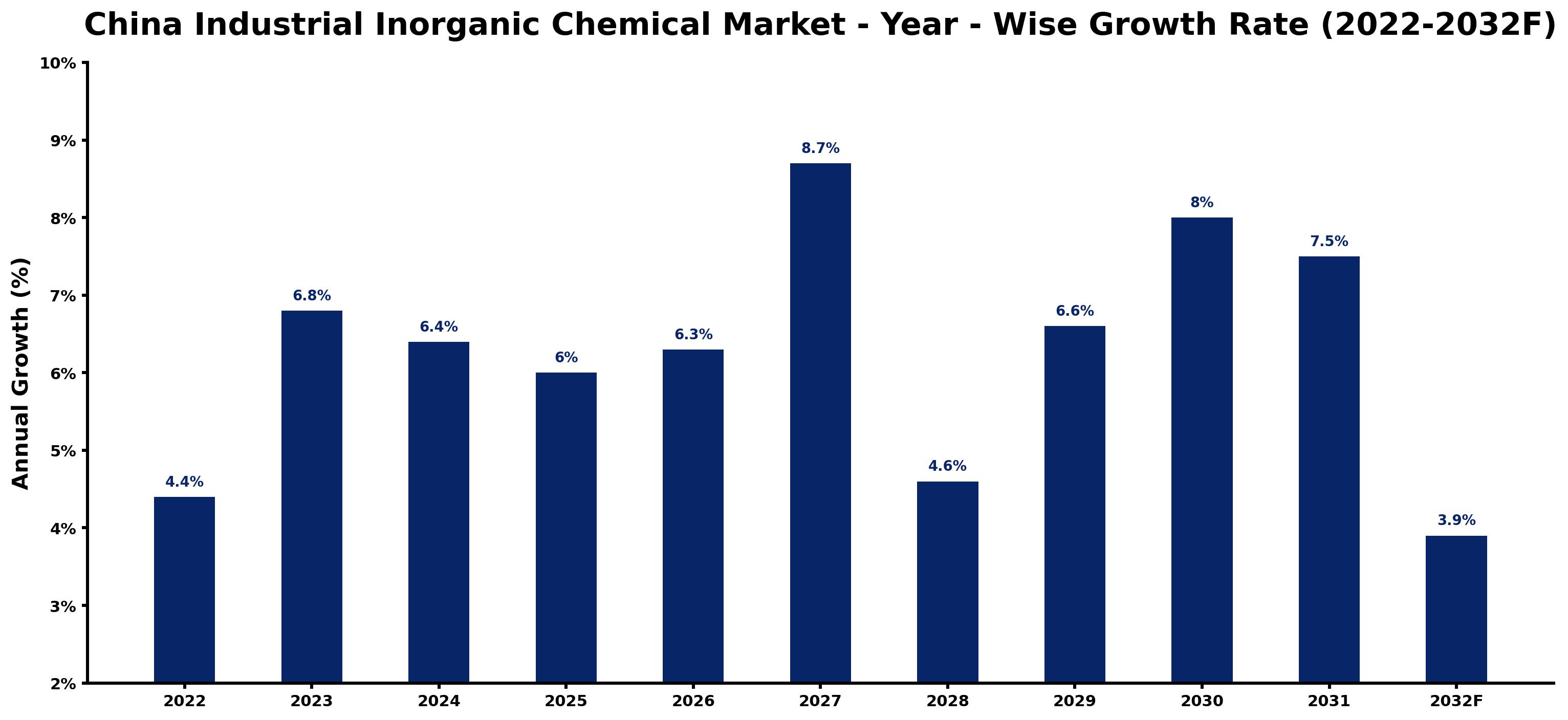
Annual growth estimates for each year appear below with the principal reason behind them, explaining the shifts that set the pace of the market.
| Year | Estimated Annual Growth (%) | Market Rationale |
| 2022 | 4.4 | The market exhibited steady growth due to strong domestic demand from the chemical processing sector. |
| 2023 | 6.8 | Growth accelerated as the chemical industry in Jiangsu province expanded its production capacity. |
| 2024 | 6.4 | A slight slowdown occurred as the market adjusted to previous high growth rates. |
| 2025 | 6.0 | Demand for fertilizers increased as the agricultural sector expanded its output through the 'Soil Fertility Improvement Program'. |
| 2026 | 6.3 | Growth resumed as investments in chemical manufacturing infrastructure increased in Guangdong and Shandong provinces. |
| 2027 | 8.7 | The market peaked due to heightened demand for industrial inorganic chemicals across various sectors, particularly agriculture. |
| 2028 | 4.6 | A slowdown followed as market conditions stabilised after the peak growth year. |
| 2029 | 6.6 | Growth picked up again, supported by rising agricultural outputs and fertilizer needs driven by the 'National Fertilizer Quality Improvement Program'. |
| 2030 | 8.0 | Demand surged as the glass manufacturing sector expanded in response to construction growth, benefiting from increased urbanisation. |
| 2031 | 7.5 | The growth rate slowed as the market began to normalise after previous peaks in production and demand. |
| 2032 | 3.9 | A further slowdown is expected as the market stabilises, reflecting ongoing demand from the chemical processing units. |
Note: Market size estimations and growth projections presented in this report are based on 6Wresearch's proprietary forecasting methodology, utilizing the latest available industry data, government publications, and primary research inputs.
China Industrial Inorganic Chemical Market Synopsis
The Industrial Inorganic Chemical Market in China encompasses a range of chemical compounds essential for various industrial applications. These chemicals are produced through processes like neutralization and precipitation, serving key roles in water treatment, cleaning agents, and fertilizers. The China Industrial Inorganic Chemical Market is growing due to strong demand from agriculture and chemical processing sectors, with substantial investments in manufacturing capabilities and infrastructure. The agricultural sector is projected to utilize 20 million tons of fertilizers annually by 2025, driving further market expansion.
Market Dynamics Impact Analysis (2026–2032)
| Factor | Type | Impact | Primary Segment Affected |
| Strong domestic demand from the agriculture sector drives the need for fertilizers and related chemicals. | Driver | High | Fertilizers |
| Increasing investments in chemical manufacturing facilities boost production capacity. | Driver | High | Chemical Processing Units |
| Growing agricultural outputs create a significant opportunity for fertilizer suppliers. | Opportunity | High | Fertilizers |
| Expansion of glass manufacturing facilities presents a demand for raw materials. | Opportunity | Medium | Glass/Ceramics |
| Stricter emissions standards may increase operational costs for chemical producers. | Restraint | High | Chemical Processing Units |
| National standards for inorganic chemicals may limit production flexibility. | Restraint | Medium | Chemical Processing Units |
| High compliance costs associated with safety regulations can deter new market entrants. | Challenge | High | Chemical Processing Units |
| Supply chain disruptions may affect the availability of raw materials. | Challenge | Medium | Fertilizers |
Evaluation of Drivers in China Industrial Inorganic Chemical Market (2026–2032)
The main growth drivers and the segments they affect most are set out below.
| Drivers | Primary Segment Affected | Why It Matters (Evidence) |
| Increased agricultural productivity drives demand for fertilizers, leading to higher purchases by farmers. | Fertilizers | The agricultural sector in China is projected to utilize 20 million tons of fertilizers annually by 2025. |
| Investment in chemical processing facilities boosts production capabilities, resulting in increased output. | Chemical Processing Units | The chemical industry in Jiangsu province is a major hub for inorganic chemicals, producing over 30 million tons of sulfuric acid in 2022. |
| Rising construction activities boost demand for glass and ceramics, increasing the need for raw materials. | Glass/Ceramics | The glass manufacturing sector in China is expected to grow steadily, driven by construction demands, with production increasing by 5% annually. |
| Growing consumption of cleaning agents in various industries leads to higher demand for bases and acids. | Cleaning | The soap and detergent industry in China is valued at approximately 200 billion CNY, driving demand for cleaning chemicals. |
| The push for sustainable practices in chemical manufacturing increases the demand for eco-friendly products. | Chemical Processing Units | The 'Green Chemistry Initiative' aims to promote sustainable practices in chemical manufacturing by 2025, influencing purchasing decisions. |
Growth across the Industrial Inorganic Chemical market in China is anchored in increased agricultural productivity, rising construction activities, and investments in chemical processing facilities. In 2022, China produced over 30 million tons of sulfuric acid, reflecting high demand from various sectors. The agricultural sector is expected to utilize 20 million tons of fertilizers annually by 2025, driving purchases from farmers. The soap and detergent industry, valued at approximately 200 billion CNY, further boosts demand for bases and acids. The glass manufacturing sector is expanding due to construction demands, increasing the need for raw materials, which is projected to grow by 5% annually.
Evaluation of Restraints in China Industrial Inorganic Chemical Market
The key brakes on demand, and where they bite hardest, are shown below.
| Market Restraint | Primary Segment Affected | Why It Matters (Evidence) |
| Compliance with updated emissions standards raises operational costs for producers. | Chemical Processing Units | In 2023, the Ministry of Ecology and Environment announced stricter emissions standards for chemical plants, increasing costs by 15%. |
| National standards may restrict production flexibility and innovation in manufacturing processes. | Chemical Processing Units | The State Administration for Market Regulation updated the national standards for inorganic chemicals in 2022, limiting production methods. |
| High production costs associated with safety regulations can deter new market entrants. | Chemical Processing Units | The 'Chemical Industry Safety Production Regulations' were updated in 2021 to improve safety protocols, raising compliance costs. |
| Supply chain disruptions may lead to shortages of essential raw materials for production. | Fertilizers | The ongoing global supply chain issues have affected many industries, including chemicals, causing a 10% reduction in raw material availability. |
| Market competition may limit pricing power for manufacturers amidst rising costs. | Chemical Processing Units | The chemical industry faces intense competition, impacting profitability for producers, particularly in Jiangsu and Guangdong. |
China Industrial Inorganic Chemical Market Challenges
Producers in the China Industrial Inorganic Chemical market face intense competition, leading to price reductions that can shrink profit margins by up to 10%. This situation stems from the high concentration of manufacturers in Jiangsu and Guangdong, forcing suppliers to lower costs to maintain market presence. Technology adoption lags behind global standards, causing production inefficiencies that can delay output by 15%. Rising raw material costs, particularly for sulfuric acid, inflate production expenses by 10%, impacting profitability for suppliers and ultimately raising prices for buyers. Skills shortages in advanced chemical processing techniques hinder innovation, limiting growth potential for both producers and buyers.
Trends in the China Industrial Inorganic Chemical Market
The trends below show where the China Industrial Inorganic Chemical Market is heading.
- Shift towards Sustainable Practices in Chemical Manufacturing: Chemical processing units are increasingly adopting eco-friendly practices, driven by the 'Green Chemistry Initiative' launched in 2021. This initiative aims for sustainable manufacturing by 2025, with many units now implementing ISO 9001:2015 standards.
- Transition to Advanced Fertilizers: The agricultural sector is moving towards advanced fertilizers to improve efficiency, supported by the 'Soil Fertility Improvement Program' launched in 2021. This program aims to enhance fertilizer use efficiency for over 1.4 billion people in China.
- Emergence of Innovative Cleaning Solutions: The soap and detergent industry is witnessing a rise in innovative cleaning solutions, with an expected growth of 8.8% in the cleaning segment. This trend is driven by increasing consumer demand for effective and eco-friendly products.
- Growth in Glass Manufacturing Demand: The glass manufacturing sector is expanding due to rising construction activities, particularly in urban areas. This growth is expected to create significant demand for raw materials, with production projected to increase steadily by 5%.
Investment Opportunities in the China Industrial Inorganic Chemical Market
Some of the investment opportunities in the China Industrial Inorganic Chemical Market are mentioned below.
- Supply of Advanced Fertilizers: The agricultural sector is increasingly seeking advanced fertilizers to improve crop yields, projected to reach 20 million tons annually by 2025. Collaborating with local agricultural cooperatives can facilitate market entry and enhance distribution channels.
- Investment in Glass Manufacturing Facilities: The demand for glass manufacturing is rising, driven by increased construction needs. Suppliers can enter this market by aligning with construction firms to meet the growing demand for raw materials.
- Expansion of Chemical Processing Units: The growth in chemical processing units presents opportunities for suppliers of industrial inorganic chemicals. Engaging in joint ventures with local firms can provide a competitive edge in this expanding market.
- Development of Eco-Friendly Cleaning Agents: The soap and detergent industry is shifting towards eco-friendly cleaning agents, creating opportunities for suppliers. With a market valued at 200 billion CNY, entering this segment can be lucrative for manufacturers.
Government Initiatives in the China Industrial Inorganic Chemical Market
The '14th Five-Year Plan for the Chemical Industry', issued by the Ministry of Industry and Information Technology in 2021, aims for sustainable growth in the sector. This plan encourages investment in environmentally friendly practices and technologies, promoting compliance with new standards. Additionally, the 'National Fertilizer Quality Improvement Program', launched in 2020, focuses on improving fertilizer efficiency and reducing environmental impact, benefiting both producers and consumers in the agricultural sector.
The Ministry of Agriculture oversees the implementation of the 'Soil Fertility Improvement Program', which funds projects aimed at improving fertilizer use efficiency. This program supports farmers in adopting better practices, ensuring that over 1.4 billion people in China benefit from enhanced agricultural outputs. Furthermore, the National Development and Reform Commission regulates chemical industry standards, ensuring compliance with safety and quality measures, impacting production processes and market access.
Future Insight of the China Industrial Inorganic Chemical Market
The China Industrial Inorganic Chemical market will experience significant changes by 2032, primarily driven by the 'Green Chemistry Initiative' that promotes sustainable manufacturing practices. The agricultural sector is expected to utilise 20 million tons of fertilizers annually, improving efficiency and supporting farmers. The glass manufacturing sector will continue to expand, supported by increasing construction demands, creating new opportunities for suppliers. The widespread adoption of ISO 9001:2015 standards will enhance product quality across the market, fostering greater trust among buyers.
Market Segmentation Analysis
Each segment group is reviewed below, with the leader by share and the fastest grower by CAGR.
By Chemical Type – Acids (H₂SO₄, HCl) Dominated, Salts (NaCl, Nitrates) Expected to Grow Fastest
According to Sachin Kumar Rai, Senior Research Analyst at 6Wresearch, with a 51% revenue share in 2025, Acids (H₂SO₄, HCl) was the largest chemical type category. Acids such as sulfuric acid and hydrochloric acid hold the largest market share due to their extensive use in chemical processes and manufacturing. For instance, the production of over 30 million tons of sulfuric acid in 2022 highlights its critical role across various industries. Over 2026–2032, Salts (NaCl, Nitrates) is expected to post the fastest growth, at a CAGR of 9.2%. Salts are witnessing rapid growth as they are increasingly utilised in agriculture and chemical manufacturing. The agricultural sector's projected consumption of 20 million tons of fertilizers annually by 2025 significantly boosts demand for nitrate and sodium chloride salts. Suppliers should focus on enhancing production capabilities for salts to meet the growing agricultural demands.
By Physical Form – Liquid Dominated, Powder / Liquid Expected to Grow Fastest
Liquid held a 50% share of the China Industrial Inorganic Chemical Market by physical form in 2025. Liquid forms of industrial inorganic chemicals dominate the market due to their ease of handling and versatility in various applications. This preference is evident in the widespread use of liquid acids in chemical processing and manufacturing. Powder / Liquid is set to record the highest CAGR in this split, 8.2% over 2026–2032. Powder and liquid forms are gaining traction as they are used in diverse applications, particularly in fertilizers and cleaning agents. The cleaning sector's growth is supported by increasing industrial cleaning solutions, further boosting demand for these forms. Buyers should consider sourcing both liquid and powder forms to maximise application efficiency across industries.
By Application Segment – Fertilizers Dominated, Cleaning Expected to Grow Fastest
In 2025, Fertilizers led the application segment split with a 44% share. Fertilizers represent the largest application segment as they are essential for supporting China's vast agricultural sector. The significant reliance on inorganic fertilizers is underscored by the projected usage of 20 million tons annually by 2025. The quickest growth will come from Cleaning, forecast to expand at a CAGR of 8.8% between 2026 and 2032. Cleaning applications are rapidly expanding due to the increasing need for effective industrial cleaning solutions. This trend is reflected in the valuation of the soap and detergent industry in China, which is approximately 200 billion CNY. Suppliers must innovate cleaning solutions to capture the growing demand in industrial cleaning applications.
By End User – Chemical Processing Units Dominated, Agriculture Sector Expected to Grow Fastest
The largest end user category in 2025 was Chemical Processing Units, with a 51% share of total revenue. Chemical processing units are the primary consumers of industrial inorganic chemicals, utilising them extensively in various manufacturing processes. This strong demand is reinforced by the concentration of chemical processing units in key provinces like Guangdong and Shandong. Agriculture Sector is projected to grow fastest, at a CAGR of 9.1% during 2026–2032. The agriculture sector is rapidly increasing its consumption of salts and fertilizers, driven by initiatives like the 'Soil Fertility Improvement Program' launched in 2021. This program aims to enhance fertilizer use efficiency, further propelling growth in this segment. Suppliers should strengthen relationships with agricultural stakeholders to capitalise on the growing demand for fertilizers.
Key Attractiveness of the Report
- 10 Years of Market Numbers
- Historical Data Starting from 2022 to 2025
- Base Year 2025
- Forecast Data until 2032
- Key Performance Indicators Impacting the Market
- Major Upcoming Developments and Projects
Key Highlights of the Report:
- China Industrial Inorganic Chemical Market Outlook
- Market Size of China Industrial Inorganic Chemical Market, 2025
- Forecast of China Industrial Inorganic Chemical Market, 2032
- Historical Data and Forecast of China Industrial Inorganic Chemical Revenues & Volume for the Period 2022 - 2032F
- China Industrial Inorganic Chemical Market Trend Evolution
- China Industrial Inorganic Chemical Market Drivers and Challenges
- China Industrial Inorganic Chemical Price Trends
- China Industrial Inorganic Chemical Porter's Five Forces
- China Industrial Inorganic Chemical Industry Life Cycle
- Historical Data and Forecast of China Industrial Inorganic Chemical Market Revenues & Volume By Chemical Type for the Period 2022 - 2032F
- Historical Data and Forecast of China Industrial Inorganic Chemical Market Revenues & Volume By Acids (H SO , HCl) for the Period 2022 - 2032F
- Historical Data and Forecast of China Industrial Inorganic Chemical Market Revenues & Volume By Bases (NaOH, KOH) for the Period 2022 - 2032F
- Historical Data and Forecast of China Industrial Inorganic Chemical Market Revenues & Volume By Salts (NaCl, Nitrates) for the Period 2022 - 2032F
- Historical Data and Forecast of China Industrial Inorganic Chemical Market Revenues & Volume By Oxides & Carbonates for the Period 2022 - 2032F
- Historical Data and Forecast of China Industrial Inorganic Chemical Market Revenues & Volume By Physical Form for the Period 2022 - 2032F
- Historical Data and Forecast of China Industrial Inorganic Chemical Market Revenues & Volume By Liquid for the Period 2022 - 2032F
- Historical Data and Forecast of China Industrial Inorganic Chemical Market Revenues & Volume By Powder / Liquid for the Period 2022 - 2032F
- Historical Data and Forecast of China Industrial Inorganic Chemical Market Revenues & Volume By Crystalline for the Period 2022 - 2032F
- Historical Data and Forecast of China Industrial Inorganic Chemical Market Revenues & Volume By Solid for the Period 2022 - 2032F
- Historical Data and Forecast of China Industrial Inorganic Chemical Market Revenues & Volume By Application Segment for the Period 2022 - 2032F
- Historical Data and Forecast of China Industrial Inorganic Chemical Market Revenues & Volume By pH Adjustment, Cleaning for the Period 2022 - 2032F
- Historical Data and Forecast of China Industrial Inorganic Chemical Market Revenues & Volume By Neutralization for the Period 2022 - 2032F
- Historical Data and Forecast of China Industrial Inorganic Chemical Market Revenues & Volume By Preservatives, Fertilizers for the Period 2022 - 2032F
- Historical Data and Forecast of China Industrial Inorganic Chemical Market Revenues & Volume By Glass/Ceramics for the Period 2022 - 2032F
- Historical Data and Forecast of China Industrial Inorganic Chemical Market Revenues & Volume By End User for the Period 2022 - 2032F
- Historical Data and Forecast of China Industrial Inorganic Chemical Market Revenues & Volume By Chemical Processing Units for the Period 2022 - 2032F
- Historical Data and Forecast of China Industrial Inorganic Chemical Market Revenues & Volume By Soap & Detergent Industry for the Period 2022 - 2032F
- Historical Data and Forecast of China Industrial Inorganic Chemical Market Revenues & Volume By Agriculture Sector for the Period 2022 - 2032F
- Historical Data and Forecast of China Industrial Inorganic Chemical Market Revenues & Volume By Construction Materials Firms for the Period 2022 - 2032F
- China Industrial Inorganic Chemical Import Export Trade Statistics
- Market Opportunity Assessment By Chemical Type
- Market Opportunity Assessment By Physical Form
- Market Opportunity Assessment By Application Segment
- Market Opportunity Assessment By End User
- China Industrial Inorganic Chemical Top Companies Market Share
- China Industrial Inorganic Chemical Competitive Benchmarking By Technical and Operational Parameters
- China Industrial Inorganic Chemical Company Profiles
- China Industrial Inorganic Chemical Key Strategic Recommendations
Market Covered
The report offers an extensive study of the following market segments.
By Chemical Type
- Acids (H₂SO₄, HCl)
- Bases (NaOH, KOH)
- Salts (NaCl, Nitrates)
- Oxides & Carbonates
By Physical Form
- Liquid
- Powder / Liquid
- Crystalline
- Solid
By Application Segment
- pH Adjustment
- Cleaning
- Neutralization
- Preservatives
- Fertilizers
- Glass/Ceramics
By End User
- Chemical Processing Units
- Soap & Detergent Industry
- Agriculture Sector
- Construction Materials Firms































