China Industrial Oven Market Size Growth Rate
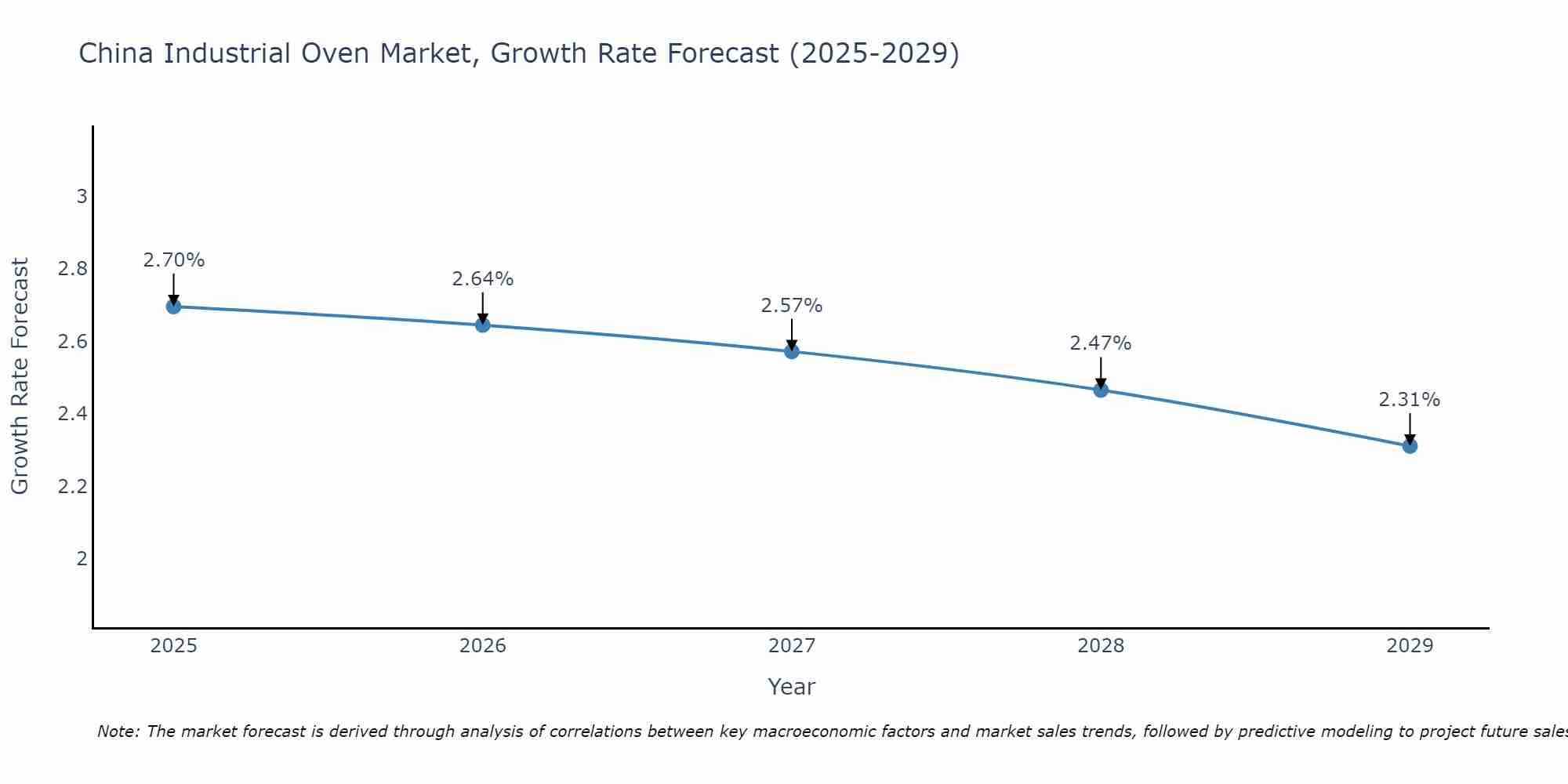
The China Industrial Oven Market could see a tapering of growth rates over 2025 to 2029. Starting high at 2.70% in 2025, the market steadily declines to 2.31% by 2029.
China Industrial Oven Market Overview
The Industrial Oven Market in China is growing as industries seek advanced oven solutions for various applications, including baking, drying, and curing. Industrial ovens are essential for maintaining precise temperature control and ensuring product quality in manufacturing processes. The market expansion is driven by advancements in oven technologies, the rise in industrial production activities, and the increasing focus on improving oven performance and energy efficiency. The demand for high-performance and versatile industrial ovens supports market growth.
Drivers of the market
The industrial oven market in China is driven by the increasing demand for heating and drying equipment used in various industrial processes, including manufacturing, food processing, and coatings. Industrial ovens are essential for providing controlled and uniform heating to achieve desired product properties and quality. The growth of industrial activities and infrastructure development supports the demand for advanced oven technologies. Additionally, advancements in oven designs, such as improved energy efficiency, temperature control, and automation features, contribute to market growth. The rising focus on process optimization and product quality further drives the adoption of industrial ovens.
Challenges of the market
The industrial oven market in China faces challenges related to energy efficiency and technological advancements. Industrial ovens, used for heating and curing processes, must offer high energy efficiency and performance. Developing advanced oven technologies that meet regulatory standards and manage production costs while staying competitive in the market adds complexity to market operations.
Government Policy of the market
Government policies affecting the industrial oven market in China focus on improving energy efficiency and reducing emissions in industrial processes. Regulations encourage the use of energy-efficient ovens that reduce energy consumption and minimize emissions. The government also supports research and development in new oven technologies that offer improved performance and energy efficiency.
Key Highlights of the Report:
- China Industrial Oven Market Outlook
- Market Size of China Industrial Oven Market, 2024
- Forecast of China Industrial Oven Market, 2031
- Historical Data and Forecast of China Industrial Oven Revenues & Volume for the Period 2018 - 2031
- China Industrial Oven Market Trend Evolution
- China Industrial Oven Market Drivers and Challenges
- China Industrial Oven Price Trends
- China Industrial Oven Porter's Five Forces
- China Industrial Oven Industry Life Cycle
- Historical Data and Forecast of China Industrial Oven Market Revenues & Volume By Product for the Period 2018 - 2031
- Historical Data and Forecast of China Industrial Oven Market Revenues & Volume By Curing Ovens for the Period 2018 - 2031
- Historical Data and Forecast of China Industrial Oven Market Revenues & Volume By Baking Ovens for the Period 2018 - 2031
- Historical Data and Forecast of China Industrial Oven Market Revenues & Volume By Drying Ovens for the Period 2018 - 2031
- Historical Data and Forecast of China Industrial Oven Market Revenues & Volume By Reflow Ovens for the Period 2018 - 2031
- Historical Data and Forecast of China Industrial Oven Market Revenues & Volume By Others for the Period 2018 - 2031
- Historical Data and Forecast of China Industrial Oven Market Revenues & Volume By Process for the Period 2018 - 2031
- Historical Data and Forecast of China Industrial Oven Market Revenues & Volume By Batch for the Period 2018 - 2031
- Historical Data and Forecast of China Industrial Oven Market Revenues & Volume By Continuous for the Period 2018 - 2031
- Historical Data and Forecast of China Industrial Oven Market Revenues & Volume By Heating Medium for the Period 2018 - 2031
- Historical Data and Forecast of China Industrial Oven Market Revenues & Volume By Electric Heat for the Period 2018 - 2031
- Historical Data and Forecast of China Industrial Oven Market Revenues & Volume By Fuel- & Gas-fired for the Period 2018 - 2031
- Historical Data and Forecast of China Industrial Oven Market Revenues & Volume By Infrared Heaters for the Period 2018 - 2031
- Historical Data and Forecast of China Industrial Oven Market Revenues & Volume By Others for the Period 2018 - 2031
- Historical Data and Forecast of China Industrial Oven Market Revenues & Volume By End-User Industry for the Period 2018 - 2031
- Historical Data and Forecast of China Industrial Oven Market Revenues & Volume By Food Production & Processing for the Period 2018 - 2031
- Historical Data and Forecast of China Industrial Oven Market Revenues & Volume By Chemical Processing for the Period 2018 - 2031
- Historical Data and Forecast of China Industrial Oven Market Revenues & Volume By Electricals & Electronics for the Period 2018 - 2031
- Historical Data and Forecast of China Industrial Oven Market Revenues & Volume By Automotive & Aerospace for the Period 2018 - 2031
- Historical Data and Forecast of China Industrial Oven Market Revenues & Volume By Pharmaceuticals for the Period 2018 - 2031
- Historical Data and Forecast of China Industrial Oven Market Revenues & Volume By Others for the Period 2018 - 2031
- China Industrial Oven Import Export Trade Statistics
- Market Opportunity Assessment By Product
- Market Opportunity Assessment By Process
- Market Opportunity Assessment By Heating Medium
- Market Opportunity Assessment By End-User Industry
- China Industrial Oven Top Companies Market Share
- China Industrial Oven Competitive Benchmarking By Technical and Operational Parameters
- China Industrial Oven Company Profiles
- China Industrial Oven Key Strategic Recommendations






































