China Nondurable Goods Market (2026-2032) Outlook | Forecast, Analysis, Industry, Companies, Growth, Trends, Value, Size, Share & Revenue
Market Forecast By Product Type (Food, Drinks, Medication, Cleaning Supplies, Cosmetics, Office Supplies, Apparel, Cigarettes And Tobacco), By Applications (Offline, Online) And Competitive Landscape
| Product Code: ETC254301 | Publication Date: Aug 2022 | Updated Date: Mar 2026 | Product Type: Market Research Report | |
| Publisher: 6Wresearch | Author: Ravi Bhandari | No. of Pages: 75 | No. of Figures: 35 | No. of Tables: 20 |
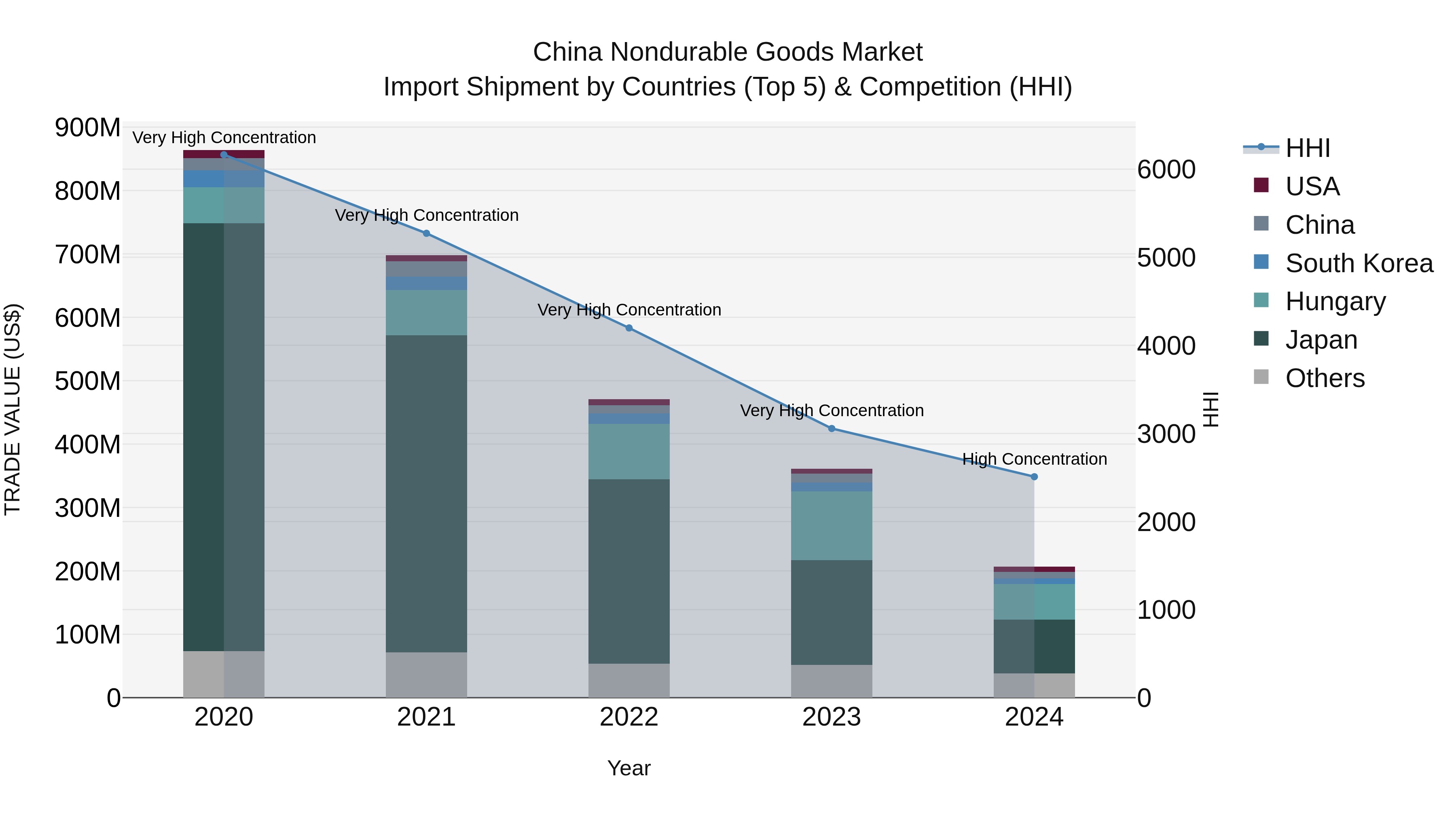
China Nondurable Goods Market Top 5 Importing Countries and Market Competition (HHI) Analysis
China nondurable goods import shipments in 2024 continued to show high concentration, with top exporting countries being Japan, Hungary, South Korea, the USA, and even China itself. The Herfindahl-Hirschman Index (HHI) indicated a shift from very high concentration in 2023 to high concentration in 2024. Despite a significant negative compound annual growth rate (CAGR) of -30.03% from 2020 to 2024, the growth rate for 2023-2024 experienced a steeper decline at -42.69%. This data suggests a challenging landscape for nondurable goods imports into China, reflecting potential shifts in market dynamics and trade relationships.
Key Highlights of the Report:
- China Nondurable Goods Market Outlook
- Market Size of China Nondurable Goods Market, 2025
- Forecast of China Nondurable Goods Market, 2032
- Historical Data and Forecast of China Nondurable Goods Revenues & Volume for the Period 2022 - 2032F
- China Nondurable Goods Market Trend Evolution
- China Nondurable Goods Market Drivers and Challenges
- China Nondurable Goods Price Trends
- China Nondurable Goods Porter's Five Forces
- China Nondurable Goods Industry Life Cycle
- Historical Data and Forecast of China Nondurable Goods Market Revenues & Volume By Product Type for the Period 2022 - 2032F
- Historical Data and Forecast of China Nondurable Goods Market Revenues & Volume By Food for the Period 2022 - 2032F
- Historical Data and Forecast of China Nondurable Goods Market Revenues & Volume By Drinks for the Period 2022 - 2032F
- Historical Data and Forecast of China Nondurable Goods Market Revenues & Volume By Medication for the Period 2022 - 2032F
- Historical Data and Forecast of China Nondurable Goods Market Revenues & Volume By Cleaning Supplies for the Period 2022 - 2032F
- Historical Data and Forecast of China Nondurable Goods Market Revenues & Volume By Cosmetics for the Period 2022 - 2032F
- Historical Data and Forecast of China Nondurable Goods Market Revenues & Volume By Office Supplies for the Period 2022 - 2032F
- Historical Data and Forecast of China Nondurable Goods Market Revenues & Volume By Apparel for the Period 2022 - 2032F
- Historical Data and Forecast of China Food Nondurable Goods Market Revenues & Volume By Cigarettes And Tobacco for the Period 2022 - 2032F
- Historical Data and Forecast of China Nondurable Goods Market Revenues & Volume By Applications for the Period 2022 - 2032F
- Historical Data and Forecast of China Nondurable Goods Market Revenues & Volume By Offline for the Period 2022 - 2032F
- Historical Data and Forecast of China Nondurable Goods Market Revenues & Volume By Online for the Period 2022 - 2032F
- China Nondurable Goods Import Export Trade Statistics
- Market Opportunity Assessment By Product Type
- Market Opportunity Assessment By Applications
- China Nondurable Goods Top Companies Market Share
- China Nondurable Goods Competitive Benchmarking By Technical and Operational Parameters
- China Nondurable Goods Company Profiles
- China Nondurable Goods Key Strategic Recommendations
Frequently Asked Questions About the Market Study (FAQs):
6Wresearch actively monitors the China Nondurable Goods Market and publishes its comprehensive annual report, highlighting emerging trends, growth drivers, revenue analysis, and forecast outlook. Our insights help businesses to make data-backed strategic decisions with ongoing market dynamics. Our analysts track relevent industries related to the China Nondurable Goods Market, allowing our clients with actionable intelligence and reliable forecasts tailored to emerging regional needs.
Yes, we provide customisation as per your requirements. To learn more, feel free to contact us on sales@6wresearch.com
1 Executive Summary |
2 Introduction |
2.1 Key Highlights of the Report |
2.2 Report Description |
2.3 Market Scope & Segmentation |
2.4 Research Methodology |
2.5 Assumptions |
3 China Nondurable Goods Market Overview |
3.1 China Country Macro Economic Indicators |
3.2 China Nondurable Goods Market Revenues & Volume, 2022 & 2032F |
3.3 China Nondurable Goods Market - Industry Life Cycle |
3.4 China Nondurable Goods Market - Porter's Five Forces |
3.5 China Nondurable Goods Market Revenues & Volume Share, By Product Type, 2022 & 2032F |
3.6 China Nondurable Goods Market Revenues & Volume Share, By Applications, 2022 & 2032F |
4 China Nondurable Goods Market Dynamics |
4.1 Impact Analysis |
4.2 Market Drivers |
4.2.1 Increasing disposable income of consumers in China |
4.2.2 Growing urbanization and changing lifestyle trends |
4.2.3 Rising demand for convenience and on-the-go products |
4.2.4 Expansion of e-commerce platforms and digitalization of retail channels |
4.3 Market Restraints |
4.3.1 Intense competition among domestic and international brands |
4.3.2 Regulatory challenges and trade barriers |
4.3.3 Fluctuating raw material prices and supply chain disruptions |
4.3.4 Environmental concerns and sustainable packaging requirements |
5 China Nondurable Goods Market Trends |
6 China Nondurable Goods Market, By Types |
6.1 China Nondurable Goods Market, By Product Type |
6.1.1 Overview and Analysis |
6.1.2 China Nondurable Goods Market Revenues & Volume, By Product Type, 2022 - 2032F |
6.1.3 China Nondurable Goods Market Revenues & Volume, By Food, 2022 - 2032F |
6.1.4 China Nondurable Goods Market Revenues & Volume, By Drinks, 2022 - 2032F |
6.1.5 China Nondurable Goods Market Revenues & Volume, By Medication, 2022 - 2032F |
6.1.6 China Nondurable Goods Market Revenues & Volume, By Cleaning Supplies, 2022 - 2032F |
6.1.7 China Nondurable Goods Market Revenues & Volume, By Cosmetics, 2022 - 2032F |
6.1.8 China Nondurable Goods Market Revenues & Volume, By Office Supplies, 2022 - 2032F |
6.1.9 China Nondurable Goods Market Revenues & Volume, By Cigarettes And Tobacco, 2022 - 2032F |
6.1.10 China Nondurable Goods Market Revenues & Volume, By Cigarettes And Tobacco, 2022 - 2032F |
6.2 China Nondurable Goods Market, By Applications |
6.2.1 Overview and Analysis |
6.2.2 China Nondurable Goods Market Revenues & Volume, By Offline, 2022 - 2032F |
6.2.3 China Nondurable Goods Market Revenues & Volume, By Online, 2022 - 2032F |
7 China Nondurable Goods Market Import-Export Trade Statistics |
7.1 China Nondurable Goods Market Export to Major Countries |
7.2 China Nondurable Goods Market Imports from Major Countries |
8 China Nondurable Goods Market Key Performance Indicators |
8.1 Consumer confidence index in China |
8.2 Household spending on non-durable goods |
8.3 Adoption rate of online shopping for non-durable goods |
8.4 Demand for eco-friendly and sustainable products |
8.5 Frequency of product innovations and launches in the market |
9 China Nondurable Goods Market - Opportunity Assessment |
9.1 China Nondurable Goods Market Opportunity Assessment, By Product Type, 2022 & 2032F |
9.2 China Nondurable Goods Market Opportunity Assessment, By Applications, 2022 & 2032F |
10 China Nondurable Goods Market - Competitive Landscape |
10.1 China Nondurable Goods Market Revenue Share, By Companies, 2025 |
10.2 China Nondurable Goods Market Competitive Benchmarking, By Operating and Technical Parameters |
11 Company Profiles |
12 Recommendations |
13 Disclaimer |
Global Go To Market Strategy - 2030
Export potential enables firms to identify high-growth global markets with greater confidence by combining advanced trade intelligence with a structured quantitative methodology. The framework analyzes emerging demand trends and country-level import patterns while integrating macroeconomic and trade datasets such as GDP and population forecasts, bilateral import–export flows, tariff structures, elasticity differentials between developed and developing economies, geographic distance, and import demand projections. Using weighted trade values from 2020–2024 as the base period to project country-to-country export potential for 2030, these inputs are operationalized through calculated drivers such as gravity model parameters, tariff impact factors, and projected GDP per-capita growth. Through an analysis of hidden potentials, demand hotspots, and market conditions that are most favorable to success, this method enables firms to focus on target countries, maximize returns, and global expansion with data, backed by accuracy.
By factoring in the projected importer demand gap that is currently unmet and could be potential opportunity, it identifies the potential for the Exporter (Country) among 190 countries, against the general trade analysis, which identifies the biggest importer or exporter.
To discover high-growth global markets and optimize your business strategy:
Click Here
Request Primary Research & Report
- Single User License$ 1,995
- Department License$ 2,400
- Site License$ 3,120
- Global License$ 3,795

Leadership Perspectives from Industry Events
Search
6Wresearch in the News
 Forbes
Citing 6Wresearch analytics to map global infrastructure and pharmaceutical industry trajectories.
 Bloomberg Law
Direct syndication of 6Wresearch's macro data points, capturing complex supply chain shifts.
 Reuters
Tracking industrial manufacturing adjustments and electronic security ecosystem scaling.
 Mint
Mint
Utilizing deep-tech sector market sizing to analyze global automation and robotics.
 The Economic Times
Anchoring features on industrial IoT growth metrics and connected smart-grid devices.
 Business Standard
Featuring strategic evaluations of Advanced Driver Assistance Systems (ADAS) and AI road safety.
 The Hindu
Spotlighting core commercial metrics ranging from unmanned aerial vehicles (UAVs) to consumer durables.
 Financial Express
Anchoring quarterly reviews on cross-border real estate tech and structural hardware manufacturing.
 Yahoo Finance
Syndicating the tracker's $30.1 billion untapped-market findings, spotlighting Japan, the US and China as India's top new-potential importers.
 India Today
Carrying the release on smartphones leading India's export potential to $94 billion by 2031, per 6WExportGTM data.
 Dailyhunt
Distributing the tracker findings to its regional readership, framing India's export diversification into Japan and Mexico.
 PR Newswire Original release
Publishing the full India Export Attractiveness Tracker 2026, detailing new trade corridors across iron ore, LCVs and pharmaceuticals.
 The Industrial
Highlighting the tracker's read on India's semiconductor ambitions and long-term chip-assembly export potential.
 PTI News
Reporting on the $66.81 billion pharmaceuticals export opportunity flagged in the tracker, amid looming US generic-drug tariffs.
 Tribune India
Covering the tracker's tariff-versus-regulation analysis across India's mature export markets in the US, China and UAE.
 ANI News
Amplifying the report's findings on polished diamonds, refined petroleum and medicines as India's core export engines.
 International Business Magazine
Covering the report's insight into how AEB, blind spot detection, and driver monitoring are reshaping India's ADAS market.
 Focus Gaming News
Highlighting the research forecast for Egypt's gambling market, projecting steady growth through 2032.
Thought Leadership and Analyst Meet





Our Clients








Latest Reports
- Namibia Financial Asset Management Market (2026-2032)
- Mozambique Financial Asset Management Market (2026-2032)
- Montenegro Financial Asset Management Market (2026-2032)
- Mongolia Financial Asset Management Market (2026-2032)
- Monaco Financial Asset Management Market (2026-2032)
- Micronesia Financial Asset Management Market (2026-2032)
- Mauritius Financial Asset Management Market (2026-2032)
- Mauritania Financial Asset Management Market (2026-2032)
- Marshall Islands Financial Asset Management Market (2026-2032)
- Malta Financial Asset Management Market (2026-2032)
Industry Events and Analyst Meet

EV India Expo 2026

HIMTEX 2026

India Refining Summit 2026

India EV Show 2026

EV tech India Expo 2026
Whitepaper
- Middle East & Africa Commercial Security Market Click here to view more.
- Middle East & Africa Fire Safety Systems & Equipment Market Click here to view more.
- GCC Drone Market Click here to view more.
- Middle East Lighting Fixture Market Click here to view more.
- GCC Physical & Perimeter Security Market Click here to view more.


