China Packaged Water Market Top 5 Importing Countries and Market Competition (HHI) Analysis
In 2024, China packaged water import market continued to demonstrate strong growth with a CAGR of 9.56% from 2020 to 2024. Despite a slight decline in growth rate from 2023 to 2024 (-1.03%), the market remains highly concentrated, with top exporting countries including Metropolitan France, Thailand, Italy, Fiji, and New Zealand. This concentration, as indicated by the high HHI, suggests a competitive landscape dominated by key players from these nations. China reliance on imports for packaged water highlights opportunities for international suppliers to capitalize on the country`s growing demand for quality bottled water products.
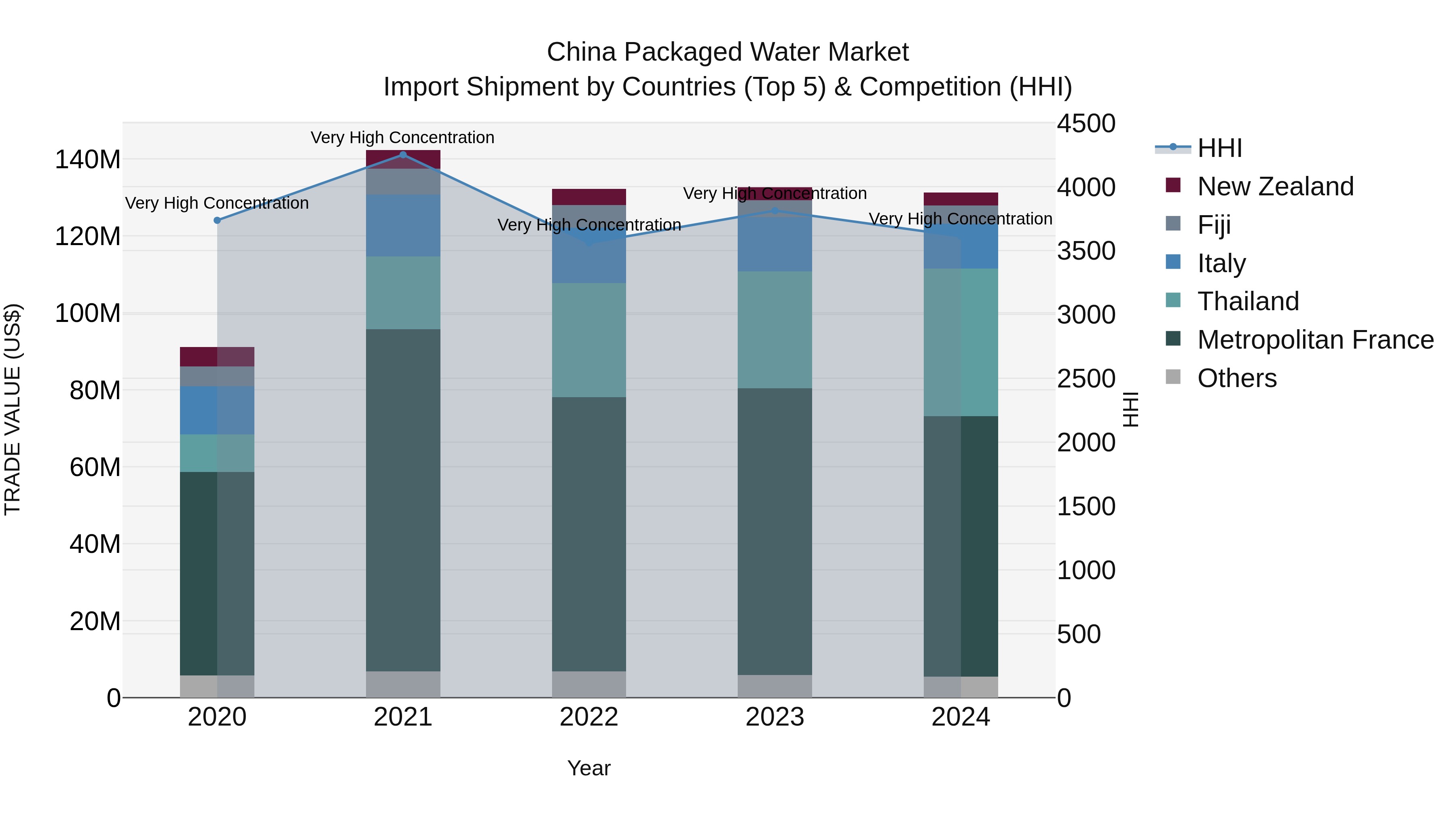
China Packaged water Market Overview
The packaged water market in China has been experiencing significant growth due to increasing health consciousness among consumers and concerns about water quality. With the rise in disposable income and rapid urbanization, there is a growing preference for convenient and safe drinking water options. Key players in the market are focusing on product innovation, such as flavored or vitamin-enhanced waters, to cater to changing consumer preferences. The market is also witnessing a shift towards sustainable packaging solutions to address environmental concerns. E-commerce platforms are playing a crucial role in the distribution of packaged water, offering consumers easy access to a wide range of brands. Overall, the China packaged water market is expected to continue its growth trajectory driven by consumer demand for safe and convenient hydration options.
China Packaged water Market Trends and Opportunities
The China packaged water market is witnessing significant growth driven by increasing health consciousness, urbanization, and convenience. Consumers are opting for packaged water over sugary beverages due to health concerns, leading to a surge in demand for purified and mineral water. The market is also benefiting from the rising popularity of functional and flavored water varieties catering to diverse consumer preferences. Opportunities lie in innovative packaging solutions, sustainable practices, and e-commerce channels to reach a wider consumer base. With a growing middle-class population and improving disposable incomes, the packaged water market in China is poised for continued expansion, presenting lucrative opportunities for market players to capitalize on the evolving consumer trends and preferences.
China Packaged water Market Challenges
In the China packaged water market, one of the main challenges faced is intense competition among numerous brands, both domestic and international. This leads to price wars and aggressive marketing strategies to capture market share. Another challenge is the increasing concern over environmental sustainability and plastic waste, as packaged water consumption contributes to plastic pollution. This has led to growing consumer preference for eco-friendly packaging options, putting pressure on companies to innovate and adopt more sustainable practices. Additionally, stringent regulations and quality standards in the bottled water industry in China pose a challenge for new entrants and smaller players trying to establish themselves in the market. Overall, companies in the China packaged water market need to navigate these challenges effectively to stay competitive and meet evolving consumer demands.
China Packaged water Market Drivers
The China Packaged water market is primarily driven by factors such as increasing health consciousness among consumers, rising concerns over water quality and safety, and the convenience offered by packaged water products. With growing urbanization and a fast-paced lifestyle, consumers are opting for packaged water as a convenient and safe hydration option. Additionally, the expansion of distribution channels, innovative packaging techniques, and aggressive marketing strategies by key players are further fueling market growth. The shift towards environmentally friendly packaging solutions and the introduction of functional water products are also expected to drive market expansion in China. Overall, the increasing demand for safe, portable, and convenient water solutions is propelling the growth of the packaged water market in the country.
China Packaged water Market Government Policy
Government policies related to the China Packaged Water Market include regulations on the quality and safety standards of packaged water, labeling requirements, and environmental considerations. The Chinese government has implemented strict guidelines to ensure that packaged water products meet specified health and safety standards to protect consumer health. Additionally, there are regulations in place to monitor and control the extraction of water resources for packaging, with an emphasis on sustainability and environmental protection. Labeling requirements mandate clear and accurate information on packaging to inform consumers about the product contents and origin. Overall, government policies in China aim to maintain high standards in the packaged water market to safeguard public health, promote environmental sustainability, and ensure consumer transparency.
China Packaged water Market Future Outlook
The future outlook for the China Packaged water market appears promising, with growing consumer awareness about the importance of hydration and health driving demand. Increasing urbanization, rising disposable incomes, and a shift towards healthier beverage options are expected to fuel market growth. The convenience and portability of packaged water, coupled with improvements in packaging sustainability and innovation, will likely attract more consumers. Furthermore, the growing e-commerce sector in China will provide additional distribution channels for packaged water products. However, the market may face challenges such as environmental concerns related to plastic waste and increasing competition from other beverages. Overall, the China Packaged water market is anticipated to experience steady growth in the coming years, driven by changing consumer preferences and lifestyle trends.
Key Highlights of the Report:
- China Packaged water Market Outlook
- Market Size of China Packaged water Market, 2024
- Forecast of China Packaged water Market, 2031
- Historical Data and Forecast of China Packaged water Revenues & Volume for the Period 2021- 2031
- China Packaged water Market Trend Evolution
- China Packaged water Market Drivers and Challenges
- China Packaged water Price Trends
- China Packaged water Porter's Five Forces
- China Packaged water Industry Life Cycle
- Historical Data and Forecast of China Packaged water Market Revenues & Volume By Product for the Period 2021- 2031
- Historical Data and Forecast of China Packaged water Market Revenues & Volume By Still for the Period 2021- 2031
- Historical Data and Forecast of China Packaged water Market Revenues & Volume By Carbonated for the Period 2021- 2031
- Historical Data and Forecast of China Packaged water Market Revenues & Volume By Flavored for the Period 2021- 2031
- Historical Data and Forecast of China Packaged water Market Revenues & Volume By Functional for the Period 2021- 2031
- China Packaged water Import Export Trade Statistics
- Market Opportunity Assessment By Product
- China Packaged water Top Companies Market Share
- China Packaged water Competitive Benchmarking By Technical and Operational Parameters
- China Packaged water Company Profiles
- China Packaged water Key Strategic Recommendations






































