China Renewable Fuels Market Size & Growth Rate
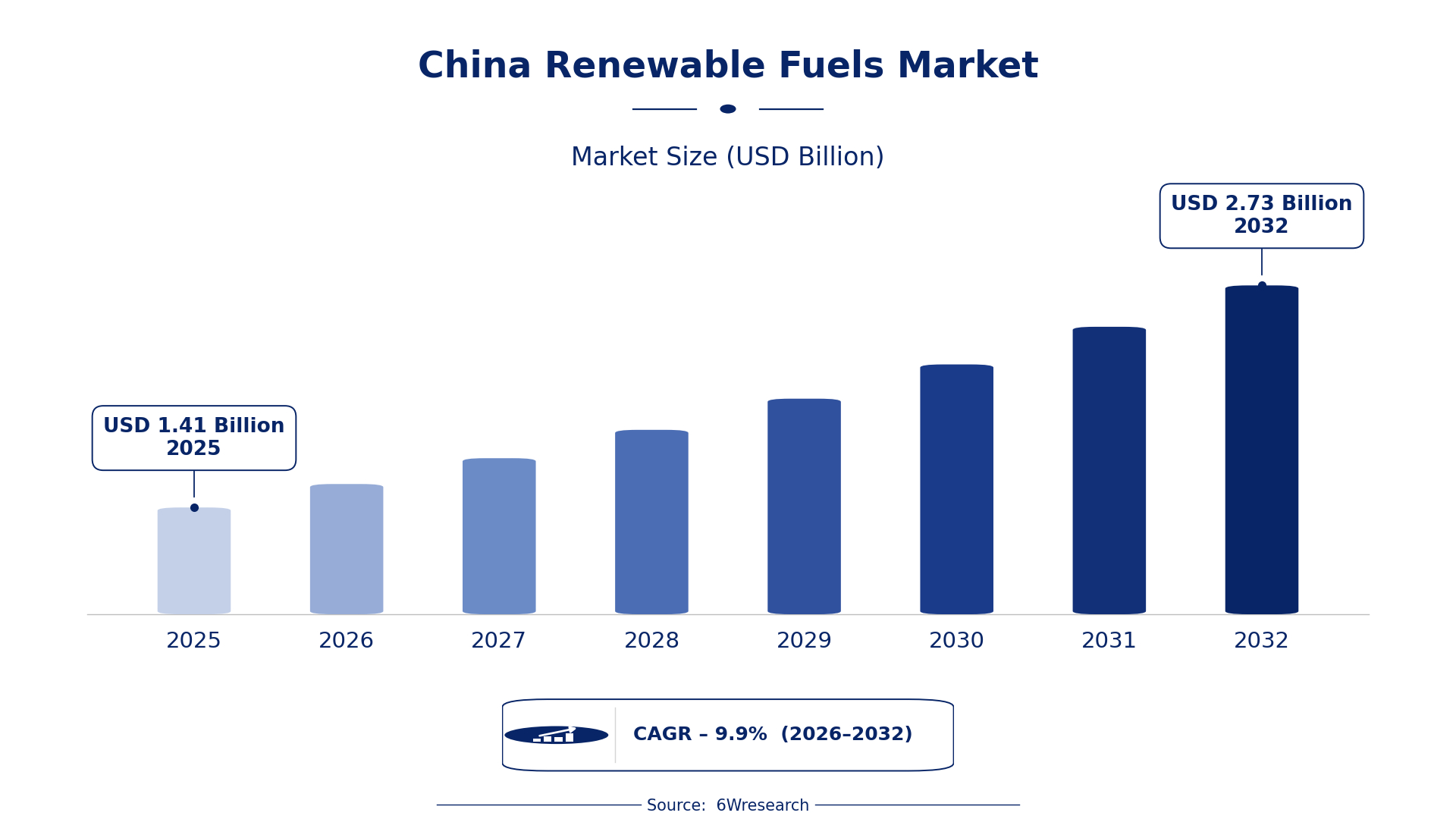
According to 6Wresearch internal database and industry insights, the China Renewable Fuels Market was valued at USD 1.41 billion in 2025 and is projected to reach USD 2.73 billion by 2032, growing at a CAGR of approximately 9.9% during 2026–2032.
China Renewable Fuels Market Highlights
| Report Metric | Details |
| Report Name | China Renewable Fuels Market |
| Market Size 2025 | USD 1.41 billion |
| Market Size 2032 | USD 2.73 billion |
| Absolute Growth 2025–2032 | USD 1.32 billion |
| CAGR 2026–2032 | 9.9% |
| Peak Annual Growth | 11.3% in 2032 |
| Forecast Period | 2026–2032 |
| Historical Data | 2022–2025 |
| Base Year | 2025 |
| Leading Fuel Type, 2025 | Bioethanol (52% share) |
| Leading Source Type, 2025 | Sugarcane/Corn (44% share) |
| Leading Energy Application, 2025 | Automotive & Aviation (39% share) |
| Leading End User, 2025 | Fuel Traders & Refineries (43% share) |
| Fastest-Growing Fuel Type | Biodiesel (12.6% CAGR) |
| Fastest-Growing Source Type | Soy/Used Oil (11.8% CAGR) |
| Fastest-Growing Energy Application | Heating & Vehicles (11.8% CAGR) |
| Fastest-Growing End User | Municipal Bus Fleets (12.2% CAGR) |
| Growing Sector | Heating & Vehicles |
| Key End Users | Automotive & Aviation, Heating & Vehicles, Drop-in Fuel, Commercial Aviation |
China Renewable Fuels Market Year-wise Growth Rate and Key Drivers (2022–2032)
This graph illustrates the annual growth rates of the market from 2022 to 2032, highlighting a steady upward trajectory and projected market expansion over the forecast period.
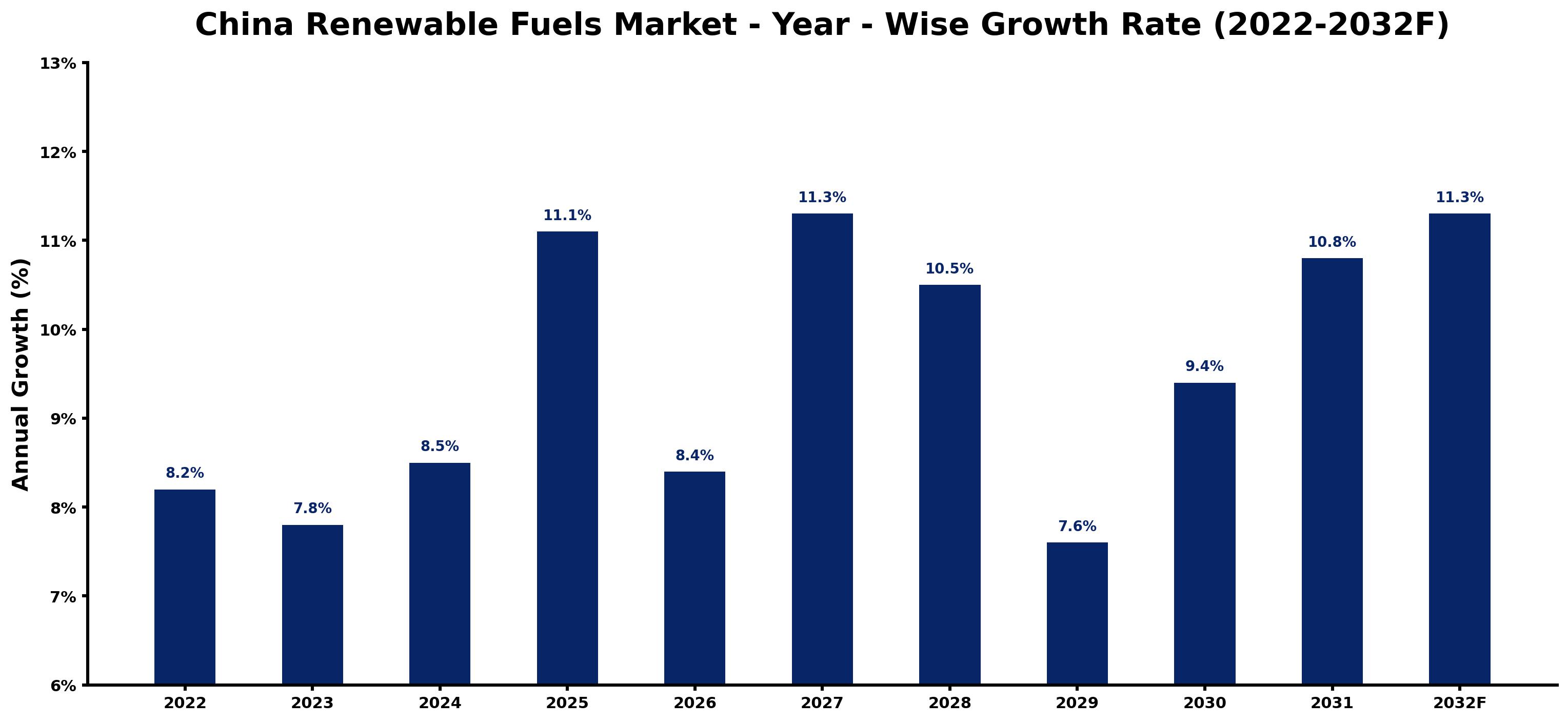
Each row of the following table gives one year's estimated growth and the event or demand shift that explains it.
| Year | Estimated Annual Growth (%) | Market Rationale |
| 2022 | 8.2 | The market experienced steady growth due to rising domestic demand for cleaner fuels. |
| 2023 | 7.8 | Production capacity adjustments took place as the National Development and Reform Commission refined biofuel policies. |
| 2024 | 8.5 | Increased bioethanol production capacity supported a faster growth rate as demand rose. |
| 2025 | 11.1 | The market peaked as biodiesel adoption surged, driven by government incentives for cleaner energy. |
| 2026 | 8.4 | Growth is expected to slow as new regulatory measures affect production capabilities. |
| 2027 | 11.3 | A renewed focus on renewable diesel will propel growth as heavy-duty vehicle adoption increases. |
| 2028 | 10.5 | Slower growth is projected as market saturation begins to affect biodiesel demand. |
| 2029 | 7.6 | The market will continue to grow, albeit at a slower rate, as new technologies are implemented. |
| 2030 | 9.4 | Growth is expected to accelerate again as public transport initiatives adopt more renewable fuels. |
| 2031 | 10.8 | Demand for renewable jet fuel will increase, boosting overall market growth. |
| 2032 | 11.3 | The market is projected to reach its peak growth rate as the government pushes for higher renewable fuel targets. |
Note: Market size estimations and growth projections presented in this report are based on 6Wresearch's proprietary forecasting methodology, utilizing the latest available industry data, government publications, and primary research inputs.
China Renewable Fuels Market Synopsis
Renewable Fuels in China encompass biofuels derived from biological materials, including crops and waste. These fuels are produced through methods like fermentation and transesterification, primarily used to reduce greenhouse gas emissions in transportation and heating. The China Renewable Fuels Market is expanding due to robust domestic demand and supportive government policies, aiming for 20% of transportation fuel to be renewable by 2030. Substantial investments in production capacity and technology further propel this growth, particularly in the biodiesel and bioethanol sectors.
Market Dynamics Impact Analysis (2026–2032)
| Factor | Type | Impact | Primary Segment Affected |
| Government incentives for cleaner energy sources drive demand for biodiesel and bioethanol. | Driver | High | Biodiesel |
| Increasing bioethanol production capacity supports higher fuel availability for transportation. | Driver | High | Bioethanol |
| The growing demand for renewable jet fuel in the aviation sector presents substantial opportunities. | Opportunity | High | Renewable Jet Fuel |
| Investment in public transport initiatives creates demand for renewable fuels in municipal fleets. | Opportunity | High | Municipal Bus Fleets |
| Production capacity limitations hinder the ability to meet rising fuel demand. | Restraint | High | Biodiesel |
| Regulatory compliance costs can deter smaller producers from entering the market. | Restraint | Medium | Bioethanol |
| Technological challenges in feedstock conversion can delay production scaling. | Challenge | High | Renewable Diesel |
| Competition from fossil fuels remains a significant barrier to market expansion. | Challenge | Medium | Renewable Jet Fuel |
Evaluation of Drivers in China Renewable Fuels Market (2026–2032)
Below mentioned are some major drivers and their influence on market dynamics.
| Drivers | Primary Segment Affected | Why It Matters (Evidence) |
| Government incentives for cleaner energy sources boost biodiesel adoption. | Biodiesel | In 2022, China produced 3 million tons of biodiesel, supported by policies promoting renewable energy. |
| Increased bioethanol production capacity improves fuel availability. | Bioethanol | China's bioethanol production capacity reached 10 million tons in 2023, meeting rising transportation demands. |
| Growing demand for renewable jet fuel in aviation drives market expansion. | Renewable Jet Fuel | The use of renewable jet fuel in airlines is expected to increase by 15% by 2025. |
| Investment in public transport initiatives creates demand for renewable fuels. | Municipal Bus Fleets | The Ministry of Transport supports renewable fuel adoption in public transport, increasing municipal fleet usage. |
| Technological advancements in feedstock conversion improve production efficiency. | Renewable Diesel | The hydrotreatment process upgrades feedstocks into renewable diesel, improving production capabilities. |
Growth in the Renewable Fuels market in China comes from rising domestic demand, increased production capacity, and support for cleaner energy. In 2022, China produced 3 million tons of biodiesel, driven by incentives for renewable energy sources. The bioethanol production capacity reached 10 million tons in 2023, facilitating greater fuel availability for transportation. The use of renewable jet fuel in airlines is projected to rise by 15% by 2025, reflecting the aviation sector's commitment to sustainability.
Evaluation of Restraints in China Renewable Fuels Market
The table below lists the restraints and the evidence behind each.
| Market Restraint | Primary Segment Affected | Why It Matters (Evidence) |
| Production capacity limitations hinder the ability to meet rising fuel demand. | Biodiesel | In 2022, biodiesel production reached 3 million tons, but demand continues to outpace supply. |
| Regulatory compliance costs can deter smaller producers from entering the market. | Bioethanol | The National Development and Reform Commission oversees biofuel policies, imposing strict regulations. |
| Technological challenges in feedstock conversion can delay production scaling. | Renewable Diesel | The hydrotreatment process requires advanced technology, which can be costly for new entrants. |
| Competition from fossil fuels remains a barrier to market expansion. | Renewable Jet Fuel | Fossil fuel prices remain competitive, making it difficult for renewable fuels to gain market share. |
| Limited public awareness about renewable fuels can slow adoption rates. | Municipal Bus Fleets | Public transport operators may hesitate to switch due to lack of information on benefits. |
China Renewable Fuels Market Challenges
The China Renewable Fuels Market still has to solve a few problems, and the first is cost. High production expenses for biodiesel, which reached 3 million tons in 2022, burden producers and inflate prices for buyers. Skills shortages in the workforce hinder efficient biofuel production, delaying project timelines for suppliers. Buyers face challenges in sourcing renewable fuels due to inconsistent supply chains, leading to increased operational costs. Competition from traditional fossil fuels remains fierce, making it challenging for renewable fuel producers to secure market share and drive prices down.
Trends in the China Renewable Fuels Market
Four trends stand out in the China Renewable Fuels Market.
- Increase in Bioethanol Production Capacity: China's bioethanol production capacity reached 10 million tons in 2023, reflecting a growing commitment to renewable energy. This increase supports the goal of 20% renewable fuel in transportation by 2030.
- Shift Towards Renewable Jet Fuel: The aviation sector is increasingly adopting renewable jet fuel, with usage projected to rise by 15% by 2025. This trend aligns with global sustainability goals and encourages airlines to invest in cleaner technologies.
- Expansion of Biodiesel in Public Transport: Municipal bus fleets are increasingly adopting biodiesel, driven by government support for cleaner fuels. Shandong province leads in biodiesel production, enhancing local fleet sustainability.
- Growing Demand for Renewable Diesel: Heavy-duty vehicles are increasingly utilising renewable diesel, driven by sustainability initiatives. The hydrotreatment process is becoming more common, improving production efficiency and meeting market needs.
Investment Opportunities in the China Renewable Fuels Market
The following opportunities in the China Renewable Fuels Market pair current demand with a clear way in.
- Timing for Investment in Biofuels: With a projected biodiesel CAGR of 12.6% through 2032, now is an ideal time to invest in biodiesel production facilities, particularly in Shandong province, which leads in production.
- Gap in Renewable Jet Fuel Supply: As airlines aim to increase renewable jet fuel usage by 15% by 2025, opportunities exist to supply this sector, especially in urban areas with high air traffic.
- Partnerships for Municipal Fleet Upgrades: The push for cleaner public transport creates opportunities for partnerships with municipal bus fleets to supply biodiesel, especially in regions like Shandong where production is strong.
- Investment in Technological Advancements: Investing in advanced hydrotreatment technologies can improve production efficiency, catering to the growing demand for renewable diesel in heavy-duty vehicles.
Government Initiatives in the China Renewable Fuels Market
The Renewable Energy Law, updated in 2020, strengthens the framework for renewable fuels, mandating a shift towards cleaner energy sources. This law requires producers to adhere to stricter environmental standards, promoting sustainable practices in the industry. The National Development and Reform Commission oversees these regulations, ensuring compliance and facilitating growth in the renewable fuels sector.
The National Energy Administration plays a key role in approving funding for renewable energy projects, allocating $500 million in 2023 to support infrastructure development. This funding aims to enhance the adoption of renewable fuels in public transport, ensuring that municipal fleets transition to cleaner energy sources.
Future Insight of the China Renewable Fuels Market
The China Renewable Fuels Market is set to evolve by 2032, driven by several key factors. The government aims for 20% of transportation fuel to be renewable by 2030, which will encourage broader adoption. Increased funding, including $500 million allocated for renewable energy projects, will support infrastructure development. The rise of bioethanol production capacity, expected to reach 10 million tons in 2023, will bolster the market. The Ministry of Transport's support for renewable fuels in public transport will further stimulate market growth.
Market Segmentation Analysis
The analysis below covers each segmentation, its leading category in 2025 and its fastest-growing category through 2032.
By Fuel Type – Bioethanol Dominated, Biodiesel Expected to Grow Fastest
According to Ravi Bhandari, Research Head at 6Wresearch, the largest fuel type category in 2025 was Bioethanol, with a 52% share of total revenue. Bioethanol holds the largest share in the China Renewable Fuels Market because it is extensively used in transportation fuels, especially in urban areas where emissions reduction is critical. The support from the National Energy Administration through the Renewable Energy Law has been instrumental in promoting its widespread adoption across the nation. Biodiesel is set to record the highest CAGR in this split, 12.6% over 2026–2032. Biodiesel is experiencing rapid growth due to its increasing application in diesel engines, which effectively reduces carbon emissions. The government's commitment to promoting biodiesel in public transport is likely to accelerate its adoption and market presence. This indicates that suppliers should focus on enhancing biodiesel production capabilities to meet the rising demand across various sectors.
By Source Type – Sugarcane/Corn Dominated, Soy/Used Oil Expected to Grow Fastest
Sugarcane/Corn accounted for a 44% market share by source type in 2025. Sugarcane and corn are the primary feedstocks for bioethanol production, making them the leading source type in the market. Their established cultivation practices and high yield contribute to their dominance in renewable fuel production. Over 2026–2032, Soy/Used Oil is expected to post the fastest growth, at a CAGR of 11.8%. Soy and used oil are rapidly gaining traction as sources for biodiesel due to their availability and lower production costs. This shift is driven by the increasing need for sustainable waste management solutions in fuel production. Buyers should consider diversifying their feedstock sources to include soy and used oil for cost-effective biodiesel production.
By Energy Application – Automotive & Aviation Dominated, Heating & Vehicles Expected to Grow Fastest
Automotive & Aviation took a 39% share of energy application in 2025, more than any other category. The automotive and aviation sectors represent the largest application area for renewable fuels, primarily due to stringent emissions regulations and the push for cleaner energy. This high demand is reflected in the increasing production of bioethanol and biodiesel for these industries. The quickest growth will come from Heating & Vehicles, forecast to expand at a CAGR of 11.8% between 2026 and 2032. Heating and vehicles are emerging as the fastest-growing application area, as more consumers seek renewable options for home heating. The government's initiatives to promote renewable heating solutions are expected to drive this growth further. Suppliers should explore opportunities in the heating sector to capitalise on the growing demand for renewable energy applications.
By End User – Fuel Traders & Refineries Dominated, Municipal Bus Fleets Expected to Grow Fastest
In 2025, Fuel Traders & Refineries led the end user split with a 43% share. Fuel traders and refineries lead the market as they are essential in the distribution of renewable fuels throughout China. Their established infrastructure and extensive networks ensure efficient management of the supply chain for biofuels. Municipal Bus Fleets are projected to grow fastest, at a CAGR of 12.2% during 2026–2032. Municipal bus fleets are quickly adopting biodiesel, driven by government incentives and the urgent need for cleaner public transport solutions. This adoption is set to continue as urban areas strive to lower their carbon footprints. Suppliers should focus on municipal bus fleets as a vital market segment for biodiesel to support urban sustainability initiatives.
Key Attractiveness of the Report
- 10 Years of Market Numbers
- Historical Data Starting from 2022 to 2025
- Base Year 2025
- Forecast Data until 2032
- Key Performance Indicators Impacting the Market
- Major Upcoming Developments and Projects
Key Highlights of the Report:
- China Renewable Fuels Market Outlook
- Market Size of China Renewable Fuels Market, 2025
- Forecast of China Renewable Fuels Market, 2032
- Historical Data and Forecast of China Renewable Fuels Revenues & Volume for the Period 2022 - 2032F
- China Renewable Fuels Market Trend Evolution
- China Renewable Fuels Market Drivers and Challenges
- China Renewable Fuels Price Trends
- China Renewable Fuels Porter's Five Forces
- China Renewable Fuels Industry Life Cycle
- Historical Data and Forecast of China Renewable Fuels Market Revenues & Volume By Fuel Type for the Period 2022 - 2032F
- Historical Data and Forecast of China Renewable Fuels Market Revenues & Volume By Bioethanol for the Period 2022 - 2032F
- Historical Data and Forecast of China Renewable Fuels Market Revenues & Volume By Biodiesel for the Period 2022 - 2032F
- Historical Data and Forecast of China Renewable Fuels Market Revenues & Volume By Renewable Diesel for the Period 2022 - 2032F
- Historical Data and Forecast of China Renewable Fuels Market Revenues & Volume By Renewable Jet Fuel for the Period 2022 - 2032F
- Historical Data and Forecast of China Renewable Fuels Market Revenues & Volume By Source Type for the Period 2022 - 2032F
- Historical Data and Forecast of China Renewable Fuels Market Revenues & Volume By Sugarcane/Corn for the Period 2022 - 2032F
- Historical Data and Forecast of China Renewable Fuels Market Revenues & Volume By Soy/Used Oil for the Period 2022 - 2032F
- Historical Data and Forecast of China Renewable Fuels Market Revenues & Volume By Hydrotreatment Process for the Period 2022 - 2032F
- Historical Data and Forecast of China Renewable Fuels Market Revenues & Volume By Algae/Animal Fats for the Period 2022 - 2032F
- Historical Data and Forecast of China Renewable Fuels Market Revenues & Volume By Energy Application for the Period 2022 - 2032F
- Historical Data and Forecast of China Renewable Fuels Market Revenues & Volume By Automotive & Aviation for the Period 2022 - 2032F
- Historical Data and Forecast of China Renewable Fuels Market Revenues & Volume By Heating & Vehicles for the Period 2022 - 2032F
- Historical Data and Forecast of China Renewable Fuels Market Revenues & Volume By Drop-in Fuel for the Period 2022 - 2032F
- Historical Data and Forecast of China Renewable Fuels Market Revenues & Volume By Commercial Aviation for the Period 2022 - 2032F
- Historical Data and Forecast of China Renewable Fuels Market Revenues & Volume By End User for the Period 2022 - 2032F
- Historical Data and Forecast of China Renewable Fuels Market Revenues & Volume By Fuel Traders & Refineries for the Period 2022 - 2032F
- Historical Data and Forecast of China Renewable Fuels Market Revenues & Volume By Municipal Bus Fleets for the Period 2022 - 2032F
- Historical Data and Forecast of China Renewable Fuels Market Revenues & Volume By Logistics and Military Fleets for the Period 2022 - 2032F
- Historical Data and Forecast of China Renewable Fuels Market Revenues & Volume By Airlines for the Period 2022 - 2032F
- China Renewable Fuels Import Export Trade Statistics
- Market Opportunity Assessment By Fuel Type
- Market Opportunity Assessment By Source Type
- Market Opportunity Assessment By Energy Application
- Market Opportunity Assessment By End User
- China Renewable Fuels Top Companies Market Share
- China Renewable Fuels Competitive Benchmarking By Technical and Operational Parameters
- China Renewable Fuels Company Profiles
- China Renewable Fuels Key Strategic Recommendations
Market Covered
This report examines the market across the segments below.
By Fuel Type
- Bioethanol
- Biodiesel
- Renewable Diesel
- Renewable Jet Fuel
By Source Type
- Sugarcane/Corn
- Soy/Used Oil
- Hydrotreatment Process
- Algae/Animal Fats
By Energy Application
- Automotive & Aviation
- Heating & Vehicles
- Drop-in Fuel
- Commercial Aviation
By End User
- Fuel Traders & Refineries
- Municipal Bus Fleets
- Logistics and Military Fleets
- Airlines































