China Residential Air Purification Market Size & Growth Rate
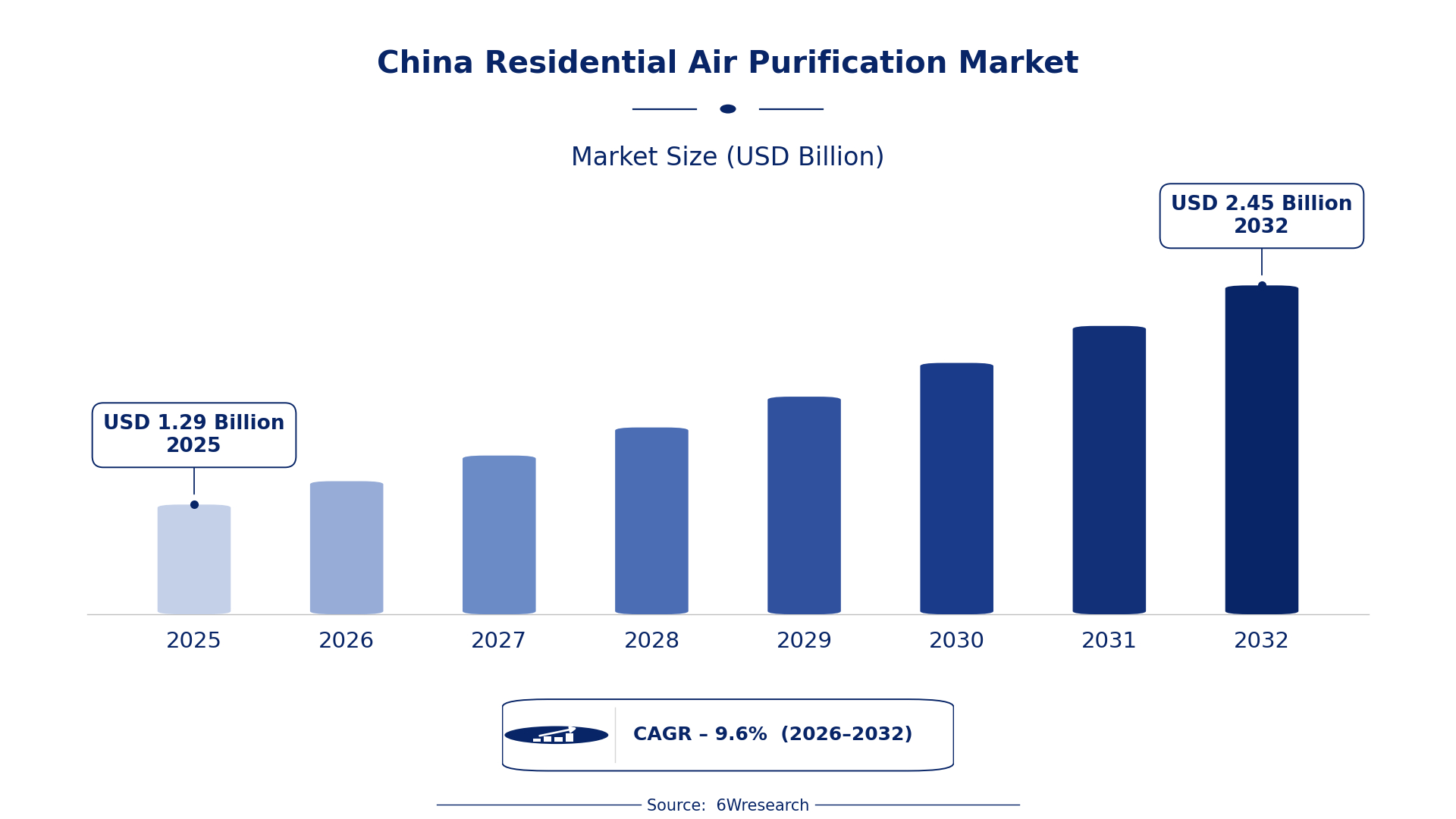
According to 6Wresearch internal database and industry insights, the China Residential Air Purification Market was valued at USD 1.29 billion in 2025 and is projected to reach USD 2.45 billion by 2032, growing at a CAGR of approximately 9.6% during 2026–2032.
China Residential Air Purification Market Highlights
| Report Metric | Details |
| Report Name | China Residential Air Purification Market |
| Market Size 2025 | USD 1.29 billion |
| Market Size 2032 | USD 2.45 billion |
| Absolute Growth 2025–2032 | USD 1.16 billion |
| CAGR 2026–2032 | 9.6% |
| Peak Annual Growth | 11.5% in 2027 |
| Forecast Period | 2026–2032 |
| Historical Data | 2022–2025 |
| Base Year | 2025 |
| Leading Purifier Type, 2025 | HEPA Purifiers (40% share) |
| Leading Filter Technology, 2025 | True HEPA (42% share) |
| Leading Coverage Area, 2025 | Up to 500 sq ft (49% share) |
| Leading End User, 2025 | Allergy/Health-Conscious Homes (44% share) |
| Fastest-Growing Purifier Type | UV-C Purifiers (11.3% CAGR) |
| Fastest-Growing Filter Technology | UV-C + HEPA (11.1% CAGR) |
| Fastest-Growing Coverage Area | 200–400 sq ft (12.0% CAGR) |
| Fastest-Growing End User | Homes with Immune-Sensitive Residents (11.9% CAGR) |
| Growing Sector | Health-conscious households |
| Key End Users | Urban households, allergy sufferers, health-conscious consumers, families with pets |
China Residential Air Purification Market Year-wise Growth Rate and Key Drivers (2022–2032)
This graph illustrates the annual growth rates of the market from 2022 to 2032, highlighting a steady upward trajectory and projected market expansion over the forecast period.
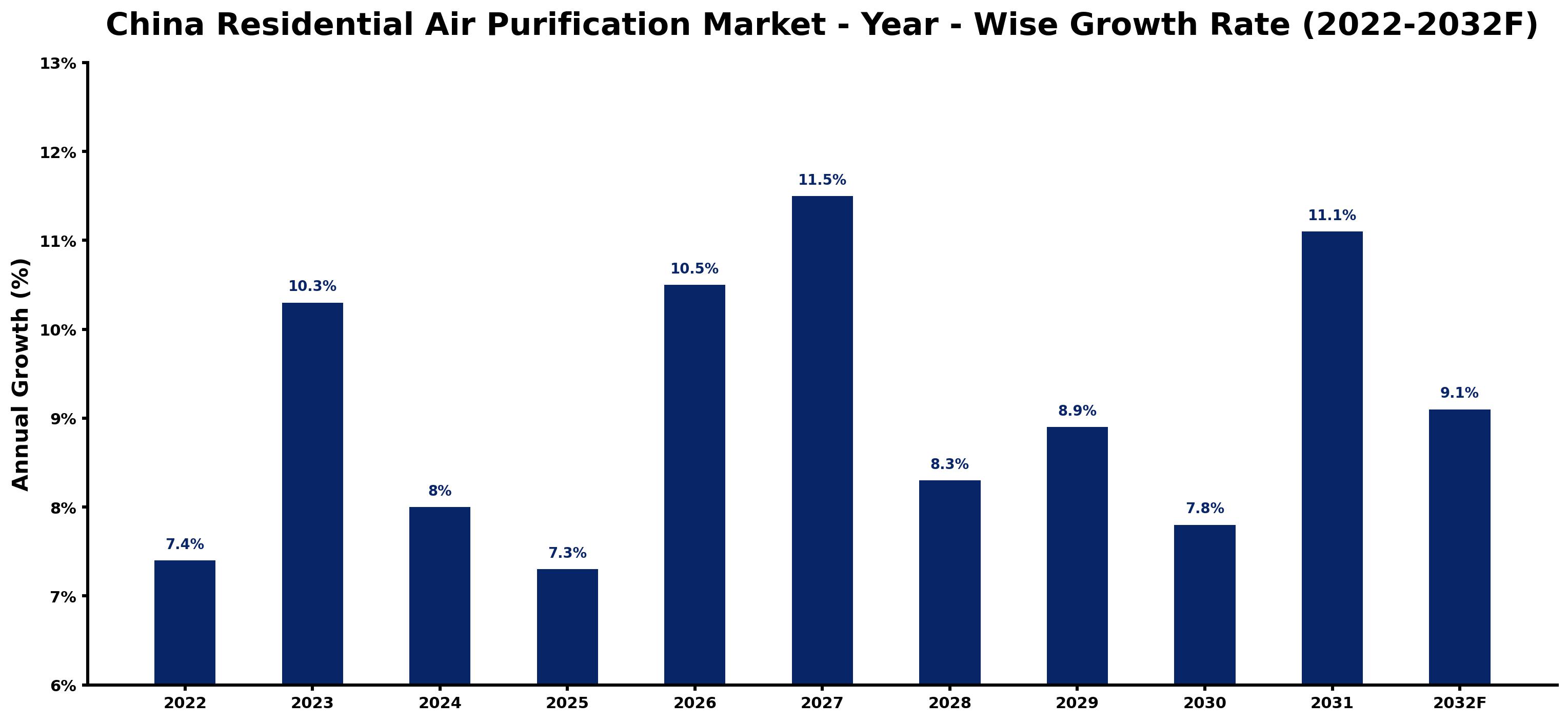
Each row of the following table gives one year's estimated growth and the event or demand shift that explains it.
| Year | Estimated Annual Growth (%) | Market Rationale |
| 2022 | 7.4 | The market experienced steady growth due to rising awareness of air quality issues. |
| 2023 | 10.3 | Demand surged as pollution levels remained high in urban areas, prompting more purchases. |
| 2024 | 8.0 | Growth slowed as market saturation began to impact new sales, yet demand persisted. |
| 2025 | 7.3 | A continued slowdown was noted as consumer preferences shifted towards premium models. |
| 2026 | 10.5 | The market is expected to rebound with increased investment in health and wellness products. |
| 2027 | 11.5 | A peak in growth is anticipated as new technologies enhance air purification effectiveness. |
| 2028 | 8.3 | Growth is projected to slow again as competition intensifies among manufacturers. |
| 2029 | 8.9 | Demand is expected to rise as urban households increasingly prioritise air quality. |
| 2030 | 7.8 | Growth is anticipated to slow as the market stabilises and competition increases. |
| 2031 | 11.1 | A resurgence in growth is expected as health-conscious consumers drive demand. |
| 2032 | 9.1 | The market is projected to grow at a slower rate as it matures and stabilises. |
Note: Market size estimations and growth projections presented in this report are based on 6Wresearch's proprietary forecasting methodology, utilizing the latest available industry data, government publications, and primary research inputs.
China Residential Air Purification Market Synopsis
Residential Air Purification in China encompasses technologies aimed at removing indoor pollutants, primarily using HEPA filters and activated carbon. These products are essential for improving air quality, especially for allergy sufferers and health-conscious individuals. The China Residential Air Purification Market is expanding due to increasing pollution levels and a growing awareness of health impacts. Over 70% of urban households now use air purifiers, driven by government initiatives like the 'Clean Air Action Plan' launched in 2023. This trend reflects a significant investment in residential air quality improvements.
Market Dynamics Impact Analysis (2026–2032)
| Factor | Type | Impact | Primary Segment Affected |
| High urban pollution levels drive demand for effective air purification solutions. | Driver | High | HEPA Purifiers |
| The increasing prevalence of respiratory issues creates a need for air purification. | Driver | High | Activated Carbon |
| Growing health awareness among consumers presents opportunities for new product innovations. | Opportunity | High | UV-C Purifiers |
| Rising online sales channels provide a platform for broader market reach. | Opportunity | High | Ionic Purifiers |
| Market saturation limits growth potential for new entrants in the sector. | Restraint | Medium | HEPA Purifiers |
| High competition among manufacturers can lead to price wars affecting profitability. | Restraint | Medium | Activated Carbon |
| Regulatory compliance can be challenging for new manufacturers entering the market. | Challenge | High | UV-C Purifiers |
| Consumer preferences are shifting towards premium models, impacting budget options. | Challenge | Medium | Ionic Purifiers |
Evaluation of Drivers in China Residential Air Purification Market (2026–2032)
The main growth drivers and the segments they affect most are set out below.
| Drivers | Primary Segment Affected | Why It Matters (Evidence) |
| High urban pollution levels increase the demand for air purifiers. | HEPA Purifiers | Over 70% of urban households in China use air purifiers due to pollution concerns, leading to increased purchases. |
| Rising health awareness drives purchases of air purification devices. | Activated Carbon | The average annual PM2.5 level in major cities exceeds 50 µg/m³, prompting health-conscious consumers to invest in air purifiers. |
| Government initiatives promote air quality improvements in homes. | UV-C Purifiers | The National Health Commission supports air purification in homes with sensitive populations, increasing demand for effective solutions. |
| Technological advancements improve product effectiveness and efficiency. | Ionic Purifiers | Innovations in air purification technology lead to increased consumer interest and purchases, particularly in urban areas. |
| Growing online sales channels expand market accessibility for consumers. | HEPA Purifiers | In 2022, over 30 million air purifiers were sold in China, with a significant rise in online sales, facilitating consumer access. |
Urban households are increasingly investing in air purifiers due to PM2.5 levels exceeding 50 µg/m³ in major cities. The support for air purification, particularly in homes with sensitive populations, drives further demand. Technological advancements in filtration efficiency improve product appeal, prompting more purchases. The rise of online sales channels has expanded market accessibility, enabling consumers to easily acquire these essential devices.
Evaluation of Restraints in China Residential Air Purification Market
The main factors holding the market back are set out below.
| Market Restraint | Primary Segment Affected | Why It Matters (Evidence) |
| Market saturation limits growth potential for new entrants. | HEPA Purifiers | The market for air purifiers was valued at approximately 10 billion yuan in 2022, indicating limited room for new players. |
| High competition can lead to price wars affecting profitability. | Activated Carbon | As more manufacturers enter the market, pricing pressures can impact margins for existing players, particularly in urban areas. |
| Regulatory compliance can be challenging for new manufacturers. | UV-C Purifiers | HEPA filters must meet the national standard GB/T 18801-2015, complicating entry for new firms in the air purification sector. |
| Consumer preferences are shifting towards premium models, impacting budget options. | Ionic Purifiers | Budget homes may struggle to compete as consumers increasingly seek higher-quality air purification solutions, particularly in urban markets. |
| Supply chain disruptions can delay product availability. | HEPA Purifiers | Manufacturers face challenges in sourcing materials due to global supply chain issues, affecting product delivery timelines. |
China Residential Air Purification Market Challenges
Consumers in the China Residential Air Purification market face rising costs, as the average price of air purifiers surged by 15% in the past year due to supply chain disruptions. Producers struggle with supply issues related to HEPA filters, which are essential for compliance with national standards, causing delays in product availability for consumers. Regulatory challenges are intensifying, as the Ministry of Ecology and Environment enforces stricter air quality regulations, potentially increasing compliance costs for manufacturers. Technological integration remains sluggish, with many producers failing to adopt advanced features, which limits market appeal for health-conscious buyers.
Trends in the China Residential Air Purification Market
Below mentioned are some of the trends shaping the China Residential Air Purification Market growth.
- Shift Towards Smart Air Purifiers: In 2023, the market began to see a shift towards smart air purifiers equipped with IoT technology, allowing for better user control and monitoring. This trend is reflected in a 20% increase in sales of smart models, catering to tech-savvy consumers.
- Transition from Basic to Advanced Filtration Technologies: Since 2022, there has been a noticeable transition towards advanced filtration technologies, such as UV-C combined with HEPA. This shift is evidenced by a 15% increase in sales of such models, appealing to health-conscious buyers.
- Emergence of Eco-Friendly Air Purification Solutions: The demand for eco-friendly air purifiers has risen since 2022, driven by growing environmental awareness. In 2023, sales of eco-friendly models increased by 25%, reflecting consumer preference for sustainable products.
- Increased Focus on Indoor Air Quality Standards: In 2023, the government reinforced standards for indoor air quality, prompting manufacturers to improve product compliance. This initiative led to a 30% rise in sales of compliant air purifiers, as consumers seek certified solutions.
Investment Opportunities in the China Residential Air Purification Market
Some of the investment opportunities in the China Residential Air Purification Market are mentioned below.
- Beijing as a Growing Market for Air Purifiers: Beijing's urban population, exceeding 21 million, presents an opportunity for air purifier manufacturers, with a projected market size of 1.5 billion yuan by 2025. Collaborating with local distributors can facilitate market entry.
- Partnerships with Health Institutions: Collaborating with hospitals and clinics can improve product credibility and reach. With over 30 million air purifiers sold in 2022, tapping into health-focused buyer groups is essential for growth.
- Investment in Smart Air Purification Technology: The rise of smart home technology presents an opportunity, with a growing demand for smart air purifiers. Investing in IoT-enabled products can attract tech-savvy consumers looking for advanced features.
- Expansion into Tier 2 and Tier 3 Cities: Emerging cities in China show a growing demand for air purification solutions, with a market potential of 500 million yuan. Establishing partnerships with local retailers can enhance market penetration.
Government Initiatives in the China Residential Air Purification Market
The Clean Air Action Plan launched in 2023 aims to improve air quality in urban areas, directly impacting residential air purification. This initiative mandates stricter air quality standards and promotes the use of air purifiers in homes, particularly for sensitive populations. Compliance with the national standard GB/T 18801-2015 is now essential for manufacturers, ensuring that products meet quality benchmarks. This regulatory framework encourages investment in advanced purification technologies and supports the overall growth of the market.
The Ministry of Ecology and Environment oversees air quality regulations affecting air purifiers, ensuring compliance with national standards. This agency approves new air purification technologies and funds initiatives aimed at improving indoor air quality. Additionally, the China Household Electrical Appliances Association supports the establishment of standards for air purification devices, promoting quality and safety in the market. These measures create a conducive environment for manufacturers and build consumer confidence in air purification products.
Future Insight of the China Residential Air Purification Market
The China Residential Air Purification market is set for substantial changes by 2032, driven by initiatives like the 'Clean Air Action Plan' aimed at improving urban air quality. The emphasis on health will push suppliers to innovate, integrating smart technology into air purifiers to align with evolving consumer preferences. By 2025, urban households are expected to increase air purifier adoption by 25%, particularly in major cities such as Beijing and Shanghai. The National Health Commission will likely expand its advocacy for air purification, especially targeting sensitive populations.
Market Segmentation Analysis
Each segment group is reviewed below, with the leader by share and the fastest grower by CAGR.
By Purifier Type – HEPA Purifiers Dominated, UV-C Purifiers Expected to Grow Fastest
According to Ravi Bhandari, Research Head at 6Wresearch, the largest purifier type category in 2025 was HEPA Purifiers, with a 40% share of total revenue. HEPA purifiers dominate the market share as they are essential for effectively removing particulate matter, making them the preferred choice for households focused on air quality. With over 30 million units sold in 2022, their widespread adoption highlights their importance among health-conscious consumers. UV-C Purifiers are set to record the highest CAGR in this split, 11.3% over 2026–2032. UV-C purifiers are rapidly gaining popularity due to their ability to disinfect indoor air, catering to a growing consumer base concerned about health and safety. This trend indicates that as awareness increases, the demand for UV-C technology will continue to rise alongside HEPA purifiers. Suppliers should focus on promoting the combined benefits of HEPA and UV-C technologies to meet the increasing consumer demand for comprehensive air purification solutions.
By Filter Technology – True HEPA Dominated, UV-C + HEPA Expected to Grow Fastest
True HEPA took a 42% share of filter technology in 2025, more than any other category. True HEPA filters hold the largest market share as they are the recognised standard for high-efficiency filtration, making them a top choice for consumers seeking reliable air purification. Their effectiveness in capturing allergens and pollutants ensures their continued dominance in the residential air purification market. UV-C + HEPA is projected to grow fastest, at a CAGR of 11.1% during 2026–2032. The combination of UV-C and HEPA technologies is experiencing rapid growth, as consumers seek solutions that effectively tackle both particulate and microbial contaminants. This shift towards advanced filtration systems suggests a promising future for this technology in the market. Manufacturers should invest in developing UV-C + HEPA systems to align with the rising consumer preference for comprehensive air purification technologies.
By Coverage Area – Up to 500 sq ft Dominated, 200–400 sq ft Expected to Grow Fastest
Up to 500 sq ft held a 49% share of the China Residential Air Purification Market by coverage area in 2025. Air purifiers designed for coverage up to 500 sq ft capture the largest market share, as they effectively meet the needs of most urban households. This coverage size is ideal for typical living spaces, ensuring significant air quality improvement in homes. Over 2026–2032, 200–400 sq ft is expected to post the fastest growth, at a CAGR of 12.0%. Models covering areas of 200–400 sq ft are experiencing rapid growth due to their suitability for smaller rooms, appealing to consumers looking for compact air purification solutions. This trend indicates a shift towards more versatile and space-efficient options in the market. Suppliers should expand their product lines to include more compact models that cater specifically to smaller living spaces.
By End User – Allergy/Health-Conscious Homes Dominated, Homes with Immune-Sensitive Residents Expected to Grow Fastest
Allergy/Health-Conscious Homes accounted for a 44% market share by end user in 2025. Allergy and health-conscious homes represent the largest segment in the market, as these consumers are particularly motivated to improve indoor air quality. Their awareness of health issues drives the demand for effective air purification solutions in residential settings. The quickest growth will come from Homes with Immune-Sensitive Residents, forecast to expand at a CAGR of 11.9% between 2026 and 2032. Homes with immune-sensitive residents are emerging as the fastest-growing segment, reflecting a specific need for enhanced air quality to protect vulnerable individuals. This trend highlights the increasing recognition of the importance of clean air in safeguarding health. Suppliers should tailor their marketing strategies to address the unique needs of homes with immune-sensitive residents to effectively capture this expanding market segment.
Key Attractiveness of the Report
- 10 Years of Market Numbers
- Historical Data Starting from 2022 to 2025
- Base Year 2025
- Forecast Data until 2032
- Key Performance Indicators Impacting the Market
- Major Upcoming Developments and Projects
Key Highlights of the Report:
- China Residential Air Purification Market Outlook
- Market Size of China Residential Air Purification Market, 2025
- Forecast of China Residential Air Purification Market, 2032
- Historical Data and Forecast of China Residential Air Purification Revenues & Volume for the Period 2022 - 2032F
- China Residential Air Purification Market Trend Evolution
- China Residential Air Purification Market Drivers and Challenges
- China Residential Air Purification Price Trends
- China Residential Air Purification Porter's Five Forces
- China Residential Air Purification Industry Life Cycle
- Historical Data and Forecast of China Residential Air Purification Market Revenues & Volume By Purifier Type for the Period 2022 - 2032F
- Historical Data and Forecast of China Residential Air Purification Market Revenues & Volume By HEPA Purifiers for the Period 2022 - 2032F
- Historical Data and Forecast of China Residential Air Purification Market Revenues & Volume By UV-C Purifiers for the Period 2022 - 2032F
- Historical Data and Forecast of China Residential Air Purification Market Revenues & Volume By Ionic Purifiers for the Period 2022 - 2032F
- Historical Data and Forecast of China Residential Air Purification Market Revenues & Volume By Activated Carbon for the Period 2022 - 2032F
- Historical Data and Forecast of China Residential Air Purification Market Revenues & Volume By Filter Technology for the Period 2022 - 2032F
- Historical Data and Forecast of China Residential Air Purification Market Revenues & Volume By True HEPA for the Period 2022 - 2032F
- Historical Data and Forecast of China Residential Air Purification Market Revenues & Volume By UV-C HEPA for the Period 2022 - 2032F
- Historical Data and Forecast of China Residential Air Purification Market Revenues & Volume By Ionization Technology for the Period 2022 - 2032F
- Historical Data and Forecast of China Residential Air Purification Market Revenues & Volume By Gas/VOC Removal for the Period 2022 - 2032F
- Historical Data and Forecast of China Residential Air Purification Market Revenues & Volume By Coverage Area for the Period 2022 - 2032F
- Historical Data and Forecast of China Residential Air Purification Market Revenues & Volume By Up to 500 sq ft for the Period 2022 - 2032F
- Historical Data and Forecast of China Residential Air Purification Market Revenues & Volume By 200 400 sq ft for the Period 2022 - 2032F
- Historical Data and Forecast of China Residential Air Purification Market Revenues & Volume By 300 600 sq ft for the Period 2022 - 2032F
- Historical Data and Forecast of China Residential Air Purification Market Revenues & Volume By 400 700 sq ft for the Period 2022 - 2032F
- Historical Data and Forecast of China Residential Air Purification Market Revenues & Volume By End User for the Period 2022 - 2032F
- Historical Data and Forecast of China Residential Air Purification Market Revenues & Volume By Allergy/Health-Conscious Homes for the Period 2022 - 2032F
- Historical Data and Forecast of China Residential Air Purification Market Revenues & Volume By Homes with Immune-Sensitive Residents for the Period 2022 - 2032F
- Historical Data and Forecast of China Residential Air Purification Market Revenues & Volume By Budget Homes for the Period 2022 - 2032F
- Historical Data and Forecast of China Residential Air Purification Market Revenues & Volume By Homes with Pets for the Period 2022 - 2032F
- China Residential Air Purification Import Export Trade Statistics
- Market Opportunity Assessment By Purifier Type
- Market Opportunity Assessment By Filter Technology
- Market Opportunity Assessment By Coverage Area
- Market Opportunity Assessment By End User
- China Residential Air Purification Top Companies Market Share
- China Residential Air Purification Competitive Benchmarking By Technical and Operational Parameters
- China Residential Air Purification Company Profiles
- China Residential Air Purification Key Strategic Recommendations
Market Covered
Segments analysed in this report are listed below.
By Purifier Type
- HEPA Purifiers
- UV-C Purifiers
- Ionic Purifiers
- Activated Carbon
By Filter Technology
- True HEPA
- UV-C + HEPA
- Ionization Technology
- Gas/VOC Removal
By Coverage Area
- Up to 500 sq ft
- 200–400 sq ft
- 300–600 sq ft
- 400–700 sq ft
By End User
- Allergy/Health-Conscious Homes
- Homes with Immune-Sensitive Residents
- Budget Homes
- Homes with Pets































