China Retail Barcode Scanner Market Size & Growth Rate
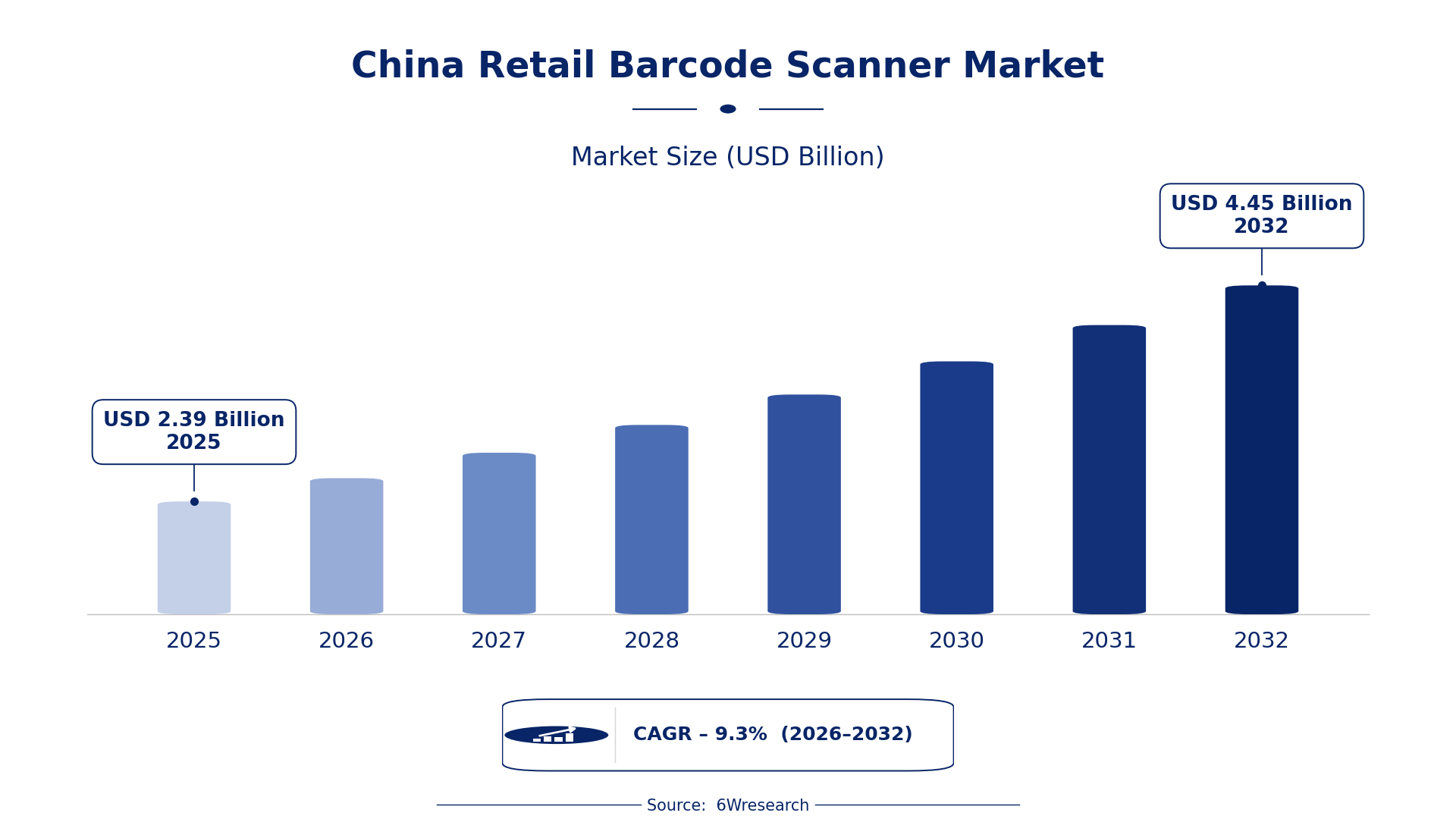
According to 6Wresearch internal database and industry insights, the China Retail Barcode Scanner Market was valued at USD 2.39 billion in 2025 and is projected to reach USD 4.45 billion by 2032, growing at a CAGR of approximately 9.3% during 2026–2032.
China Retail Barcode Scanner Market Highlights
| Report Metric | Details |
| Report Name | China Retail Barcode Scanner Market |
| Market Size 2025 | USD 2.39 billion |
| Market Size 2032 | USD 4.45 billion |
| Absolute Growth 2025–2032 | USD 2.06 billion |
| CAGR 2026–2032 | 9.3% |
| Peak Annual Growth | 11.7% in 2027 |
| Forecast Period | 2026–2032 |
| Historical Data | 2022–2025 |
| Base Year | 2025 |
| Leading Scanner Type, 2025 | Handheld Laser Scanners (43% share) |
| Leading Scan Mode, 2025 | 1D Barcode Scanning (40% share) |
| Leading Connectivity, 2025 | USB / Bluetooth (46% share) |
| Leading End User, 2025 | Checkout Counters (52% share) |
| Fastest-Growing Scanner Type | Presentation Scanners (10.7% CAGR) |
| Fastest-Growing Scan Mode | 2D Barcode & QR Scan (11.7% CAGR) |
| Fastest-Growing Connectivity | Wired / BLE (10.5% CAGR) |
| Fastest-Growing End User | POS & Self-service Kiosks (10.9% CAGR) |
| Growing Sector | Retail |
| Key End Users | Retailers, Supermarkets, E-commerce Companies, Logistics Providers |
China Retail Barcode Scanner Market Year-wise Growth Rate and Key Drivers (2022–2032)
This graph illustrates the annual growth rates of the market from 2022 to 2032, highlighting a steady upward trajectory and projected market expansion over the forecast period.
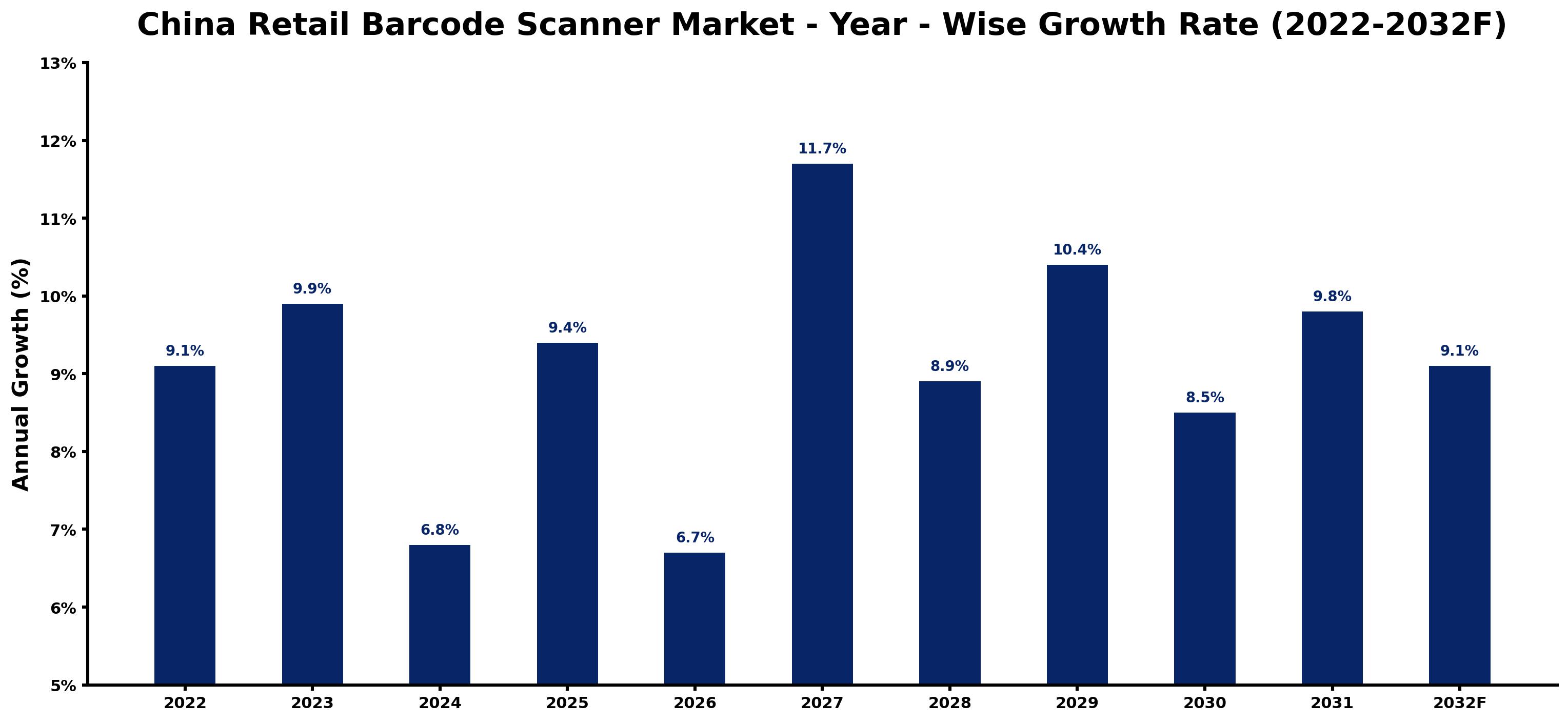
Below, each year's estimated growth is shown next to the factor that most influenced it.
| Year | Estimated Annual Growth (%) | Market Rationale |
| 2022 | 9.1 | The retail sector showed strong performance, contributing to steady demand for barcode scanners. |
| 2023 | 9.9 | Sales growth accelerated due to increased adoption of digital payment systems and QR code scanning. |
| 2024 | 6.8 | Growth slowed as the market adjusted to the high adoption rates of previous years. |
| 2025 | 9.4 | Demand rebounded as more retail stores implemented self-service kiosks equipped with scanners. |
| 2026 | 6.7 | Market growth is expected to slow due to a temporary saturation in urban retail environments. |
| 2027 | 11.7 | A surge in e-commerce logistics is projected to drive demand for fixed-mount scanners in warehouses. |
| 2028 | 8.9 | Growth is anticipated to decelerate as the market stabilises after rapid expansions in previous years. |
| 2029 | 10.4 | Increased urbanisation and population density will revitalise demand for handheld scanners. |
| 2030 | 8.5 | Market growth is expected to slow as competition intensifies among scanner manufacturers. |
| 2031 | 9.8 | Demand will increase with the rise of automated checkouts in retail settings. |
| 2032 | 9.1 | Growth is projected to decelerate as the market reaches maturity, stabilising at a high level. |
Note: Market size estimations and growth projections presented in this report are based on 6Wresearch's proprietary forecasting methodology, utilizing the latest available industry data, government publications, and primary research inputs.
China Retail Barcode Scanner Market Synopsis
Retail Barcode Scanner Market in China encompasses electronic devices designed to read barcodes, essential for efficient inventory management and checkout processes. These devices utilise laser or imaging technology, with applications in various retail environments. The market is expanding due to rising sales in the retail sector, which exceeded 38 trillion CNY in 2023. The growing adoption of digital payments and self-service kiosks further drives demand, highlighting opportunities for suppliers in logistics and retail.
Market Dynamics Impact Analysis (2026–2032)
| Factor | Type | Impact | Primary Segment Affected |
| Growing adoption of digital payment systems increases demand for QR code scanning. | Driver | High | 2D Barcode & QR Scan |
| Expansion of e-commerce logistics boosts the need for fixed-mount scanners. | Driver | High | Fixed-Mount Scanners |
| The rise in automated checkouts presents opportunities for suppliers of barcode scanners. | Opportunity | High | Automated Checkouts |
| Increasing urbanisation creates demand for handheld scanners in densely populated areas. | Opportunity | Medium | Handheld Laser Scanners |
| Competition among manufacturers may lead to price pressures affecting profit margins. | Restraint | High | Handheld Laser Scanners |
| Saturation in urban retail markets could limit growth potential for new entrants. | Restraint | Medium | Handheld Laser Scanners |
| Supply chain disruptions can delay deliveries of barcode scanning devices. | Challenge | High | Handheld Laser Scanners |
| Technological advancements require continuous investment to stay competitive. | Challenge | Medium | Handheld Laser Scanners |
Evaluation of Drivers in China Retail Barcode Scanner Market (2026–2032)
The main growth drivers and the segments they affect most are set out below.
| Drivers | Primary Segment Affected | Why It Matters (Evidence) |
| Increased sales in the retail sector support demand for barcode scanners. | Handheld Laser Scanners | In 2023, the retail sector in China accounted for over 38 trillion CNY in sales, prompting retailers to improve operational efficiency. |
| The rise of e-commerce logistics drives the need for advanced scanning solutions. | Fixed-Mount Scanners | With China's e-commerce penetration rate reaching 50% in 2023, logistics operations require efficient scanning solutions. |
| The growing trend of self-service kiosks boosts the demand for presentation scanners. | Presentation Scanners | Over 70% of supermarkets now utilise self-service kiosks, increasing the need for user-friendly scanning solutions. |
| Urbanisation leads to higher demand for handheld scanners in retail environments. | Handheld Laser Scanners | The average population density in urban areas necessitates efficient scanning solutions for retailers. |
| The adoption of digital payments increases the use of QR code scanning technology. | 2D Barcode & QR Scan | The Chinese government promotes digital payments, leading to increased QR code scanning in retail. |
Market growth in China for Retail Barcode Scanner rests on rising end-use demand from the retail sector, coupled with a strong supply response. The retail sector's sales exceeded 38 trillion CNY in 2023, prompting retailers to enhance operational efficiency. E-commerce logistics is also driving demand, with a penetration rate of 50% in 2023, necessitating advanced scanning solutions. Over 70% of supermarkets have adopted self-service kiosks, increasing the need for user-friendly scanning solutions. The growing trend of digital payments is further boosting QR code scanning capabilities, improving transaction speeds in retail environments.
Evaluation of Restraints in China Retail Barcode Scanner Market
The following restraints limit how fast demand can grow.
| Market Restraint | Primary Segment Affected | Why It Matters (Evidence) |
| Intense competition among manufacturers may lead to lower profit margins. | Handheld Laser Scanners | As more players enter the market, price pressures can affect profitability for existing manufacturers. |
| Saturation in urban retail markets limits growth opportunities for new entrants. | Handheld Laser Scanners | With many retailers already using barcode scanners, new market entrants may struggle to gain traction. |
| Supply chain disruptions can delay the availability of barcode scanning devices. | Handheld Laser Scanners | Global supply chain issues have impacted the timely delivery of components needed for production. |
| Technological advancements require ongoing investment to remain competitive. | Handheld Laser Scanners | Manufacturers must continuously invest in R&D to keep up with evolving technology and consumer demands. |
| Regulatory compliance can increase operational costs for producers. | Handheld Laser Scanners | Standards for barcode scanning devices, such as GB/T 18284-2013, require manufacturers to meet specific criteria. |
China Retail Barcode Scanner Market Challenges
Buyers in the China Retail Barcode Scanner Market encounter notable challenges, starting with the high cost of advanced scanning technology. Many face initial investments exceeding 50,000 CNY for complete setups, which delays their transition to efficient systems. Supply chain disruptions hinder the availability of essential components, leading to longer lead times for producers and increased operational costs. A shortage of skilled technicians complicates maintenance and repair processes, causing further downtime for retailers reliant on these devices. Rapid technological advancements create hurdles for buyers to keep pace with evolving standards, risking obsolescence within a few years.
Trends in the China Retail Barcode Scanner Market
Four trends stand out in the China Retail Barcode Scanner Market.
- Shift to Self-service Kiosks: Retailers are increasingly adopting self-service kiosks to improve customer experience, with over 70% of supermarkets now using them. This trend reflects a growing demand for efficient checkout processes, allowing retailers to serve more customers quickly.
- Growth in QR Code Scanning: Since 2023, QR code scanning has gained traction due to the government's promotion of digital payments. This shift is driving demand for 2D barcode scanners in retail environments, enhancing transaction efficiency.
- Rise of Automated Checkouts: The number of automated checkouts in retail stores increased by 25% in 2022, reflecting a shift towards automation. This trend is creating new opportunities for suppliers of barcode scanners, enabling faster transactions.
- Expansion of E-commerce Logistics: The logistics industry is experiencing significant growth, with a corresponding rise in demand for fixed-mount scanners. This trend is driven by China's e-commerce penetration rate reaching 50% in 2023, necessitating efficient scanning solutions.
Investment Opportunities in the China Retail Barcode Scanner Market
Some of the investment opportunities in the China Retail Barcode Scanner Market are mentioned below.
- Timing for Investment: As of 2023, the retail sector's sales exceeded 38 trillion CNY, indicating a ripe opportunity for suppliers. Investing in barcode scanning technology for retail environments can yield substantial returns as demand continues to grow.
- Gap in Self-service Technology: With over 70% of supermarkets using self-service kiosks, there is a clear demand for innovative scanning solutions. Suppliers can enter this market by partnering with retailers to provide tailored solutions that enhance customer experience.
- Focus on Urban Retail: Urban areas with high population density present a strong opportunity for handheld scanners. Suppliers can target major cities like Shanghai and Beijing to meet the increasing demand for efficient scanning solutions.
- Investment in E-commerce Logistics: The logistics industry is expected to grow significantly, increasing demand for fixed-mount scanners. Suppliers should focus on developing solutions that cater to this expanding market, particularly in e-commerce.
Government Initiatives in the China Retail Barcode Scanner Market
The Ministry of Commerce has implemented measures to support smart retail technology adoption, promoting the use of barcode scanners in various retail environments. Initiatives aim to improve operational efficiency and customer experience, encouraging retailers to invest in modern scanning solutions. The government has set a target for 2025 to increase the adoption of digital payment systems, which will further drive demand for barcode scanning technology. This policy framework is essential for producers and buyers alike, ensuring compliance with standards and fostering innovation in the sector.
The Ministry of Industry and Information Technology oversees the approval of standards for barcode scanning devices, including GB/T 18284-2013. This agency ensures that manufacturers meet quality and safety requirements, facilitating smoother market entry for compliant products. Additionally, funding is available for projects aimed at enhancing technological capabilities in the retail sector. These measures support the development and deployment of advanced barcode scanning solutions, benefiting both producers and retailers.
Future Insight of the China Retail Barcode Scanner Market
The China Retail Barcode Scanner Market will experience transformative changes by 2032, driven by the increasing adoption of 2D barcode scanning technology in e-commerce logistics. Urban population density will elevate demand for efficient scanning solutions, particularly in busy retail environments. The government's promotion of digital payments will improve QR code scanning capabilities, enhancing transaction speeds. By 2025, the number of automated checkouts in retail stores is projected to rise by 30%, reshaping the shopping experience for consumers and presenting new opportunities for suppliers.
Market Segmentation Analysis
The report offers a comprehensive study of the following market segments and their leading categories in the market.
By Scanner Type – Handheld Laser Scanners Dominated, Presentation Scanners Expected to Grow Fastest
According to Ravi Bhandari, Research Head at 6Wresearch, with a 43% revenue share in 2025, Handheld Laser Scanners was the largest scanner type category. Handheld laser scanners hold the largest market share as they are extensively used in over 1 million retail stores in China, particularly in major urban areas like Shanghai and Beijing. Their efficiency in speeding up transactions at checkout counters makes them a vital tool for retailers aiming to optimise operations. Over 2026–2032, Presentation Scanners are expected to post the fastest growth, at a CAGR of 10.7%. Presentation scanners are experiencing rapid growth as they are increasingly preferred at checkout counters due to their user-friendly design. The rise of self-service kiosks, which are now prevalent in over 70% of supermarkets, indicates a strong shift towards more intuitive scanning solutions in retail. Suppliers should focus on enhancing presentation scanner features to meet the rising demand for efficient retail solutions.
By Scan Mode – 1D Barcode Scanning Dominated, 2D Barcode & QR Scan Expected to Grow Fastest
1D Barcode Scanning accounted for a 40% market share by scan mode in 2025. 1D barcode scanning commands the largest market share because it is widely used for traditional barcodes across various retail applications. This established technology is essential for effective inventory management and checkout processes, solidifying its role in the retail sector. The quickest growth will come from 2D Barcode & QR Scan, forecast to expand at a CAGR of 11.7% between 2026 and 2032. The rapid growth of 2D barcode and QR scanning is largely attributed to the increasing adoption of mobile payments, which reached a penetration rate of 50% in 2023. This trend signifies a shift towards more versatile scanning solutions that cater to modern payment methods. Buyers should consider integrating 2D scanning capabilities to stay competitive in the evolving retail landscape.
By Connectivity – USB / Bluetooth Dominated, Wired / BLE Expected to Grow Fastest
The largest connectivity category in 2025 was USB / Bluetooth, with a 46% share of total revenue. USB and Bluetooth connectivity dominate the market as they are commonly used in retail environments for seamless integration with existing systems. This convenience is crucial for retailers looking to streamline operations and enhance customer service. Wired / BLE is set to record the highest CAGR in this split, 10.5% over 2026–2032. Wired and BLE connectivity are gaining traction due to their ability to provide stable connections necessary for high-volume transactions in busy retail settings. As the logistics sector continues to grow, the demand for reliable scanning solutions will further increase, benefiting this segment. Suppliers must ensure their products offer a range of connectivity options to cater to the diverse needs of retailers.
By End User – Checkout Counters Dominated, POS & Self-service Kiosks Expected to Grow Fastest
Checkout Counters held a 52% share of the China Retail Barcode Scanner Market by end user in 2025. Checkout counters represent the largest market share as they are the primary application area for retail barcode scanners, facilitating quick transactions. The widespread use of self-service kiosks in over 70% of supermarkets reinforces the strong demand for this segment. POS & Self-service Kiosks are projected to grow fastest, at a CAGR of 10.9% during 2026–2032. POS and self-service kiosks are rapidly emerging as the fastest-growing segment, reflecting a trend towards automated solutions in retail. The notable increase in automated checkouts, which rose by 25% in 2022, highlights this shift towards efficiency. Retailers should invest in POS and self-service kiosk technologies to improve operational efficiency and enhance customer satisfaction.
Key Attractiveness of the Report
- 10 Years of Market Numbers
- Historical Data Starting from 2022 to 2025
- Base Year 2025
- Forecast Data until 2032
- Key Performance Indicators Impacting the Market
- Major Upcoming Developments and Projects
Key Highlights of the Report:
- China Retail Barcode Scanner Market Outlook
- Market Size of China Retail Barcode Scanner Market, 2025
- Forecast of China Retail Barcode Scanner Market, 2032
- Historical Data and Forecast of China Retail Barcode Scanner Revenues & Volume for the Period 2022 - 2032F
- China Retail Barcode Scanner Market Trend Evolution
- China Retail Barcode Scanner Market Drivers and Challenges
- China Retail Barcode Scanner Price Trends
- China Retail Barcode Scanner Porter's Five Forces
- China Retail Barcode Scanner Industry Life Cycle
- Historical Data and Forecast of China Retail Barcode Scanner Market Revenues & Volume By Scanner Type for the Period 2022 - 2032F
- Historical Data and Forecast of China Retail Barcode Scanner Market Revenues & Volume By Handheld Laser Scanners for the Period 2022 - 2032F
- Historical Data and Forecast of China Retail Barcode Scanner Market Revenues & Volume By Presentation Scanners for the Period 2022 - 2032F
- Historical Data and Forecast of China Retail Barcode Scanner Market Revenues & Volume By Mobile Scanner Guns for the Period 2022 - 2032F
- Historical Data and Forecast of China Retail Barcode Scanner Market Revenues & Volume By Fixed-Mount Scanners for the Period 2022 - 2032F
- Historical Data and Forecast of China Retail Barcode Scanner Market Revenues & Volume By Scan Mode for the Period 2022 - 2032F
- Historical Data and Forecast of China Retail Barcode Scanner Market Revenues & Volume By 1D Barcode Scanning for the Period 2022 - 2032F
- Historical Data and Forecast of China Retail Barcode Scanner Market Revenues & Volume By 2D Barcode & QR Scan for the Period 2022 - 2032F
- Historical Data and Forecast of China Retail Barcode Scanner Market Revenues & Volume By 2D/1D Scanning for the Period 2022 - 2032F
- Historical Data and Forecast of China Retail Barcode Scanner Market Revenues & Volume By Conveyor Scanning for the Period 2022 - 2032F
- Historical Data and Forecast of China Retail Barcode Scanner Market Revenues & Volume By Connectivity for the Period 2022 - 2032F
- Historical Data and Forecast of China Retail Barcode Scanner Market Revenues & Volume By USB / Bluetooth for the Period 2022 - 2032F
- Historical Data and Forecast of China Retail Barcode Scanner Market Revenues & Volume By Wired / BLE for the Period 2022 - 2032F
- Historical Data and Forecast of China Retail Barcode Scanner Market Revenues & Volume By Wi Fi / RFID for the Period 2022 - 2032F
- Historical Data and Forecast of China Retail Barcode Scanner Market Revenues & Volume By Wired Integration for the Period 2022 - 2032F
- Historical Data and Forecast of China Retail Barcode Scanner Market Revenues & Volume By End User for the Period 2022 - 2032F
- Historical Data and Forecast of China Retail Barcode Scanner Market Revenues & Volume By Checkout Counters for the Period 2022 - 2032F
- Historical Data and Forecast of China Retail Barcode Scanner Market Revenues & Volume By POS & Self-service Kiosks for the Period 2022 - 2032F
- Historical Data and Forecast of China Retail Barcode Scanner Market Revenues & Volume By Inventory Staff for the Period 2022 - 2032F
- Historical Data and Forecast of China Retail Barcode Scanner Market Revenues & Volume By Automated Checkouts for the Period 2022 - 2032F
- China Retail Barcode Scanner Import Export Trade Statistics
- Market Opportunity Assessment By Scanner Type
- Market Opportunity Assessment By Scan Mode
- Market Opportunity Assessment By Connectivity
- Market Opportunity Assessment By End User
- China Retail Barcode Scanner Top Companies Market Share
- China Retail Barcode Scanner Competitive Benchmarking By Technical and Operational Parameters
- China Retail Barcode Scanner Company Profiles
- China Retail Barcode Scanner Key Strategic Recommendations
Market Covered
This report examines the market across the segments below.
By Scanner Type
- Handheld Laser Scanners
- Presentation Scanners
- Mobile Scanner Guns
- Fixed-Mount Scanners
By Scan Mode
- 1D Barcode Scanning
- 2D Barcode & QR Scan
- 2D/1D Scanning
- Conveyor Scanning
By Connectivity
- USB / Bluetooth
- Wired / BLE
- Wi‑Fi / RFID
- Wired Integration
By End User
- Checkout Counters
- POS & Self-service Kiosks
- Inventory Staff
- Automated Checkouts































