China Rice Starch Market Size Growth Rate
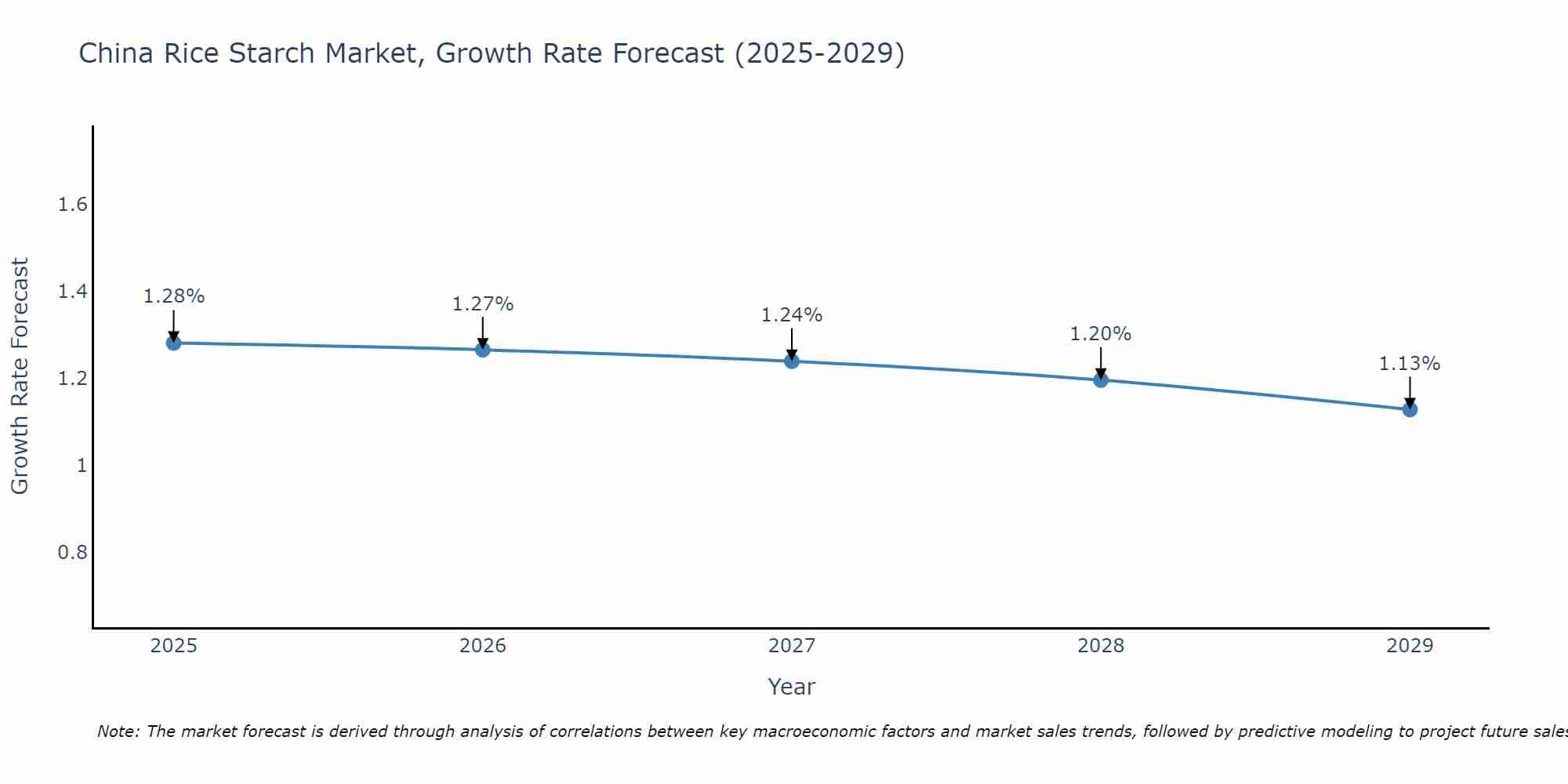
The China Rice Starch Market could see a tapering of growth rates over 2025 to 2029. Beginning strongly at 1.28% in 2025, growth softens to 1.13% in 2029.
China Rice Starch Market Overview
The China Rice Starch Market is experiencing significant growth driven by increasing demand in various industries such as food and beverage, pharmaceuticals, and cosmetics. Rice starch is gaining popularity as a natural ingredient with functional properties like thickening, stabilizing, and texturizing. The market is witnessing a shift towards clean label and organic products, leading to a rise in the production and consumption of rice starch. Key players in the market are focusing on product innovation, expanding their distribution networks, and strategic partnerships to gain a competitive edge. Government initiatives promoting sustainable agriculture practices and technological advancements in rice processing are also contributing to the market growth. Overall, the China Rice Starch Market is poised for further expansion in the coming years.
China Rice Starch Market Trends
The China rice starch market is witnessing several key trends. One of the significant trends is the increasing demand for clean-label and natural ingredients in food products, driving the growth of rice starch as a popular alternative to traditional starches. In addition, the rising health consciousness among Chinese consumers is fueling the demand for rice starch due to its gluten-free and non-allergenic properties. Moreover, the food and beverage industry in China is incorporating rice starch in a wide range of products such as noodles, snacks, and beverages to enhance texture and improve nutritional profiles. Furthermore, technological advancements in rice starch production processes are leading to higher quality and more versatile products, catering to the evolving needs of manufacturers in the market.
China Rice Starch Market Challenges
In the China Rice Starch Market, some challenges faced include increasing competition from alternative starch sources, such as corn and potato starch, which offer similar functionalities at potentially lower costs. Additionally, fluctuations in raw material prices and availability of high-quality rice could impact production costs and supply stability. Regulatory changes and quality control issues also pose challenges for rice starch manufacturers in China, as they need to comply with stringent standards to ensure product safety and quality. Furthermore, market fragmentation and the presence of numerous small-scale producers can lead to pricing pressures and hinder market consolidation efforts. Overall, navigating these challenges requires companies in the China Rice Starch Market to innovate, streamline operations, and differentiate their products to maintain a competitive edge in the market.
China Rice Starch Market Investment Opportunities
The China Rice Starch Market offers promising investment opportunities due to the increasing demand for rice starch in various industries such as food and beverage, pharmaceuticals, and cosmetics. With the growing health consciousness among consumers, the demand for natural and gluten-free ingredients like rice starch is on the rise. Additionally, the rise in disposable income and changing dietary preferences in China further drive the demand for rice starch-based products. Investors can consider opportunities in rice starch production facilities, distribution networks, or research and development for innovative rice starch applications. However, it is crucial to closely monitor regulatory changes and market dynamics to make informed investment decisions in this evolving market segment.
China Rice Starch Market Government Policy
The Chinese government has implemented various policies to regulate the rice starch market in China. These policies aim to promote the development of the rice starch industry, ensure food safety standards, and support sustainable agricultural practices. Some key policies include subsidies for rice farmers to encourage the production of high-quality rice for starch extraction, regulations on the use of pesticides and fertilizers to minimize environmental impact, and quality control measures to maintain product standards. Additionally, the government has introduced initiatives to promote innovation and technology adoption in rice starch processing to enhance efficiency and competitiveness in the market. Overall, these policies reflect the government`s commitment to fostering a thriving and sustainable rice starch industry in China.
China Rice Starch Market Future Outlook
The future outlook for the China Rice Starch Market appears to be positive, driven by various factors such as increasing consumer demand for natural and clean label ingredients, growing awareness about the health benefits of rice starch, and the expanding food and beverage industry in the region. Additionally, the rising popularity of gluten-free products and the versatile applications of rice starch in various industries including food, pharmaceuticals, and cosmetics are expected to further boost market growth. However, challenges such as fluctuating raw material prices, competition from alternative starch sources, and regulatory constraints may impact market dynamics. Overall, with increasing investments in research and development, innovation in product offerings, and strategic partnerships, the China Rice Starch Market is likely to witness steady growth in the coming years.
Key Highlights of the Report:
- China Rice Starch Market Outlook
- Market Size of China Rice Starch Market, 2021
- Forecast of China Rice Starch Market, 2031
- Historical Data and Forecast of China Rice Starch Revenues & Volume for the Period 2018 - 2031
- China Rice Starch Market Trend Evolution
- China Rice Starch Market Drivers and Challenges
- China Rice Starch Price Trends
- China Rice Starch Porter's Five Forces
- China Rice Starch Industry Life Cycle
- Historical Data and Forecast of China Rice Starch Market Revenues & Volume By Type for the Period 2018 - 2031
- Historical Data and Forecast of China Rice Starch Market Revenues & Volume By Native for the Period 2018 - 2031
- Historical Data and Forecast of China Rice Starch Market Revenues & Volume By Modified for the Period 2018 - 2031
- Historical Data and Forecast of China Rice Starch Market Revenues & Volume By Others for the Period 2018 - 2031
- Historical Data and Forecast of China Rice Starch Market Revenues & Volume By Application for the Period 2018 - 2031
- Historical Data and Forecast of China Rice Starch Market Revenues & Volume By Food and Beverages for the Period 2018 - 2031
- Historical Data and Forecast of China Rice Starch Market Revenues & Volume By Pharmaceuticals for the Period 2018 - 2031
- Historical Data and Forecast of China Rice Starch Market Revenues & Volume By Cosmetics and Personal Care for the Period 2018 - 2031
- Historical Data and Forecast of China Rice Starch Market Revenues & Volume By Textiles for the Period 2018 - 2031
- Historical Data and Forecast of China Rice Starch Market Revenues & Volume By Others for the Period 2018 - 2031
- China Rice Starch Import Export Trade Statistics
- Market Opportunity Assessment By Type
- Market Opportunity Assessment By Application
- China Rice Starch Top Companies Market Share
- China Rice Starch Competitive Benchmarking By Technical and Operational Parameters
- China Rice Starch Company Profiles
- China Rice Starch Key Strategic Recommendations






































