China Rocket Propellant Market Size & Growth Rate
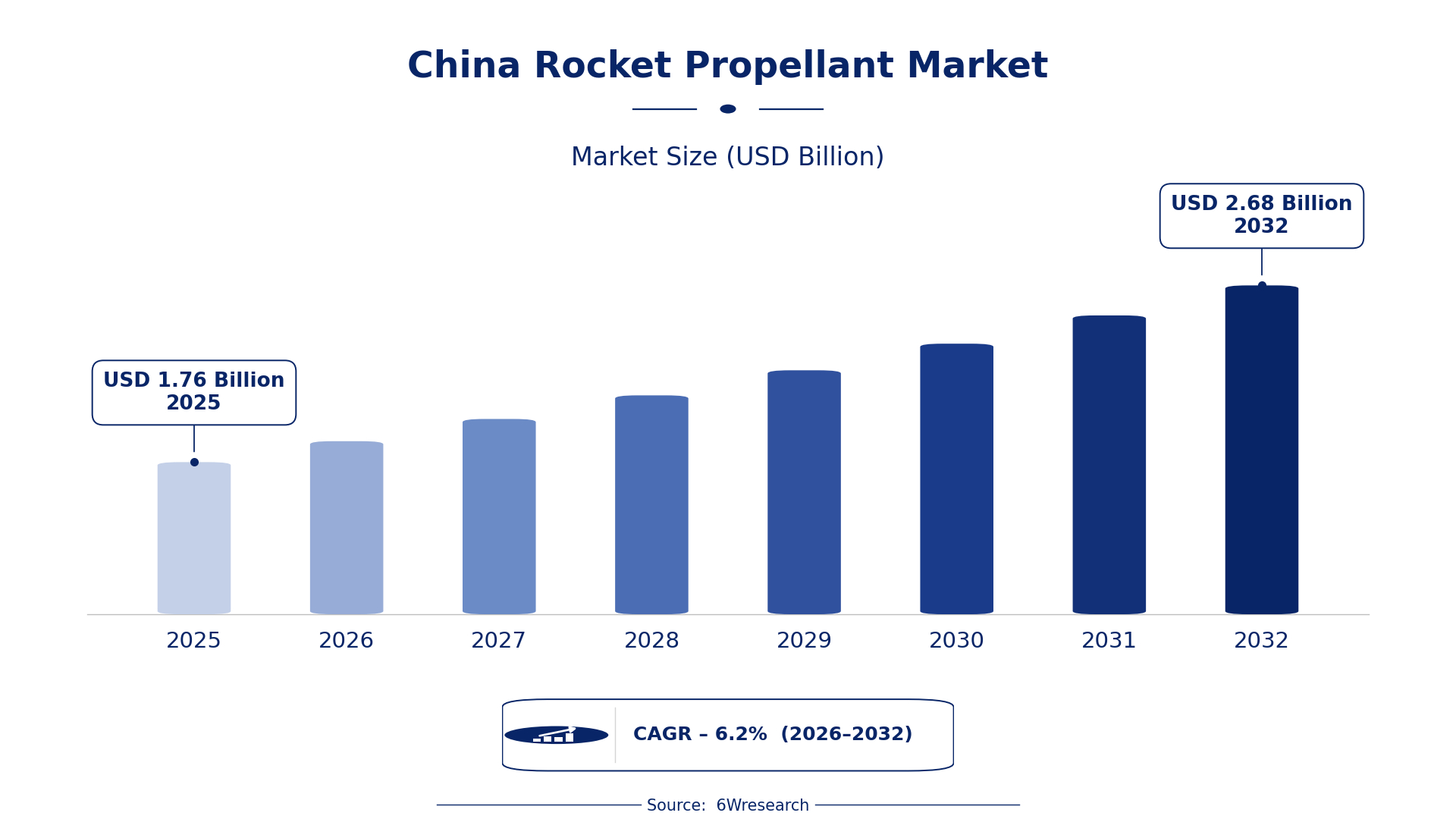
According to 6Wresearch internal database and industry insights, the China Rocket Propellant Market was valued at USD 1.76 billion in 2025 and is projected to reach USD 2.68 billion by 2032, growing at a CAGR of approximately 6.2% during 2026–2032.
China Rocket Propellant Market Highlights
| Report Metric | Details |
| Report Name | China Rocket Propellant Market |
| Market Size 2025 | USD 1.76 billion |
| Market Size 2032 | USD 2.68 billion |
| Absolute Growth 2025–2032 | USD 0.92 billion |
| CAGR 2026–2032 | 6.2% |
| Peak Annual Growth | 8.6% in 2029 |
| Forecast Period | 2026–2032 |
| Historical Data | 2022–2025 |
| Base Year | 2025 |
| Leading Propellant Type, 2025 | Liquid Propellants (48% share) |
| Leading Fuel Type, 2025 | RP‑1 / LOX (39% share) |
| Leading Propulsion Stage, 2025 | First-Stage Engines (44% share) |
| Leading End User, 2025 | Launch Service Providers (36% share) |
| Fastest-Growing Propellant Type | Hybrid Propellants (7.4% CAGR) |
| Fastest-Growing Fuel Type | Liquid Hydrogen / LOX (8.1% CAGR) |
| Fastest-Growing Propulsion Stage | Upper Stages (8.8% CAGR) |
| Fastest-Growing End User | Aerospace Firms (8.5% CAGR) |
| Growing Sector | aerospace |
| Key End Users | Launch Service Providers, Space Agencies, Aerospace Firms, R&D Organizations |
China Rocket Propellant Market Year-wise Growth Rate and Key Drivers (2022–2032)
This graph illustrates the annual growth rates of the market from 2022 to 2032, highlighting a steady upward trajectory and projected market expansion over the forecast period.
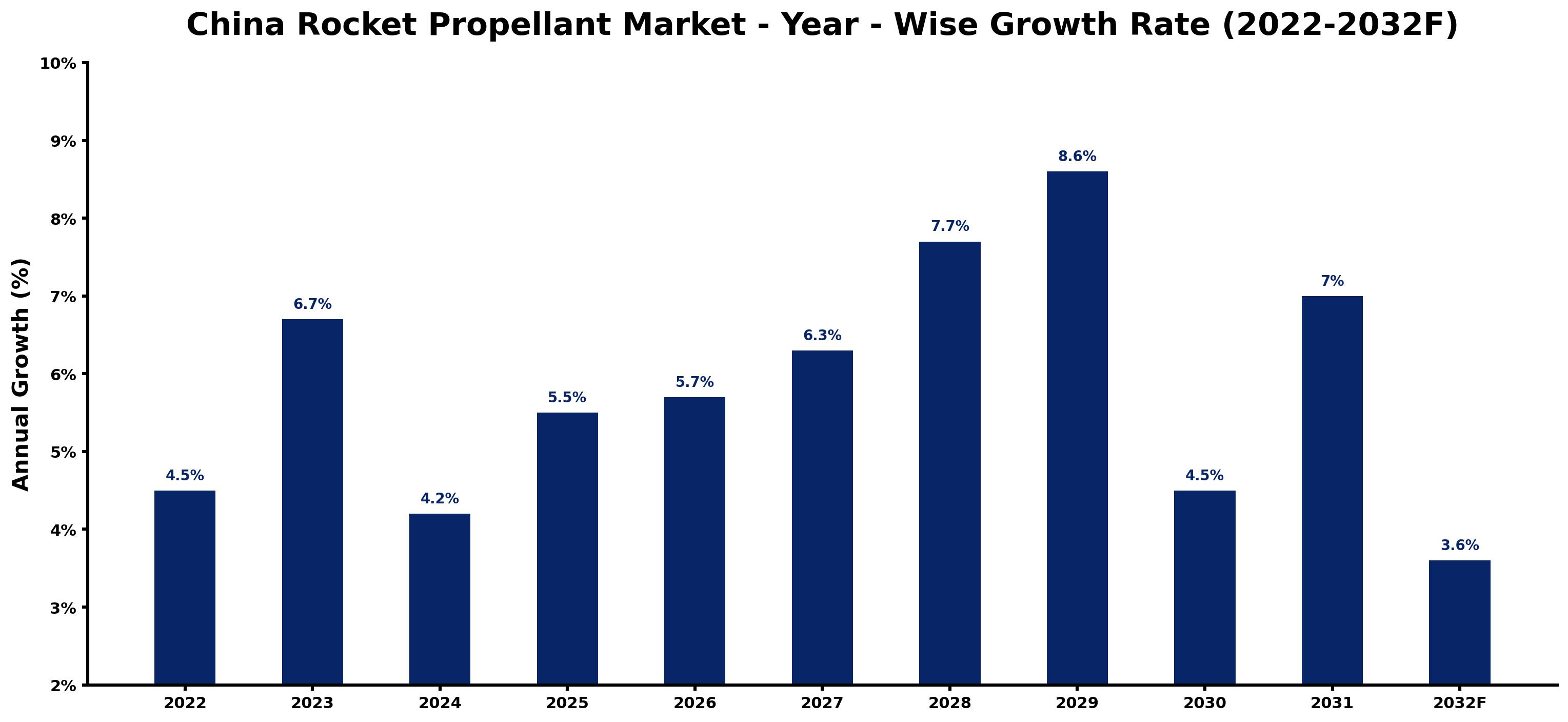
Below, each year's estimated growth is shown next to the factor that most influenced it.
| Year | Estimated Annual Growth (%) | Market Rationale |
| 2022 | 4.5 | The market experienced steady growth due to increased missions by the National Space Administration. |
| 2023 | 6.7 | Demand surged as China's space program launched over 50 missions, boosting propellant needs. |
| 2024 | 4.2 | Growth slowed as the market adjusted after a peak in 2023, yet remained positive. |
| 2025 | 5.5 | The market rebounded with faster growth driven by rising demands from Launch Service Providers. |
| 2026 | 5.7 | New facilities are expected to support market growth as domestic production capabilities expand. |
| 2027 | 6.3 | Demand is projected to strengthen as the aerospace sector grows, requiring more propellant supplies. |
| 2028 | 7.7 | Growth is anticipated to accelerate due to advancements in propellant technologies and increased launches from space agencies. |
| 2029 | 8.6 | The market is expected to peak as demand from space agencies and commercial providers surges. |
| 2030 | 4.5 | Growth is projected to slow as the market normalises after a period of rapid expansion. |
| 2031 | 7.0 | An increase in satellite launches is expected to contribute to a resurgence in market growth. |
| 2032 | 3.6 | Growth is projected to decelerate as the market stabilises after a period of rapid expansion. |
Note: Market size estimations and growth projections presented in this report are based on 6Wresearch's proprietary forecasting methodology, utilizing the latest available industry data, government publications, and primary research inputs.
China Rocket Propellant Market Synopsis
The China Rocket Propellant Market includes chemical substances used to propel rockets, produced through intricate chemical processes. Key applications encompass launching satellites and military operations, with RP-1/LOX being a standard fuel type. Growth in the Rocket Propellant Market stems from investments in domestic space programs and an emphasis on production capabilities. In 2023, China's space budget reached approximately 10 billion USD, driving advancements in propellant technologies. The rising number of satellite launches also fuels demand, with a target of 100 launches annually by 2025.
Market Dynamics Impact Analysis (2026–2032)
| Factor | Type | Impact | Primary Segment Affected |
| Growing domestic space missions fuel demand for reliable rocket propellants. | Driver | High | Liquid Propellants |
| Increased investment in R&D for advanced propellant technologies creates opportunities. | Driver | High | Hybrid Propellants |
| The need for sustainable production methods presents investment opportunities. | Opportunity | High | Cryogenic Propellants |
| Growing demand for satellite communications drives the need for more launches. | Opportunity | High | RP‑1 / LOX |
| High production costs can limit the competitiveness of local manufacturers. | Restraint | Medium | Solid Propellants |
| Stringent safety regulations may delay production timelines for propellants. | Restraint | Medium | HTPB-Based |
| The market faces challenges in scaling production to meet rising demand. | Challenge | High | First-Stage Engines |
| Technological complexities in developing hybrid propellants pose risks. | Challenge | Medium | Hybrid Propellants |
Evaluation of Drivers in China Rocket Propellant Market (2026–2032)
The main growth drivers and the segments they affect most are set out below.
| Drivers | Primary Segment Affected | Why It Matters (Evidence) |
| Increasing number of space missions drives demand for liquid propellants. | Liquid Propellants | China's space program launched over 50 missions in 2022, leading to higher propellant requirements. |
| R&D investments improve hybrid propellant performance and application. | Hybrid Propellants | Funding for research since 2020 has improved hybrid technologies, attracting interest from aerospace firms. |
| Growing satellite launches increase demand for RP-1/LOX fuel. | RP‑1 / LOX | The government aims for 100 satellite launches annually by 2025, boosting RP-1/LOX needs. |
| Cryogenic propellants are essential for advanced space missions. | Cryogenic Propellants | The Chang'e lunar missions require cryogenic propellants for upper stage propulsion. |
| Military applications drive demand for solid propellants. | Solid Propellants | The military's reliance on reliable solid propellant systems supports ongoing demand. |
The Rocket Propellant market in China is growing on the back of increasing end-use demand from both commercial and military sectors. In 2022, over 50 missions were launched, raising the need for liquid propellants. Investments in R&D for hybrid propellants have improved their performance, attracting interest from aerospace firms. Military applications continue to drive demand for solid propellants, ensuring a steady market for these products.
Evaluation of Restraints in China Rocket Propellant Market
The key brakes on demand, and where they bite hardest, are shown below.
| Market Restraint | Primary Segment Affected | Why It Matters (Evidence) |
| High production costs limit the competitiveness of local manufacturers. | Solid Propellants | Production costs for solid propellants can exceed 30% of total expenses, impacting pricing. |
| Stringent safety regulations may delay production timelines. | HTPB-Based | Compliance with the Aerospace Propellant Safety Regulation can extend approval processes. |
| Limited infrastructure for scaling production affects supply capabilities. | Cryogenic Propellants | Inadequate facilities for cryogenic propellant production can hinder timely deliveries. |
| Technological complexities in hybrid propellant development pose risks. | Hybrid Propellants | Challenges in achieving reliable performance can slow adoption rates. |
| Market volatility due to fluctuating raw material prices impacts planning. | RP‑1 / LOX | Price instability of key components can disrupt budgeting for manufacturers. |
China Rocket Propellant Market Challenges
The China Rocket Propellant Market encounters practical issues, starting with buyers facing fluctuating prices due to unstable raw material costs. This instability arises from global supply chain disruptions, potentially delaying projects for aerospace firms. Technological limitations impede progress, as many producers depend on outdated propellant formulations, which restrict innovation and diminish the competitiveness of local products. The rising cost of R&D for hybrid propellants, projected at 2 billion USD in 2023, places financial pressure on suppliers, limiting their capacity to invest in new technologies. Competition from international markets intensifies, as foreign entities can offer advanced propellant solutions at lower prices, challenging the market share of domestic producers.
Trends in the China Rocket Propellant Market
Several trends are reshaping the China Rocket Propellant Market; the most important are set out below.
- Shift to Advanced Propellant Technologies: Since 2020, China has focused on developing advanced propellant technologies to improve performance. The Rocket Propellant Research and Development Program aims to improve efficiency, with funding of approximately 10 billion USD allocated for 2023.
- Increasing Military Applications: The military sector is increasingly adopting solid propellants for reliability in missile systems. This shift aligns with the National Defense Authorization Act's provisions for improving rocket capabilities, reflecting a growing investment in defence technologies.
- Growth in Commercial Launch Services: Launch Service Providers are expanding their operations, driven by the rising demand for satellite communications. In 2023, the market saw a 36% share for Launch Service Providers, indicating a strong commercial focus.
- Focus on Sustainable Production Methods: The national plan for sustainable rocket propellant production by 2025 reflects a commitment to eco-friendly practices. This initiative is projected to attract investments in green technologies, aligning with global sustainability trends.
Investment Opportunities in the China Rocket Propellant Market
Some of the investment opportunities in the China Rocket Propellant Market are mentioned below.
- Joint Ventures for Production Expansion: Collaborating with local manufacturers can improve production capabilities, addressing the growing demand. The Tianwen-1 Mars mission illustrates the need for increased propellant supply, with an expected investment of 10 billion USD.
- Investment in Cryogenic Facilities: There is a significant gap in cryogenic propellant production capacity, with a projected need for new facilities. Establishing operations in Sichuan could meet the demand for Chang'e lunar missions, which require advanced propellants.
- Supply of Hybrid Propellant Technologies: The rising interest in hybrid propellants presents opportunities for suppliers to innovate. The government’s focus on R&D since 2020 supports the development of these technologies, attracting investment from aerospace firms.
- Enhancing Solid Propellant Production: Investing in solid propellant production capabilities can meet military and commercial needs. The National Aerospace Innovation Strategy allocates funds for improving production processes, creating a pathway for new entrants.
Government Initiatives in the China Rocket Propellant Market
The National Space Administration of China launched the 'China Space Development Plan 2021-2025' to improve rocket propellant production capabilities, focusing on innovation and sustainability. This plan aims to increase domestic production and reduce reliance on imports, ensuring a stable supply for both military and civilian applications. The 'Aerospace Industry Development Plan' issued in 2020 emphasised the importance of developing local manufacturing capabilities. These measures are designed to support the growth of the rocket propellant market and improve overall efficiency in production processes.
The Ministry of Industry and Information Technology oversees the implementation of safety regulations for propellant production. The 'Aerospace Propellant Safety Regulation' initiated in 2022 ensures compliance with national safety standards, affecting how manufacturers operate. The Ministry of Science and Technology funds the 'Rocket Propellant Research and Development Program', launched in 2023, which aims to improve propellant performance and reduce costs. This program is critical for advancing technology and ensuring the competitiveness of Chinese propellants in the global market.
Future Insight of the China Rocket Propellant Market
The China Rocket Propellant Market is expected to evolve by 2032, driven by advancements in propellant technologies and increased production capabilities. The government's initiative to boost domestic propellant output will create a more efficient supply chain, benefiting both buyers and suppliers. By 2025, the aim to increase satellite launches to 100 per year will necessitate robust infrastructure for propellant manufacturing. Ongoing investments in R&D for sustainable rocket propellant production will likely result in more environmentally friendly options, aligning with global trends in aerospace practices.
Market Segmentation Analysis
The analysis below covers each segmentation, its leading category in 2025 and its fastest-growing category through 2032.
By Propellant Type – Liquid Propellants Dominated, Hybrid Propellants Expected to Grow Fastest
According to Shubham Padhi, Research Analyst at 6Wresearch, in 2025, Liquid Propellants led the propellant type split with a 48% share. Liquid propellants dominate the China Rocket Propellant Market due to their efficiency and widespread use across various rocket stages. The Long March 5 rocket exemplifies this trend, relying heavily on RP-1/LOX for its successful missions. The quickest growth will come from Hybrid Propellants, forecast to expand at a CAGR of 7.4% between 2026 and 2032. Hybrid propellants are experiencing rapid growth as China invests in advanced technologies, particularly for specific applications. The government's focus on enhancing domestic production capabilities will likely lead to increased adoption of hybrid propellants in experimental settings. Suppliers should prioritise liquid propellants while also exploring opportunities in hybrid technologies to align with market trends.
By Fuel Type – RP‑1 / LOX Dominated, Liquid Hydrogen / LOX Expected to Grow Fastest
With a 39% revenue share in 2025, RP‑1 / LOX was the largest fuel type category. RP-1/LOX holds the largest market share as it is the standard fuel for many first-stage rockets, which are crucial for successful launches. Its extensive application in China's space missions underscores its importance in the industry. Liquid Hydrogen / LOX is projected to grow fastest, at a CAGR of 8.1% during 2026–2032. Liquid hydrogen/LOX is witnessing the fastest growth due to its essential role in upper stage propulsion, necessary for reaching final orbits. The government's ambitious plans to increase satellite launches will further drive demand for this fuel type. Buyers should consider the strategic advantages of liquid hydrogen/LOX for upper stage applications to support the country's launch objectives.
By Propulsion Stage – First-Stage Engines Dominated, Upper Stages Expected to Grow Fastest
The largest propulsion stage category in 2025 was First-Stage Engines, with a 44% share of total revenue. First-stage engines command the largest market share as they are critical for launching payloads into orbit, making them essential in rocket propulsion. The high demand for reliable first-stage engines highlights their importance in ensuring mission success. Upper Stages are set to record the highest CAGR in this split, 8.8% over 2026–2032. Upper stages are experiencing rapid growth as they are necessary for achieving final orbits, especially with the planned increase in satellite launches. This segment's expansion is supported by advancements in propulsion technologies that improve performance. Suppliers must focus on enhancing upper stage technologies to meet the rising demand for complex orbital missions.
By End User – Launch Service Providers Dominated, Aerospace Firms Expected to Grow Fastest
Launch Service Providers accounted for a 36% market share by end user in 2025. Launch service providers represent the largest share in the market as they are the primary users of rocket propellants for commercial launches. Their continuous growth is driven by China's expanding space programme and increasing launch frequency. Over 2026–2032, Aerospace Firms are expected to post the fastest growth, at a CAGR of 8.5%. Aerospace firms are experiencing the fastest growth as they develop and manufacture rockets and spacecraft, aligning with the government's push for innovation in the aerospace sector. This trend indicates a shift towards more integrated aerospace solutions. Suppliers should strengthen partnerships with aerospace firms to capitalise on the growing demand for advanced rocket technologies.
Key Attractiveness of the Report
- 10 Years of Market Numbers
- Historical Data Starting from 2022 to 2025
- Base Year 2025
- Forecast Data until 2032
- Key Performance Indicators Impacting the Market
- Major Upcoming Developments and Projects
Key Highlights of the Report:
- China Rocket Propellant Market Outlook
- Market Size of China Rocket Propellant Market, 2025
- Forecast of China Rocket Propellant Market, 2032
- Historical Data and Forecast of China Rocket Propellant Revenues & Volume for the Period 2022 - 2032F
- China Rocket Propellant Market Trend Evolution
- China Rocket Propellant Market Drivers and Challenges
- China Rocket Propellant Price Trends
- China Rocket Propellant Porter's Five Forces
- China Rocket Propellant Industry Life Cycle
- Historical Data and Forecast of China Rocket Propellant Market Revenues & Volume By Propellant Type for the Period 2022 - 2032F
- Historical Data and Forecast of China Rocket Propellant Market Revenues & Volume By Liquid Propellants for the Period 2022 - 2032F
- Historical Data and Forecast of China Rocket Propellant Market Revenues & Volume By Solid Propellants for the Period 2022 - 2032F
- Historical Data and Forecast of China Rocket Propellant Market Revenues & Volume By Cryogenic Propellants for the Period 2022 - 2032F
- Historical Data and Forecast of China Rocket Propellant Market Revenues & Volume By Hybrid Propellants for the Period 2022 - 2032F
- Historical Data and Forecast of China Rocket Propellant Market Revenues & Volume By Fuel Type for the Period 2022 - 2032F
- Historical Data and Forecast of China Rocket Propellant Market Revenues & Volume By RP 1 / LOX for the Period 2022 - 2032F
- Historical Data and Forecast of China Rocket Propellant Market Revenues & Volume By HTPB-Based for the Period 2022 - 2032F
- Historical Data and Forecast of China Rocket Propellant Market Revenues & Volume By Liquid Hydrogen / LOX for the Period 2022 - 2032F
- Historical Data and Forecast of China Rocket Propellant Market Revenues & Volume By Fuel Oxidizer for the Period 2022 - 2032F
- Historical Data and Forecast of China Rocket Propellant Market Revenues & Volume By Propulsion Stage for the Period 2022 - 2032F
- Historical Data and Forecast of China Rocket Propellant Market Revenues & Volume By First-Stage Engines for the Period 2022 - 2032F
- Historical Data and Forecast of China Rocket Propellant Market Revenues & Volume By Boosters for the Period 2022 - 2032F
- Historical Data and Forecast of China Rocket Propellant Market Revenues & Volume By Upper Stages for the Period 2022 - 2032F
- Historical Data and Forecast of China Rocket Propellant Market Revenues & Volume By Experimental Rockets for the Period 2022 - 2032F
- Historical Data and Forecast of China Rocket Propellant Market Revenues & Volume By End User for the Period 2022 - 2032F
- Historical Data and Forecast of China Rocket Propellant Market Revenues & Volume By Launch Service Providers for the Period 2022 - 2032F
- Historical Data and Forecast of China Rocket Propellant Market Revenues & Volume By Space Agencies for the Period 2022 - 2032F
- Historical Data and Forecast of China Rocket Propellant Market Revenues & Volume By Aerospace Firms for the Period 2022 - 2032F
- Historical Data and Forecast of China Rocket Propellant Market Revenues & Volume By R&D Organizations for the Period 2022 - 2032F
- China Rocket Propellant Import Export Trade Statistics
- Market Opportunity Assessment By Propellant Type
- Market Opportunity Assessment By Fuel Type
- Market Opportunity Assessment By Propulsion Stage
- Market Opportunity Assessment By End User
- China Rocket Propellant Top Companies Market Share
- China Rocket Propellant Competitive Benchmarking By Technical and Operational Parameters
- China Rocket Propellant Company Profiles
- China Rocket Propellant Key Strategic Recommendations
Market Covered
The report offers an extensive study of the following market segments.
By Propellant Type
- Liquid Propellants
- Solid Propellants
- Cryogenic Propellants
- Hybrid Propellants
By Fuel Type
- RP‑1 / LOX
- HTPB-Based
- Liquid Hydrogen / LOX
- Fuel + Oxidizer
By Propulsion Stage
- First-Stage Engines
- Boosters
- Upper Stages
- Experimental Rockets
By End User
- Launch Service Providers
- Space Agencies
- Aerospace Firms
- R&D Organizations






































