China School IAQ Sensor Market Size & Growth Rate
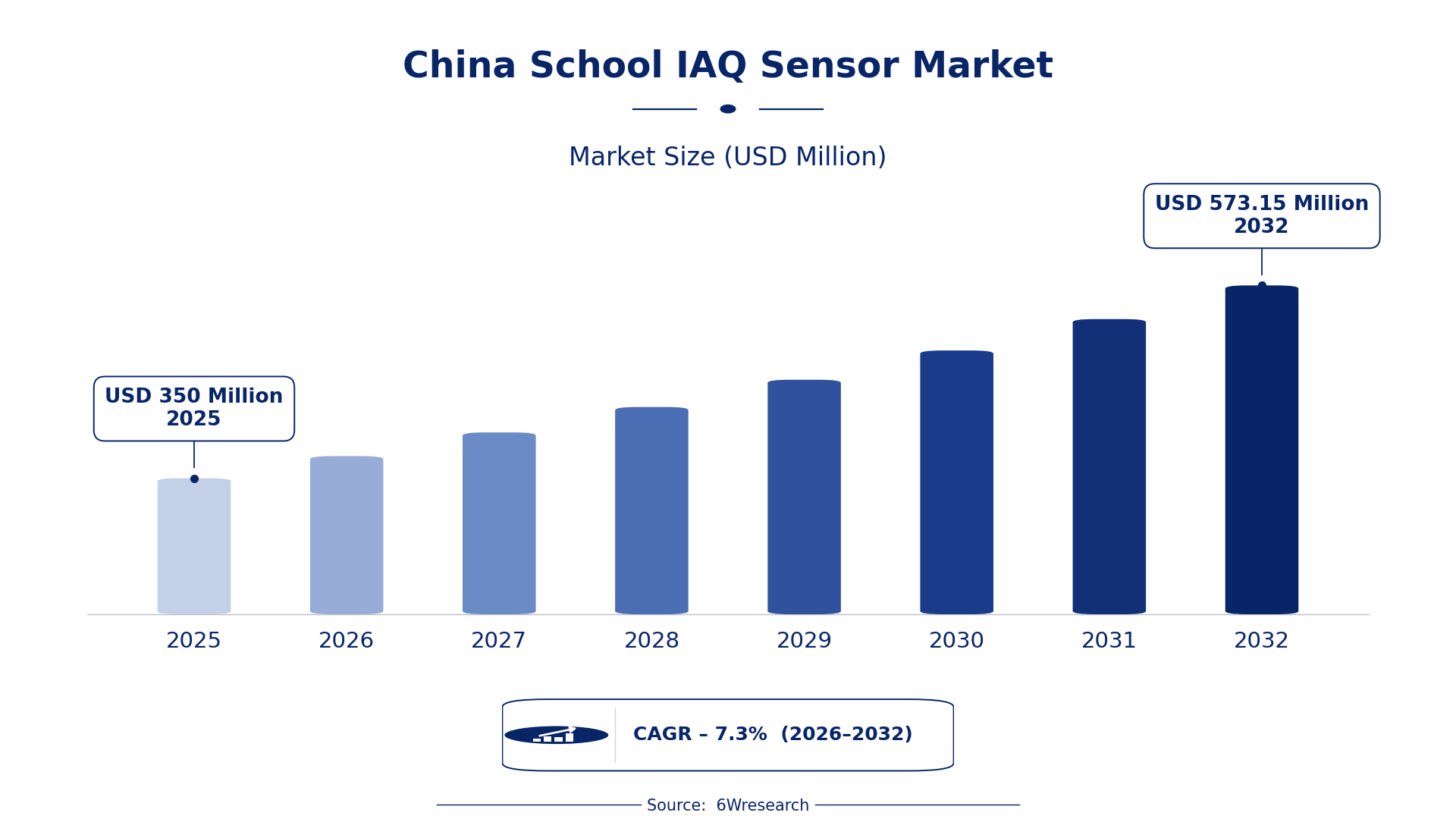
According to 6Wresearch internal database and industry insights, the China School IAQ Sensor Market was valued at USD 350.0 million in 2025 and is projected to reach USD 573.15 million by 2032, growing at a CAGR of approximately 7.3% during 2026–2032.
China School IAQ Sensor Market Highlights
| Report Metric | Details |
| Report Name | China School IAQ Sensor Market |
| Market Size 2025 | USD 350.0 million |
| Market Size 2032 | USD 573.15 million |
| Absolute Growth 2025–2032 | USD 223.15 million |
| CAGR 2026–2032 | 7.3% |
| Peak Annual Growth | 9.7% in 2032 |
| Forecast Period | 2026–2032 |
| Historical Data | 2022–2025 |
| Base Year | 2025 |
| Leading Sensor Type, 2025 | Multi-Parameter Units (43% share) |
| Leading Parameter Measured, 2025 | Indoor Air Quality (48% share) |
| Leading Deployment Mode, 2025 | Networked (Wi-Fi) (38% share) |
| Leading End User, 2025 | School Facilities Managers (43% share) |
| Fastest-Growing Sensor Type | VOC Sensors (8.5% CAGR) |
| Fastest-Growing Parameter Measured | Temp & Humidity (9.1% CAGR) |
| Fastest-Growing End User | Health & Safety Officers (10.1% CAGR) |
| Growing Sector | Health & Safety Officers |
| Key End Users | School Facilities Managers, Health & Safety Officers, School Administrators, District Maintenance Teams |
China School IAQ Sensor Market Year-wise Growth Rate and Key Drivers (2022–2032)
This graph illustrates the annual growth rates of the market from 2022 to 2032, highlighting a steady upward trajectory and projected market expansion over the forecast period.
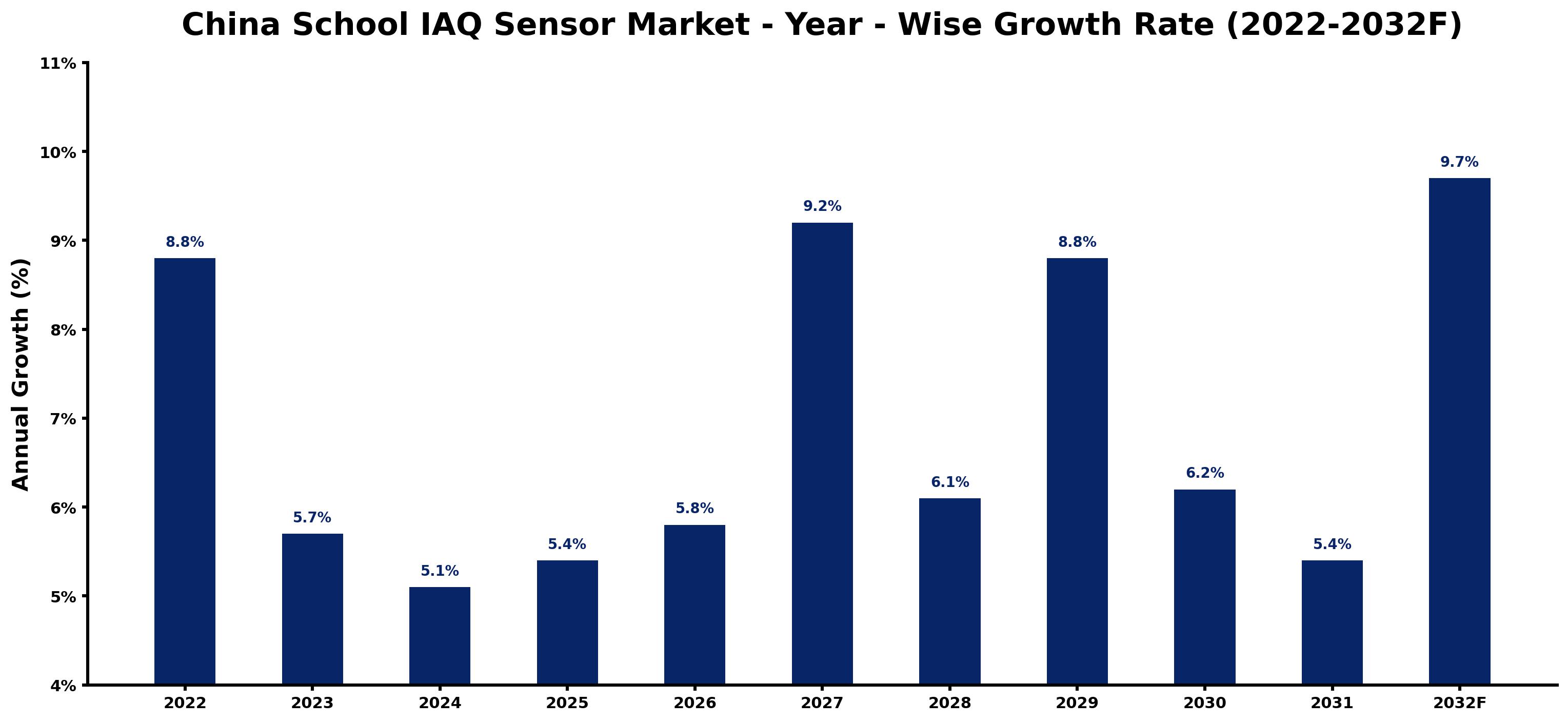
Year by year, the estimates below pair each growth rate with the development that shaped it.
| Year | Estimated Annual Growth (%) | Market Rationale |
| 2022 | 8.8 | The education sector focused on improving indoor air quality standards in schools. |
| 2023 | 5.7 | The 'Healthy Schools Initiative' launched, promoting air quality monitoring in educational facilities. |
| 2024 | 5.1 | Growth slowed as schools continued to adapt to new air quality regulations. |
| 2025 | 5.4 | Increased installations of IAQ sensors in newly constructed schools boosted market activity. |
| 2026 | 5.8 | The adoption of multi-parameter monitoring systems gained traction among school facilities managers. |
| 2027 | 9.2 | Demand surged due to heightened awareness of health impacts related to indoor air quality. |
| 2028 | 6.1 | Market growth slowed as schools adjusted to existing air quality measures. |
| 2029 | 8.8 | The integration of IAQ sensors into smart building technologies drove renewed interest. |
| 2030 | 6.2 | Growth decelerated as the market matured and competition intensified. |
| 2031 | 5.4 | Demand remained steady as schools maintained compliance with health standards. |
| 2032 | 9.7 | The market peaked as urban areas implemented comprehensive air quality monitoring systems. |
Note: Market size estimations and growth projections presented in this report are based on 6Wresearch's proprietary forecasting methodology, utilizing the latest available industry data, government publications, and primary research inputs.
China School IAQ Sensor Market Synopsis
The School IAQ Sensor Market in China includes devices designed to monitor indoor air quality in educational settings. These sensors track parameters such as CO₂, VOCs, temperature, and humidity to maintain a healthy learning environment. In 2022, more than 60% of urban schools adopted IAQ sensors, spurred by government initiatives focused on health standards and the 'Healthy Schools Initiative'. The demand is further reinforced by the National Standard GB/T 18883-2002, which highlights the importance of air quality monitoring in schools.
Market Dynamics Impact Analysis (2026–2032)
| Factor | Type | Impact | Primary Segment Affected |
| Growing awareness of health impacts from poor indoor air quality | Driver | High | Indoor Air Quality |
| Increased government funding for air quality improvement projects | Driver | High | Indoor Air Quality |
| Investment in smart building technologies for schools | Opportunity | High | Networked (Wi-Fi) |
| Rising demand for multi-parameter monitoring systems | Opportunity | Medium | Multi-Parameter Units |
| High installation costs for advanced IAQ sensors | Restraint | Medium | VOC Sensors |
| Limited awareness in rural areas about air quality monitoring | Restraint | High | Temperature/Humidity |
| The market faces challenges in rural adoption of IAQ sensors | Challenge | Medium | Standalone Devices |
| Competition from low-cost sensor alternatives | Challenge | High | Integrated HVAC Systems |
Evaluation of Drivers in China School IAQ Sensor Market (2026–2032)
Key forces behind demand, with the segment each one moves most, are listed below.
| Drivers | Primary Segment Affected | Why It Matters (Evidence) |
| Increased government funding for air quality improvement projects | Indoor Air Quality | The Chinese government allocated 500 million RMB for air quality projects in schools, driving sensor demand. |
| Growing awareness of health impacts from poor indoor air quality | VOC Sensors | With over 280 million students enrolled, schools are prioritising health, increasing VOC sensor installations. |
| Adoption of smart building technologies in schools | Networked (Wi-Fi) | Integration of IAQ sensors into smart technologies improves monitoring capabilities, appealing to school facilities managers. |
| Implementation of the 'Healthy Schools Initiative' | Multi-Parameter Units | This initiative encourages schools to adopt advanced monitoring systems, boosting demand for multi-parameter units. |
| Rising health standards set by the National Health Commission | Temperature/Humidity | Stricter guidelines prompt schools to invest in temperature and humidity monitoring for compliance. |
The School IAQ Sensor market in China is expanding as awareness of health impacts from poor indoor air quality, increased funding for air quality improvement projects, and the adoption of smart building technologies drive demand. With a large student population, educational institutions are prioritising health, resulting in increased installations of VOC sensors to ensure safe environments. Stricter guidelines from the National Health Commission also prompt schools to invest in temperature and humidity monitoring to meet compliance standards.
Evaluation of Restraints in China School IAQ Sensor Market
The following restraints limit how fast demand can grow.
| Market Restraint | Primary Segment Affected | Why It Matters (Evidence) |
| Supply chain disruptions affecting sensor deliveries | Indoor Air Quality | Delays in sensor deliveries hinder educational institutions' ability to monitor air quality effectively. |
| High costs of upgrading infrastructure for IAQ technologies | Networked (Wi-Fi) | Urban buyers face expenses reaching up to 500 million RMB for some projects, straining budgets. |
| Need for multiple sensors in larger classrooms | Multi-Parameter Units | The average classroom size of 40 students necessitates multiple sensors, increasing financial strain. |
| Competition among suppliers driving prices higher | VOC Sensors | Educational institutions strive to meet updated national standards, limiting options for smaller facilities. |
| Limited awareness of the benefits of advanced IAQ systems | Temperature/Humidity | Some schools remain hesitant to invest in new technologies, slowing market adoption. |
China School IAQ Sensor Market Challenges
The China School IAQ Sensor Market faces several practical problems, starting with supply chain disruptions that can delay sensor deliveries, which hampers schools' ability to monitor air quality effectively. Urban buyers often struggle with high costs associated with upgrading infrastructure for new IAQ technologies, with expenses reaching 500 million RMB for certain projects. The average classroom size of 40 students necessitates multiple sensors for adequate coverage, imposing additional financial burdens on educational institutions. Competition among suppliers intensifies as schools aim to comply with updated national standards, raising prices and limiting choices for smaller facilities.
Trends in the China School IAQ Sensor Market
Below mentioned are some of the trends shaping the China School IAQ Sensor Market growth.
- Shift Towards Multi-Parameter Monitoring: Beijing is increasingly adopting multi-parameter IAQ monitoring systems in schools, with 30% of urban institutions implementing these solutions by 2023. This shift improves data collection and air quality management.
- Transition from Standalone to Networked Systems: Since 2021, urban schools have been moving towards networked (Wi-Fi) IAQ sensors, capturing 38% market share by 2025. This transition enables real-time monitoring and alerts, enhancing responsiveness.
- Emergence of Health-Focused Standards: The National Standard GB/T 18883-2002 has been revised to include stricter air quality parameters, prompting schools to improve monitoring practices. This update is expected to drive sensor demand significantly.
- Growing Integration with Smart Technologies: In 2022, over 60% of urban schools began incorporating IAQ sensors into smart building technologies. This trend improves monitoring capabilities and supports healthier learning environments.
Investment Opportunities in the China School IAQ Sensor Market
Investors looking at the China School IAQ Sensor Market should consider the following areas.
- Investment in Smart Building Technologies: With the government's emphasis on health standards, there is a growing opportunity to supply smart IAQ monitoring systems. Urban schools are increasingly seeking advanced solutions to improve air quality.
- Expansion of the 'Healthy Schools Initiative': The 'Healthy Schools Initiative' launched in 2023 offers an opportunity to invest in air quality improvement projects. Schools are searching for reliable suppliers to meet new standards.
- Development of Multi-Parameter Units: The rising demand for multi-parameter IAQ monitoring systems presents an opportunity to develop and supply advanced sensor technologies. Educational institutions are focusing on comprehensive monitoring solutions.
- Partnerships with Educational Institutions: Now is an ideal time to form partnerships with school districts to provide IAQ sensors. Collaborating with local authorities can facilitate market entry and boost product adoption.
Government Initiatives in the China School IAQ Sensor Market
The 'Healthy Schools Initiative' launched by the Ministry of Education in 2023 aims to enhance air quality monitoring in schools with a focus on new sensor technologies. This initiative builds on previous regulations, such as the National Standard GB/T 18883-2002, which emphasises indoor air quality standards in educational facilities. The initiative mandates schools to implement advanced monitoring systems, ensuring compliance with health standards and improving overall air quality management.
School Facilities Managers utilise the 'Healthy Schools Initiative' to secure funding for air quality improvement projects. The initiative provides resources for the installation of IAQ sensors, enabling schools to meet updated health standards. Additionally, the National Health Commission's guidelines for indoor air quality monitoring support schools in achieving compliance through regular assessments and reporting.
Future Insight of the China School IAQ Sensor Market
The China School IAQ Sensor Market is set to evolve considerably by 2032, driven by initiatives like the 'Healthy Schools Initiative' and the updated National Standard for Indoor Air Quality in Schools. Increased investment in smart building technologies will facilitate the integration of IAQ sensors in educational facilities, improving monitoring capabilities. By 2025, 30% of urban educational institutions are expected to adopt multi-parameter IAQ monitoring systems, benefiting over 60 million students. Ongoing government support and funding will further encourage the uptake of these technologies, promoting a healthier learning environment.
Market Segmentation Analysis
The report offers a comprehensive study of the following market segments and their leading categories in the market.
By Sensor Type – Multi-Parameter Units Dominated, VOC Sensors Expected to Grow Fastest
According to Shubham Padhi, Research Analyst at 6Wresearch, Multi-Parameter Units accounted for a 43% market share by sensor type in 2025. Multi-Parameter Units dominate the market share because they deliver essential air quality data, crucial for maintaining safe environments in schools. With over 60% of urban schools adopting these units, their role in promoting student and staff health is undeniable. The quickest growth will come from VOC Sensors, forecast to expand at a CAGR of 8.5% between 2026 and 2032. VOC Sensors are witnessing rapid growth as they effectively detect harmful volatile organic compounds that can impact health. The increasing focus on indoor air quality in educational settings has led to a surge in demand for these sensors. Suppliers should enhance VOC Sensors' capabilities to align with the rising market demand.
By Parameter Measured – Indoor Air Quality Dominated, Temp & Humidity Expected to Grow Fastest
The largest parameter measured category in 2025 was Indoor Air Quality, with a 48% share of total revenue. Indoor Air Quality is the leading parameter measured, as it is directly linked to the health and safety of students and staff in educational environments. The adherence to the National Standard GB/T 18883-2002 has further solidified its importance in schools. Temp & Humidity is projected to grow fastest, at a CAGR of 9.1% during 2026–2032. Temp & Humidity monitoring is growing quickly due to its critical role in ensuring a conducive learning atmosphere, especially in classrooms with larger student populations. Recent guidelines from the Ministry of Education have highlighted the need for optimal temperature and humidity control. Suppliers should focus on developing effective temperature and humidity monitoring solutions to capitalise on this increasing demand.
By Deployment Mode – Networked (Wi-Fi) Dominated and Is Expected to Record the Fastest Growth
In 2025, Networked (Wi-Fi) led the deployment mode split with a 38% share. Networked (Wi-Fi) systems lead the market as they enable real-time monitoring and alerts, essential for maintaining indoor air quality in schools. The integration of these systems into smart building technologies has further increased their adoption across educational institutions. The same category is also set to grow fastest, at a CAGR of 9.3% during 2026–2032. Networked (Wi-Fi) is also the fastest-growing deployment mode due to the rising trend of smart technology integration in schools, facilitating immediate responses to air quality fluctuations. This dual role as leader and fastest highlights the increasing reliance on technology for effective air quality management. This suggests that suppliers should invest in advanced networked solutions to meet the ongoing demand for real-time monitoring.
By End User – School Facilities Managers Dominated, Health & Safety Officers Expected to Grow Fastest
School Facilities Managers held a 43% share of the China School IAQ Sensor Market by end user in 2025. School Facilities Managers hold the largest market share as they are responsible for maintaining air quality standards within educational institutions. Their active role in implementing health and safety protocols makes them key stakeholders in the adoption of IAQ sensors. Health & Safety Officers are set to record the highest CAGR in this split, 10.1% over 2026–2032. Health & Safety Officers are the fastest-growing end user group, as they ensure compliance with health standards in schools, particularly in light of recent regulatory changes. Their increased focus on health impacts is driving the demand for advanced monitoring solutions. This indicates that suppliers should tailor their products to meet the specific needs of Health & Safety Officers to capture this expanding segment.
Key Attractiveness of the Report
- 10 Years of Market Numbers
- Historical Data Starting from 2022 to 2025
- Base Year 2025
- Forecast Data until 2032
- Key Performance Indicators Impacting the Market
- Major Upcoming Developments and Projects
Key Highlights of the Report:
- China School IAQ Sensor Market Outlook
- Market Size of China School IAQ Sensor Market, 2025
- Forecast of China School IAQ Sensor Market, 2032
- Historical Data and Forecast of China School IAQ Sensor Revenues & Volume for the Period 2022 - 2032F
- China School IAQ Sensor Market Trend Evolution
- China School IAQ Sensor Market Drivers and Challenges
- China School IAQ Sensor Price Trends
- China School IAQ Sensor Porter's Five Forces
- China School IAQ Sensor Industry Life Cycle
- Historical Data and Forecast of China School IAQ Sensor Market Revenues & Volume By Sensor Type for the Period 2022 - 2032F
- Historical Data and Forecast of China School IAQ Sensor Market Revenues & Volume By CO Sensors for the Period 2022 - 2032F
- Historical Data and Forecast of China School IAQ Sensor Market Revenues & Volume By VOC Sensors for the Period 2022 - 2032F
- Historical Data and Forecast of China School IAQ Sensor Market Revenues & Volume By Temperature/Humidity for the Period 2022 - 2032F
- Historical Data and Forecast of China School IAQ Sensor Market Revenues & Volume By Multi-Parameter Units for the Period 2022 - 2032F
- Historical Data and Forecast of China School IAQ Sensor Market Revenues & Volume By Parameter Measured for the Period 2022 - 2032F
- Historical Data and Forecast of China School IAQ Sensor Market Revenues & Volume By Indoor Air Quality for the Period 2022 - 2032F
- Historical Data and Forecast of China School IAQ Sensor Market Revenues & Volume By VOC/Particles for the Period 2022 - 2032F
- Historical Data and Forecast of China School IAQ Sensor Market Revenues & Volume By Temp & Humidity for the Period 2022 - 2032F
- Historical Data and Forecast of China School IAQ Sensor Market Revenues & Volume By CO TVOCs PM2.5 for the Period 2022 - 2032F
- Historical Data and Forecast of China School IAQ Sensor Market Revenues & Volume By Deployment Mode for the Period 2022 - 2032F
- Historical Data and Forecast of China School IAQ Sensor Market Revenues & Volume By Networked (Wi-Fi) for the Period 2022 - 2032F
- Historical Data and Forecast of China School IAQ Sensor Market Revenues & Volume By Standalone Devices for the Period 2022 - 2032F
- Historical Data and Forecast of China School IAQ Sensor Market Revenues & Volume By Integrated HVAC Systems for the Period 2022 - 2032F
- Historical Data and Forecast of China School IAQ Sensor Market Revenues & Volume By SaaS-Connected for the Period 2022 - 2032F
- Historical Data and Forecast of China School IAQ Sensor Market Revenues & Volume By End User for the Period 2022 - 2032F
- Historical Data and Forecast of China School IAQ Sensor Market Revenues & Volume By School Facilities Managers for the Period 2022 - 2032F
- Historical Data and Forecast of China School IAQ Sensor Market Revenues & Volume By Health & Safety Officers for the Period 2022 - 2032F
- Historical Data and Forecast of China School IAQ Sensor Market Revenues & Volume By School Administrators for the Period 2022 - 2032F
- Historical Data and Forecast of China School IAQ Sensor Market Revenues & Volume By District Maintenance Teams for the Period 2022 - 2032F
- China School IAQ Sensor Import Export Trade Statistics
- Market Opportunity Assessment By Sensor Type
- Market Opportunity Assessment By Parameter Measured
- Market Opportunity Assessment By Deployment Mode
- Market Opportunity Assessment By End User
- China School IAQ Sensor Top Companies Market Share
- China School IAQ Sensor Competitive Benchmarking By Technical and Operational Parameters
- China School IAQ Sensor Company Profiles
- China School IAQ Sensor Key Strategic Recommendations
Market Covered
This report examines the market across the segments below.
By Sensor Type
- CO₂ Sensors
- VOC Sensors
- Temperature/Humidity
- Multi-Parameter Units
By Parameter Measured
- Indoor Air Quality
- VOC/Particles
- Temp & Humidity
- CO₂ + TVOCs + PM2.5
By Deployment Mode
- Networked (Wi-Fi)
- Standalone Devices
- Integrated HVAC Systems
- SaaS-Connected
By End User
- School Facilities Managers
- Health & Safety Officers
- School Administrators
- District Maintenance Teams































