China Seeding & Planting Robots Market Size & Growth Rate
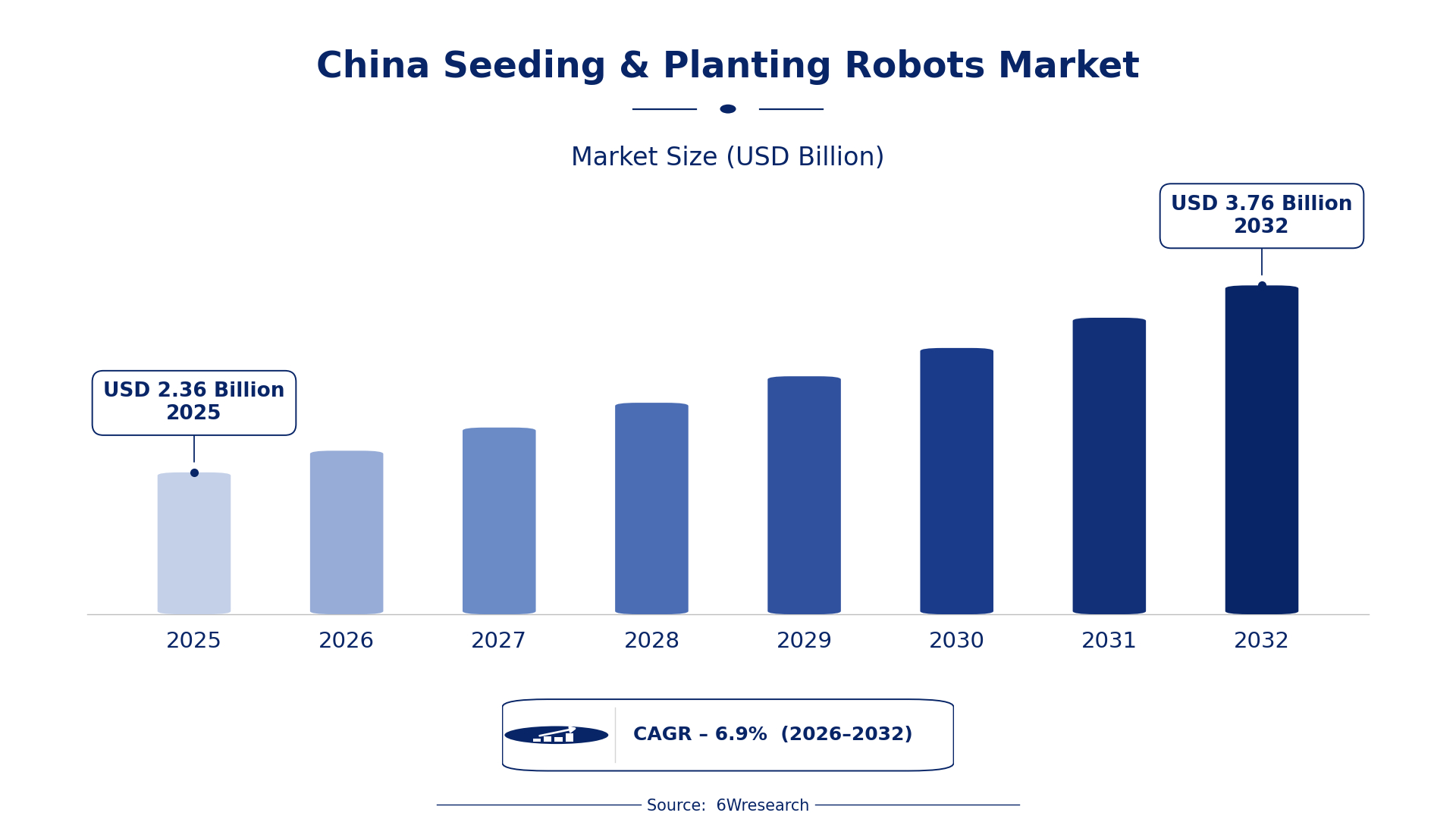
According to 6Wresearch internal database and industry insights, the China Seeding & Planting Robots Market was valued at USD 2.36 billion in 2025 and is projected to reach USD 3.76 billion by 2032, growing at a CAGR of approximately 6.9% during 2026–2032.
China Seeding & Planting Robots Market Highlights
| Report Metric | Details |
| Report Name | China Seeding & Planting Robots Market |
| Market Size 2025 | USD 2.36 billion |
| Market Size 2032 | USD 3.76 billion |
| Absolute Growth 2025–2032 | USD 1.40 billion |
| CAGR 2026–2032 | 6.9% |
| Peak Annual Growth | 9.2% in 2032 |
| Forecast Period | 2026–2032 |
| Historical Data | 2022–2025 |
| Base Year | 2025 |
| Leading Robot Type, 2025 | Autonomous Seeders (36% share) |
| Leading Navigation Tech, 2025 | GPS/RTK (43% share) |
| Leading Power Source, 2025 | Battery-Electric (40% share) |
| Leading End User, 2025 | Smart Farms (38% share) |
| Fastest-Growing Robot Type | Drone Seeders (9.3% CAGR) |
| Fastest-Growing Navigation Tech | AI-Enabled Flight (8.3% CAGR) |
| Fastest-Growing End User | Precision Agriculture (8.7% CAGR) |
| Growing Sector | Agricultural Technology |
| Key End Users | Smart Farms, Agribusiness Enterprises, Precision Agriculture |
China Seeding & Planting Robots Market Year-wise Growth Rate and Key Drivers (2022–2032)
This graph illustrates the annual growth rates of the market from 2022 to 2032, highlighting a steady upward trajectory and projected market expansion over the forecast period.
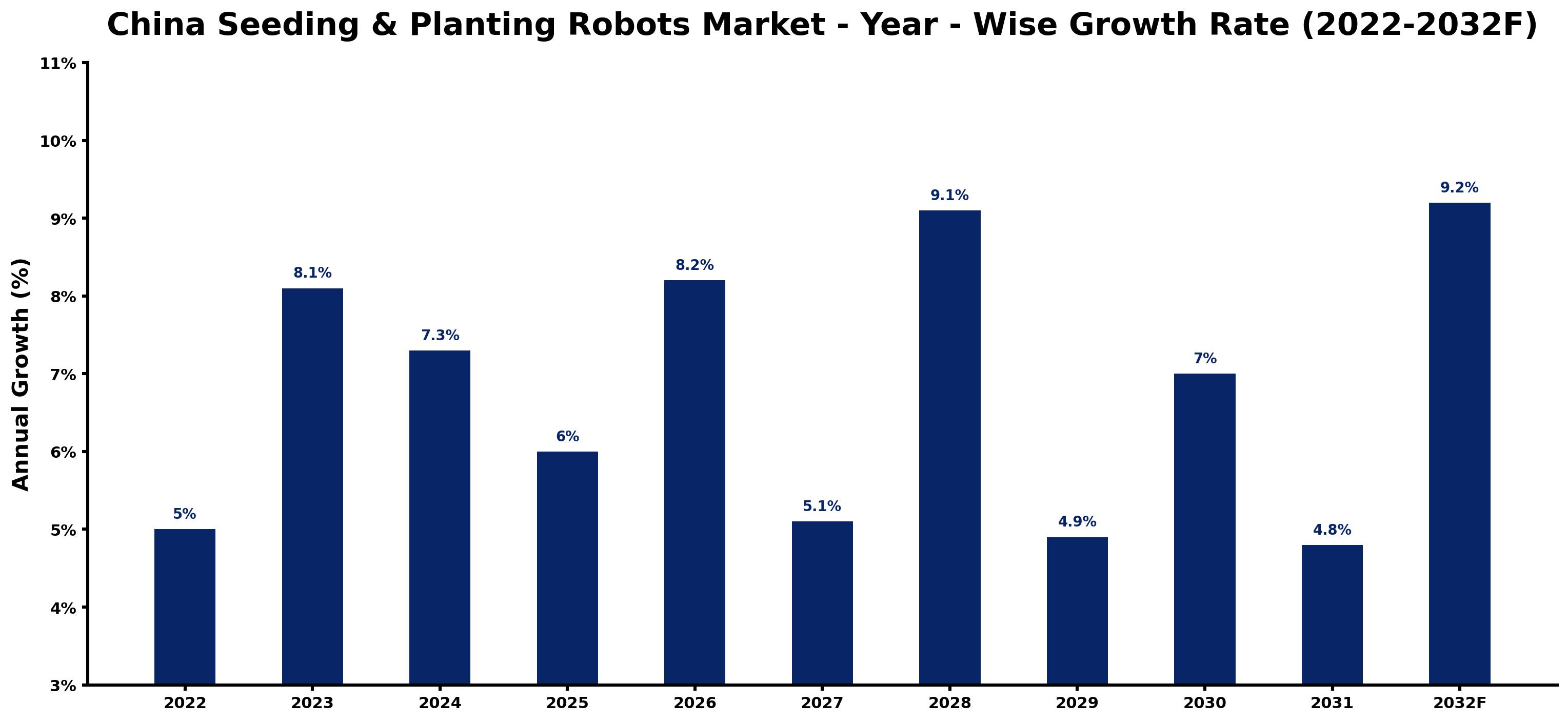
The table below sets out the estimated growth rate for each year and the main factor behind it.
| Year | Estimated Annual Growth (%) | Market Rationale |
| 2022 | 5.0 | The market showed steady growth as agricultural automation began gaining traction through various initiatives. |
| 2023 | 8.1 | Increased investments in smart farming technologies contributed to faster growth this year, particularly in the Yangtze River Delta region. |
| 2024 | 7.3 | Growth slowed as some farms faced challenges in adopting new technologies, including integration issues. |
| 2025 | 6.0 | The market continued to grow, but at a slower pace due to the effects of the Smart Agriculture Development Plan. |
| 2026 | 8.2 | Demand surged as new technologies were introduced, boosting adoption rates among large farms in the Yangtze River Delta. |
| 2027 | 5.1 | Growth slowed again as some buyers delayed purchases amid economic uncertainty and high initial costs. |
| 2028 | 9.1 | A resurgence in demand occurred as technology integration improved efficiency, particularly in precision agriculture practices. |
| 2029 | 4.9 | Growth slowed as the market began to stabilise after rapid advancements in automation technologies. |
| 2030 | 7.0 | Demand increased again as more farms adopted precision agriculture practices, supported by government initiatives such as the Digital Agriculture Action Plan. |
| 2031 | 4.8 | Growth slowed slightly as the market reached a more mature phase, with many farms fully integrating automation technologies. |
| 2032 | 9.2 | The market peaked with advancements in automation technologies, driven by the government's support for smart farming initiatives. |
Note: Market size estimations and growth projections presented in this report are based on 6Wresearch's proprietary forecasting methodology, utilizing the latest available industry data, government publications, and primary research inputs.
China Seeding & Planting Robots Market Synopsis
The China Seeding & Planting Robots Market encompasses advanced agricultural technologies that automate sowing and planting processes. These robots utilise robotics, AI, and navigation technologies to improve efficiency and precision in agriculture. The market is experiencing growth driven by strong demand from large farms and substantial investments in smart farming technologies. In 2022, the market was valued at approximately 10 billion USD, with over 60% of large farms adopting automation solutions. Initiatives such as the Smart Agriculture Development Plan further support this upward trend.
Market Dynamics Impact Analysis (2026–2032)
| Factor | Type | Impact | Primary Segment Affected |
| Growing adoption of smart farming technologies | Driver | High | Autonomous Seeders |
| Increased investment in agricultural automation | Driver | High | Drone Seeders |
| Emerging demand for precision agriculture solutions | Opportunity | High | Robotic Planters |
| Rising interest in sustainable farming practices | Opportunity | High | Smart Farms |
| High initial investment costs for advanced robots | Restraint | Medium | Modular Planting Bots |
| Limited awareness of technological benefits among farmers | Restraint | Medium | Precision Agriculture |
| Challenges in integrating new technologies into existing systems | Challenge | High | Agribusiness Enterprises |
| Dependence on skilled workforce for operation and maintenance | Challenge | Medium | Autonomous Seeders |
Evaluation of Drivers in China Seeding & Planting Robots Market (2026–2032)
Key forces behind demand, with the segment each one moves most, are listed below.
| Drivers | Primary Segment Affected | Why It Matters (Evidence) |
| Increased demand for efficiency and productivity | Autonomous Seeders | Over 60% of large farms are adopting smart farming technologies, driving demand for efficient seeding solutions. |
| Government initiatives promoting automation in agriculture | Drone Seeders | The Smart Agriculture Development Plan aims for 30% automation by 2025, boosting demand for these technologies. |
| Growing interest in sustainable farming practices | Robotic Planters | Investments in sustainable practices are increasing, leading to more demand for robotic planting technologies. |
| Technological advancements in AI and robotics | Modular Planting Bots | Innovations in AI are improving the capabilities of planting robots, attracting more buyers in the market. |
| Rising costs of manual labour in agriculture | Precision Agriculture | China aims to reduce labour costs in agriculture by 20% through automation by 2025. |
Growth in the Seeding & Planting Robots market in China comes from increasing demand for efficiency and productivity, with over 60% of large farms adopting smart farming technologies. The Smart Agriculture Development Plan, aiming for 30% automation by 2025, is driving demand for advanced planting solutions. The growing interest in sustainable farming practices is leading to increased investments in robotic planting technologies. Technological advancements in AI and robotics are improving the capabilities of planting robots, attracting more buyers. Rising costs of manual labour in agriculture push farmers to seek automated solutions to maintain profitability.
Evaluation of Restraints in China Seeding & Planting Robots Market
The main factors holding the market back are set out below.
| Market Restraint | Primary Segment Affected | Why It Matters (Evidence) |
| High initial investment costs for advanced robots | Modular Planting Bots | Many farmers are hesitant to invest in costly robotic systems, limiting market growth. |
| Limited awareness of technological benefits among farmers | Precision Agriculture | Some farmers remain unaware of the advantages of automation, affecting adoption rates and slowing growth. |
| Challenges in integrating new technologies into existing systems | Agribusiness Enterprises | Integration issues can delay the deployment of new robotic solutions on farms, affecting productivity. |
| Dependence on skilled workforce for operation and maintenance | Autonomous Seeders | A shortage of skilled workers can hinder the effective use of advanced planting robots, limiting their adoption. |
| Regulatory hurdles in technology adoption | Drone Seeders | Strict regulations can slow down the approval process for new agricultural technologies, affecting market entry. |
China Seeding & Planting Robots Market Challenges
Buyers in the China seeding and planting robots market encounter supply chain issues that lead to increased costs. These challenges arise from reliance on specific imported components, causing delivery delays of up to 25%. Competition intensifies as numerous local firms enter the market, forcing established suppliers to lower prices, which can drop by 15% or more, squeezing profit margins for manufacturers. Technological integration remains a challenge; many producers struggle to adopt new robotics, resulting in inefficiencies that can extend project timelines by several months. High initial costs, reaching 500,000 USD per unit, deter buyers, particularly smaller farms, from investing in these technologies.
Trends in the China Seeding & Planting Robots Market
Buyers and suppliers in the China Seeding & Planting Robots Market are adjusting to the following trends.
- Launch of the Smart Agriculture Development Plan: The Smart Agriculture Development Plan, initiated in 2022, aims for 30% automation in farming by 2025. This initiative is driving investments in seeding and planting robots, with the market expected to grow as a result.
- Shift towards AI-Enabled Flight Technologies: There is a growing trend towards using AI-Enabled Flight technologies for drone seeders, improving their efficiency and accuracy. This shift is evidenced by an expected CAGR of 8.3% from 2026 to 2032.
- Increase in Precision Agriculture Adoption: The adoption of precision agriculture is increasing as farmers seek to optimise yields and reduce costs. By 2025, China aims to achieve a 50% adoption rate of precision agriculture technologies.
- Expansion of the Agricultural Machinery Purchase Subsidy Program: In 2023, the Agricultural Machinery Purchase Subsidy Program allocated 1 billion USD to support the acquisition of planting robots. This funding is expected to boost the market for automated planting solutions.
Investment Opportunities in the China Seeding & Planting Robots Market
The following opportunities in the China Seeding & Planting Robots Market pair current demand with a clear way in.
- Supply of Seeding & Planting Robots: There is a growing opportunity to supply seeding and planting robots as the market expands, particularly in the Yangtze River Delta region, a key area for agricultural robotics development. The expected growth in this region presents a prime time for investment.
- Development of AI-Enabled Flight Technologies: The demand for AI-Enabled Flight technologies is increasing, especially among smart farms looking to improve their operations. Investing in this technology can yield high returns as the market continues to grow.
- Investment in Training Programs for Farmers: With the increasing adoption of automation, there is a pressing need for training programs for farmers. This opportunity is particularly relevant in regions where awareness of technology benefits is low, enhancing overall adoption.
- Expansion in Precision Agriculture Services: As precision agriculture adoption increases, there is a significant opportunity to provide related services and technologies. The focus on efficiency and yield optimisation makes this a promising area for investment.
Government Initiatives in the China Seeding & Planting Robots Market
The 'Smart Agriculture Development Plan', launched in 2022, aims for 30% automation in farming by 2025. This initiative builds on the 'Digital Agriculture Action Plan' from 2021, which promoted technology adoption in agriculture. The new plan provides guidelines and funding for integrating robotics into farming practices, ensuring compliance with safety standards and improving productivity for buyers and producers alike.
In 2023, 1 billion USD was allocated for the Agricultural Machinery Purchase Subsidy Program, supporting the acquisition of planting robots. The Ministry of Agriculture and Rural Affairs oversees this program, facilitating the purchase of advanced agricultural technologies. This funding encourages farmers to adopt automation solutions, increasing efficiency and reducing labour costs in the sector. The program is expected to significantly boost the market for seeding and planting robots.
Future Insight of the China Seeding & Planting Robots Market
The China seeding and planting robots market is set to evolve significantly by 2032, driven by government initiatives and advancements in technology. The 'Smart Agriculture Development Plan' aims for 30% automation by 2025, prompting increased adoption of these systems. The establishment of the National Standard for Agricultural Robots will enhance quality and safety, fostering buyer trust. By 2025, the goal of achieving a 50% adoption rate of precision agriculture technologies will improve crop yields and reduce labor costs, benefiting both buyers and suppliers.
Market Segmentation Analysis
The report offers a comprehensive study of the following market segments and their leading categories in the market.
By Robot Type – Autonomous Seeders Dominated, Drone Seeders Expected to Grow Fastest
According to Shubham Padhi, Research Analyst at 6Wresearch, Autonomous Seeders took a 36% share of robot type in 2025, more than any other category. Autonomous Seeders command the largest market share due to their critical role in executing the seeding process efficiently, which is essential for large-scale agricultural operations. Their widespread adoption in key agricultural regions like the Yangtze River Delta demonstrates their effectiveness in enhancing farming productivity. Drone Seeders are projected to grow fastest, at a CAGR of 9.3% during 2026–2032. Drone Seeders are witnessing rapid growth as they enable aerial seeding over extensive areas, catering to the increasing demand for efficient planting solutions. The impressive sale of over 200,000 units in 2022 reflects their rising popularity among farmers seeking innovative technologies. Suppliers should focus on enhancing the capabilities of Drone Seeders to leverage the growing interest in this segment.
By Navigation Tech – GPS/RTK Dominated, AI-Enabled Flight Expected to Grow Fastest
The largest navigation tech category in 2025 was GPS/RTK, with a 43% share of total revenue. GPS/RTK technology leads the market share because it is vital for precise navigation and positioning during the seeding process, ensuring optimal planting accuracy. Its widespread use across various farms in China underscores its importance in advancing agricultural practices. AI-Enabled Flight is set to record the highest CAGR in this split, 8.3% over 2026–2032. AI-Enabled Flight is experiencing the fastest growth as it enhances the autonomous navigation capabilities of drones, increasing their operational effectiveness. This growth is further supported by government initiatives promoting automation in agriculture, driving its adoption. Buyers should consider investing in AI-Enabled Flight systems to improve the efficiency of their planting operations.
By Power Source – Battery-Electric Dominated and Is Expected to Record the Fastest Growth
In 2025, Battery-Electric led the power source split with a 40% share. Battery-Electric power sources dominate the market share as they are the preferred option for mobile planting robots, providing reliable performance for farmers. This trend is particularly pronounced among large farms that prioritise sustainable energy solutions for their operations. Its lead should widen, with a projected CAGR of 8.9% during 2026–2032, the highest in this split. Battery-Electric technology is also the fastest-growing segment, with ongoing advancements in battery efficiency significantly enhancing robot performance. The emphasis on reducing agricultural labour costs further accelerates this growth trajectory. Suppliers must innovate in battery technologies to address the increasing demand for efficient power sources in planting robots.
By End User – Smart Farms Dominated, Precision Agriculture Expected to Grow Fastest
With a 38% revenue share in 2025, Smart Farms was the largest end user category. Smart Farms represent the largest market share as they are the primary adopters of advanced planting technologies, leveraging automation to enhance productivity. This trend is evident, with over 60% of large farms in China embracing these modern agricultural practices. The quickest growth will come from Precision Agriculture, forecast to expand at a CAGR of 8.7% between 2026 and 2032. Precision Agriculture is the fastest-growing segment, closely linked to the deployment of planting robots aimed at improving operational efficiency and crop yields. The government's goal of achieving 50% adoption of precision agriculture technologies by 2025 serves as a strong growth catalyst. Suppliers should align their offerings with Precision Agriculture initiatives to meet the evolving demands of modern farming.
Key Attractiveness of the Report
- 10 Years of Market Numbers
- Historical Data Starting from 2022 to 2025
- Base Year 2025
- Forecast Data until 2032
- Key Performance Indicators Impacting the Market
- Major Upcoming Developments and Projects
Key Highlights of the Report:
- China Seeding & Planting Robots Market Outlook
- Market Size of China Seeding & Planting Robots Market, 2025
- Forecast of China Seeding & Planting Robots Market, 2032
- Historical Data and Forecast of China Seeding & Planting Robots Revenues & Volume for the Period 2022 - 2032F
- China Seeding & Planting Robots Market Trend Evolution
- China Seeding & Planting Robots Market Drivers and Challenges
- China Seeding & Planting Robots Price Trends
- China Seeding & Planting Robots Porter's Five Forces
- China Seeding & Planting Robots Industry Life Cycle
- Historical Data and Forecast of China Seeding & Planting Robots Market Revenues & Volume By Robot Type for the Period 2022 - 2032F
- Historical Data and Forecast of China Seeding & Planting Robots Market Revenues & Volume By Autonomous Seeders for the Period 2022 - 2032F
- Historical Data and Forecast of China Seeding & Planting Robots Market Revenues & Volume By Drone Seeders for the Period 2022 - 2032F
- Historical Data and Forecast of China Seeding & Planting Robots Market Revenues & Volume By Robotic Planters for the Period 2022 - 2032F
- Historical Data and Forecast of China Seeding & Planting Robots Market Revenues & Volume By Modular Planting Bots for the Period 2022 - 2032F
- Historical Data and Forecast of China Seeding & Planting Robots Market Revenues & Volume By Navigation Tech for the Period 2022 - 2032F
- Historical Data and Forecast of China Seeding & Planting Robots Market Revenues & Volume By GPS/RTK for the Period 2022 - 2032F
- Historical Data and Forecast of China Seeding & Planting Robots Market Revenues & Volume By AI-Enabled Flight for the Period 2022 - 2032F
- Historical Data and Forecast of China Seeding & Planting Robots Market Revenues & Volume By Vision Sensors for the Period 2022 - 2032F
- Historical Data and Forecast of China Seeding & Planting Robots Market Revenues & Volume By LiDAR + ML for the Period 2022 - 2032F
- Historical Data and Forecast of China Seeding & Planting Robots Market Revenues & Volume By Power Source for the Period 2022 - 2032F
- Historical Data and Forecast of China Seeding & Planting Robots Market Revenues & Volume By Battery-Electric for the Period 2022 - 2032F
- Historical Data and Forecast of China Seeding & Planting Robots Market Revenues & Volume By Solar + Battery for the Period 2022 - 2032F
- Historical Data and Forecast of China Seeding & Planting Robots Market Revenues & Volume By Hybrid Power for the Period 2022 - 2032F
- Historical Data and Forecast of China Seeding & Planting Robots Market Revenues & Volume By Grid/Electric for the Period 2022 - 2032F
- Historical Data and Forecast of China Seeding & Planting Robots Market Revenues & Volume By End User for the Period 2022 - 2032F
- Historical Data and Forecast of China Seeding & Planting Robots Market Revenues & Volume By Smart Farms for the Period 2022 - 2032F
- Historical Data and Forecast of China Seeding & Planting Robots Market Revenues & Volume By Agroforestry Projects for the Period 2022 - 2032F
- Historical Data and Forecast of China Seeding & Planting Robots Market Revenues & Volume By Precision Agriculture for the Period 2022 - 2032F
- Historical Data and Forecast of China Seeding & Planting Robots Market Revenues & Volume By Agribusiness Enterprises for the Period 2022 - 2032F
- China Seeding & Planting Robots Import Export Trade Statistics
- Market Opportunity Assessment By Robot Type
- Market Opportunity Assessment By Navigation Tech
- Market Opportunity Assessment By Power Source
- Market Opportunity Assessment By End User
- China Seeding & Planting Robots Top Companies Market Share
- China Seeding & Planting Robots Competitive Benchmarking By Technical and Operational Parameters
- China Seeding & Planting Robots Company Profiles
- China Seeding & Planting Robots Key Strategic Recommendations
Market Covered
This report examines the market across the segments below.
By Robot Type
- Autonomous Seeders
- Drone Seeders
- Robotic Planters
- Modular Planting Bots
By Navigation Tech
- GPS/RTK
- AI-Enabled Flight
- Vision Sensors
- LiDAR + ML
By Power Source
- Battery-Electric
- Solar + Battery
- Hybrid Power
- Grid/Electric
By End User
- Smart Farms
- Agroforestry Projects
- Precision Agriculture
- Agribusiness Enterprises































