China Semiconductor Substrate Market Size & Growth Rate
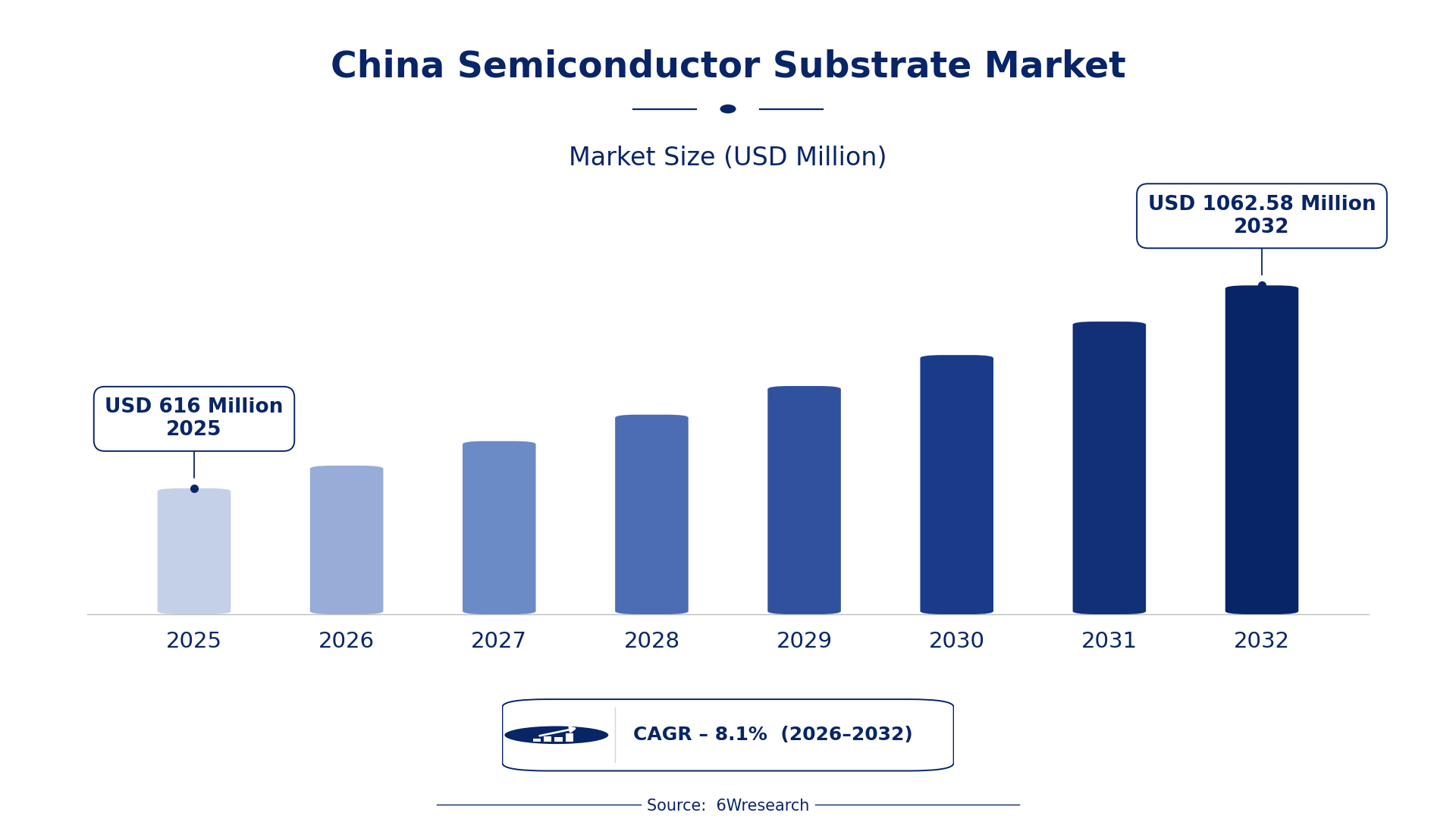
According to 6Wresearch internal database and industry insights, the China Semiconductor Substrate Market was valued at USD 616.0 million in 2025 and is projected to reach USD 1,062.58 million by 2032, growing at a CAGR of approximately 8.1% during 2026–2032.
China Semiconductor Substrate Market Highlights
| Report Metric | Details |
| Report Name | China Semiconductor Substrate Market |
| Market Size 2025 | USD 616.0 million |
| Market Size 2032 | USD 1,062.58 million |
| Absolute Growth 2025–2032 | USD 446.58 million |
| CAGR 2026–2032 | 8.1% |
| Peak Annual Growth | 10.6% in 2027 |
| Forecast Period | 2026–2032 |
| Historical Data | 2022–2025 |
| Base Year | 2025 |
| Leading Substrate Type, 2025 | Silicon Wafers (44% share) |
| Leading Material Used, 2025 | Monocrystalline (52% share) |
| Leading Technology Node, 2025 | ≤10 nm (40% share) |
| Leading End User, 2025 | Foundries & IDMs (40% share) |
| Fastest-Growing Substrate Type | SOI Wafers (9.5% CAGR) |
| Fastest-Growing Material Used | Silicon on Insulator (9.4% CAGR) |
| Fastest-Growing End User | Logic Chip Designers (10.7% CAGR) |
| Growing Sector | Consumer Electronics |
| Key End Users | Foundries & IDMs, Logic Chip Designers, RFIC Suppliers |
China Semiconductor Substrate Market Year-wise Growth Rate and Key Drivers (2022–2032)
This graph illustrates the annual growth rates of the market from 2022 to 2032, highlighting a steady upward trajectory and projected market expansion over the forecast period.
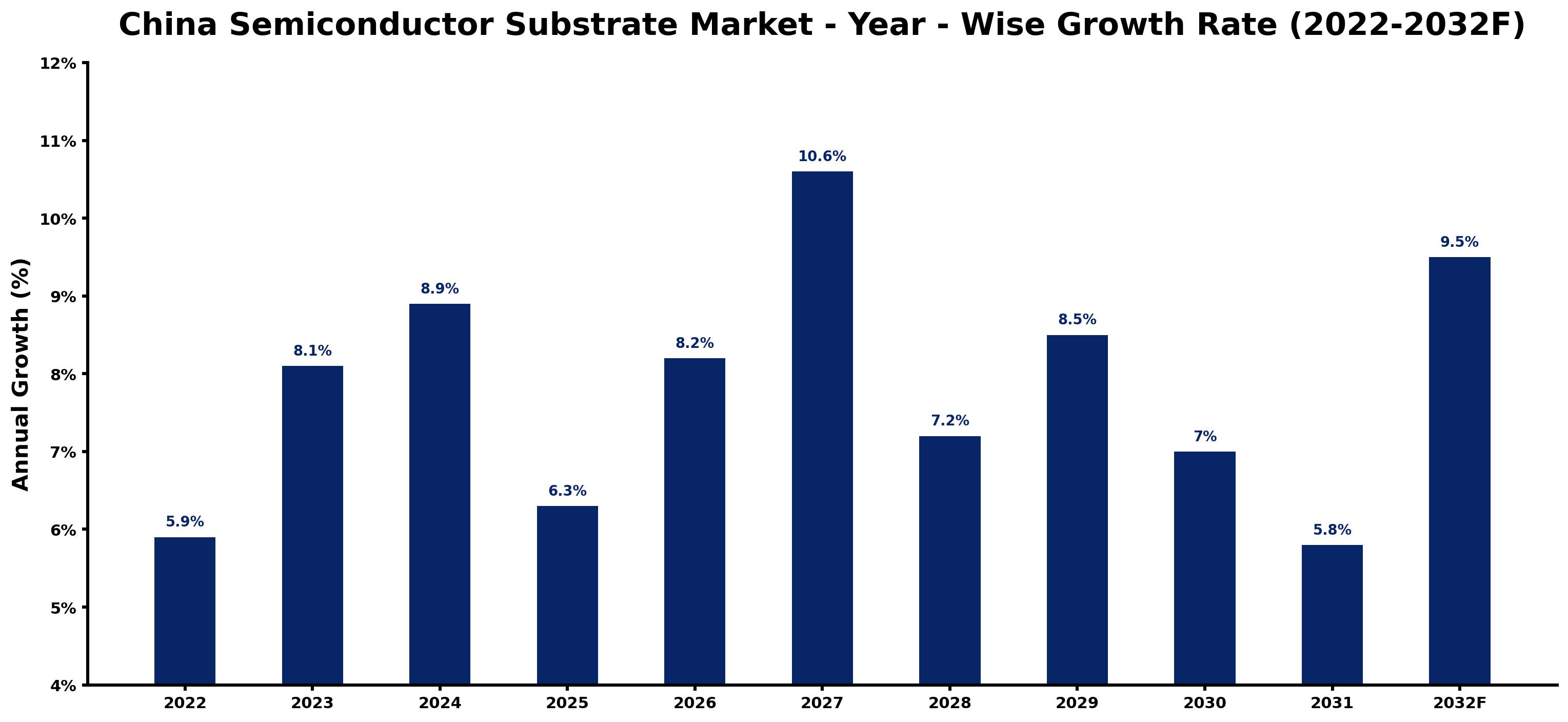
Each row of the following table gives one year's estimated growth and the event or demand shift that explains it.
| Year | Estimated Annual Growth (%) | Market Rationale |
| 2022 | 5.9 | The market experienced steady growth, supported by strong domestic production and consumption. |
| 2023 | 8.1 | Increased demand from consumer electronics and automotive sectors drove growth faster than the previous year. |
| 2024 | 8.9 | Continued investment in semiconductor manufacturing facilities led to growth faster than the previous year. |
| 2025 | 6.3 | A slowdown occurred as the market adjusted to previous rapid growth, yet it still expanded. |
| 2026 | 8.2 | Growth resumed as semiconductor manufacturers increased capacity to meet rising demand. |
| 2027 | 10.6 | The market peaked with significant investments in advanced technology nodes and production capabilities. |
| 2028 | 7.2 | A slight slowdown was observed as the market stabilised after the peak growth year. |
| 2029 | 8.5 | Demand surged again, driven by advancements in logic chip design and production. |
| 2030 | 7.0 | Growth slowed as manufacturers faced challenges in scaling production efficiently. |
| 2031 | 5.8 | The market continued to grow, albeit at a slower pace due to market saturation. |
| 2032 | 9.5 | A resurgence in demand is expected as the industry aims for higher self-sufficiency. |
Note: Market size estimations and growth projections presented in this report are based on 6Wresearch's proprietary forecasting methodology, utilizing the latest available industry data, government publications, and primary research inputs.
China Semiconductor Substrate Market Synopsis
The Semiconductor Substrate Market in China includes key components used in semiconductor devices, primarily crafted from silicon, gallium arsenide, or sapphire. These substrates are integral to the fabrication of integrated circuits and other electronic components. The market is expanding due to increasing demand from sectors like consumer electronics and telecommunications. Substantial investments in semiconductor manufacturing and the drive for technological progress are propelling this growth. The market was valued at approximately 20 billion USD in 2022, with forecasts suggesting continued expansion through 2032.
Market Dynamics Impact Analysis (2026–2032)
| Factor | Type | Impact | Primary Segment Affected |
| Increasing domestic production capacity | Driver | High | Silicon Wafers |
| Rising demand from consumer electronics | Driver | High | Foundries & IDMs |
| Growing investments in semiconductor manufacturing | Opportunity | High | SOI Wafers |
| Expansion of logic chip design capabilities | Opportunity | Medium | Logic Chip Designers |
| High competition among local manufacturers | Restraint | High | GaAs Substrates |
| Challenges in scaling production efficiently | Restraint | Medium | Sapphire Substrates |
| Cost pressures from raw material sourcing | Challenge | High | Silicon on Insulator |
| Regulatory hurdles in technology adoption | Challenge | Medium | ≤10 nm |
Evaluation of Drivers in China Semiconductor Substrate Market (2026–2032)
The table below links each growth driver to the segment it affects and the evidence for it.
| Drivers | Primary Segment Affected | Why It Matters (Evidence) |
| Strong domestic production of silicon wafers | Silicon Wafers | China accounts for over 50% of global silicon wafer supply, boosting local manufacturing capabilities. |
| Growing consumer electronics market | Foundries & IDMs | The consumer electronics sector's growth increases substrate demand for various applications. |
| Increased investment in advanced manufacturing technologies | SOI Wafers | The adoption of silicon on insulator technology is prevalent in over 70% of advanced fabs, improving production capabilities. |
| Rising logic chip design activities | Logic Chip Designers | The concentration of designers in the Beijing region increases substrate demand for innovative chip designs. |
| Government support for semiconductor innovation | ≤10 nm | The '14th Five-Year Plan' aims for a 30% increase in semiconductor production by 2025, fostering local development. |
Growth in the Semiconductor Substrate market in China comes from rising domestic production capacity, increasing demand from consumer electronics, and investments in advanced manufacturing technologies. The country produces over 50% of global silicon wafers, which boosts local manufacturing capabilities. Demand from the consumer electronics sector is increasing, driving higher substrate needs, particularly from foundries and IDMs. The adoption of silicon on insulator technology is prevalent in over 70% of advanced semiconductor fabs, further driving substrate demand. Additionally, the concentration of logic chip designers in the Beijing region supports this growth, as they require high-quality substrates for innovative chips.
Evaluation of Restraints in China Semiconductor Substrate Market
The following restraints limit how fast demand can grow.
| Market Restraint | Primary Segment Affected | Why It Matters (Evidence) |
| Intense competition among local manufacturers | GaAs Substrates | High competition pressures profit margins, affecting the viability of GaAs substrate producers. |
| Challenges in scaling production efficiently | Sapphire Substrates | Sapphire substrate manufacturers face difficulties in meeting market demand without compromising quality. |
| Cost pressures from raw material sourcing | Silicon on Insulator | Fluctuating raw material prices impact the production costs of silicon on insulator substrates. |
| Regulatory hurdles in technology adoption | ≤10 nm | Strict regulations on technology implementation can delay production timelines for advanced nodes. |
| Limited availability of skilled workforce | SOI Wafers | A shortage of skilled labour in semiconductor manufacturing hampers production efficiency. |
China Semiconductor Substrate Market Challenges
Buyers in the China Semiconductor Substrate Market are contending with rising costs due to a 15% increase in raw material prices this year, which strains budgets and limits procurement flexibility. The slow adoption of advanced manufacturing technologies affects over 40% of semiconductor fabs, delaying upgrades and extending project timelines by six months. Intense competition among local manufacturers leads to price wars, which reduce profit margins for suppliers and can compromise product quality. Supply chain inefficiencies in the Guangdong province create logistics bottlenecks, causing shipment delays that disrupt production schedules for about 30% of semiconductor fabs.
Trends in the China Semiconductor Substrate Market
Below mentioned are some of the trends shaping the China Semiconductor Substrate Market growth.
- Shift towards Advanced Technology Nodes: China is increasingly focusing on advanced technology nodes, particularly ≤10 nm, to improve semiconductor performance. The '14th Five-Year Plan' targets a 30% increase in domestic production by 2025, promoting innovation in substrate materials.
- Rise of Monocrystalline Substrates: Monocrystalline substrates are gaining prominence in semiconductor manufacturing, accounting for 52% of the market share. This trend is supported by their superior performance in high-performance applications.
- Growing Demand for SOI Wafers: The adoption of silicon on insulator technology is expanding rapidly, with a projected CAGR of 9.4% from 2026 to 2032. This trend is evident in over 70% of advanced semiconductor fabs across China.
- Increased Investment in GaAs Production: The Shanghai region has seen substantial investments in GaAs substrate production facilities, reflecting a growing need for specialized substrates in RF applications.
Investment Opportunities in the China Semiconductor Substrate Market
Several openings in the China Semiconductor Substrate Market merit attention from investors.
- Investment in Advanced Manufacturing: With a projected market size of 1,062 million USD by 2032, opportunities exist in advanced semiconductor substrate manufacturing. Foundries and IDMs are key buyers, and local partnerships can facilitate market entry.
- Growing Logic Chip Design Sector: The logic chip design sector is expanding, creating a need for high-quality substrates. The Beijing region's designers are looking for reliable suppliers to meet their demands.
- Rising Demand for SOI Technology: The increasing adoption of silicon on insulator technology presents an opportunity, with a projected CAGR of 9.4%. Suppliers can target advanced fabs to meet this demand.
- Focus on Self-Sufficiency in Semiconductor Production: China's aim for 70% self-sufficiency in semiconductor production by 2025 creates opportunities for local suppliers to fill gaps in the market.
Government Initiatives in the China Semiconductor Substrate Market
The 'Made in China 2025' initiative, launched in 2015, set ambitious targets for semiconductor production, aiming for 70% self-sufficiency by 2025. The 'National Semiconductor Innovation Fund', established in 2020, allocates 50 billion CNY to support R&D in semiconductor technologies. Additionally, the '14th Five-Year Plan for Integrated Circuit Industry', released in 2021, targets a 30% increase in domestic semiconductor production by 2025, enhancing local manufacturing capabilities.
The National Integrated Circuit Industry Investment Fund oversees various semiconductor initiatives, including the 'Action Plan for Promoting the Development of the Semiconductor Industry' launched in 2022. This plan focuses on strengthening domestic supply chains and provides funding for local firms. The fund, with a budget exceeding 100 billion CNY, supports projects aimed at boosting semiconductor production.
Future Insight of the China Semiconductor Substrate Market
The China Semiconductor Substrate Market is set to transform by 2032, driven by the '14th Five-Year Plan for Integrated Circuit Industry' that aims to boost local production. Investments from the National Integrated Circuit Industry Investment Fund, exceeding 100 billion CNY, will enhance infrastructure and support technological advancements. The widespread adoption of silicon on insulator technology in over 70% of advanced semiconductor fabs will improve efficiency and performance. Workforce development initiatives will empower over 1 million employees, fostering innovation and positioning the market for sustained growth.
Market Segmentation Analysis
The analysis below covers each segmentation, its leading category in 2025 and its fastest-growing category through 2032.
By Substrate Type – Silicon Wafers Dominated, SOI Wafers Expected to Grow Fastest
According to Shubham Padhi, Research Analyst at 6Wresearch, in 2025, Silicon Wafers led the substrate type split with a 44% share. Silicon wafers dominate the semiconductor substrate market due to their critical role in the fabrication of integrated circuits. Their extensive use in over 70% of advanced semiconductor fabs in China ensures a robust installed base that supports ongoing demand. SOI Wafers are set to record the highest CAGR in this split, 9.5% over 2026–2032. The growth of SOI wafers is propelled by their importance in high-performance electronic devices, which are increasingly in demand. As the market evolves, the need for SOI wafers will likely rise, further strengthening their position. Suppliers should focus on advancing SOI wafer technology to capture the expanding opportunities in the semiconductor substrate market.
By Material Used – Monocrystalline Dominated, Silicon on Insulator Expected to Grow Fastest
Monocrystalline held a 52% share of the China Semiconductor Substrate Market by material used in 2025. Monocrystalline materials are preferred for their superior performance in semiconductor substrates, making them essential for high-performance applications. Their exceptional properties allow them to maintain the largest market share in the industry. Silicon on Insulator is projected to grow fastest, at a CAGR of 9.4% during 2026–2032. The rapid uptake of Silicon on Insulator technology is driven by its effectiveness in reducing parasitic capacitance, which is crucial for modern circuit designs. As demand for efficient electronic devices increases, this segment is set for significant growth. Buyers should prioritise monocrystalline substrates to ensure optimal performance in their semiconductor applications.
By Technology Node – ≤10 nm Dominated and Is Expected to Record the Fastest Growth
≤10 nm took a 40% share of technology node in 2025, more than any other category. Substrates for technology nodes of ≤10 nm are vital for the latest semiconductor fabrication processes, reflecting the industry's emphasis on advanced technologies. The increasing complexity of semiconductor devices highlights the importance of this segment in the market. The same category is also set to grow fastest, at a CAGR of 9.7% during 2026–2032. The ≤10 nm technology node is experiencing rapid growth due to its necessity in advanced semiconductor applications that are essential for modern electronics. As the leading segment, its growth will likely widen the gap with other nodes. Suppliers must enhance their capabilities for ≤10 nm substrates to meet the rising demands of advanced semiconductor manufacturing.
By End User – Foundries & IDMs Dominated, Logic Chip Designers Expected to Grow Fastest
The largest end user category in 2025 was Foundries & IDMs, with a 40% share of total revenue. Foundries and IDMs are the primary consumers of semiconductor substrates, accounting for a substantial share of the market. Their large-scale production operations and high-volume requirements reinforce their status as the leading end user group. The quickest growth will come from Logic Chip Designers, forecast to expand at a CAGR of 10.7% between 2026 and 2032. Logic chip designers are driving the fastest growth in the semiconductor substrate market, as their dependence on advanced substrates for innovative products increases. This trend indicates a shift in demand towards more specialised substrate types. Suppliers should tailor their offerings to meet the specific needs of logic chip designers to capitalise on emerging market opportunities.
Key Attractiveness of the Report
- 10 Years of Market Numbers
- Historical Data Starting from 2022 to 2025
- Base Year 2025
- Forecast Data until 2032
- Key Performance Indicators Impacting the Market
- Major Upcoming Developments and Projects
Key Highlights of the Report:
- China Semiconductor Substrate Market Outlook
- Market Size of China Semiconductor Substrate Market, 2025
- Forecast of China Semiconductor Substrate Market, 2032
- Historical Data and Forecast of China Semiconductor Substrate Revenues & Volume for the Period 2022 - 2032F
- China Semiconductor Substrate Market Trend Evolution
- China Semiconductor Substrate Market Drivers and Challenges
- China Semiconductor Substrate Price Trends
- China Semiconductor Substrate Porter's Five Forces
- China Semiconductor Substrate Industry Life Cycle
- Historical Data and Forecast of China Semiconductor Substrate Market Revenues & Volume By Substrate Type for the Period 2022 - 2032F
- Historical Data and Forecast of China Semiconductor Substrate Market Revenues & Volume By Silicon Wafers for the Period 2022 - 2032F
- Historical Data and Forecast of China Semiconductor Substrate Market Revenues & Volume By SOI Wafers for the Period 2022 - 2032F
- Historical Data and Forecast of China Semiconductor Substrate Market Revenues & Volume By Sapphire Substrates for the Period 2022 - 2032F
- Historical Data and Forecast of China Semiconductor Substrate Market Revenues & Volume By GaAs Substrates for the Period 2022 - 2032F
- Historical Data and Forecast of China Semiconductor Substrate Market Revenues & Volume By Material Used for the Period 2022 - 2032F
- Historical Data and Forecast of China Semiconductor Substrate Market Revenues & Volume By Monocrystalline for the Period 2022 - 2032F
- Historical Data and Forecast of China Semiconductor Substrate Market Revenues & Volume By Silicon on Insulator for the Period 2022 - 2032F
- Historical Data and Forecast of China Semiconductor Substrate Market Revenues & Volume By Al O for the Period 2022 - 2032F
- Historical Data and Forecast of China Semiconductor Substrate Market Revenues & Volume By Gallium Arsenide for the Period 2022 - 2032F
- Historical Data and Forecast of China Semiconductor Substrate Market Revenues & Volume By Technology Node for the Period 2022 - 2032F
- Historical Data and Forecast of China Semiconductor Substrate Market Revenues & Volume By 10 nm for the Period 2022 - 2032F
- Historical Data and Forecast of China Semiconductor Substrate Market Revenues & Volume By 7 28 nm for the Period 2022 - 2032F
- Historical Data and Forecast of China Semiconductor Substrate Market Revenues & Volume By Optoelectronics for the Period 2022 - 2032F
- Historical Data and Forecast of China Semiconductor Substrate Market Revenues & Volume By RF/High Frequency for the Period 2022 - 2032F
- Historical Data and Forecast of China Semiconductor Substrate Market Revenues & Volume By End User for the Period 2022 - 2032F
- Historical Data and Forecast of China Semiconductor Substrate Market Revenues & Volume By Foundries & IDMs for the Period 2022 - 2032F
- Historical Data and Forecast of China Semiconductor Substrate Market Revenues & Volume By Logic Chip Designers for the Period 2022 - 2032F
- Historical Data and Forecast of China Semiconductor Substrate Market Revenues & Volume By LED Manufacturers for the Period 2022 - 2032F
- Historical Data and Forecast of China Semiconductor Substrate Market Revenues & Volume By RFIC Suppliers for the Period 2022 - 2032F
- China Semiconductor Substrate Import Export Trade Statistics
- Market Opportunity Assessment By Substrate Type
- Market Opportunity Assessment By Material Used
- Market Opportunity Assessment By Technology Node
- Market Opportunity Assessment By End User
- China Semiconductor Substrate Top Companies Market Share
- China Semiconductor Substrate Competitive Benchmarking By Technical and Operational Parameters
- China Semiconductor Substrate Company Profiles
- China Semiconductor Substrate Key Strategic Recommendations
Market Covered
This report examines the market across the segments below.
By Substrate Type
- Silicon Wafers
- SOI Wafers
- Sapphire Substrates
- GaAs Substrates
By Material Used
- Monocrystalline
- Silicon on Insulator
- Al₂O₃
- Gallium Arsenide
By Technology Node
- ≤10 nm
- 7–28 nm
- Optoelectronics
- RF/High Frequency
By End User
- Foundries & IDMs
- Logic Chip Designers
- LED Manufacturers
- RFIC Suppliers































