China Smart Device Sensor Market Size & Growth Rate
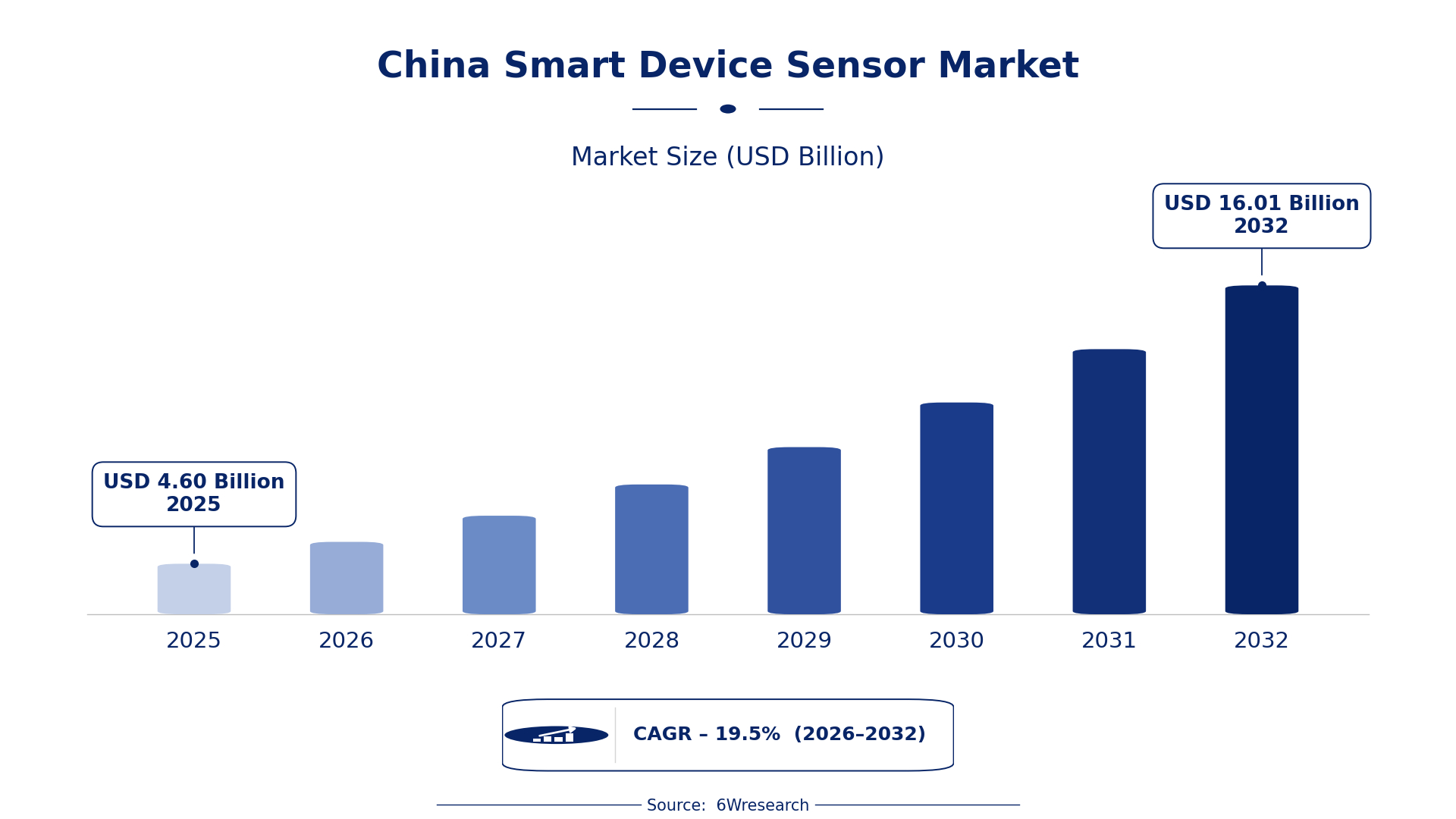
According to 6Wresearch internal database and industry insights, the China Smart Device Sensor Market was valued at USD 4.60 billion in 2025 and is projected to reach USD 16.01 billion by 2032, growing at a CAGR of approximately 19.5% during 2026–2032.
China Smart Device Sensor Market Highlights
| Report Metric | Details |
| Report Name | China Smart Device Sensor Market |
| Market Size 2025 | USD 4.60 billion |
| Market Size 2032 | USD 16.01 billion |
| Absolute Growth 2025–2032 | USD 11.41 billion |
| CAGR 2026–2032 | 19.5% |
| Peak Annual Growth | 21.9% in 2029 |
| Forecast Period | 2026–2032 |
| Historical Data | 2022–2025 |
| Base Year | 2025 |
| Leading Sensor Type, 2025 | Accelerometers (44% share) |
| Leading Function, 2025 | Motion Detection (46% share) |
| Leading Device Application, 2025 | Phones (41% share) |
| Leading End User, 2025 | Wearables & Gadget Brands (52% share) |
| Fastest-Growing Sensor Type | Temperature Sensors (21.3% CAGR) |
| Fastest-Growing Function | Thermal Feedback (21.9% CAGR) |
| Fastest-Growing Device Application | Watches (21.9% CAGR) |
| Fastest-Growing End User | Home Automation Firms (20.7% CAGR) |
| Growing Sector | Wearable Technology |
| Key End Users | Consumer Electronics, Health Tech Innovators, Home Automation Firms |
China Smart Device Sensor Market Year-wise Growth Rate and Key Drivers (2022–2032)
This graph illustrates the annual growth rates of the market from 2022 to 2032, highlighting a steady upward trajectory and projected market expansion over the forecast period.
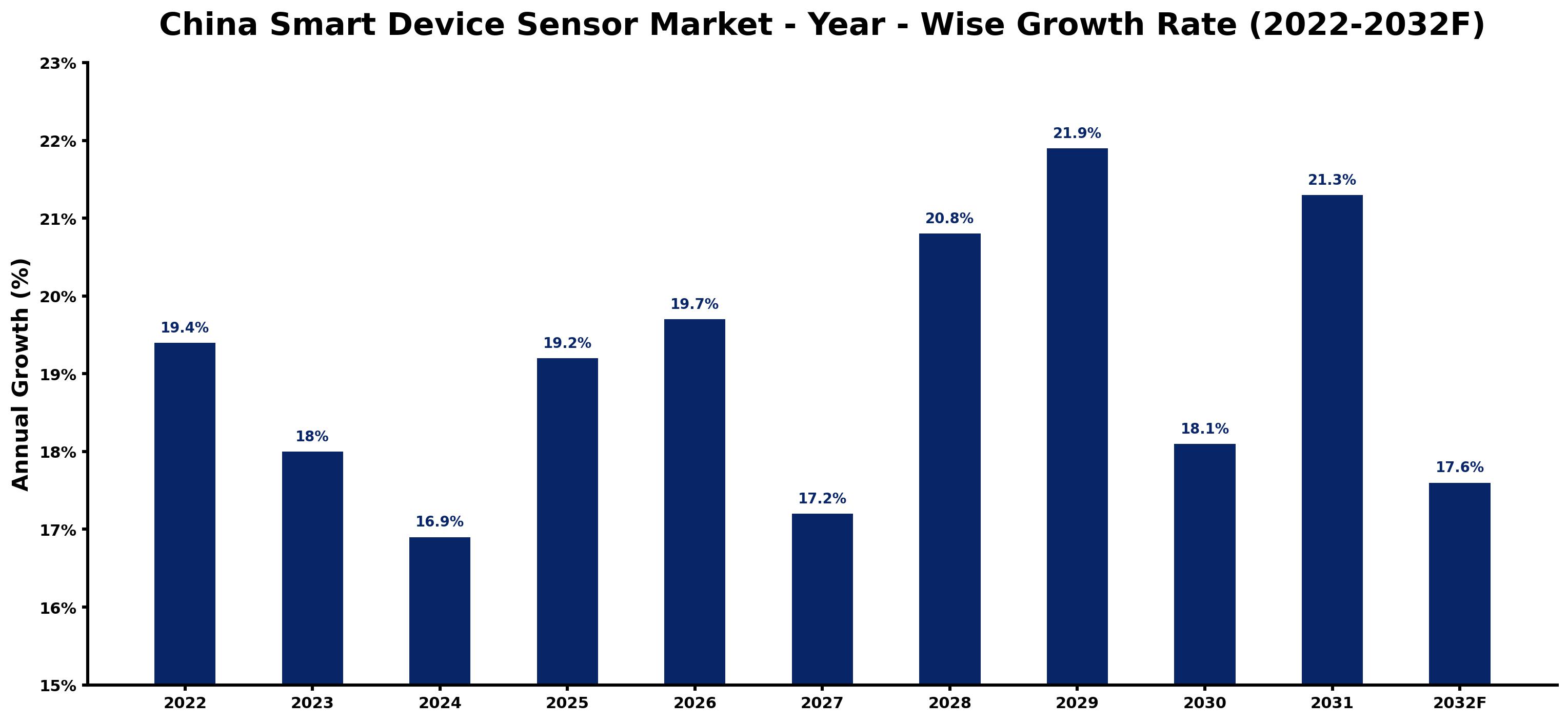
Year by year, the estimates below pair each growth rate with the development that shaped it.
| Year | Estimated Annual Growth (%) | Market Rationale |
| 2022 | 19.4 | The market experienced strong growth due to rising smartphone sales and consumer electronics demand. |
| 2023 | 18.0 | Growth slowed as the market adjusted to increased competition and supply chain challenges. |
| 2024 | 16.9 | The market continued to grow, albeit at a slower rate, as consumer preferences shifted towards advanced sensor technologies. |
| 2025 | 19.2 | Demand accelerated again with the introduction of new smart home devices and health monitoring applications. |
| 2026 | 19.7 | Growth is expected to remain strong as the health tech sector increases investments in sensor technologies. |
| 2027 | 17.2 | The market will see a slowdown as the focus shifts to integrating sensors into existing devices. |
| 2028 | 20.8 | Growth is projected to pick up due to heightened interest in smart home automation and energy management solutions. |
| 2029 | 21.9 | The market will peak as consumer electronics adoption surges, particularly in wearables and smart devices. |
| 2030 | 18.1 | Growth is expected to slow slightly as the market begins to stabilise after rapid expansion in previous years. |
| 2031 | 21.3 | Demand will increase again with the rise of new smart device applications and innovations. |
| 2032 | 17.6 | The market growth rate is projected to normalise as consumer preferences mature and technology becomes standard. |
Note: Market size estimations and growth projections presented in this report are based on 6Wresearch's proprietary forecasting methodology, utilizing the latest available industry data, government publications, and primary research inputs.
China Smart Device Sensor Market Synopsis
The China Smart Device Sensor Market includes electronic components that detect physical stimuli, enabling automation and improving user interaction in devices such as smartphones and wearables. The market is expanding due to increasing consumer electronics demand, with over 500 million smartphones sold in 2023 and an anticipated annual growth of 10% in the sector. The 'Smart Manufacturing 2025' initiative is propelling technological advancements, further driving demand. Key buyer groups comprise health tech innovators and home automation companies, presenting numerous opportunities for suppliers.
Market Dynamics Impact Analysis (2026–2032)
| Factor | Type | Impact | Primary Segment Affected |
| Rising smartphone sales are driving demand for smart device sensors, particularly in motion detection applications. | Driver | High | Motion Detection |
| Increasing adoption of wearables is creating a significant demand for bio-sensors and health monitoring technologies. | Driver | High | Bio-sensors |
| The growing smart home sector presents opportunities for suppliers of smart device sensors, particularly in automation. | Opportunity | High | Home Automation Firms |
| The expansion of health tech investments creates a demand for advanced sensor technologies in medical devices. | Opportunity | High | Health Tech Innovators |
| Supply chain disruptions have affected the availability of key components for smart device sensors. | Restraint | High | Accelerometers |
| Regulatory compliance can be a barrier for new entrants in the smart device sensor market. | Restraint | Medium | Accelerometers |
| Market competition is intensifying, making it challenging for new players to establish a foothold. | Challenge | High | Accelerometers |
| Technological advancements require continuous investment, which can strain smaller manufacturers. | Challenge | Medium | Accelerometers |
Evaluation of Drivers in China Smart Device Sensor Market (2026–2032)
The table below links each growth driver to the segment it affects and the evidence for it.
| Drivers | Primary Segment Affected | Why It Matters (Evidence) |
| Increasing smartphone penetration drives demand for motion detection sensors, with over 500 million units sold in 2023. | Motion Detection | Smartphones require advanced sensors for improved user interaction and functionality. |
| The rise in wearable technology adoption, reaching 30% in urban areas, boosts demand for bio-sensors in health monitoring. | Bio-sensors | Wearables rely on sensors to track health metrics, increasing their market presence. |
| Growing consumer interest in smart home devices, with an average annual growth rate of 15%, fuels sensor demand. | Home Automation Firms | Smart home devices integrate sensors for automation, improving user convenience. |
| The health tech sector's investment of over 5 billion USD in sensor technologies supports market expansion. | Health Tech Innovators | Investment in health tech drives the need for advanced sensor solutions in medical devices. |
| The national standard GB/T 25000.51-2019 promotes sensor performance, encouraging manufacturers to innovate. | Accelerometers | Compliance with standards drives quality improvements and market competitiveness. |
Growth in the Smart Device Sensor market in China comes from increasing smartphone penetration, with over 500 million units sold in 2023. The rise in wearable technology adoption, reaching 30% in urban areas, boosts demand for bio-sensors critical for health monitoring. Consumer interest in smart home devices, growing at an average annual rate of 15%, fuels sensor demand as automation becomes more prevalent. The health tech sector's investment of over 5 billion USD in sensor technologies supports market expansion. The national standard GB/T 25000.51-2019 promotes sensor performance, encouraging manufacturers to innovate and improve their offerings.
Evaluation of Restraints in China Smart Device Sensor Market
The key brakes on demand, and where they bite hardest, are shown below.
| Market Restraint | Primary Segment Affected | Why It Matters (Evidence) |
| Supply chain disruptions have led to delays in sensor production, affecting availability. | Accelerometers | Manufacturers face challenges in sourcing materials, impacting their ability to meet demand. |
| Regulatory compliance requirements can be burdensome for new entrants in the market. | Accelerometers | Navigating regulations can slow down the time to market for new products. |
| High competition among established players limits market share for newcomers. | Accelerometers | Intense competition makes it difficult for new companies to gain traction. |
| Technological advancements require substantial investment, which can be a barrier for smaller firms. | Accelerometers | Smaller manufacturers may struggle to keep up with rapid technology changes. |
| Market volatility can impact investment decisions and long-term planning for manufacturers. | Accelerometers | Fluctuations in demand can create uncertainty in production and investment. |
China Smart Device Sensor Market Challenges
The China Smart Device Sensor market still has to solve a few problems, starting with fierce competition among producers. This competition stems from the booming consumer electronics sector, leading to price wars that can reduce profit margins for suppliers. A lack of skilled professionals in sensor technology limits production efficiency, causing delays in product development for manufacturers. Rapid technological advancements create challenges for many firms, as they struggle to keep pace and miss out on innovation opportunities. Supply chain disruptions can arise from reliance on specific regions like Shenzhen, delaying deliveries and raising costs for buyers.
Trends in the China Smart Device Sensor Market
Several trends are reshaping the China Smart Device Sensor Market; the most important are set out below.
- Shift towards Advanced Motion Detection: The demand for advanced motion detection sensors is rising, particularly in smartphones and wearables. In 2023, over 500 million smartphones were sold in China, driving this trend and creating opportunities for suppliers.
- Rise of Health Monitoring Wearables: Wearable technology is evolving rapidly, with 200 million active fitness trackers reported in 2022. This growth pushes manufacturers to develop more sophisticated bio-sensors, enhancing health monitoring capabilities.
- Expansion of Smart Home Automation: Smart home automation is gaining popularity, with the average household in urban China owning 3 smart devices as of 2023. This trend prompts home automation firms to integrate more sensors into their products.
- Introduction of National Standards: The introduction of the national standard GB/T 25000.51-2019 is influencing the smart device sensor market. This standard ensures improved performance and reliability, motivating manufacturers to enhance their product offerings.
Investment Opportunities in the China Smart Device Sensor Market
The following opportunities in the China Smart Device Sensor Market pair current demand with a clear way in.
- Supply of Advanced Bio-sensors: The health tech sector is projected to reach 1 trillion RMB by 2025, creating a demand for advanced bio-sensors. Health tech innovators are looking for suppliers who can provide innovative sensor technologies.
- Integration of Sensors in Smart Home Devices: With the average annual growth rate for smart home devices at 15%, there is a gap for suppliers of smart device sensors. Home automation firms are actively seeking partnerships to improve their product lines.
- Development of Smart Thermostats: The smart thermostat market is expected to grow by 20% by 2025, indicating a need for innovative temperature sensors. Manufacturers should consider collaborating with home automation firms to enter this market.
- Investment in Motion Detection Technologies: The increasing smartphone sales create opportunities for suppliers of motion detection sensors. Collaborating with smartphone manufacturers in Shenzhen can facilitate market entry.
Government Initiatives in the China Smart Device Sensor Market
The 'Smart Manufacturing 2025' initiative, launched in 2022, aims to improve sensor technology and manufacturing capabilities in China. This initiative builds on previous strategies by promoting innovation and investment in smart device sensors. It encourages manufacturers to adopt advanced technologies and improve production efficiency, ultimately benefiting the market. The national standard GB/T 25000.51-2019, established in 2019, governs sensor performance, ensuring quality and safety in production.
The Ministry of Industry and Information Technology oversees the implementation of sensor regulations and standards. This agency ensures compliance with the national standard GB/T 25000.51-2019, which governs sensor performance. Manufacturers must adhere to these standards to ensure product quality and safety, impacting their market competitiveness. The National Development and Reform Commission also supports initiatives that promote innovation in sensor technology, funding projects that enhance production capabilities.
Future Insight of the China Smart Device Sensor Market
By 2032, transformative changes will reshape the China Smart Device Sensor market, driven by several key initiatives. The 'Smart Manufacturing 2025' initiative will enhance production capabilities, while the health tech sector's growth to 1 trillion RMB will create new opportunities for sensor applications. The smart home device market is expected to grow at an annual rate of 15%, increasing demand for advanced sensor technologies. The 'Internet Plus' strategy will facilitate the integration of IoT technologies across various sectors, broadening innovation prospects.
Market Segmentation Analysis
The report offers a comprehensive study of the following market segments and their leading categories in the market.
By Sensor Type – Accelerometers Dominated, Temperature Sensors Expected to Grow Fastest
According to Dhaval Chaurasia, Assistant Manager at 6Wresearch, Accelerometers took a 44% share of sensor type in 2025, more than any other category. Accelerometers dominate the market share as they are crucial for motion detection in devices, significantly enhancing user interaction. Their relevance is highlighted by the extensive use in smartphones, which sold over 500 million units in 2023. The quickest growth will come from Temperature Sensors, forecast to expand at a CAGR of 21.3% between 2026 and 2032. Temperature Sensors are rapidly gaining traction due to the surging demand for effective thermal management in smart devices. The anticipated 20% growth in the smart thermostat market by 2025 showcases the increasing necessity for these sensors. Suppliers should focus on advancing temperature sensor technologies to meet the growing demands of smart device manufacturers.
By Function – Motion Detection Dominated, Thermal Feedback Expected to Grow Fastest
With a 46% revenue share in 2025, Motion Detection was the largest function category. Motion Detection leads the market as it is essential for improving user experience in smart devices through features like navigation and gaming. The high sales volume of smartphones, exceeding 500 million in 2023, reinforces the critical role of this function. Over 2026–2032, Thermal Feedback is expected to post the fastest growth, at a CAGR of 21.9%. Thermal Feedback is the fastest-growing function, vital for ensuring device performance and safety. The projected annual growth rate of 15% for smart home devices indicates a rising demand for effective thermal management solutions. Manufacturers should prioritise the development of thermal feedback technologies to enhance device performance and safety.
By Device Application – Phones Dominated, Watches Expected to Grow Fastest
Phones accounted for a 41% market share by device application in 2025. Phones account for the largest application of smart device sensors, playing a pivotal role in sensor integration within consumer electronics. The sale of over 500 million smartphones in 2023 solidifies this segment's importance for sensor manufacturers. Watches are set to record the highest CAGR in this split, 21.9% over 2026–2032. Watches are witnessing the fastest growth as they increasingly incorporate smart device sensors for various functions. The sale of over 100 million smartwatches in 2023 reflects the growing consumer interest in wearable technology. Suppliers should invest in sensor technologies tailored for watches to capitalise on the expanding wearable market.
By End User – Wearables & Gadget Brands Dominated, Home Automation Firms Expected to Grow Fastest
The largest end user category in 2025 was Wearables & Gadget Brands, with a 52% share of total revenue. Wearables & Gadget Brands are the primary consumers of smart device sensors, utilising them to enhance product functionality and user experience. The presence of 200 million active fitness trackers in China illustrates the substantial demand from this segment. Home Automation Firms are projected to grow fastest, at a CAGR of 20.7% during 2026–2032. Home Automation Firms are the fastest-growing end users, incorporating sensors to create smarter living environments. The 'Internet Plus' strategy aims to integrate IoT technologies, further driving the demand for smart device sensors in home automation. Suppliers should target home automation firms to expand their market share in the rapidly growing smart home sector.
Key Attractiveness of the Report
- 10 Years of Market Numbers
- Historical Data Starting from 2022 to 2025
- Base Year 2025
- Forecast Data until 2032
- Key Performance Indicators Impacting the Market
- Major Upcoming Developments and Projects
Key Highlights of the Report:
- China Smart Device Sensor Market Outlook
- Market Size of China Smart Device Sensor Market, 2025
- Forecast of China Smart Device Sensor Market, 2032
- Historical Data and Forecast of China Smart Device Sensor Revenues & Volume for the Period 2022 - 2032F
- China Smart Device Sensor Market Trend Evolution
- China Smart Device Sensor Market Drivers and Challenges
- China Smart Device Sensor Price Trends
- China Smart Device Sensor Porter's Five Forces
- China Smart Device Sensor Industry Life Cycle
- Historical Data and Forecast of China Smart Device Sensor Market Revenues & Volume By Sensor Type for the Period 2022 - 2032F
- Historical Data and Forecast of China Smart Device Sensor Market Revenues & Volume By Accelerometers for the Period 2022 - 2032F
- Historical Data and Forecast of China Smart Device Sensor Market Revenues & Volume By Temperature Sensors for the Period 2022 - 2032F
- Historical Data and Forecast of China Smart Device Sensor Market Revenues & Volume By Proximity Sensors for the Period 2022 - 2032F
- Historical Data and Forecast of China Smart Device Sensor Market Revenues & Volume By Bio-sensors for the Period 2022 - 2032F
- Historical Data and Forecast of China Smart Device Sensor Market Revenues & Volume By Function for the Period 2022 - 2032F
- Historical Data and Forecast of China Smart Device Sensor Market Revenues & Volume By Motion Detection for the Period 2022 - 2032F
- Historical Data and Forecast of China Smart Device Sensor Market Revenues & Volume By Thermal Feedback for the Period 2022 - 2032F
- Historical Data and Forecast of China Smart Device Sensor Market Revenues & Volume By Auto Sleep/Wake for the Period 2022 - 2032F
- Historical Data and Forecast of China Smart Device Sensor Market Revenues & Volume By Heart Rate/SpO for the Period 2022 - 2032F
- Historical Data and Forecast of China Smart Device Sensor Market Revenues & Volume By Device Application for the Period 2022 - 2032F
- Historical Data and Forecast of China Smart Device Sensor Market Revenues & Volume By Phones, Watches for the Period 2022 - 2032F
- Historical Data and Forecast of China Smart Device Sensor Market Revenues & Volume By Smart Thermostats for the Period 2022 - 2032F
- Historical Data and Forecast of China Smart Device Sensor Market Revenues & Volume By Smartphones, Tablets for the Period 2022 - 2032F
- Historical Data and Forecast of China Smart Device Sensor Market Revenues & Volume By Fitness Bands for the Period 2022 - 2032F
- Historical Data and Forecast of China Smart Device Sensor Market Revenues & Volume By End User for the Period 2022 - 2032F
- Historical Data and Forecast of China Smart Device Sensor Market Revenues & Volume By Wearables & Gadget Brands for the Period 2022 - 2032F
- Historical Data and Forecast of China Smart Device Sensor Market Revenues & Volume By Home Automation Firms for the Period 2022 - 2032F
- Historical Data and Forecast of China Smart Device Sensor Market Revenues & Volume By Consumer Electronics for the Period 2022 - 2032F
- Historical Data and Forecast of China Smart Device Sensor Market Revenues & Volume By Health Tech Innovators for the Period 2022 - 2032F
- China Smart Device Sensor Import Export Trade Statistics
- Market Opportunity Assessment By Sensor Type
- Market Opportunity Assessment By Function
- Market Opportunity Assessment By Device Application
- Market Opportunity Assessment By End User
- China Smart Device Sensor Top Companies Market Share
- China Smart Device Sensor Competitive Benchmarking By Technical and Operational Parameters
- China Smart Device Sensor Company Profiles
- China Smart Device Sensor Key Strategic Recommendations
Market Covered
This report examines the market across the segments below.
By Sensor Type
- Accelerometers
- Temperature Sensors
- Proximity Sensors
- Bio-sensors
By Function
- Motion Detection
- Thermal Feedback
- Auto Sleep/Wake
- Heart Rate/SpO₂
By Device Application
- Phones
- Watches
- Smart Thermostats
- Smartphones
- Tablets
- Fitness Bands
By End User
- Wearables & Gadget Brands
- Home Automation Firms
- Consumer Electronics
- Health Tech Innovators































