China Smart Fire Suppression Market Size & Growth Rate
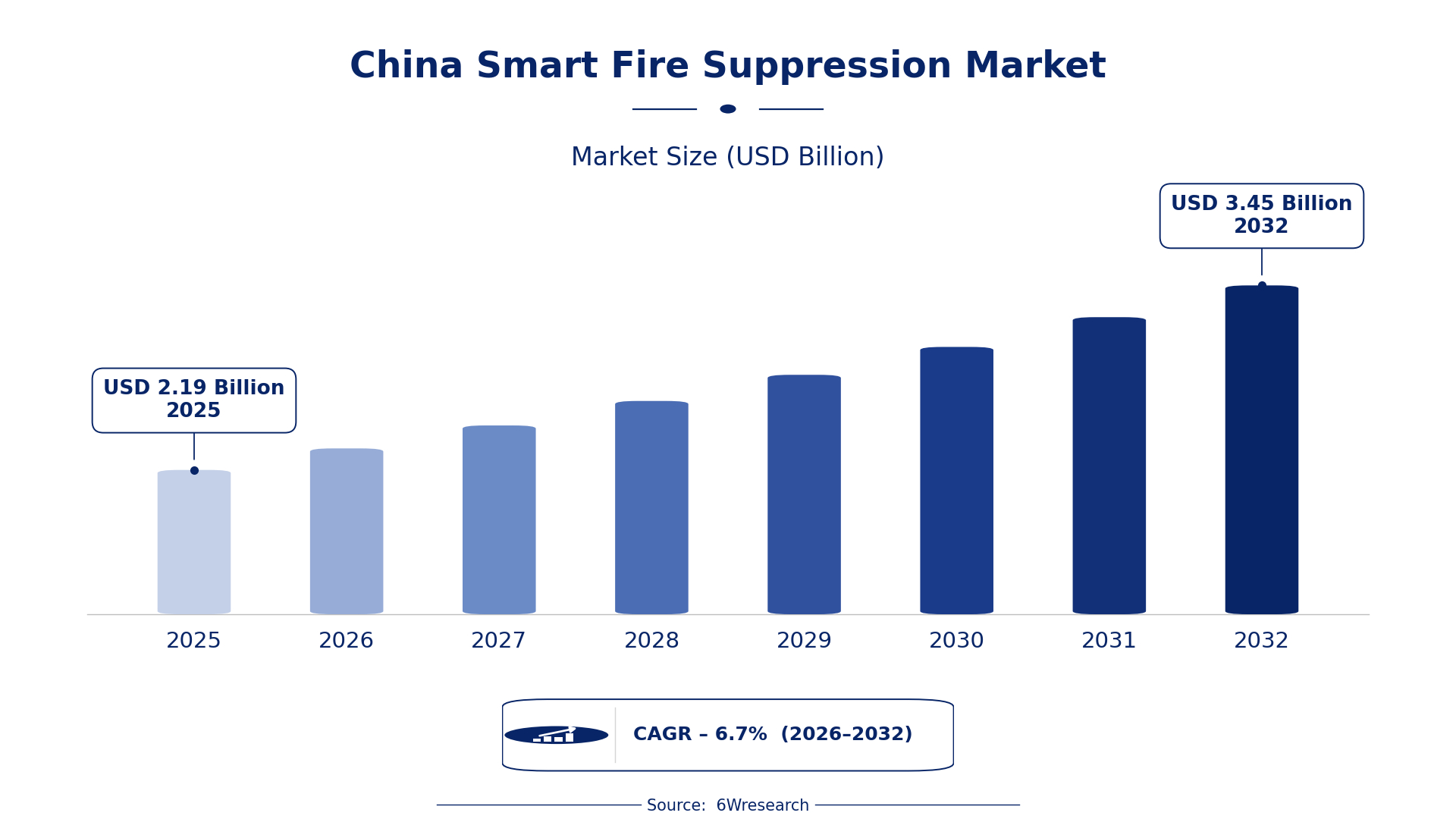
According to 6Wresearch internal database and industry insights, the China Smart Fire Suppression Market was valued at USD 2.19 billion in 2025 and is projected to reach USD 3.45 billion by 2032, growing at a CAGR of approximately 6.7% during 2026–2032.
China Smart Fire Suppression Market Highlights
| Report Metric | Details |
| Report Name | China Smart Fire Suppression Market |
| Market Size 2025 | USD 2.19 billion |
| Market Size 2032 | USD 3.45 billion |
| Absolute Growth 2025–2032 | USD 1.26 billion |
| CAGR 2026–2032 | 6.7% |
| Peak Annual Growth | 8.4% in 2028 |
| Forecast Period | 2026–2032 |
| Historical Data | 2022–2025 |
| Base Year | 2025 |
| Leading Suppression System, 2025 | IoT-Based Sprinkler Systems (43% share) |
| Leading Smart Trigger Mechanism, 2025 | Temp + Smoke Detection (35% share) |
| Leading Application Site, 2025 | Factories (42% share) |
| Leading End User, 2025 | Industrial Facility Owners (35% share) |
| Fastest-Growing Suppression System | AI Fire Extinguishers (8.0% CAGR) |
| Fastest-Growing Smart Trigger Mechanism | Fire Type Adaptivity (9.3% CAGR) |
| Fastest-Growing Application Site | Data Centers (8.9% CAGR) |
| Fastest-Growing End User | Fire Safety Integrators (9.3% CAGR) |
| Growing Sector | Industrial Facilities |
| Key End Users | Industrial Facility Owners, Fire Safety Integrators, Hospitality Chains, Public Infrastructure Bodies |
China Smart Fire Suppression Market Year-wise Growth Rate and Key Drivers (2022–2032)
This graph illustrates the annual growth rates of the market from 2022 to 2032, highlighting a steady upward trajectory and projected market expansion over the forecast period.
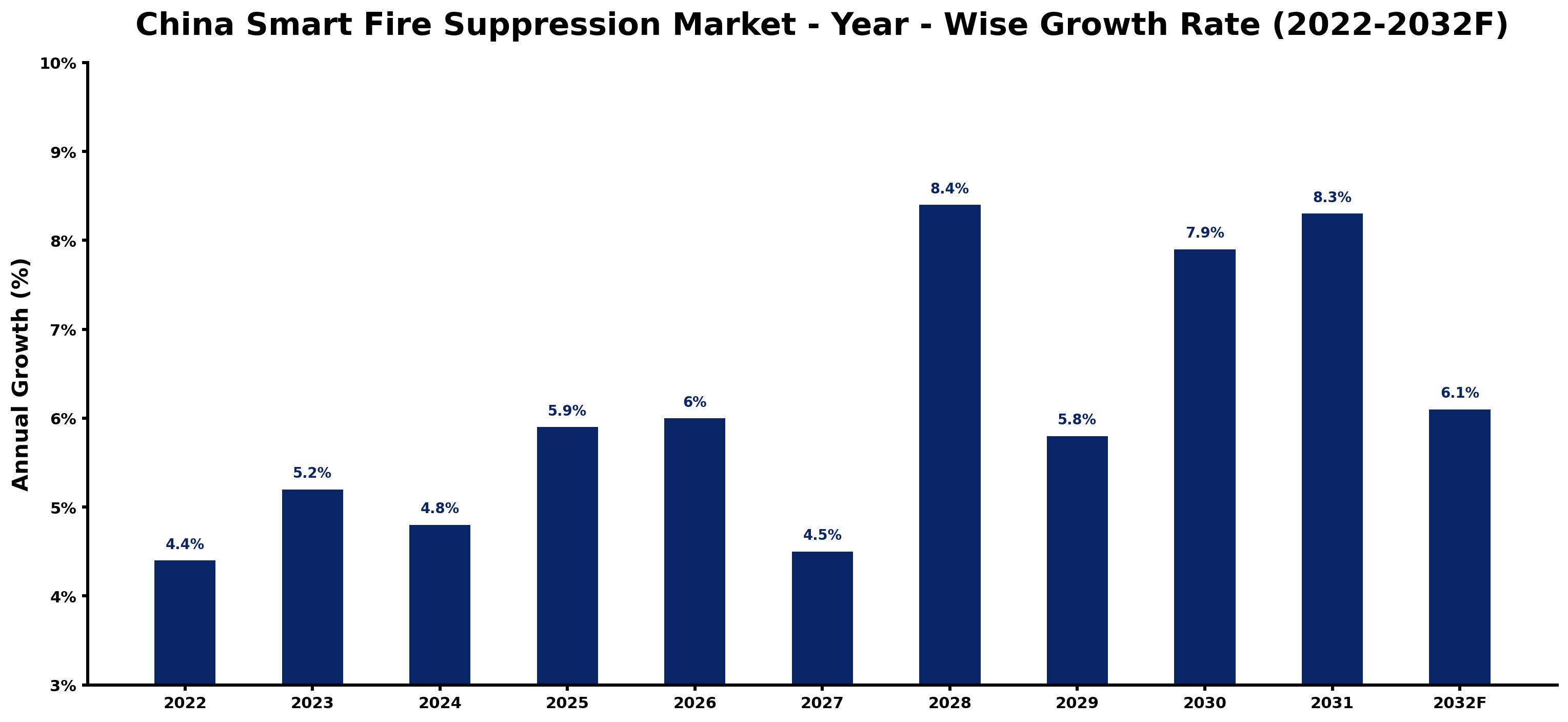
Annual growth estimates for each year appear below with the principal reason behind them, explaining the shifts that set the pace of the market.
| Year | Estimated Annual Growth (%) | Market Rationale |
| 2022 | 4.4 | The market experienced steady growth due to increased urbanisation and industrial activities. |
| 2023 | 5.2 | Demand rose as the Ministry of Emergency Management launched the Smart Fire Safety Initiative. |
| 2024 | 4.8 | Growth slowed slightly as the market adjusted to the updated National Standard for Fire Safety in Buildings. |
| 2025 | 5.9 | The market saw a boost from the updated National Standard for Fire Safety in Buildings. |
| 2026 | 6.0 | Demand is expected to increase with the ongoing integration of smart technologies in fire safety. |
| 2027 | 4.5 | Growth is projected to slow as the market faces challenges in technology adoption. |
| 2028 | 8.4 | The market is expected to peak due to heightened awareness of fire safety in urban areas. |
| 2029 | 5.8 | Growth is projected to slow as competition intensifies among suppliers of smart systems. |
| 2030 | 7.9 | Demand is expected to rise again as data centres increasingly adopt AI fire extinguishers. |
| 2031 | 8.3 | Growth will continue with the implementation of stricter regulations in industrial sectors. |
| 2032 | 6.1 | The market is projected to experience a slowdown due to the ongoing integration of smart solutions. |
Note: Market size estimations and growth projections presented in this report are based on 6Wresearch's proprietary forecasting methodology, utilizing the latest available industry data, government publications, and primary research inputs.
China Smart Fire Suppression Market Synopsis
Smart Fire Suppression in China encompasses advanced systems that utilise IoT and AI for fire safety. These systems integrate sensors and automated responses for early detection and suppression. The China Smart Fire Suppression Market is expanding due to urbanisation, ongoing industrial activities, and stricter safety regulations. The Smart Fire Safety Initiative launched in 2023 promotes the adoption of advanced technologies across various sectors, driving demand significantly. Industrial Facility Owners and Fire Safety Integrators are key buyer groups, reflecting the increasing focus on safety compliance.
Market Dynamics Impact Analysis (2026–2032)
| Factor | Type | Impact | Primary Segment Affected |
| Increased urbanisation drives demand for advanced fire safety solutions in commercial properties. | Driver | High | IoT-Based Sprinkler Systems |
| Growing industrial activities necessitate robust fire suppression systems in factories. | Driver | High | Factories |
| The need for enhanced safety measures in commercial kitchens creates opportunities for suppliers. | Opportunity | High | Commercial Kitchens |
| The rising demand for smart fire solutions in hospitals presents a lucrative market for integrators. | Opportunity | High | Hospitals |
| High installation costs of smart systems can deter smaller businesses from investing. | Restraint | Medium | IoT-Based Sprinkler Systems |
| Regulatory compliance can be challenging for new entrants in the market. | Restraint | Medium | IoT-Based Sprinkler Systems |
| Buyers face delays in obtaining approvals for new technologies in fire safety systems. | Challenge | High | IoT-Based Sprinkler Systems |
| Suppliers struggle with the rapid pace of technological advancements in fire suppression. | Challenge | Medium | IoT-Based Sprinkler Systems |
Evaluation of Drivers in China Smart Fire Suppression Market (2026–2032)
Key forces behind demand, with the segment each one moves most, are listed below.
| Drivers | Primary Segment Affected | Why It Matters (Evidence) |
| Urbanisation increases the need for advanced fire safety solutions in commercial buildings. | IoT-Based Sprinkler Systems | Over 60% of fire incidents in urban areas involve commercial properties, driving demand. |
| Industrial activities require fire suppression systems to ensure safety. | Factories | Factories account for 42% of the application site share, necessitating advanced solutions. |
| The adoption of IoT technology improves fire detection and response capabilities. | IoT-Based Sprinkler Systems | IoT-based solutions are expected to account for 30% of the market by 2025. |
| Increased focus on employee safety in offices boosts demand for smart systems. | Offices | The average response time for fire incidents is around 8 minutes, highlighting the need. |
| Growing awareness of fire safety in hospitals drives investment in smart technologies. | Hospitals | Hospitals have seen a 25% increase in smart fire suppression installations since 2020. |
Expansion of the Smart Fire Suppression market in China is backed by rising end-use demand from various sectors and a strong supply response. Urbanisation is increasing the need for advanced fire safety solutions in commercial buildings, with over 60% of fire incidents occurring in urban areas. Industrial activities further necessitate fire suppression systems, particularly in factories, which hold a significant market share. The adoption of IoT technology improves fire detection capabilities, with expectations that IoT-based solutions will account for 30% of the market by 2025. Data centres in Beijing are increasingly adopting AI fire extinguishers, evidenced by a 25% increase in installations since 2020.
Evaluation of Restraints in China Smart Fire Suppression Market
The main factors holding the market back are set out below.
| Market Restraint | Primary Segment Affected | Why It Matters (Evidence) |
| High installation costs deter smaller businesses from adopting smart systems. | IoT-Based Sprinkler Systems | The average lifespan of smart fire suppression systems is estimated to be 10-15 years, impacting ROI. |
| Regulatory compliance can be complex and time-consuming for new entrants. | IoT-Based Sprinkler Systems | The updated National Standard for Fire Safety in Buildings includes stringent requirements. |
| Limited awareness of smart technologies among potential buyers hampers market growth. | IoT-Based Sprinkler Systems | Fire safety training programs are being enhanced to include smart technology usage as of 2022. |
| Supply chain disruptions can delay the availability of advanced fire safety solutions. | Fire Safety Integrators | The demand for fire safety integrators has grown by 20% in the last two years. |
| Technological advancements require continuous investment, which can strain budgets. | IoT-Based Sprinkler Systems | Suppliers must keep pace with rapid changes in fire suppression technologies. |
China Smart Fire Suppression Market Challenges
Buyers and suppliers in the China Smart Fire Suppression market face a skills shortage, as many technicians lack training in advanced technologies, which delays installations and increases costs by up to 15%. Technology integration is complicated by outdated systems still prevalent in many facilities, raising expenses for buyers by approximately 20%. The initial investment for smart fire suppression systems can exceed 500,000 CNY, deterring smaller businesses from upgrading and limiting market growth. Competition is intensifying as new entrants offer lower-priced alternatives, forcing established suppliers to reduce prices and potentially erode their profit margins.
Trends in the China Smart Fire Suppression Market
The trends below show where the China Smart Fire Suppression Market is heading.
- Shift from Traditional to Smart Fire Safety Solutions: In urban China, the shift towards smart fire safety solutions began in 2023 with the Smart Fire Safety Initiative. This initiative promotes the adoption of IoT technologies, leading to a 15% decrease in fire incidents reported by the Shanghai Fire Department.
- Transition from Manual to Automated Fire Suppression: Since 2021, factories in Guangdong province have increasingly adopted automated fire suppression systems. This transition reflects a growing need for efficiency and safety, with smart systems now accounting for 43% of the suppression system market.
- Data Centres Prioritising AI Fire Extinguishers: Data centres in Beijing are increasingly adopting AI fire extinguishers, driven by the need to protect valuable data. The adoption rate has risen by 25% since 2020, highlighting the importance of advanced safety measures.
- Commercial Kitchens Adopting IoT-Based Solutions: In 2023, new regulations in Shanghai mandated the installation of IoT-based sprinkler systems in commercial kitchens. This requirement aims to improve safety in high-risk environments, with a notable increase in installations reported.
Investment Opportunities in the China Smart Fire Suppression Market
Below are the investment opportunities with the strongest case in the China Smart Fire Suppression Market.
- Partnerships with Fire Safety Integrators: Now is an ideal time to partner with fire safety integrators to supply smart systems. With a 20% increase in demand, collaboration can create market entry and expansion opportunities in urban areas.
- Investment in Smart Solutions for Hospitals: Hospitals in major cities are increasingly investing in cloud-connected alarms for better monitoring. With a 25% increase in installations since 2020, suppliers can tap into this growing demand by forming local partnerships.
- Expansion into Industrial Facilities: The Guangdong province's stricter regulations for fire safety create opportunities for suppliers. With factories accounting for 42% of the application site share, entering this market can yield substantial returns.
- Focus on Compliance with New Regulations: With the updated National Standard for Fire Safety in Buildings, suppliers should focus on compliance. This approach will facilitate smoother market entry and align with the increasing demand for smart technologies.
Government Initiatives in the China Smart Fire Suppression Market
The Ministry of Emergency Management launched the National Fire Safety Technology Development Plan in 2022, aiming to promote innovation in fire suppression technologies. This plan focuses on smart systems, encouraging manufacturers to invest in advanced solutions. The updated National Standard for Fire Safety in Buildings (GB 50016-2014), introduced in 2021, includes requirements for smart fire suppression systems in new constructions. These measures ensure that producers align with modern safety standards and improve overall fire safety in the country. Additionally, the Fire Safety Enhancement Program initiated in 2022 aims to improve fire safety standards in commercial buildings, including the use of smart technologies.
The Ministry of Emergency Management oversees the Smart Fire Safety Initiative, which encourages urban areas to adopt IoT technologies for fire safety. This initiative targets high-risk regions, ensuring that commercial properties are equipped with advanced suppression systems. In 2023, the Shanghai Fire Department's Smart Fire Safety Project allocated 100 million CNY to equip major commercial buildings with these technologies. This funding supports the implementation of smart fire solutions, benefiting both producers and buyers in the market.
Future Insight of the China Smart Fire Suppression Market
The China Smart Fire Suppression market will shift towards IoT-based solutions by 2032, driven by the government's Smart Fire Safety Initiative promoting advanced technologies. This initiative will improve real-time monitoring capabilities for buyers, as evidenced by the reported 15% decrease in fire incidents due to advanced suppression technologies. Stricter regulations in provinces like Guangdong will compel facilities to adopt advanced systems, ensuring compliance and safety. The integration of smart fire solutions in new buildings will become standard, promoting widespread adoption and innovation across various sectors.
Market Segmentation Analysis
Each segment group is reviewed below, with the leader by share and the fastest grower by CAGR.
By Suppression System – IoT-Based Sprinkler Systems Dominated, AI Fire Extinguishers Expected to Grow Fastest
According to Dhaval Chaurasia, Assistant Manager at 6Wresearch, IoT-Based Sprinkler Systems held a 43% share of the China Smart Fire Suppression Market by suppression system in 2025. IoT-based sprinkler systems hold the largest market share due to their ability to provide real-time data and automated responses, which are essential for effective fire management. Their prevalent use in commercial properties, where over 60% of urban fire incidents occur, highlights their critical role in enhancing safety measures. AI Fire Extinguishers are projected to grow fastest, at a CAGR of 8.0% during 2026–2032. AI fire extinguishers are rapidly gaining popularity as they optimise extinguishing methods tailored to specific fire types, which addresses the challenges posed by different fire scenarios. The notable increase in their adoption within data centres demonstrates their importance in protecting valuable assets from fire damage. Suppliers should focus on advancing IoT technologies to meet the growing demand for smart fire suppression systems.
By Smart Trigger Mechanism – Temp + Smoke Detection Dominated, Fire Type Adaptivity Expected to Grow Fastest
With a 35% revenue share in 2025, Temp + Smoke Detection was the largest smart trigger mechanism category. Temp and smoke detection systems dominate the market as they are vital for early fire detection in various applications, ensuring timely responses to potential threats. Their integration into industrial environments is particularly crucial, given the presence of hazardous materials that require immediate attention. Over 2026–2032, Fire Type Adaptivity is expected to post the fastest growth, at a CAGR of 9.3%. Fire type adaptivity is experiencing significant growth as it allows systems to respond appropriately to various fire types, thereby enhancing overall safety. This capability is increasingly sought after in sectors like manufacturing, where the risk of diverse fire hazards is prevalent. Buyers should prioritise acquiring systems with adaptive features to ensure comprehensive fire safety across different environments.
By Application Site – Factories Dominated, Data Centers Expected to Grow Fastest
Factories accounted for a 42% market share by application site in 2025. Factories command the largest share in the market as they have a high demand for fire safety solutions due to the presence of hazardous materials and processes. The stringent safety regulations imposed on industrial settings further necessitate the implementation of effective fire suppression systems. Data Centers are set to record the highest CAGR in this split, 8.9% over 2026–2032. Data centres are swiftly adopting smart fire suppression technologies, driven by the urgent need to protect critical data and equipment from fire threats. The growing reliance on digital infrastructure elevates fire safety to a top priority within this sector. Suppliers must customise their products to address the specific fire safety needs of data centres and industrial facilities.
By End User – Industrial Facility Owners Dominated, Fire Safety Integrators Expected to Grow Fastest
Industrial Facility Owners took a 35% share of end user in 2025, more than any other category. Industrial facility owners represent the largest market share since they require robust fire protection systems to comply with safety standards and regulations. Their substantial investments in fire safety technologies underscore the critical importance of safeguarding their operations. The quickest growth will come from Fire Safety Integrators, forecast to expand at a CAGR of 9.3% between 2026 and 2032. Fire safety integrators are witnessing rapid growth as they play a key role in implementing smart fire solutions across various sectors. Their expertise in integrating advanced technologies is essential for meeting the evolving safety requirements of end users. Suppliers should collaborate with fire safety integrators to enhance the deployment of smart fire suppression systems in industrial settings.
Key Attractiveness of the Report
- 10 Years of Market Numbers
- Historical Data Starting from 2022 to 2025
- Base Year 2025
- Forecast Data until 2032
- Key Performance Indicators Impacting the Market
- Major Upcoming Developments and Projects
Key Highlights of the Report:
- China Smart Fire Suppression Market Outlook
- Market Size of China Smart Fire Suppression Market, 2025
- Forecast of China Smart Fire Suppression Market, 2032
- Historical Data and Forecast of China Smart Fire Suppression Revenues & Volume for the Period 2022 - 2032F
- China Smart Fire Suppression Market Trend Evolution
- China Smart Fire Suppression Market Drivers and Challenges
- China Smart Fire Suppression Price Trends
- China Smart Fire Suppression Porter's Five Forces
- China Smart Fire Suppression Industry Life Cycle
- Historical Data and Forecast of China Smart Fire Suppression Market Revenues & Volume By Suppression System for the Period 2022 - 2032F
- Historical Data and Forecast of China Smart Fire Suppression Market Revenues & Volume By IoT-Based Sprinkler Systems for the Period 2022 - 2032F
- Historical Data and Forecast of China Smart Fire Suppression Market Revenues & Volume By Smart Gas Suppression for the Period 2022 - 2032F
- Historical Data and Forecast of China Smart Fire Suppression Market Revenues & Volume By AI Fire Extinguishers for the Period 2022 - 2032F
- Historical Data and Forecast of China Smart Fire Suppression Market Revenues & Volume By Cloud-Connected Alarms for the Period 2022 - 2032F
- Historical Data and Forecast of China Smart Fire Suppression Market Revenues & Volume By Smart Trigger Mechanism for the Period 2022 - 2032F
- Historical Data and Forecast of China Smart Fire Suppression Market Revenues & Volume By Temp + Smoke Detection for the Period 2022 - 2032F
- Historical Data and Forecast of China Smart Fire Suppression Market Revenues & Volume By Fire Type Adaptivity for the Period 2022 - 2032F
- Historical Data and Forecast of China Smart Fire Suppression Market Revenues & Volume By Auto Directional Control for the Period 2022 - 2032F
- Historical Data and Forecast of China Smart Fire Suppression Market Revenues & Volume By Remote Monitoring Alerts for the Period 2022 - 2032F
- Historical Data and Forecast of China Smart Fire Suppression Market Revenues & Volume By Application Site for the Period 2022 - 2032F
- Historical Data and Forecast of China Smart Fire Suppression Market Revenues & Volume By Factories, Offices for the Period 2022 - 2032F
- Historical Data and Forecast of China Smart Fire Suppression Market Revenues & Volume By Data Centers, Labs for the Period 2022 - 2032F
- Historical Data and Forecast of China Smart Fire Suppression Market Revenues & Volume By Commercial Kitchens for the Period 2022 - 2032F
- Historical Data and Forecast of China Smart Fire Suppression Market Revenues & Volume By Hospitals, Airports for the Period 2022 - 2032F
- Historical Data and Forecast of China Smart Fire Suppression Market Revenues & Volume By End User for the Period 2022 - 2032F
- Historical Data and Forecast of China Smart Fire Suppression Market Revenues & Volume By Industrial Facility Owners for the Period 2022 - 2032F
- Historical Data and Forecast of China Smart Fire Suppression Market Revenues & Volume By Fire Safety Integrators for the Period 2022 - 2032F
- Historical Data and Forecast of China Smart Fire Suppression Market Revenues & Volume By Hospitality Chains for the Period 2022 - 2032F
- Historical Data and Forecast of China Smart Fire Suppression Market Revenues & Volume By Public Infrastructure Bodies for the Period 2022 - 2032F
- China Smart Fire Suppression Import Export Trade Statistics
- Market Opportunity Assessment By Suppression System
- Market Opportunity Assessment By Smart Trigger Mechanism
- Market Opportunity Assessment By Application Site
- Market Opportunity Assessment By End User
- China Smart Fire Suppression Top Companies Market Share
- China Smart Fire Suppression Competitive Benchmarking By Technical and Operational Parameters
- China Smart Fire Suppression Company Profiles
- China Smart Fire Suppression Key Strategic Recommendations
Market Covered
The report offers an extensive study of the following market segments.
By Suppression System
- IoT-Based Sprinkler Systems
- Smart Gas Suppression
- AI Fire Extinguishers
- Cloud-Connected Alarms
By Smart Trigger Mechanism
- Temp + Smoke Detection
- Fire Type Adaptivity
- Auto Directional Control
- Remote Monitoring Alerts
By Application Site
- Factories
- Offices
- Data Centers
- Labs
- Commercial Kitchens
- Hospitals
- Airports
By End User
- Industrial Facility Owners
- Fire Safety Integrators
- Hospitality Chains
- Public Infrastructure Bodies































