China Space-Based Internet Market Size & Growth Rate
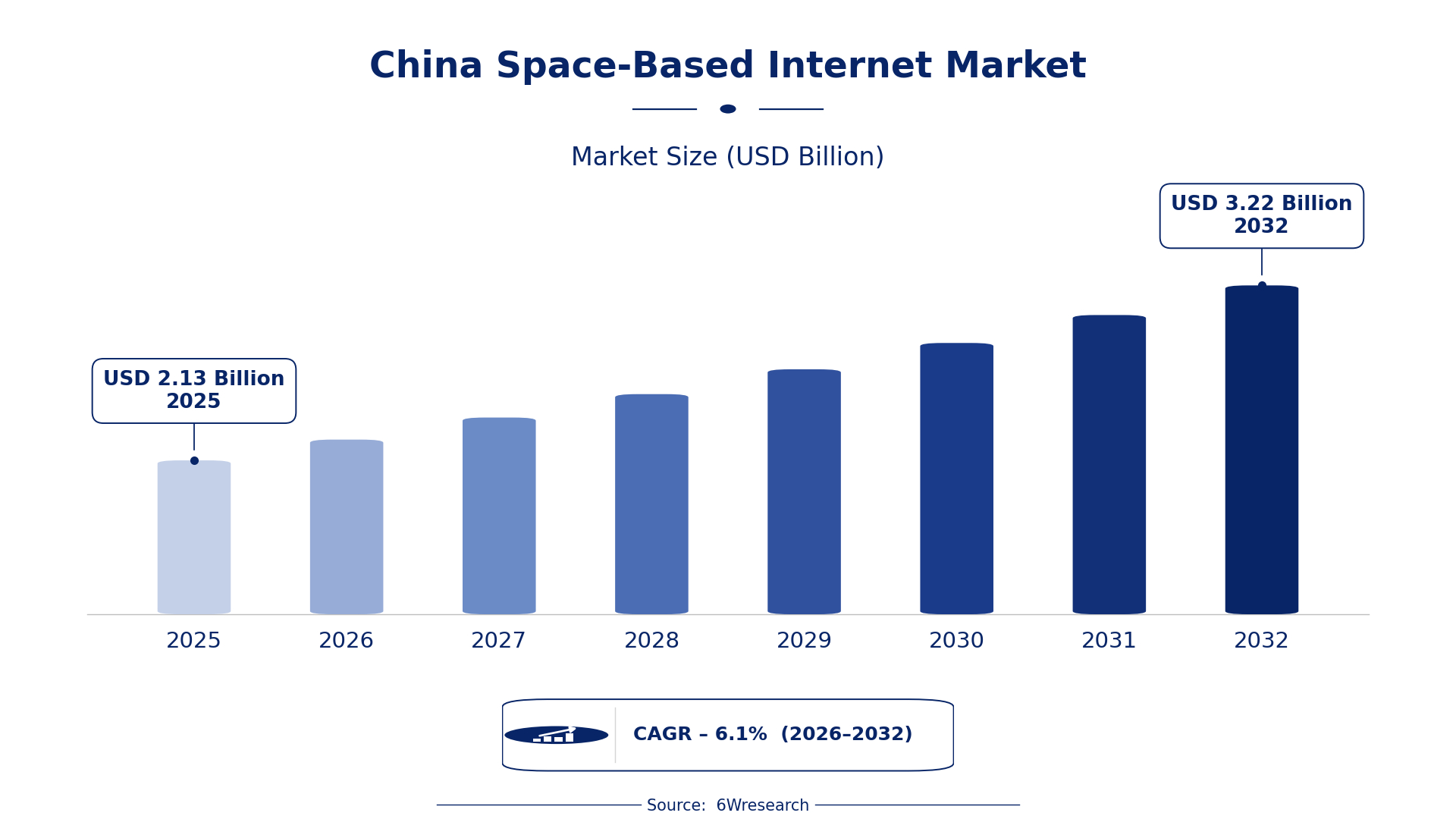
According to 6Wresearch internal database and industry insights, the China Space-Based Internet Market was valued at USD 2.13 billion in 2025 and is projected to reach USD 3.22 billion by 2032, growing at a CAGR of approximately 6.1% during 2026–2032.
China Space-Based Internet Market Highlights
| Report Metric | Details |
| Report Name | China Space-Based Internet Market |
| Market Size 2025 | USD 2.13 billion |
| Market Size 2032 | USD 3.22 billion |
| Absolute Growth 2025–2032 | USD 1.09 billion |
| CAGR 2026–2032 | 6.1% |
| Peak Annual Growth | 8.7% in 2026 |
| Forecast Period | 2026–2032 |
| Historical Data | 2022–2025 |
| Base Year | 2025 |
| Leading Service Type, 2025 | Broadband Services (39% share) |
| Leading Orbit Class, 2025 | LEO/MEO (46% share) |
| Leading Coverage Scope, 2025 | Global (42% share) |
| Leading End User, 2025 | Rural Households (34% share) |
| Fastest-Growing Service Type | IoT Connectivity (7.5% CAGR) |
| Fastest-Growing Orbit Class | GEO (7.7% CAGR) |
| Fastest-Growing Coverage Scope | Remote Infrastructure (8.1% CAGR) |
| Fastest-Growing End User | Industrial Facilities (8.1% CAGR) |
| Growing Sector | Rural Broadband Services |
| Key End Users | Rural Households, Industrial Facilities, Shipping Companies, Airline Operators |
China Space-Based Internet Market Year-wise Growth Rate and Key Drivers (2022–2032)
This graph illustrates the annual growth rates of the market from 2022 to 2032, highlighting a steady upward trajectory and projected market expansion over the forecast period.
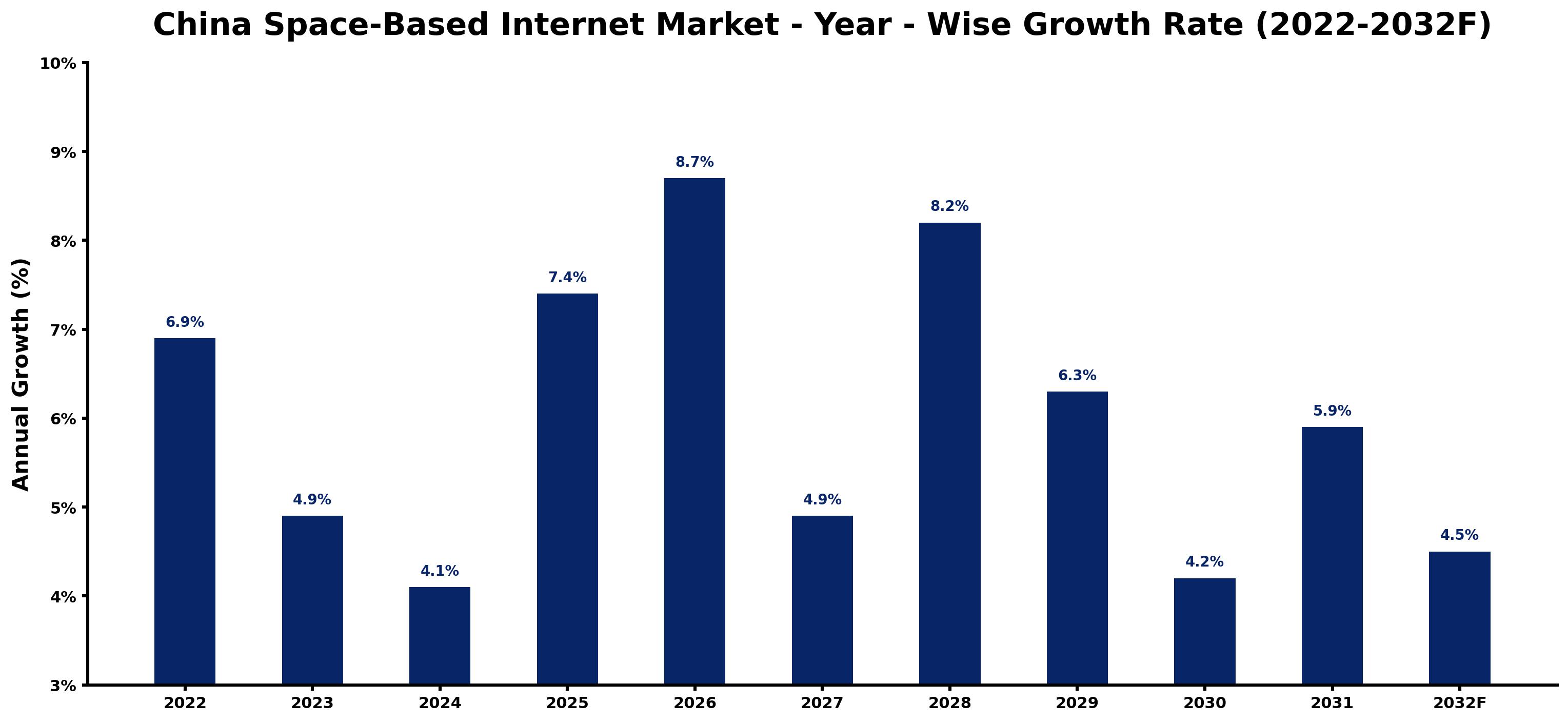
The table below sets out the estimated growth rate for each year and the main factor behind it.
| Year | Estimated Annual Growth (%) | Market Rationale |
| 2022 | 6.9 | The market experienced strong demand from rural households for broadband services. |
| 2023 | 4.9 | Growth slowed due to the National Development and Reform Commission's focus on satellite internet development. |
| 2024 | 4.1 | Investment in satellite infrastructure supported market expansion, particularly in rural areas. |
| 2025 | 7.4 | Demand surged as the government set ambitious connectivity targets for rural households. |
| 2026 | 8.7 | The peak growth rate was driven by the launch of new LEO satellites under the Satellite Internet Development Program. |
| 2027 | 4.9 | A slowdown occurred as market saturation began in urban regions, impacting growth rates. |
| 2028 | 8.2 | Growth accelerated again with rising demand for IoT connectivity, driven by the Internet Plus Initiative. |
| 2029 | 6.3 | Market growth slowed as rural broadband penetration approached saturation, limiting expansion opportunities. |
| 2030 | 4.2 | The market continued to expand, driven by ongoing government initiatives for rural connectivity. |
| 2031 | 5.9 | Demand increased as more industrial facilities sought satellite connectivity, enhancing operational efficiency. |
| 2032 | 4.5 | Growth slowed as the market matured and competition intensified, impacting profitability. |
Note: Market size estimations and growth projections presented in this report are based on 6Wresearch's proprietary forecasting methodology, utilizing the latest available industry data, government publications, and primary research inputs.
China Space-Based Internet Market Synopsis
Space-Based Internet in China refers to internet services delivered via satellites, primarily in Low Earth Orbit (LEO) and Medium Earth Orbit (MEO). This technology enables broadband access to remote areas and supports IoT connectivity. The China Space-Based Internet Market is expanding due to strong demand from rural households and industrial facilities. Approximately 500 million people in rural areas require better internet access, while the IoT market is projected to reach 1 trillion yuan by 2025. Government initiatives are further stimulating this growth by improving satellite internet infrastructure.
Market Dynamics Impact Analysis (2026–2032)
| Factor | Type | Impact | Primary Segment Affected |
| Rising demand for broadband services in rural areas drives market growth. | Driver | High | Broadband Services |
| The increasing number of connected devices boosts demand for IoT connectivity. | Driver | High | IoT Connectivity |
| Investment opportunities exist in satellite technology development. | Opportunity | High | Maritime Internet |
| The need for enhanced connectivity in remote regions presents a market gap. | Opportunity | High | Remote Infrastructure |
| High competition among service providers may limit market share. | Restraint | Medium | Aeronautical Internet |
| Infrastructure development costs can hinder new entrants. | Restraint | Medium | Broadband Services |
| Regulatory hurdles can delay satellite deployment projects. | Challenge | High | IoT Connectivity |
| Technological advancements may outpace current infrastructure capabilities. | Challenge | High | Maritime Internet |
Evaluation of Drivers in China Space-Based Internet Market (2026–2032)
The factors lifting demand, and the evidence behind each, are summarised below.
| Drivers | Primary Segment Affected | Why It Matters (Evidence) |
| Growing rural population demanding broadband services. | Broadband Services | Approximately 500 million rural residents require internet access, leading to increased purchases of satellite services. |
| Expansion of IoT applications drives connectivity needs. | IoT Connectivity | China's IoT market is projected to reach 1 trillion yuan by 2025, increasing demand for satellite connectivity. |
| Government initiatives support satellite internet infrastructure development. | Maritime Internet | The National Development and Reform Commission's 14th Five-Year Plan aims to enhance satellite internet access, boosting demand. |
| Rising maritime industry growth fuels demand for internet services. | Maritime Internet | China's maritime industry is expected to grow by 6% annually, increasing demand for satellite communication. |
| Increased investment in satellite technology enhances service offerings. | Aeronautical Internet | China's investment in satellite technology is projected to exceed 100 billion yuan by 2025, improving connectivity options. |
Expansion of the Space-Based Internet market in China is backed by rising demand for broadband services, increased IoT applications, and support for infrastructure development. Approximately 500 million rural residents require better internet access, leading to increased purchases of satellite services. The IoT market is projected to reach 1 trillion yuan by 2025, driving demand for connectivity among industrial facilities. The National Development and Reform Commission's 14th Five-Year Plan aims to improve satellite internet access, promoting growth in the maritime sector. China's investment in satellite technology is set to exceed 100 billion yuan by 2025, improving service offerings and connectivity options.
Evaluation of Restraints in China Space-Based Internet Market
The following restraints limit how fast demand can grow.
| Market Restraint | Primary Segment Affected | Why It Matters (Evidence) |
| High competition among service providers limits market share. | Aeronautical Internet | Increased competition can lead to price wars, affecting profitability for providers. |
| Infrastructure development costs can hinder new entrants. | Broadband Services | High initial investment requirements may deter smaller companies from entering the market. |
| Regulatory hurdles can delay satellite deployment projects. | IoT Connectivity | Complex approval processes can slow down the rollout of new satellite services. |
| Technological advancements may outpace current infrastructure capabilities. | Maritime Internet | Existing infrastructure may struggle to support new technologies, limiting service quality. |
| Market saturation in urban areas slows growth. | Broadband Services | As urban broadband penetration increases, growth opportunities diminish in these regions. |
China Space-Based Internet Market Challenges
The China Space-Based Internet market faces several pressing issues, starting with a shortage of skilled workers in satellite technology. The rapid deployment of satellite networks demands expertise in advanced engineering, which is lacking, causing delays in project timelines for producers. Next, technology integration poses challenges as existing ground infrastructure is not equipped to support new satellite systems, impeding service rollout for buyers. Regulatory complexities arise from the National Standard GB/T 33400-2016, which creates compliance hurdles that slow down deployment for suppliers. Lastly, the high initial costs of satellite launches and infrastructure investments strain budgets for rural service providers, limiting access to essential broadband services for approximately 500 million rural residents.
Trends in the China Space-Based Internet Market
Four trends stand out in the China Space-Based Internet Market.
- Shift towards Improved Rural Connectivity: The 2023 Space-Based Internet Development Action Plan aims to connect all rural households to high-speed internet by 2025. This initiative is projected to increase satellite service adoption in rural areas, addressing the digital divide.
- Growth of IoT Connectivity Solutions: Since 2020, the integration of satellite internet with IoT applications has gained traction. The Ministry of Industry and Information Technology's Internet Plus Initiative promotes this trend, driving demand for smart devices and connectivity solutions.
- Expansion of Maritime Internet Services: In 2023, China's coastal provinces are leading in maritime internet adoption due to increased shipping activities. The maritime industry is expected to grow by 6% annually, driving demand for satellite communication.
- Advancements in Satellite Technology: The establishment of the China Satellite Network Group in 2023 highlights a focus on improving satellite internet capabilities. This initiative aims to improve service quality and expand coverage for users.
Investment Opportunities in the China Space-Based Internet Market
Several openings in the China Space-Based Internet Market merit attention from investors.
- Investing in Satellite Technology Development: China's investment in satellite technology is projected to exceed 100 billion yuan by 2025. Collaborating with local technology firms can facilitate market entry and development.
- Supply of IoT Connectivity Solutions: The demand for IoT connectivity solutions is growing, with the IoT market expected to reach 1 trillion yuan by 2025. Targeting industrial facilities can lead to substantial opportunities in this sector.
- Expansion of Maritime Internet Services: The maritime industry is projected to grow by 6% annually, creating demand for satellite communication services. Focusing on coastal provinces can yield significant returns for service providers.
- Improving Remote Infrastructure Connectivity: The need for enhanced connectivity in remote areas presents a gap in the market. Collaborating with local governments can facilitate access to funding and approvals for satellite projects.
Government Initiatives in the China Space-Based Internet Market
The 14th Five-Year Plan for Economic and Social Development, established by the National Development and Reform Commission in 2021, aims to enhance satellite internet infrastructure across China, focusing on improving connectivity in rural areas. This plan mandates the deployment of additional LEO satellites, which is crucial for expanding broadband access to underserved populations. Furthermore, the National Space Administration's Satellite Internet Development Program, initiated in 2022, allocates significant funding for satellite deployment, ensuring that internet services reach remote regions effectively. The updated National Standard GB/T 33400-2016, released in 2021, includes specifications that ensure quality and interoperability for satellite internet services, benefiting both producers and consumers. These measures collectively enhance the operational framework for satellite internet providers and improve access for users in rural areas.
In 2023, the Space-Based Internet Development Action Plan, launched by the Ministry of Science and Technology, aims to increase satellite internet coverage to 95% of remote areas by 2025. This ambitious plan is supported by a funding allocation of 50 billion yuan, which will facilitate the necessary infrastructure improvements. The Ministry of Industry and Information Technology's Internet Plus Initiative, introduced in 2020, promotes the integration of satellite internet with IoT applications, further boosting economic growth. These initiatives are crucial for ensuring that satellite internet services are effectively implemented and widely adopted, particularly in rural and industrial sectors.
Future Insight of the China Space-Based Internet Market
The China Space-Based Internet market is set for transformation by 2032, driven by multiple factors. The government's initiative to connect all rural households to high-speed internet by 2025 will expand accessibility for a vast population. Investment in satellite technology is projected to exceed 100 billion yuan, facilitating faster service deployment. Advancements in satellite capabilities, showcased at the 2023 China Space Conference, will lead to improved internet speeds, projected to reach 100 Mbps, benefiting users in remote and industrial areas.
Market Segmentation Analysis
The analysis below covers each segmentation, its leading category in 2025 and its fastest-growing category through 2032.
By Service Type – Broadband Services Dominated, IoT Connectivity Expected to Grow Fastest
According to Summon Dutta, Assistant Manager at 6Wresearch, Broadband Services held a 39% share of the China Space-Based Internet Market by service type in 2025. Broadband services hold the largest share as they provide essential internet access to around 500 million rural residents in China, addressing a vital need for connectivity. The government's commitment to connect all rural households to high-speed internet by 2025 reinforces this segment's strong position. IoT Connectivity is set to record the highest CAGR in this split, 7.5% over 2026–2032. The IoT connectivity segment is growing rapidly due to the anticipated expansion of China's IoT market, projected to reach 1 trillion yuan by 2025. This growth is propelled by the increasing number of connected devices across various sectors, including agriculture and manufacturing. Suppliers should enhance broadband offerings for rural areas while also investing in IoT solutions to capitalise on the rising demand.
By Orbit Class – LEO/MEO Dominated, GEO Expected to Grow Fastest
LEO/MEO took a 46% share of orbit class in 2025, more than any other category. LEO/MEO satellites lead the market due to their critical role in delivering low-latency services essential for effective internet connectivity. The launch of over 40 LEO satellites for internet services in China illustrates the focus on this orbit class for enhanced performance. Over 2026–2032, GEO is expected to post the fastest growth, at a CAGR of 7.7%. GEO satellites are experiencing the fastest growth as they are increasingly utilised for traditional satellite communications, catering to established markets. Their reliability in providing consistent coverage appeals to various sectors, including telecommunications and broadcasting. Suppliers must balance their offerings between LEO/MEO for low-latency services and GEO for traditional communications to meet diverse customer requirements.
By Coverage Scope – Global Dominated, Remote Infrastructure Expected to Grow Fastest
With a 42% revenue share in 2025, Global was the largest coverage scope category. The global coverage scope holds the largest share as it provides extensive connectivity across various regions, catering to a vast user base. This is especially important for the government's goal to enhance digital infrastructure nationwide, ensuring widespread access. Remote Infrastructure is projected to grow fastest, at a CAGR of 8.1% during 2026–2032. Remote infrastructure is the fastest-growing segment as it supports connectivity in isolated regions where traditional internet access remains limited. The increasing focus on connecting underserved areas drives this segment's rapid expansion, highlighting the need for targeted solutions. Suppliers should prioritise solutions that enhance global coverage while also developing targeted services for remote infrastructure to seize emerging opportunities.
By End User – Rural Households Dominated, Industrial Facilities Expected to Grow Fastest
The largest end user category in 2025 was Rural Households, with a 34% share of total revenue. Rural households account for the largest share as they directly address the digital divide in rural areas, where internet access is crucial for education and economic development. The government's initiatives to connect these households further strengthen this segment's position in the market. The quickest growth will come from Industrial Facilities, forecast to expand at a CAGR of 8.1% between 2026 and 2032. Industrial facilities represent the fastest-growing end user segment as they enable smart manufacturing and operations, aligning with China's push for technological advancement in various industries. The increasing integration of IoT in industrial settings fuels this growth, creating new opportunities. Suppliers should tailor their offerings to meet the specific needs of rural households while also innovating solutions for industrial facilities to leverage the growing demand.
Key Attractiveness of the Report
- 10 Years of Market Numbers
- Historical Data Starting from 2022 to 2025
- Base Year 2025
- Forecast Data until 2032
- Key Performance Indicators Impacting the Market
- Major Upcoming Developments and Projects
Key Highlights of the Report:
- China Space-Based Internet Market Outlook
- Market Size of China Space-Based Internet Market, 2025
- Forecast of China Space-Based Internet Market, 2032
- Historical Data and Forecast of China Space-Based Internet Revenues & Volume for the Period 2022 - 2032F
- China Space-Based Internet Market Trend Evolution
- China Space-Based Internet Market Drivers and Challenges
- China Space-Based Internet Price Trends
- China Space-Based Internet Porter's Five Forces
- China Space-Based Internet Industry Life Cycle
- Historical Data and Forecast of China Space-Based Internet Market Revenues & Volume By Service Type for the Period 2022 - 2032F
- Historical Data and Forecast of China Space-Based Internet Market Revenues & Volume By Broadband Services for the Period 2022 - 2032F
- Historical Data and Forecast of China Space-Based Internet Market Revenues & Volume By IoT Connectivity for the Period 2022 - 2032F
- Historical Data and Forecast of China Space-Based Internet Market Revenues & Volume By Maritime Internet for the Period 2022 - 2032F
- Historical Data and Forecast of China Space-Based Internet Market Revenues & Volume By Aeronautical Internet for the Period 2022 - 2032F
- Historical Data and Forecast of China Space-Based Internet Market Revenues & Volume By Orbit Class for the Period 2022 - 2032F
- Historical Data and Forecast of China Space-Based Internet Market Revenues & Volume By LEO/MEO for the Period 2022 - 2032F
- Historical Data and Forecast of China Space-Based Internet Market Revenues & Volume By GEO for the Period 2022 - 2032F
- Historical Data and Forecast of China Space-Based Internet Market Revenues & Volume By LEO for the Period 2022 - 2032F
- Historical Data and Forecast of China Space-Based Internet Market Revenues & Volume By MEO for the Period 2022 - 2032F
- Historical Data and Forecast of China Space-Based Internet Market Revenues & Volume By Coverage Scope for the Period 2022 - 2032F
- Historical Data and Forecast of China Space-Based Internet Market Revenues & Volume By Global for the Period 2022 - 2032F
- Historical Data and Forecast of China Space-Based Internet Market Revenues & Volume By Remote Infrastructure for the Period 2022 - 2032F
- Historical Data and Forecast of China Space-Based Internet Market Revenues & Volume By Sea Routes for the Period 2022 - 2032F
- Historical Data and Forecast of China Space-Based Internet Market Revenues & Volume By In-flight Connectivity for the Period 2022 - 2032F
- Historical Data and Forecast of China Space-Based Internet Market Revenues & Volume By End User for the Period 2022 - 2032F
- Historical Data and Forecast of China Space-Based Internet Market Revenues & Volume By Rural Households for the Period 2022 - 2032F
- Historical Data and Forecast of China Space-Based Internet Market Revenues & Volume By Industrial Facilities for the Period 2022 - 2032F
- Historical Data and Forecast of China Space-Based Internet Market Revenues & Volume By Shipping Companies for the Period 2022 - 2032F
- Historical Data and Forecast of China Space-Based Internet Market Revenues & Volume By Airline Operators for the Period 2022 - 2032F
- China Space-Based Internet Import Export Trade Statistics
- Market Opportunity Assessment By Service Type
- Market Opportunity Assessment By Orbit Class
- Market Opportunity Assessment By Coverage Scope
- Market Opportunity Assessment By End User
- China Space-Based Internet Top Companies Market Share
- China Space-Based Internet Competitive Benchmarking By Technical and Operational Parameters
- China Space-Based Internet Company Profiles
- China Space-Based Internet Key Strategic Recommendations
Market Covered
Segments analysed in this report are listed below.
By Service Type
- Broadband Services
- IoT Connectivity
- Maritime Internet
- Aeronautical Internet
By Orbit Class
- LEO/MEO
- GEO
- LEO
- MEO
By Coverage Scope
- Global
- Remote Infrastructure
- Sea Routes
- In-flight Connectivity
By End User
- Rural Households
- Industrial Facilities
- Shipping Companies
- Airline Operators































