China Table Olives Market Top 5 Importing Countries and Market Competition (HHI) Analysis
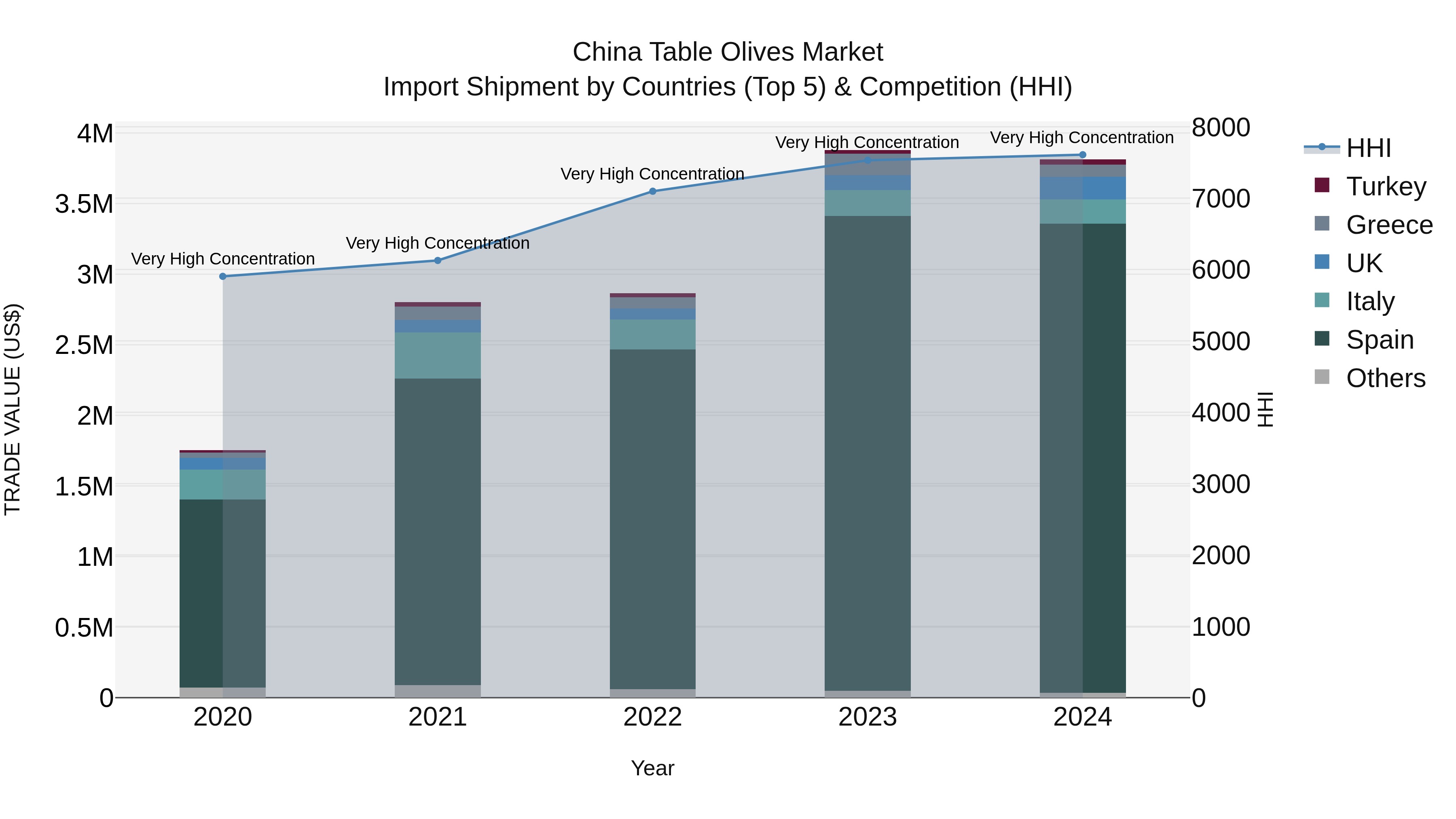
China table olives import market in 2024 continued to be dominated by top exporting countries such as Spain, Italy, UK, Greece, and Turkey, maintaining a high Herfindahl-Hirschman Index (HHI) concentration. The impressive compound annual growth rate (CAGR) of 21.41% from 2020 to 2024 indicates a strong upward trend in demand. Despite a slight decline in growth rate from 2023 to 2024 (-1.71%), the market remains robust and offers opportunities for further expansion and competition among key players.
China Table Olives Market Synopsis
The China Table Olives Market is experiencing steady growth driven by increasing consumer awareness of the health benefits associated with olives, such as their high antioxidant content and heart-healthy fats. Domestic production of table olives in China is also on the rise, supported by government initiatives to boost agricultural productivity. Furthermore, the growing popularity of Mediterranean cuisine in China has contributed to the increased demand for table olives as a key ingredient in various dishes. Key players in the market are focusing on product innovation and expanding their distribution channels to cater to the evolving consumer preferences. With a large population and rising disposable incomes, the China Table Olives Market presents significant opportunities for both domestic and international olive producers to capitalize on the growing demand for healthy and flavorful food products.
China Table Olives Market Trends
The China Table Olives Market is experiencing growth due to increasing health consciousness among consumers and growing demand for Mediterranean cuisine. One of the key trends in the market is the shift towards organic and natural table olives, driven by consumers seeking healthier and more environmentally friendly options. There is also a rising popularity of flavored table olives, offering unique and diverse taste experiences. Opportunities in the market include the expansion of online retail channels, as well as increasing exports to other countries. With a large population and a growing middle class, China presents a significant market potential for table olives producers looking to capitalize on these trends and opportunities.
China Table Olives Market Challenges
In the China table olives market, several challenges are faced, including intense competition from domestic and international brands, varying consumer preferences across regions, inconsistent quality standards, and limited awareness and understanding of table olives among Chinese consumers. Additionally, high import tariffs on table olives can hinder market growth and increase prices for consumers. The lack of established distribution networks and limited shelf space in retail outlets also pose challenges for market penetration and product visibility. To succeed in the China table olives market, companies need to navigate these obstacles by investing in marketing strategies tailored to local preferences, ensuring consistent product quality, and establishing strong partnerships with distributors to increase market reach and brand recognition.
China Table Olives Market Investment Opportunities
The China Table Olives Market is primarily driven by the increasing consumer awareness about the health benefits of olives, such as their high antioxidant content and potential to reduce the risk of chronic diseases. Additionally, the growing trend of Western cuisine adoption in China, leading to an increased demand for olives as an ingredient or snack, is fueling market growth. The expanding middle-class population with higher disposable income levels is also contributing to the rising consumption of table olives as a premium food product. Furthermore, the convenience factor of table olives as a ready-to-eat and versatile food option is attracting busy urban consumers, driving the market further. Overall, these factors are expected to continue driving the growth of the China Table Olives Market in the foreseeable future.
China Table Olives Market Government Polices
The Chinese government has implemented various policies to support and regulate the table olives market. These policies include agricultural subsidies, quality control standards, and export promotion initiatives. The government provides subsidies to encourage farmers to cultivate olives and improve production efficiency. Quality control standards ensure that table olives meet certain criteria for safety and quality before they can be sold in domestic and international markets. Additionally, export promotion initiatives aim to increase the competitiveness of Chinese table olives in the global market by providing support for marketing activities and trade missions. Overall, these policies play a crucial role in promoting the growth and sustainability of the China table olives market.
China Table Olives Market Future Outlook
The China Table Olives Market is expected to witness steady growth in the coming years due to increasing consumer awareness of the health benefits associated with olives. The market is likely to be driven by factors such as rising disposable incomes, changing dietary preferences towards healthier options, and growing demand for Mediterranean cuisine in the region. Additionally, the expanding retail sector and e-commerce platforms are expected to further boost the market by increasing accessibility to a wider consumer base. However, challenges such as fluctuating prices of raw materials and competition from other snack options may hinder the market growth to some extent. Overall, the China Table Olives Market is anticipated to show promising growth prospects with opportunities for innovation and product diversification in the near future.
Key Highlights of the Report:
- China Table Olives Market Outlook
- Market Size of China Table Olives Market, 2024
- Forecast of China Table Olives Market, 2031
- Historical Data and Forecast of China Table Olives Revenues & Volume for the Period 2021- 2031
- China Table Olives Market Trend Evolution
- China Table Olives Market Drivers and Challenges
- China Table Olives Price Trends
- China Table Olives Porter's Five Forces
- China Table Olives Industry Life Cycle
- Historical Data and Forecast of China Table Olives Market Revenues & Volume By Type for the Period 2021- 2031
- Historical Data and Forecast of China Table Olives Market Revenues & Volume By Black Olive for the Period 2021- 2031
- Historical Data and Forecast of China Table Olives Market Revenues & Volume By Green Olive for the Period 2021- 2031
- Historical Data and Forecast of China Table Olives Market Revenues & Volume By Application for the Period 2021- 2031
- Historical Data and Forecast of China Table Olives Market Revenues & Volume By Online Store for the Period 2021- 2031
- Historical Data and Forecast of China Table Olives Market Revenues & Volume By Supermarket for the Period 2021- 2031
- Historical Data and Forecast of China Table Olives Market Revenues & Volume By Convenience Store for the Period 2021- 2031
- Historical Data and Forecast of China Table Olives Market Revenues & Volume By Other for the Period 2021- 2031
- China Table Olives Import Export Trade Statistics
- Market Opportunity Assessment By Type
- Market Opportunity Assessment By Application
- China Table Olives Top Companies Market Share
- China Table Olives Competitive Benchmarking By Technical and Operational Parameters
- China Table Olives Company Profiles
- China Table Olives Key Strategic Recommendations






































