China Telecom Software Market Size & Growth Rate
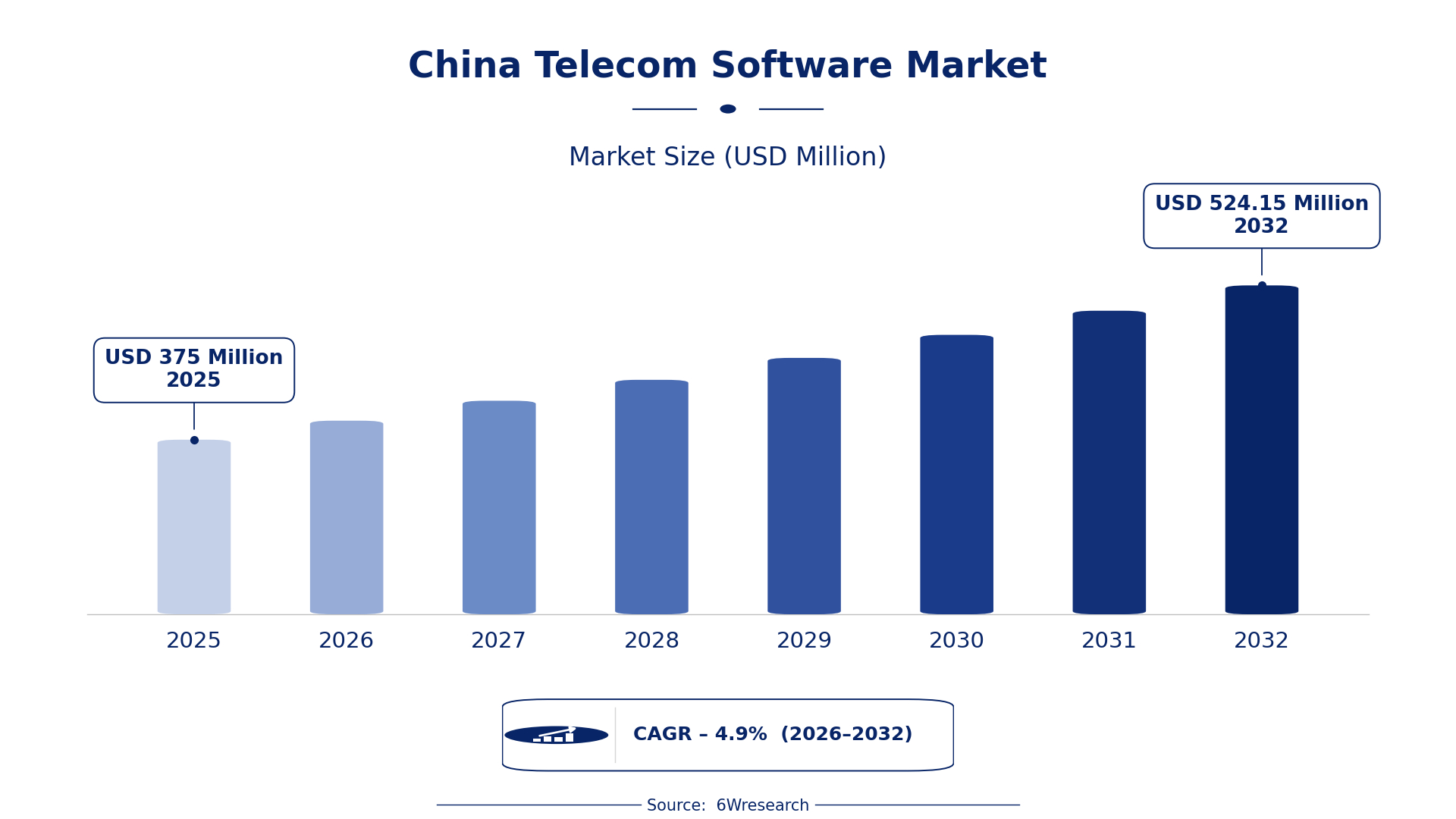
According to 6Wresearch internal database and industry insights, the China Telecom Software Market was valued at USD 375.0 million in 2025 and is projected to reach USD 524.15 million by 2032, growing at a CAGR of approximately 4.9% during 2026–2032.
China Telecom Software Market Highlights
| Report Metric | Details |
| Report Name | China Telecom Software Market |
| Market Size 2025 | USD 375.0 million |
| Market Size 2032 | USD 524.15 million |
| Absolute Growth 2025–2032 | USD 149.15 million |
| CAGR 2026–2032 | 4.9% |
| Peak Annual Growth | 7.2% in 2031 |
| Forecast Period | 2026–2032 |
| Historical Data | 2022–2025 |
| Base Year | 2025 |
| Leading Telecom Software Type, 2025 | BSS Software (43% share) |
| Leading Product Type, 2025 | Billing & Invoicing (49% share) |
| Leading Software Type, 2025 | CRM & ERP (34% share) |
| Leading Distribution Channel, 2025 | SaaS Providers (40% share) |
| Leading End User Industry, 2025 | Telecom Back Office (46% share) |
| Fastest-Growing Telecom Software Type | Network Management Tools (6.7% CAGR) |
| Fastest-Growing Product Type | Network Monitoring (6.5% CAGR) |
| Fastest-Growing Distribution Channel | Direct Sales (7.3% CAGR) |
| Fastest-Growing End User Industry | Managed Networks (6.0% CAGR) |
| Growing Sector | Telecom Back Office |
| Key End Users | Telecom operators, SMEs, telecom engineers, urban businesses |
China Telecom Software Market Year-wise Growth Rate and Key Drivers (2022–2032)
This graph illustrates the annual growth rates of the market from 2022 to 2032, highlighting a steady upward trajectory and projected market expansion over the forecast period.
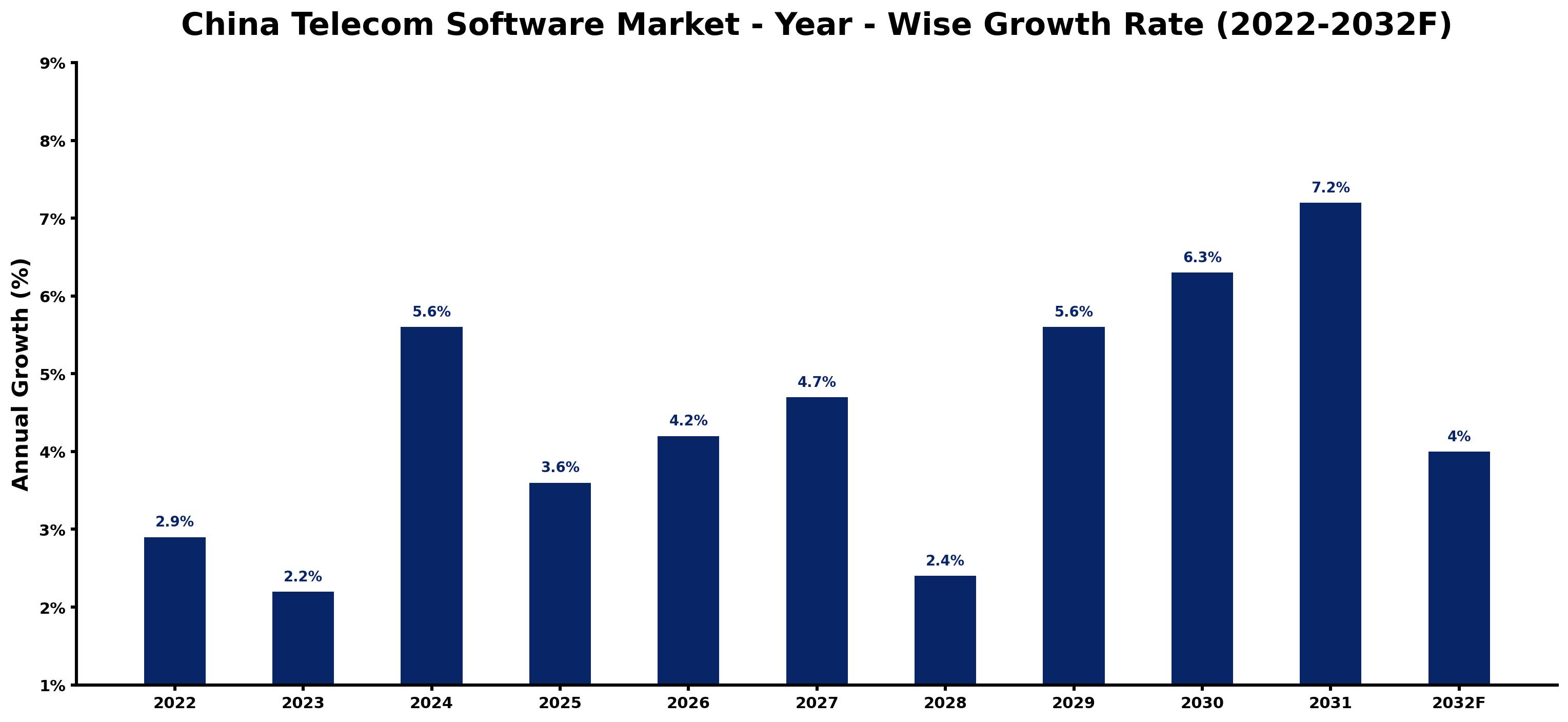
Annual growth estimates for each year appear below with the principal reason behind them, explaining the shifts that set the pace of the market.
| Year | Estimated Annual Growth (%) | Market Rationale |
| 2022 | 2.9 | The market showed steady growth, reflecting ongoing demand for telecom software solutions driven by urban expansion. |
| 2023 | 2.2 | Growth slowed due to a temporary dip in investment from telecom operators focusing on digital transformation. |
| 2024 | 5.6 | Increased adoption of OSS software drove faster growth as operators upgraded their systems to meet new standards. |
| 2025 | 3.6 | A slowdown occurred as operators adjusted their strategies following rapid expansion in previous years. |
| 2026 | 4.2 | Demand for BSS software is expected to increase, leading to a recovery in growth rates as operators enhance customer management. |
| 2027 | 4.7 | Network management tools are projected to gain traction, further boosting growth in the sector as urban infrastructure expands. |
| 2028 | 2.4 | Growth is expected to slow again as the market adjusts to recent technological advancements and investment patterns. |
| 2029 | 5.6 | A resurgence in demand for VoIP software is anticipated to contribute to a faster growth rate as businesses upgrade communication tools. |
| 2030 | 6.3 | The rise of cloud-based solutions will support continued growth in telecom software as operators seek efficiency. |
| 2031 | 7.2 | The peak growth rate will be driven by investments in 5G technologies, enhancing operational capabilities for telecom providers. |
| 2032 | 4.0 | Growth is projected to slow as the market stabilises, reflecting maturation in telecom software adoption and integration. |
Note: Market size estimations and growth projections presented in this report are based on 6Wresearch's proprietary forecasting methodology, utilizing the latest available industry data, government publications, and primary research inputs.
China Telecom Software Market Synopsis
Telecom Software in China includes applications for managing telecommunications networks and services, covering systems for network management, billing, and customer relationship management. The Ministry of Industry and Information Technology actively supports this expansion, particularly through efforts focused on 5G technologies and software development. Investment in telecom software is anticipated to reach 300 billion CNY by 2022, further stimulating demand for advanced solutions.
Market Dynamics Impact Analysis (2026–2032)
| Factor | Type | Impact | Primary Segment Affected |
| Increasing mobile subscriber base | Driver | High | BSS Software |
| Growing demand for cloud-based solutions | Driver | High | OSS Software |
| Expansion of urban telecom infrastructure | Opportunity | High | Network Management Tools |
| Rising adoption of AI-driven tools | Opportunity | Medium | VoIP Software |
| Compliance with cybersecurity regulations | Restraint | High | Telecom Back Office |
| High costs associated with software upgrades | Restraint | Medium | Billing & Invoicing |
| Limited skilled workforce in telecom software | Challenge | High | OSS Software |
| Rapid technological changes creating uncertainty | Challenge | Medium | BSS Software |
Evaluation of Drivers in China Telecom Software Market (2026–2032)
Key forces behind demand, with the segment each one moves most, are listed below.
| Drivers | Primary Segment Affected | Why It Matters (Evidence) |
| Investment in 5G technologies | Telecom Back Office | Investment in 5G infrastructure is pushing telecom back offices to adopt advanced software solutions for operational efficiency. |
| Growing mobile subscriptions | BSS Software | With over 1.6 billion mobile subscribers, telecom operators are increasingly investing in BSS software for improved customer management. |
| Urban infrastructure development | Network Management Tools | Urban areas are seeing greater demand for network management tools to maintain service quality and reliability. |
| Rise of cloud-based solutions | OSS Software | The shift towards cloud-based OSS solutions is essential for efficient network operations, enabling operators to enhance their service capabilities. |
| Increased VoIP adoption | VoIP Software | The growing use of VoIP software in business communications is driving demand for advanced telecom solutions. |
The Telecom Software market in China is expanding as rising mobile subscriptions, urban infrastructure development, and the adoption of cloud solutions drive demand for advanced applications. With over 1.6 billion mobile subscribers, telecom operators are increasingly investing in BSS software to improve customer management and service delivery. Urban areas are experiencing heightened demand for network management tools to ensure service quality, while VoIP software usage is growing significantly in business communications. The shift towards cloud-based OSS solutions is crucial for efficient network operations, enabling operators to enhance their capabilities. Investment in 5G technologies is expected to prompt telecom back offices to adopt advanced software solutions, ensuring competitiveness in a rapidly evolving market.
Evaluation of Restraints in China Telecom Software Market
The following restraints limit how fast demand can grow.
| Market Restraint | Primary Segment Affected | Why It Matters (Evidence) |
| High costs of software upgrades | Billing & Invoicing | The need for frequent upgrades to meet evolving standards can strain budgets for telecom operators, limiting their investment capabilities. |
| Rapid technological changes | BSS Software | Frequent advancements create uncertainty, making it difficult for operators to keep up with software requirements and affecting service delivery. |
| Market competition driving prices down | Network Management Tools | Intense competition among providers is leading to reduced prices, affecting profitability and sustainability for software developers. |
| Integration challenges with legacy systems | VoIP Software | Many operators face difficulties integrating new VoIP solutions with existing legacy systems, delaying implementation and affecting service quality. |
| Regulatory compliance costs | OSS Software | Compliance with the Cybersecurity Law of 2020 imposes additional costs on telecom software providers, affecting their pricing strategies. |
China Telecom Software Market Challenges
The National Standards of China (GB/T 35273-2020) impose strict guidelines that can delay software deployment for telecom operators, affecting timely service delivery. Cost pressures arise as the average revenue per user (ARPU) stands at approximately 50 CNY, pushing buyers to seek budget-friendly solutions, which may limit investment in advanced telecom applications. Urban users struggle to maintain service quality due to inadequate network management tools, leading to increased customer dissatisfaction. Supply chain issues stem from reliance on specific software solutions, causing delays in updates and maintenance for telecom operators.
Trends in the China Telecom Software Market
Four trends stand out in the China Telecom Software Market.
- Shift to Cloud-Based Solutions: Telecom operators are increasingly adopting cloud-based software solutions, particularly in urban telecom back offices. Approximately 40% of telecom software is now delivered via SaaS models, which improves operational efficiency.
- Rise in VoIP Software Usage: Urban businesses are rapidly adopting VoIP software for communication, with substantial growth reported in metropolitan areas. This trend is reflected in a 20% increase in VoIP usage across China.
- Increased Focus on Network Management Tools: Telecom operators are prioritising network management tools to ensure service quality, especially in urban settings. This shift is evidenced by a 6.5% CAGR in the network management segment.
- Adoption of AI-Driven Tools: Telecom engineers are increasingly utilising AI-driven tools for network management, which improves operational efficiency. The integration of AI is projected to grow by 15% annually in the coming years.
Investment Opportunities in the China Telecom Software Market
Several openings in the China Telecom Software Market merit attention from investors.
- Investment in 5G Infrastructure: With telecom investment reaching 300 billion CNY, there is a chance for software providers to develop solutions tailored for 5G networks. Telecom operators are actively seeking partnerships to enhance their capabilities.
- Growing Demand for Network Management Tools: As urban infrastructure expands, there is a pressing need for advanced network management tools. Telecom operators in major cities are looking for innovative solutions to maintain service quality.
- Expansion of VoIP Services: The rapid growth of VoIP services presents an opportunity for software developers to create enhanced communication solutions. Businesses in urban areas are increasingly investing in VoIP technology.
- Cloud-Based Software Solutions: The shift towards cloud-based software solutions is creating a demand for innovative telecom software. Telecom back offices are actively seeking partnerships with SaaS providers to improve their operations.
Government Initiatives in the China Telecom Software Market
The Cybersecurity Law of 2020 mandates compliance for telecom software providers, ensuring data protection and security measures are in place. This law requires software developers to implement stringent security protocols, affecting how they design and manage their products. Compliance with this law is essential for maintaining customer trust and operational integrity in the telecom sector. Additionally, the 14th Five-Year Plan for Economic and Social Development emphasises the importance of digital infrastructure, including telecom software, in 2021, targeting a total investment of 300 billion CNY by 2022.
The National Development and Reform Commission (NDRC) introduced a subsidy program in 2022 to support the adoption of telecom software in small and medium enterprises. This program aims to reduce financial barriers for SMEs, facilitating their access to essential telecom software solutions. The NDRC's initiative is expected to enhance the overall competitiveness of SMEs in the telecom industry, allowing them to adopt advanced technologies and improve service delivery.
Future Insight of the China Telecom Software Market
The ongoing digital transformation within the telecom sector will promote the use of AI-driven tools for network management, boosting operational efficiency. Investment in 5G technologies will open new avenues for software innovation, aligning with the 14th Five-Year Plan's emphasis on enhancing digital infrastructure. By 2025, total telecom investment is projected to reach 300 billion CNY, fostering growth in telecom applications. The shift towards cloud-based solutions will enable telecom back offices to function more effectively, providing advantages for both buyers and suppliers.
Market Segmentation Analysis
The report offers a comprehensive study of the following market segments and their leading categories in the market.
By Telecom Software Type – BSS Software Dominated, Network Management Tools Expected to Grow Fastest
According to Sumit Sagar, AM at 6Wresearch, with a 43% revenue share in 2025, BSS Software was the largest telecom software type category. BSS software leads the market in China due to its critical role in customer management and billing processes for telecom operators. With over 1.6 billion mobile subscribers, the demand for efficient business operations is paramount in this sector. Over 2026–2032, Network Management Tools are expected to post the fastest growth, at a CAGR of 6.7%. Network management tools are rapidly growing, driven by the increasing need for effective monitoring and maintenance of network health in urban areas. The ongoing digital transformation in China's telecom sector further fuels this demand for robust management solutions. Suppliers should focus on enhancing their offerings in network management tools to capture the growing market share.
By Product Type – Billing & Invoicing Dominated, Network Monitoring Expected to Grow Fastest
The largest product type category in 2025 was Billing & Invoicing, with a 49% share of total revenue. Billing and invoicing software commands the largest share as it is fundamental for managing customer billing processes in the telecom sector. The average revenue per user of approximately 50 CNY underscores the importance of efficient billing systems for operators. Network Monitoring is projected to grow fastest, at a CAGR of 6.5% during 2026–2032. Network monitoring is witnessing the fastest growth due to its vital role in ensuring network performance and reliability amidst increasing user demands. The expansion of telecom services necessitates robust monitoring solutions to maintain service quality. Buyers are encouraged to invest in advanced network monitoring solutions to ensure optimal service delivery and customer satisfaction.
By Software Type – CRM & ERP Dominated and Is Expected to Record the Fastest Growth
In 2025, CRM & ERP led the software type split with a 34% share. CRM and ERP software leads the market due to its importance in managing customer relations and enterprise resources effectively. This segment's dominance is attributed to the growing emphasis on customer-centric strategies within the telecom industry. The same category is also set to grow fastest, at a CAGR of 7.0% during 2026–2032. As CRM and ERP software is also the fastest-growing segment, its lead will continue to widen as telecom operators increasingly adopt integrated solutions for enhanced customer engagement and operational efficiency. Suppliers must prioritise the development of comprehensive CRM and ERP solutions to meet the evolving needs of telecom operators.
By Distribution Channel – SaaS Providers Dominated, Direct Sales Expected to Grow Fastest
SaaS Providers took a 40% share of distribution channel in 2025, more than any other category. SaaS providers dominate the market as the key delivery model for telecom software solutions, offering flexibility and scalability to operators. This model aligns well with the industry's shift towards cloud-based technologies, making it a preferred choice. Direct Sales is set to record the highest CAGR in this split, 7.3% over 2026–2032. Direct sales is the fastest-growing channel, reflecting the increasing preference for personalised service and direct engagement with telecom software providers. This trend indicates a shift towards more tailored solutions for end-users seeking specific functionalities. Suppliers should enhance their direct sales strategies to better connect with potential clients and address their specific needs.
By End User Industry – Telecom Back Office Dominated, Managed Networks Expected to Grow Fastest
Telecom Back Office held a 46% share of the China Telecom Software Market by end user industry in 2025. The telecom back office holds the largest share as it is critical for operational support functions, ensuring seamless service delivery. The ongoing digital transformation drives the demand for back-office solutions, making it a vital segment. Over 2026–2032, Managed Networks are expected to post the fastest growth, at a CAGR of 6.0%. Managed networks are experiencing the fastest growth as operators increasingly utilise telecom software for efficient network management. This trend is driven by the need for enhanced service quality in a competitive market, highlighting the importance of effective management tools. Buyers in the managed networks segment should seek advanced software solutions to optimise their network operations.
Key Attractiveness of the Report
- 10 Years of Market Numbers
- Historical Data Starting from 2022 to 2025
- Base Year 2025
- Forecast Data until 2032
- Key Performance Indicators Impacting the Market
- Major Upcoming Developments and Projects
Key Highlights of the Report:
- China Telecom Software Market Outlook
- Market Size of China Telecom Software Market, 2025
- Forecast of China Telecom Software Market, 2032
- Historical Data and Forecast of China Telecom Software Revenues & Volume for the Period 2022 - 2032F
- China Telecom Software Market Trend Evolution
- China Telecom Software Market Drivers and Challenges
- China Telecom Software Price Trends
- China Telecom Software Porter's Five Forces
- China Telecom Software Industry Life Cycle
- Historical Data and Forecast of China Telecom Software Market Revenues & Volume By Telecom Software Type for the Period 2022 - 2032F
- Historical Data and Forecast of China Telecom Software Market Revenues & Volume By OSS Software for the Period 2022 - 2032F
- Historical Data and Forecast of China Telecom Software Market Revenues & Volume By BSS Software for the Period 2022 - 2032F
- Historical Data and Forecast of China Telecom Software Market Revenues & Volume By Network Management Tools for the Period 2022 - 2032F
- Historical Data and Forecast of China Telecom Software Market Revenues & Volume By VoIP Software for the Period 2022 - 2032F
- Historical Data and Forecast of China Telecom Software Market Revenues & Volume By Product Type for the Period 2022 - 2032F
- Historical Data and Forecast of China Telecom Software Market Revenues & Volume By Network Monitoring for the Period 2022 - 2032F
- Historical Data and Forecast of China Telecom Software Market Revenues & Volume By Billing & Invoicing for the Period 2022 - 2032F
- Historical Data and Forecast of China Telecom Software Market Revenues & Volume By SDN Controllers for the Period 2022 - 2032F
- Historical Data and Forecast of China Telecom Software Market Revenues & Volume By Communication Tools for the Period 2022 - 2032F
- Historical Data and Forecast of China Telecom Software Market Revenues & Volume By Software Type for the Period 2022 - 2032F
- Historical Data and Forecast of China Telecom Software Market Revenues & Volume By Fault & Config Mgmt for the Period 2022 - 2032F
- Historical Data and Forecast of China Telecom Software Market Revenues & Volume By CRM & ERP for the Period 2022 - 2032F
- Historical Data and Forecast of China Telecom Software Market Revenues & Volume By Multi-Vendor Mgmt for the Period 2022 - 2032F
- Historical Data and Forecast of China Telecom Software Market Revenues & Volume By SIP-Based Apps for the Period 2022 - 2032F
- Historical Data and Forecast of China Telecom Software Market Revenues & Volume By Distribution Channel for the Period 2022 - 2032F
- Historical Data and Forecast of China Telecom Software Market Revenues & Volume By SaaS Providers for the Period 2022 - 2032F
- Historical Data and Forecast of China Telecom Software Market Revenues & Volume By Direct Sales for the Period 2022 - 2032F
- Historical Data and Forecast of China Telecom Software Market Revenues & Volume By Software Integrators for the Period 2022 - 2032F
- Historical Data and Forecast of China Telecom Software Market Revenues & Volume By Online Platforms for the Period 2022 - 2032F
- Historical Data and Forecast of China Telecom Software Market Revenues & Volume By End User Industry for the Period 2022 - 2032F
- Historical Data and Forecast of China Telecom Software Market Revenues & Volume By Telco Engineers for the Period 2022 - 2032F
- Historical Data and Forecast of China Telecom Software Market Revenues & Volume By Telecom Back Office for the Period 2022 - 2032F
- Historical Data and Forecast of China Telecom Software Market Revenues & Volume By Managed Networks for the Period 2022 - 2032F
- Historical Data and Forecast of China Telecom Software Market Revenues & Volume By IP Telephony Services for the Period 2022 - 2032F
- China Telecom Software Import Export Trade Statistics
- Market Opportunity Assessment By Telecom Software Type
- Market Opportunity Assessment By Product Type
- Market Opportunity Assessment By Software Type
- Market Opportunity Assessment By Distribution Channel
- Market Opportunity Assessment By End User Industry
- China Telecom Software Top Companies Market Share
- China Telecom Software Competitive Benchmarking By Technical and Operational Parameters
- China Telecom Software Company Profiles
- China Telecom Software Key Strategic Recommendations
Market Covered
The report offers an extensive study of the following market segments.
By Telecom Software Type
- OSS Software
- BSS Software
- Network Management Tools
- VoIP Software
By Product Type
- Network Monitoring
- Billing & Invoicing
- SDN Controllers
- Communication Tools
By Software Type
- Fault & Config Mgmt
- CRM & ERP
- Multi-Vendor Mgmt
- SIP-Based Apps
By Distribution Channel
- SaaS Providers
- Direct Sales
- Software Integrators
- Online Platforms
By End User Industry
- Telco Engineers
- Telecom Back Office
- Managed Networks
- IP Telephony Services































