China Warehousing and Storage Market Size, Share & Growth Rate
The China Warehousing and Storage Market was estimated at USD 221 Million in 2025 and is projected to reach USD 256 Million by 2032, growing at a CAGR of 2.1% from 2026 to 2032. This growth trajectory is primarily fueled by the explosive expansion of e-commerce, which necessitates robust storage and distribution networks. Additionally, the rising demand for efficient supply chain solutions and temperature-sensitive storage options for perishable goods are key contributors to this upward trend.
China Warehousing and Storage Market Year-wise Growth Rate and Key Drivers
This graph highlights how the China Warehousing and Storage Market has steadily grown over the years, supported by major growth factors.
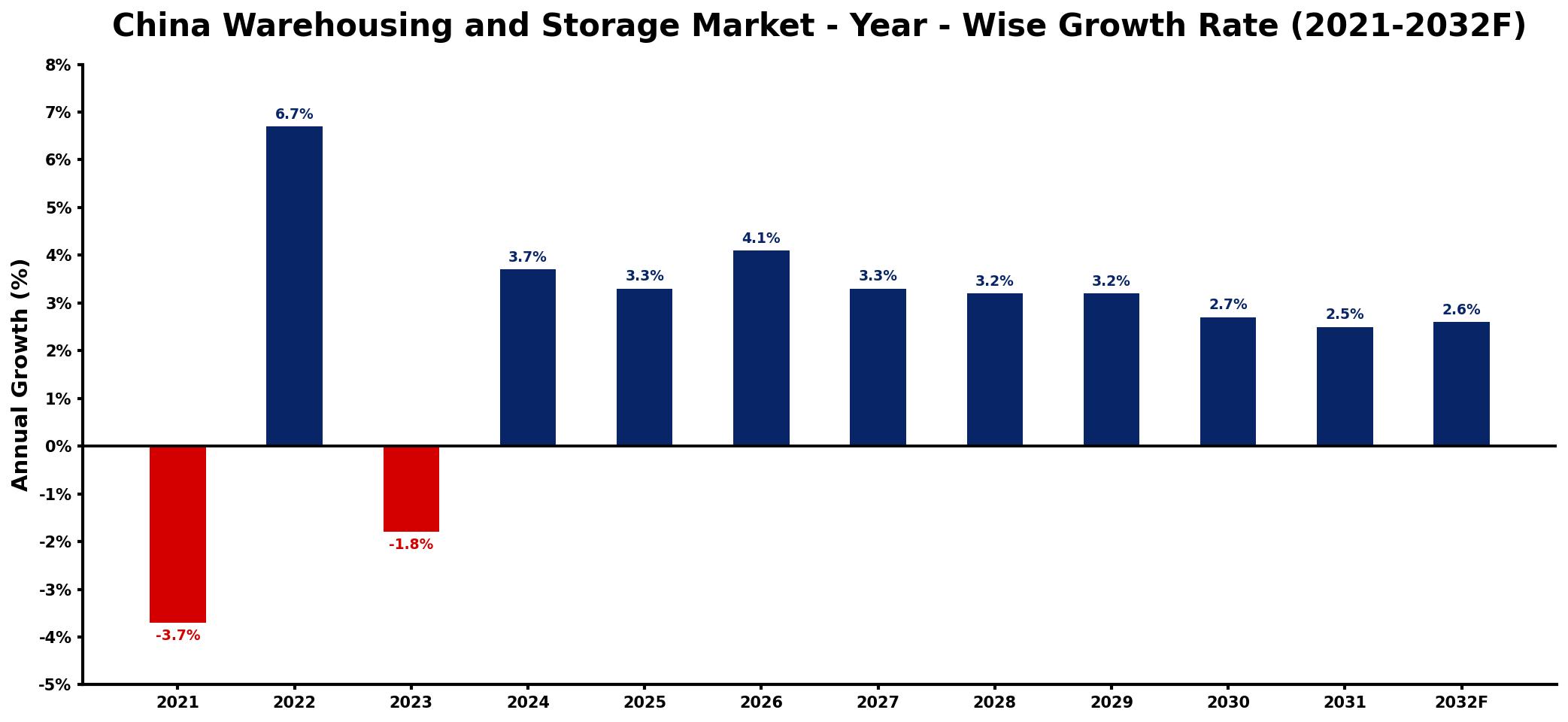
The table below presents the year‑wise growth rates along with the key drivers influencing the market
| Year | Growth Rate | Major Drivers |
| 2021 | -3.7% | decrease in logistic investments |
| 2022 | 6.7% | surge in e-commerce demand |
| 2023 | -1.8% | fall in retail expansion plans |
| 2024 | 3.7% | growth in manufacturing sectors |
| 2025 | 3.3% | rise in cold chain logistics |
| 2026 | 4.1% | expansion of last mile delivery |
| 2027 | 3.3% | increase in cross-border trade |
| 2028 | 3.2% | development of smart technologies |
| 2029 | 3.2% | boost in regional distribution hubs |
| 2030 | 2.7% | improved processing technologies adoption |
| 2031 | 2.5% | increased overall sector activity |
| 2032 | 2.6% | rising end-use demand growth |
Note: Market size estimations and growth projections presented in this report are based on 6Wresearch's proprietary forecasting methodology, utilizing the latest available industry data, government publications, and primary research inputs.
China Warehousing and Storage Market Synopsis
A notable aspect of the China Warehousing and Storage Market is the increasing integration of advanced technologies such as automation and real-time inventory tracking. These innovations are essential to meet the evolving consumer demands and to enhance operational efficiency across diverse sectors, including retail and pharmaceuticals. Moreover, the surge in international trade is amplifying the need for strategic warehousing locations, reinforcing the market's growth.
China's logistical landscape is undergoing significant transformation, with investments directed towards cold storage solutions driven by the food and beverage sectors requirements. Coupled with this is the governments commitment to modernizing infrastructure, which promises to bolster the capabilities and competitiveness of the warehousing sector. As a result, stakeholders are positioned to capitalize on emerging opportunities in this dynamic market.
China Warehousing and Storage Market Key Takeaways
- The market is witnessing a robust demand surge, primarily due to e-commerce growth.
- Technological advancements such as automation are becoming vital in operations.
- Cold storage solutions are increasingly crucial for handling perishable goods.
- Government initiatives are enhancing logistics efficiency and infrastructure investments.
- Strategic location planning is essential due to rising real estate costs.
Evaluation of Restraints in China Warehousing and Storage Market
Despite its promising trajectory, the China Warehousing and Storage Market faces several challenges that could impede its growth. One of the most pressing constraints is the escalating cost of real estate, which affects the affordability and availability of warehouse spaces, particularly in urban areas. Additionally, the industry is grappling with a growing need for skilled labor adept at managing advanced technological systems, which are becoming essential in modern warehousing operations. This skills gap could hinder operational efficiency and scalability. Moreover, the rapidly changing consumer expectations associated with e-commerce may compel companies to adapt quickly, creating additional pressure on existing frameworks.
China Warehousing and Storage Market Trends
Several key trends are shaping the future of the China Warehousing and Storage Market. One notable trend is the increasing focus on sustainability and environmentally-friendly practices within warehousing operations, which is becoming essential to meet both regulatory standards and consumer expectations. Furthermore, the shift towards omnichannel distribution methods is necessitating greater flexibility and responsiveness in warehousing strategies, thereby impacting design and operational processes. The integration of artificial intelligence and machine learning technologies is also becoming prevalent, enabling enhanced data analysis and forecasting capabilities.
China Warehousing and Storage Market Opportunities
The China Warehousing and Storage Market offers a wealth of investment opportunities, particularly in segments related to technology integration and infrastructure development. Companies that focus on automated warehousing solutions stand to gain significant market share, given the growing need for efficiency. Additionally, the expansion of cold storage facilities to meet the needs of the food and beverage industry presents a lucrative avenue for growth. Emerging trends in e-commerce logistics, including last-mile delivery services, also highlight opportunities for stakeholders to innovate and improve their service offerings.
Government Initiatives in the China Warehousing and Storage Market
The Chinese government is actively engaged in initiatives aimed at enhancing the logistics and warehousing sector. Strategic policies focusing on the modernization of logistics networks are being implemented to facilitate seamless supply chain management. Investments in distribution centers, alongside incentives for adopting smart warehousing technologies, have been introduced to stimulate market growth. These efforts are designed to bolster operational standards and promote a more efficient logistical environment conducive to the needs of a rapidly growing economy.
Future Insights of the China Warehousing and Storage Market
Looking forward to 2026-2032, the China Warehousing and Storage Market is expected to continue its upward trajectory, albeit at a measured pace. The ongoing evolution of e-commerce will likely catalyze further innovations in warehousing technologies, thereby enhancing operational efficiency. Moreover, the increased emphasis on sustainability practices will reshape warehousing strategies, compelling companies to adopt greener technologies. As the regulatory environment evolves and consumer expectations shift, the market will require flexibility and responsiveness, making adaptability a cornerstone for success.
China Warehousing and Storage Market Latest Developments (2025 - 2026)
In recent months, there has been a notable push towards the development of integrated logistics solutions, which combine warehousing and transportation services to streamline operations. Companies are increasingly investing in technology upgrades to enhance inventory management and tracking capabilities. Simultaneously, demand for cold storage facilities has surged, prompting significant investments in temperature-controlled storage solutions. The overall industry direction reflects a commitment to improving efficiencies while addressing the complexities associated with rising consumer expectations.
China Warehousing and Storage Market - Key Attractiveness of the Report
- 10 Years of Market Numbers
- Historical Data Starting from 2022 to 2025
- Base Year: 2025
- Forecast Data until 2032
- Key Performance Indicators Impacting the Market
- Major Upcoming Developments and Projects
Key Highlights of the Report:
- China Warehousing and Storage Market Outlook
- Market Size of China Warehousing and Storage Market, 2025
- Forecast of China Warehousing and Storage Market, 2032
- Historical Data and Forecast of China Warehousing and Storage Revenues & Volume for the Period 2022-2032F
- China Warehousing and Storage Market Trend Evolution
- China Warehousing and Storage Market Drivers and Challenges
- China Warehousing and Storage Price Trends
- China Warehousing and Storage Porter's Five Forces
- China Warehousing and Storage Industry Life Cycle
- Historical Data and Forecast of China Warehousing and Storage Market Revenues & Volume By Type for the Period 2022-2032F
- Historical Data and Forecast of China Warehousing and Storage Market Revenues & Volume By General Warehousing and Storage for the Period 2022-2032F
- Historical Data and Forecast of China Warehousing and Storage Market Revenues & Volume By Refrigerated Warehousing and Storage for the Period 2022-2032F
- Historical Data and Forecast of China Warehousing and Storage Market Revenues & Volume By Farm Product Warehousing and Storage for the Period 2022-2032F
- Historical Data and Forecast of China Warehousing and Storage Market Revenues & Volume By Ownership for the Period 2022-2032F
- Historical Data and Forecast of China Warehousing and Storage Market Revenues & Volume By Private Warehouses for the Period 2022-2032F
- Historical Data and Forecast of China Warehousing and Storage Market Revenues & Volume By Public Warehouses for the Period 2022-2032F
- Historical Data and Forecast of China Warehousing and Storage Market Revenues & Volume By Bonded Warehouses for the Period 2022-2032F
- Historical Data and Forecast of China Warehousing and Storage Market Revenues & Volume By End-Use for the Period 2022-2032F
- Historical Data and Forecast of China Warehousing and Storage Market Revenues & Volume By Manufacturing for the Period 2022-2032F
- Historical Data and Forecast of China Warehousing and Storage Market Revenues & Volume By Consumer Goods for the Period 2022-2032F
- Historical Data and Forecast of China Warehousing and Storage Market Revenues & Volume By Retail for the Period 2022-2032F
- Historical Data and Forecast of China Warehousing and Storage Market Revenues & Volume By Food and Beverage for the Period 2022-2032F
- Historical Data and Forecast of China Warehousing and Storage Market Revenues & Volume By IT Hardware for the Period 2022-2032F
- Historical Data and Forecast of China Warehousing and Storage Market Revenues & Volume By Healthcare for the Period 2022-2032F
- Historical Data and Forecast of China Warehousing and Storage Market Revenues & Volume By Chemicals for the Period 2022-2032F
- Historical Data and Forecast of China Warehousing and Storage Market Revenues & Volume By Others for the Period 2022-2032F
- China Warehousing and Storage Import Export Trade Statistics
- Market Opportunity Assessment By Type
- Market Opportunity Assessment By Ownership
- Market Opportunity Assessment By End-Use
- China Warehousing and Storage Top Companies Market Share
- China Warehousing and Storage Competitive Benchmarking By Technical and Operational Parameters
- China Warehousing and Storage Company Profiles
- China Warehousing and Storage Key Strategic Recommendations






































