Colombia Carbonated Beverages Market: Top 5 Importing Countries and Market Competition (HHI) Analysis
Despite a slight negative growth rate in 2024, Colombia carbonated beverages import market continued to be dominated by key exporting countries such as the United States, United Kingdom, Italy, Canada, and France. The high Herfindahl-Hirschman Index (HHI) indicates a concentrated market landscape, with these top countries holding significant market share. With a modest compound annual growth rate (CAGR) of 0.37% from 2020 to 2024, Colombia demand for carbonated beverages remains relatively stable, showcasing opportunities for both local and international players to capitalize on this market.
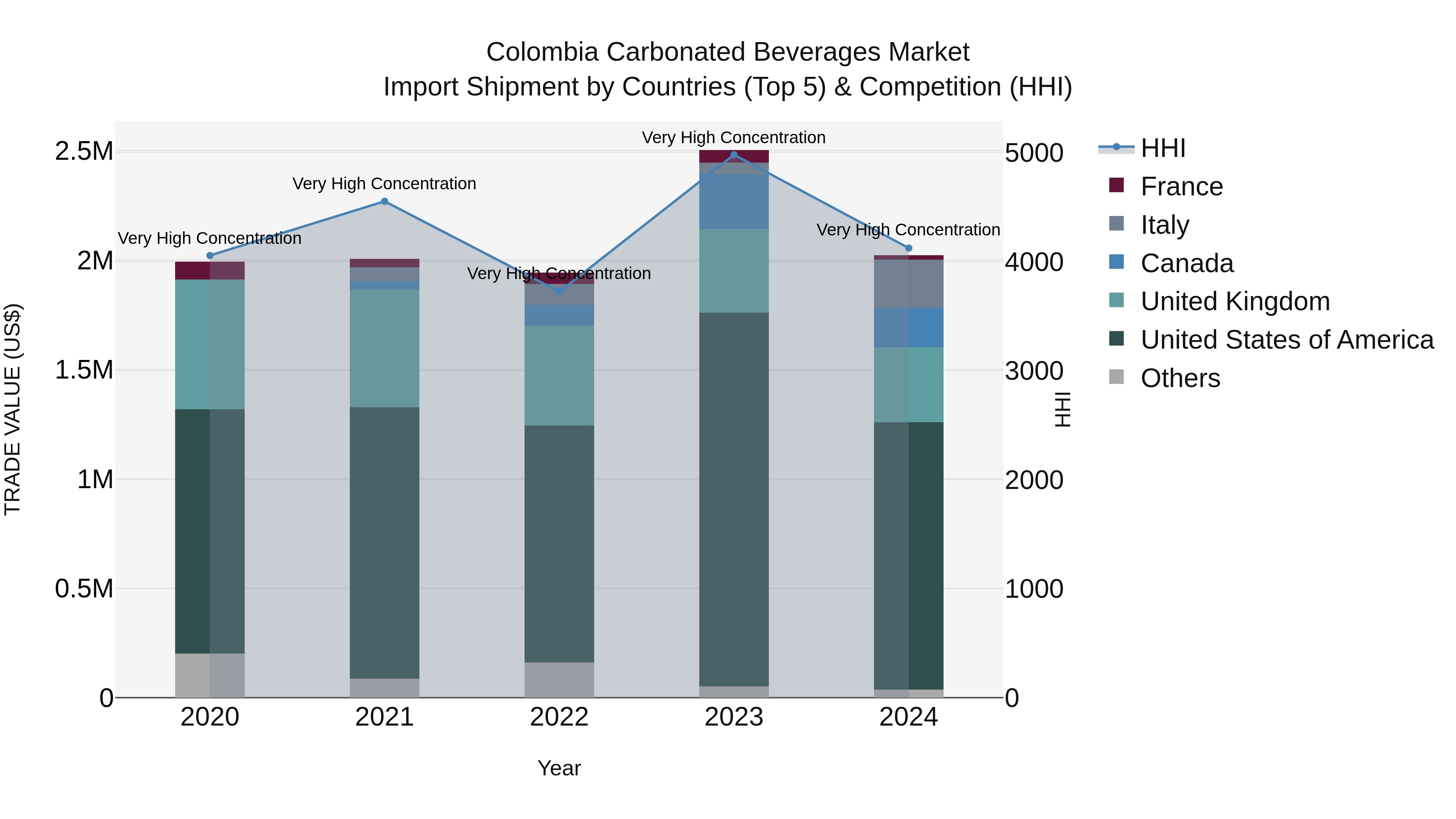
Colombia Carbonated Beverages Market Overview
Colombia carbonated beverages market has witnessed steady growth over the past few years, driven by increasing urbanization, rising disposable incomes, and changing consumer preferences. Major players in the market have been introducing innovative flavors and packaging to attract consumers. The market is also influenced by health trends, with a growing demand for low-calorie and natural ingredient-based carbonated beverages. However, concerns regarding the health implications of excessive sugar consumption pose a challenge to the market`s growth.
Drivers of the market
The Colombia carbonated beverages market is primarily driven by shifting consumer preferences towards convenient and ready-to-drink options. With rising disposable incomes and urbanization, there`s an increasing demand for on-the-go refreshments. Additionally, aggressive marketing strategies by key players, innovative product offerings, and the expansion of distribution channels further contribute to market growth. Health concerns regarding sugar content and the introduction of healthier alternatives also play a role in shaping consumer choices, influencing the market dynamics.
Challenges of the market
The carbonated beverages market in Colombia faces several challenges. One significant challenge is the increasing awareness of health concerns associated with sugary drinks, leading to a shift in consumer preferences towards healthier alternatives. Additionally, the implementation of sugar taxes and regulations aimed at reducing the consumption of sugary beverages further complicates the market landscape. Competition from other non-alcoholic beverages, such as bottled water and fruit juices, also poses a challenge for carbonated beverage manufacturers. Furthermore, economic fluctuations and changes in consumer disposable income can impact purchasing behavior, affecting market demand.
Government Policy of the market
The Colombia government has implemented several policies to regulate the carbonated beverages market. These policies focus on ensuring product safety, promoting healthy consumption habits, and regulating advertising to protect consumers, especially children, from excessive sugar intake. In recent years, there has been a push towards implementing sugar taxes and labeling regulations to encourage the consumption of healthier beverage options.
Key Highlights of the Report:
- Colombia Carbonated Beverages Market Outlook
- Market Size of Colombia Carbonated Beverages Market, 2024
- Forecast of Colombia Carbonated Beverages Market, 2031
- Historical Data and Forecast of Colombia Carbonated Beverages Revenues & Volume for the Period 2021-2031
- Colombia Carbonated Beverages Market Trend Evolution
- Colombia Carbonated Beverages Market Drivers and Challenges
- Colombia Carbonated Beverages Price Trends
- Colombia Carbonated Beverages Porter's Five Forces
- Colombia Carbonated Beverages Industry Life Cycle
- Historical Data and Forecast of Colombia Carbonated Beverages Market Revenues & Volume By Product Types for the Period 2021-2031
- Historical Data and Forecast of Colombia Carbonated Beverages Market Revenues & Volume By Soft Drinks for the Period 2021-2031
- Historical Data and Forecast of Colombia Carbonated Beverages Market Revenues & Volume By Carbonated Water for the Period 2021-2031
- Historical Data and Forecast of Colombia Carbonated Beverages Market Revenues & Volume By Sports & Energy Drinks for the Period 2021-2031
- Historical Data and Forecast of Colombia Carbonated Beverages Market Revenues & Volume By Others for the Period 2021-2031
- Historical Data and Forecast of Colombia Carbonated Beverages Market Revenues & Volume By Flavour for the Period 2021-2031
- Historical Data and Forecast of Colombia Carbonated Beverages Market Revenues & Volume By Cola for the Period 2021-2031
- Historical Data and Forecast of Colombia Carbonated Beverages Market Revenues & Volume By Fruit Based for the Period 2021-2031
- Historical Data and Forecast of Colombia Carbonated Beverages Market Revenues & Volume By Others for the Period 2021-2031
- Historical Data and Forecast of Colombia Carbonated Beverages Market Revenues & Volume By Distribution Channel for the Period 2021-2031
- Historical Data and Forecast of Colombia Carbonated Beverages Market Revenues & Volume By Hypermarkets & Supermarkets for the Period 2021-2031
- Historical Data and Forecast of Colombia Carbonated Beverages Market Revenues & Volume By Convenience Stores for the Period 2021-2031
- Historical Data and Forecast of Colombia Carbonated Beverages Market Revenues & Volume By Food Service Outlets for the Period 2021-2031
- Historical Data and Forecast of Colombia Carbonated Beverages Market Revenues & Volume By Transport Terminals for the Period 2021-2031
- Historical Data and Forecast of Colombia Carbonated Beverages Market Revenues & Volume By Online Stores & D2C for the Period 2021-2031
- Colombia Carbonated Beverages Import Export Trade Statistics
- Market Opportunity Assessment By Product Types
- Market Opportunity Assessment By Flavour
- Market Opportunity Assessment By Distribution Channel
- Colombia Carbonated Beverages Top Companies Market Share
- Colombia Carbonated Beverages Competitive Benchmarking By Technical and Operational Parameters
- Colombia Carbonated Beverages Company Profiles
- Colombia Carbonated Beverages Key Strategic Recommendations






































