Colombia Crop Protection Chemicals Market: Top 5 Importing Countries and Market Competition (HHI) Analysis
Colombia crop protection chemicals import market in 2024 saw a shift in concentration levels from high to moderate, indicating increased competition among top exporting countries. The United States, China, United Kingdom, Mexico, and India maintained their positions as key suppliers. With a impressive CAGR of 9.0% from 2020 to 2024 and a notable growth rate of 15.74% from 2023 to 2024, the market is showing resilience and attractiveness for international players looking to capitalize on Colombia agricultural sector.
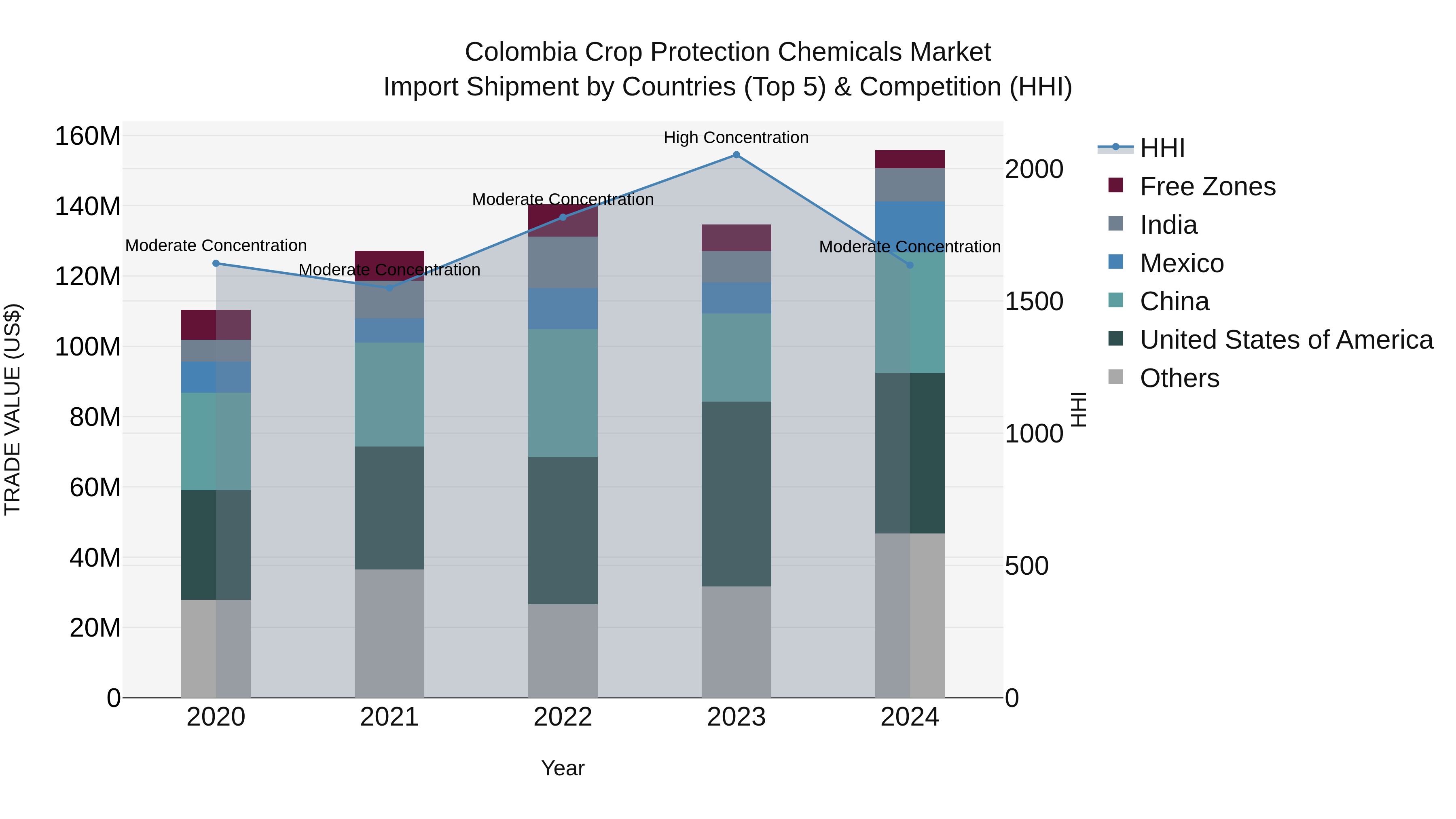
Colombia Crop Protection Chemicals Market Overview
The Colombia crop protection chemicals market supports the agricultural sector by providing agrochemical products for pest control, weed management, and disease prevention in crop production. Crop protection chemicals include herbicides, insecticides, fungicides, and other formulations designed to enhance crop yield and quality. The market is influenced by factors such as agricultural practices, crop patterns, pest pressures, regulatory policies, and environmental concerns. Sustainable agriculture practices and integrated pest management (IPM) approaches drive demand for bio-based and environmentally friendly crop protection solutions. Manufacturers focus on developing innovative formulations and delivering customized solutions to address the diverse needs of farmers and agribusinesses in Colombia dynamic agricultural landscape.
Drivers of the market
The crop protection chemicals market in Colombia is influenced by factors such as the increasing demand for high-quality agricultural produce, the prevalence of pests and diseases affecting crop yield, and government initiatives to promote sustainable farming practices. Additionally, the adoption of genetically modified crops and bio-based pesticides also drive market growth.
Challenges of the market
The Colombia crop protection chemicals market faces challenges related to regulatory compliance, environmental concerns, and resistance management. Regulatory requirements for the registration and use of crop protection chemicals can be stringent, requiring manufacturers to invest in extensive testing and documentation processes. Environmental concerns regarding the impact of chemical pesticides on soil, water, and biodiversity necessitate the development and adoption of safer and more sustainable alternatives. Moreover, the emergence of pesticide-resistant pests and weeds poses challenges for effective pest management strategies, requiring continuous innovation in crop protection technologies.
Government Policy of the market
The Colombia government regulates the crop protection chemicals market through the Ministry of Agriculture and Rural Development to ensure the safe and responsible use of pesticides, herbicides, and fertilizers. Regulatory policies focus on product registration, labeling requirements, and monitoring of pesticide residues to protect human health and the environment.
Key Highlights of the Report:
- Colombia Crop Protection Chemicals Market Outlook
- Market Size of Colombia Crop Protection Chemicals Market, 2024
- Forecast of Colombia Crop Protection Chemicals Market, 2031
- Historical Data and Forecast of Colombia Crop Protection Chemicals Revenues & Volume for the Period 2021-2031
- Colombia Crop Protection Chemicals Market Trend Evolution
- Colombia Crop Protection Chemicals Market Drivers and Challenges
- Colombia Crop Protection Chemicals Price Trends
- Colombia Crop Protection Chemicals Porter's Five Forces
- Colombia Crop Protection Chemicals Industry Life Cycle
- Historical Data and Forecast of Colombia Crop Protection Chemicals Market Revenues & Volume By Origin for the Period 2021-2031
- Historical Data and Forecast of Colombia Crop Protection Chemicals Market Revenues & Volume By Synthetic for the Period 2021-2031
- Historical Data and Forecast of Colombia Crop Protection Chemicals Market Revenues & Volume By Bio-based for the Period 2021-2031
- Historical Data and Forecast of Colombia Crop Protection Chemicals Market Revenues & Volume By Type for the Period 2021-2031
- Historical Data and Forecast of Colombia Crop Protection Chemicals Market Revenues & Volume By Fungicide for the Period 2021-2031
- Historical Data and Forecast of Colombia Crop Protection Chemicals Market Revenues & Volume By Insecticide for the Period 2021-2031
- Historical Data and Forecast of Colombia Crop Protection Chemicals Market Revenues & Volume By Nematicide for the Period 2021-2031
- Historical Data and Forecast of Colombia Crop Protection Chemicals Market Revenues & Volume By Herbicide for the Period 2021-2031
- Historical Data and Forecast of Colombia Crop Protection Chemicals Market Revenues & Volume By Others Types for the Period 2021-2031
- Historical Data and Forecast of Colombia Crop Protection Chemicals Market Revenues & Volume By Application for the Period 2021-2031
- Historical Data and Forecast of Colombia Crop Protection Chemicals Market Revenues & Volume By Grains and Cereals for the Period 2021-2031
- Historical Data and Forecast of Colombia Crop Protection Chemicals Market Revenues & Volume By Pulses and Oilseeds for the Period 2021-2031
- Historical Data and Forecast of Colombia Crop Protection Chemicals Market Revenues & Volume By Fruits and Vegetables for the Period 2021-2031
- Historical Data and Forecast of Colombia Crop Protection Chemicals Market Revenues & Volume By Commercial Crops for the Period 2021-2031
- Historical Data and Forecast of Colombia Crop Protection Chemicals Market Revenues & Volume By Other Applications for the Period 2021-2031
- Colombia Crop Protection Chemicals Import Export Trade Statistics
- Market Opportunity Assessment By Origin
- Market Opportunity Assessment By Type
- Market Opportunity Assessment By Application
- Colombia Crop Protection Chemicals Top Companies Market Share
- Colombia Crop Protection Chemicals Competitive Benchmarking By Technical and Operational Parameters
- Colombia Crop Protection Chemicals Company Profiles
- Colombia Crop Protection Chemicals Key Strategic Recommendations






































